The short answer
- Is it a copy?
- No. It replaces the original, which is why states gate it so heavily. The word duplicate is the single most misleading thing about the transaction.
- Can I just apply?
- Only in 1 of the 5 situations below. A lienholder, a counter clerk or the Highway Patrol stands in the way of the other 4.
- What does it cost?
- $2 to $20 across the 3 states that publish a figure — and the cheapest route is the slowest one.
Not a copy
A certified copy replaces the original title
Texas Form VTR-34 (Rev 10/24)
$2–$20
Published fees across 3 states
Texas, Michigan, New York
1 of 5
Situations where you are the applicant
Cal. Veh. Code 4466; FLHSMV TL-05
90 days
Ask twice inside this window and CHP inspects the car
Cal. Veh. Code 4466(a)(5)
The word duplicate is doing a lot of damage
A duplicate sounds harmless. It sounds like a photocopy — a second, equal thing you can make freely, leaving the first exactly as it was. That intuition is wrong in a way that explains every difficulty in this article, and the states know it even though their own web pages rarely say so.
A certificate of title is not information. It is an instrument: a physical object whose possession carries legal weight in a transfer. Federal rule requires it to be built like one. 49 CFR 580.4(a) provides that each physical title shall be set forth by means of a secure printing process or other secure process, which is why a real title is printed on security stock with the features a photocopier cannot reproduce.
So the state cannot simply run you off another one. There would then be two secure instruments for one car, both looking authentic, both apparently transferable, and only one of them attached to the truth. What the state issues instead is a replacement that demotes the original. Everything below follows from that.
What actually happens to the original
Two states put it in writing, and they are worth quoting because almost nothing else on the subject is this direct. Texas Form VTR-34 says a Certified Copy of Texas Title replaces the original Texas Certificate of Title and any previously issued Certified Copy of Texas Title. Note the second half of that sentence: it supersedes not just the original but every earlier replacement too, which means the newest one always wins.
Florida is more elaborate. Its statute requires that the duplicate be plainly marked across their faces “duplicate copy”, and then adds a duty most owners never hear about: if the original is recovered, the owner shall forthwith surrender the original certificate to the department for cancellation.
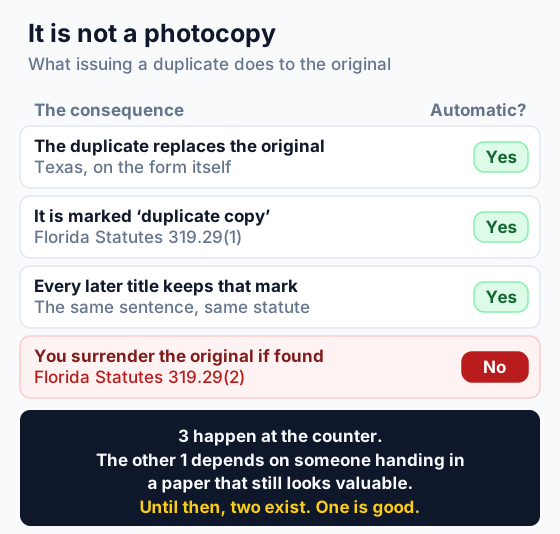
Read the shape of that rather than the rows. The state can demote a document by administrative act, and it does so the moment the replacement prints. What it cannot do is reach into a drawer, a glovebox or a former partner’s filing cabinet and physically retrieve the paper. So a surrender duty is the only tool available, and a surrender duty is only as good as the person subject to it.
This is the honest answer to does a duplicate void the original. Legally the original stops being the operative instrument. Practically it remains a convincing, security-printed certificate in somebody’s possession, and the state has no way to know where.
The Florida sentence that follows the car forever
One provision deserves its own section because it is the most consequential thing written about duplicate titles anywhere in American law, and it appears on no page currently ranking for the term.
Florida Statutes 319.29(1) does not stop at marking the duplicate. It requires that the mark appear on the duplicate copy and all subsequent certificates of title issued in the chain of title originated by such duplicate copy. The mark is hereditary. Sell the car, and the buyer’s new title carries it. They sell it, and so does the next. It does not wash out with a transfer, a state line or a decade.
Then comes the part that actually costs money. The same sentence provides that any subsequent purchaser in that chain shall acquire only such rights in the motor vehicle or mobile home as the original holder of the duplicate copy himself or herself had.
A statute does not usually offer you a contractual remedy unless the legislature expects you to need one. That indemnity clause is Florida quietly conceding that claims on the original certificate do get presented, and that the person left holding the car is the one who bought it in good faith.
Who the state is willing to deal with
Most guidance treats this as a formality — fill in the form, pay the fee. In practice the prior question decides the whole matter, and the answer is frequently that you are not the applicant.
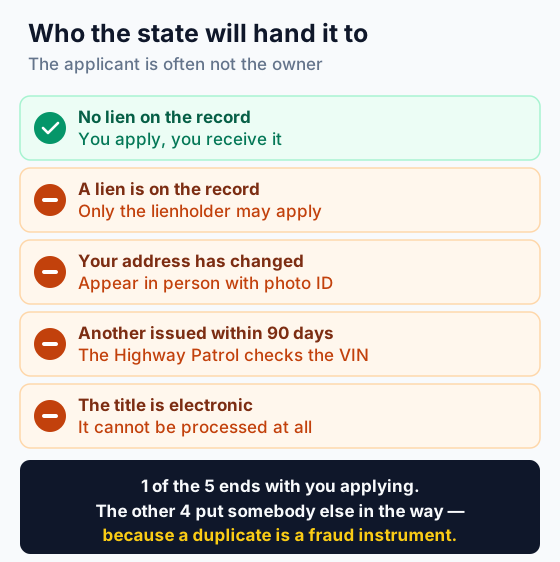
| The situation | Who the state deals with |
|---|---|
| No lien on the record | You apply, and you receive it |
| A lien is on the record | Only the lienholder may apply |
| Your address has changed | Appear in person with photo ID |
| Another issued within 90 days | The Highway Patrol checks the VIN |
| The title is electronic | It cannot be processed at all |
Pennsylvania makes the point structurally rather than in prose: it publishes three different forms for the same transaction, MV-38O for a vehicle owner, MV-38L for a lienholder and MV-38D for a dealer. A state does not maintain three forms unless who is asking changes what happens.
If a lien is recorded, you are not the applicant
This is the single most common reason a duplicate application fails, and it surprises people who paid the loan off years ago.
California’s statute assigns the right in order of interest. Cal. Veh. Code 4459 provides that where a certificate of ownership is lost, the legal owner or, if none, then the ownermay apply. In California vocabulary the legal owner is the lienholder. If a lien stands on the record, the lienholder is first in line and you are not in line at all. Florida’s procedure manual states it without qualification: when there is an outstanding lien on record, only the lienholder may apply for a duplicate certificate of title.
The trap is that the record can outlive the loan. Texas warns applicants directly that if the vehicle was ever financed, the department’s records may still show the lien even if it has been paid off, and requires an original signed release of lien before it will act — on the lienholder’s letterhead or on Form VTR-266, with photocopies, scans, faxes and emails all expressly refused.
There is a related trap for jointly owned vehicles. Michigan will accept one owner’s signature for an ordinary duplicate, with both names remaining on the replacement. Texas requires all recorded owners to sign, or a power of attorney for each. The default is not consistent, so check before assuming your co-owner need not be involved.
The address gate two states wrote independently
Here is a pattern that says more than either state does alone. California and Florida, which share no legislative tradition, both singled out the same fact as the fraud indicator worth legislating against: a duplicate application whose address does not match the address on the record.
Cal. Veh. Code 4466(a) provides that the department shall not issue a duplicate or substitute certificate of titlewhere the address on the application differs from the department’s record, unless the registered owner applies in personand presents proof of ownership plus a photo driver’s license or identification card, whose authenticity the department then verifies against its own records.
Florida Statutes 319.29(4) arrives at the same place by instruction rather than prohibition, directing the department to implement a system to verify that the application is signed by a person authorized to receive a duplicate title certificatewhere the address differs. Florida’s procedure manual then implements it, naming 7 acceptable proofs of address change plus a catch-all.
- A photo ID showing the new address
- A paid receipt for telephone or utilities
- A paid contract or connect order for utilities
- Proof of homestead exemption
- A rental or lease contract agreement
- A current year vehicle registration certificate
- A homeowner's or renter's insurance policy
The reasoning is not hard to reconstruct. The cheapest way to steal a car you do not own is to have its title mailed to you. Every element of that scheme is paperwork except one: the thief has to name an address they control, and it will not be the one on file. Both states found the same pressure point.
Worth knowing if you are legitimately caught by this: California waives the in-person requirement where the application comes through a legal owner, a dealer or its agent, a dismantler, an insurer or its agent, or a salvage pool. Institutions are trusted; you are not. That asymmetry is deliberate.
Asking twice, and the tripwire it sets off
The sharpest anti-fraud provision found anywhere in this research is a single clause in California’s statute, and it converts a paperwork problem into a physical one.
Under Cal. Veh. Code 4466(a)(5), where the department has a record of a prior duplicate or substitute title issued for the vehicle within the past 90 days, the applicant must supply a copy of a report from the California Highway Patrol verifying the vehicle identification number of the vehicle.
Consider what that means. You have not been accused of anything. You have asked for the same routine document twice in three months. And the response is that someone in law enforcement must physically look at your car and confirm the number on it is real before any more paper is issued.
When there is no paper to lose
A growing share of vehicles have no paper title at all, and for their owners this entire article is the wrong question.
Most states now run an electronic lien and title system. California was directed to build one by Cal. Veh. Code 4450.5. Where a lender holds an electronic lien, the state holds the title record electronically and no certificate is printed until the lien is satisfied. Nothing was ever mailed, so nothing can be lost.
Florida’s procedure manual states the consequence in one line: when the title record reflects an electronic title status, a duplicate or lost in transit title cannot be processed. The transaction is not refused because you failed a check. It is refused because there is nothing to duplicate.
If that is your situation, what you actually want is for the electronic record to be converted to a printed certificate — a different transaction with a different form, usually available once any lien is released. Establish which one you are in before you fill in anything, because the paperwork does not overlap.
What it costs, and why the spread is absurd
Every state prints its own fee and none of them prints anyone else’s, so the range is invisible unless you go looking. It is wider than it has any business being.
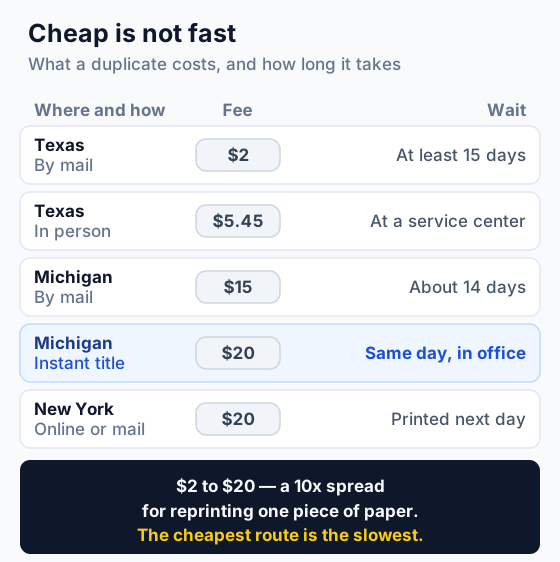
| State and route | Fee and wait |
|---|---|
| Texas — By mail | $2 — At least 15 days |
| Texas — In person | $5.45 — At a service center |
| Michigan — By mail | $15 — About 14 days |
| Michigan — Instant title | $20 — Same day, in office |
| New York — Online or mail | $20 — Printed next day |
Texas at $2 by mail and New York at $20 are charging for the same act: looking up a record and printing a certificate on security stock. The 10-fold difference reflects state fee policy and nothing about your vehicle.
How fast, and the same-day question nobody answers
The related searches for this topic are dominated by urgency — fastest way, same day, how long does it take. It is the right question, because the answer varies far more than the fee does, and because people usually discover a title is missing at the worst possible moment: with a buyer waiting.
Michigan is the clearest example of a state that solved it. An ordinary duplicate arrives by mail in about fourteen days for $15. An instant title is issued the same day in a Secretary of State office for $20. Five dollars buys two weeks.
But the fast route carries its own restriction, and it is one people trip over: Michigan does not permit an agent to act for an instant title. Every owner listed on the title must appear in person. The convenience is real, and it is only available if the people whose names are on the document can all be in the same room.
New York occupies a middle position, printing a replacement ordered before 8 pm on the next business day and mailing it the day after. Texas is at the other end: at least 15 days by mail, with the department stating plainly that it cannot provide a status and that application tracking is unavailable. Texas does accept in-person applications, but only at a regional service center, which for much of the state is not a short drive.
Lost in transit is a different transaction
If the state issued a title and it never arrived, do not apply for a duplicate. There is a separate, cheaper transaction, and using the wrong one costs you money and the mark on the document.
Florida Statutes 319.29(3) provides that where a certificate is lost in transit and not delivered, the owner or lienholder may apply for reissuance within 180 days of the date of issuance, and that no additional fee shall be charged for reissuance under this subsection.
The procedure manual adds the practical envelope: a lost-in-transit title can be issued at no cost provided the title processed date exceeds 20 days and the customer applies within 180 days of the issue date. Wait longer than 180 days and it becomes an ordinary duplicate with ordinary fees. There is also a floor: the state will not treat a title as missing until 20 days have passed, because most of them are simply still in the mail.
Florida also flags undelivered titles internally with a return stop on the vehicle record when mail comes back, and clears it by correcting the address. If your title never came and your address is wrong on the file, the state may already know before you call.
The mileage printed on it is not current
A small technical point with real consequences for anyone reading a duplicate as a buyer.
49 CFR 580.5(a) requires that when a title is issued it must contain the mileage disclosed by the transferor when ownership of the vehicle was transferred. The number carried onto a title is the reading captured at the last change of ownership.
A duplicate reissues that record. It does not capture today’s odometer, because nobody looked at the car to produce it — a duplicate is a records transaction. So a replacement title issued last week can show a mileage figure from a transfer four years and sixty thousand miles ago, and it is not wrong to do so.
Treat the mileage on any title as a historical data point tied to a transfer date, never as a current reading. The federal disclosure that matters happens at the next sale, when the seller must disclose the mileage at that moment and certify whether it reflects the actual mileage.
Duplicate, certified copy, replacement: same thing, different word
Part of what makes this topic hard to research is that states do not agree on what to call it, and the terminology is not decorative — searching the wrong word on the wrong state’s site returns nothing.
| What the state calls it | Where |
|---|---|
| Duplicate title | Michigan, Pennsylvania, Colorado, Florida |
| Certified copy of title | Texas — Form VTR-34 |
| Replacement title | California, and New York's page title |
| Duplicate certificate of title | Florida, in the statute itself |
| Lost in transit reissuance | Florida, when it never arrived |
Texas is the instructive one. Calling it a certified copy rather than a duplicate sounds like weaker paper and is in fact the strongest formulation of the three: the form says outright that it replaces the original and every previously issued certified copy. The name suggests a photocopy; the legal effect is supersession.
What to bring, wherever you are
The forms differ but the underlying demands are consistent, because every state is answering the same three questions: is this vehicle real, are you who you say you are, and does anyone else have a claim on it.
- 1Establish which transaction you needAn ordinary duplicate, a lost-in-transit reissuance, or a paper title from an electronic record. They have different forms and different fees, and the cheapest is often the one people skip.
- 2Clear the lien firstIf the vehicle was ever financed, get an original signed release of lien from the lender before anything else. Photocopies, scans and emails are commonly refused outright.
- 3Match the address to the recordIf you have moved, expect an in-person appearance or documentary proof of the change. This is the single most common reason an application is bounced.
- 4Gather identification for everyone namedGovernment-issued photo ID for each recorded owner. Texas accepts an ID up to twelve months past expiry; do not assume that everywhere.
- 5Decide between cheap and fastIf a sale is pending, find out whether your state prints at a counter and whether all owners can attend. If not, apply early and expect weeks.
One warning that appears on the Texas form and applies in spirit everywhere: no documents submitted to a TxDMV Regional Service Center will be returned. If you are handing over an original release of lien or a court document, assume it is gone. Photograph everything before it leaves your hands.
Getting one from a state you no longer live in
A common and genuinely awkward situation: you moved, the title was issued by your old state, and it is missing. Your new state cannot help, because it has never titled this vehicle and has no record to reprint.
The duplicate has to come from the issuing state, and it has to come to you before the new state will do anything. Some states handle this routinely — Michigan publishes a dedicated out-of-state resident duplicate title application for exactly this case. Others expect an in-person appearance you can no longer conveniently make, which collides directly with the address-mismatch rules above: you have moved, so your address will not match the record, so the easy route is closed.
Sequence matters here, and it interacts with a deadline. Most states give you a limited window to register after establishing residency, and that clock does not pause while another state posts you a document. The deadlines and what each new state checks are set out on registering a car in another state, and California’s version — the shortest common deadline in the country — on registering an out-of-state car in California.
Buying a car that shows a duplicate title
Most duplicates are innocent. Titles genuinely get lost, and the transaction exists because that is a normal thing to happen. But a duplicate is worth one extra question, and the question is cheap to ask.
- Confirm the seller is the person named on the title, with photo ID that matches
- Ask when and why the duplicate was issued, and listen for a recent date
- Be wary if more than one replacement has been issued in quick succession
- In Florida, expect the words duplicate copy on the face and treat them as normal
- Check the record for title events, not just the paper in your hand
The one that matters most is the third. A single duplicate is unremarkable. A pattern of them is the signature California legislated against by requiring a Highway Patrol inspection after a second inside 90 days, and it is the pattern that precedes the same car being sold to two people.
If the car is Florida-titled and the face reads duplicate copy, that is not itself a warning. It may be inherited from a duplicate issued to an owner three transactions ago, exactly as the statute intends. What it does mean is that the good-faith protection you would normally rely on is reduced, so the identity check on the seller carries more weight than usual.
When the duplicate is the fraud
It is worth being explicit about the mechanism, because understanding it makes every gate on this page obvious rather than bureaucratic.
The scheme is simple. A seller holds a title. They sell the car and hand over the signed title, or they sell it and stall on delivering the paperwork. They then report the title lost and obtain a duplicate. Now there are two documents, and the seller has one of them for a car they no longer own.
Nothing in the issuing process detects this. The state has no way to know the original is in a buyer’s glovebox rather than lost, because the application is a sworn statement and the swearing is the only evidence. That is why Texas prints state law makes falsifying information a third degree felony directly above the signature line, and why the certification requires you to state that the original has been lost, destroyed, or mutilated. The criminal penalty is doing the work that verification cannot.
Everything else follows: the address gate, because the thief needs the document posted somewhere they control; the 90-day inspection, because repetition is the tell; the lienholder rule, because an institution has no motive to help; and Florida’s hereditary mark, because the state cannot undo the sale but can at least warn every future owner that this chain began with a replacement. The closely related fraud of never transferring the title at all is covered on title jumping.
What the record shows, and what it does not
A vehicle history record is the one place a duplicate leaves a visible trace outside the issuing state’s own file. Title events are reported by state agencies, so a replacement issued in one state is visible to someone reading the record in another.
What that gets you is chronology. You can see that a title event occurred, roughly when, and in which state, and you can compare that against what the seller is telling you. A replacement issued the month before the car went up for sale is a different fact from one issued six years ago.
What it cannot tell you is intent, and it is worth being honest about the limits. The record does not know whether the original was genuinely lost. It does not know who is currently holding it. And reporting is neither instant nor uniform — a very recent event may not have propagated. Use it as one input against the document and the person in front of you, never as a verdict on either. You can run the VIN free on CheckerVIN before you commit to anything.
Where this information comes from
- Florida Statutes 319.29 — lost or destroyed certificates of titleQuoted in full at the head of FLHSMV Procedure TL-05. Subsection (1) requires the duplicate and all subsequent certificates in the chain of title originated by it to be plainly marked 'duplicate copy', and limits a later purchaser to the rights the duplicate holder had. Subsection (2) provides the indemnity remedy and the duty to surrender a recovered original for cancellation. Subsection (3) sets the 180-day lost-in-transit reissuance at no additional fee. Subsection (4) directs the department to verify authorization where the address differs.
- FLHSMV Procedure TL-05 — Duplicate and Lost in Transit Certificates of TitleRevision 08/25, the manual Florida tax collector and agency staff work from. States that only the lienholder may apply where a lien is on record, that a duplicate cannot be processed at all where the title record is electronic, and lists the acceptable proofs of address change.
- Texas Form VTR-34 — Application for a Certified Copy of TitleRevision 10/24. Source of the supersession sentence, the $2 mail and $5.45 in-person fees, the 15-day mail estimate, the statement that application tracking is unavailable, the third degree felony certification, and the requirement for an original signed release of lien even where the loan is paid in full.
- California Vehicle Code 4459 — duplicate certificate of ownershipGives the right to apply to 'the legal owner or, if none, then the owner' — the lienholder ranks ahead of the registered owner.
- California Vehicle Code 4466 — restrictions on issuing duplicatesThe address-mismatch prohibition and the in-person exception at (a)(1)-(2), the Highway Patrol VIN verification requirement where a duplicate issued within the past 90 days at (a)(5), and the institutional waivers for legal owners, dealers, dismantlers, insurers and salvage pools at (b)(2).
- California Vehicle Code 4450.5 — Electronic Lien and Title ProgramThe statutory basis for holding title records electronically, which is why a growing share of vehicles have no paper certificate that could be lost.
- 49 CFR 580.4 — security of physical documents and electronic titlesRequires each physical title to be set forth by a secure printing process, which is the reason a replacement must be issued by the state rather than copied.
- 49 CFR 580.5 — disclosure of odometer informationSubsection (a) requires a title to carry the mileage disclosed when ownership was last transferred, which is why the figure on a freshly issued duplicate can be years out of date.
- New York DMV — Replace a Title CertificateForm MV-902 and the $20 fee, plus the printing schedule: an order placed before 8 pm is printed the next business day and mailed the day after.
- Michigan Department of State — Title replacement/duplicateThe $15 mail fee with roughly 14-day delivery, the $20 same-day instant title, the rule that agents may not be used for an instant title, and the single-signature rule for jointly owned vehicles.
- Pennsylvania — Get a Duplicate TitlePublishes three separate forms for the same transaction — MV-38O for owners, MV-38L for lienholders and MV-38D for dealers — and routes the fee to the separate schedule at Form MV-70S.
Frequently asked questions
What is a duplicate title?
A replacement certificate of title issued by the state when the original is lost, stolen, mutilated or destroyed. It is not a photocopy and not a second equal document. Texas says on the form that a certified copy replaces the original title and any previously issued certified copy, and Florida requires the replacement to be plainly marked across its face with the words duplicate copy. Issuing one demotes the original rather than joining it.
Does a duplicate title void the original?
In effect, yes, but it does not make the paper disappear, and that distinction is the whole risk. Texas states the replacement supersedes the original. Florida goes further and requires that if the original is later recovered the owner must surrender it to the department for cancellation. 3 of the 4 consequences happen automatically at the counter; that last one depends on somebody choosing to hand in a document that still looks valuable. Until they do, two certificates for one car exist.
Who can apply for a duplicate title?
The owner of record, a lienholder, or an authorized agent of either — but only one of the 5 common situations ends with the owner simply applying and receiving it. If a lien is recorded, Florida's procedure manual is blunt that only the lienholder may apply. Texas requires an original signed release of lien even if the loan has been paid in full. If your address no longer matches the state's record, California requires you to appear in person with photo identification.
How much does a duplicate title cost?
Across the 3 states that publish both a fee and a wait, it runs from $2 to $20 — about a 10-fold spread for reprinting the same document. Texas charges $2 by mail and $5.45 in person, Michigan $15 by mail or $20 for an instant title, and New York $20. The cheapest route is also the slowest: Texas asks you to allow at least 15 days and says application tracking is unavailable.
Is it safe to buy a car with a duplicate title?
It is common and usually innocent, but it deserves one extra question, because a duplicate is the instrument double-selling runs on. In Florida the risk is written into statute: a purchaser in a chain of title originating from a duplicate acquires only such rights in the vehicle as the holder of the duplicate had, so the usual protection a good-faith buyer expects is reduced. Confirm the seller is the person named on the title, and check the vehicle history record for the title events behind the paper in front of you.