The short answer
- Does it transfer ownership?
- No. It records that a sale happened. Only the buyer's title application moves the record, and nothing in this filing forces them to make one.
- How long do I have?
- 5 to 30 days depending on the state — and in 1 of the 4 the clock counts business days, not calendar days.
- Is it worth doing?
- Yes, but treat it as evidence. In 2 of 4 states the statute says the filing settles the question. In the other 2 it plainly does not.
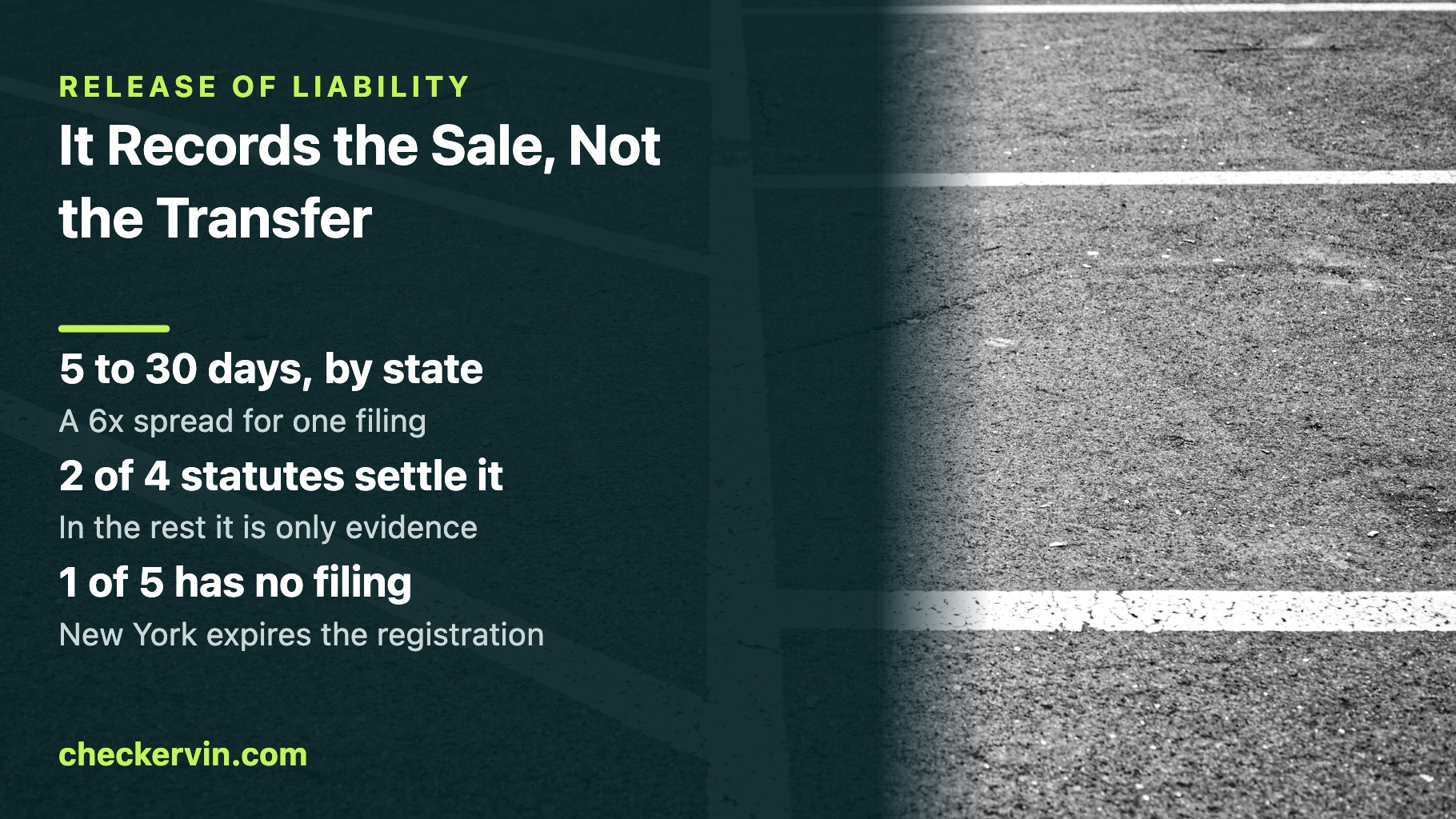
5–30 days
The deadline across 4 states that have one
A 6x spread for the same act
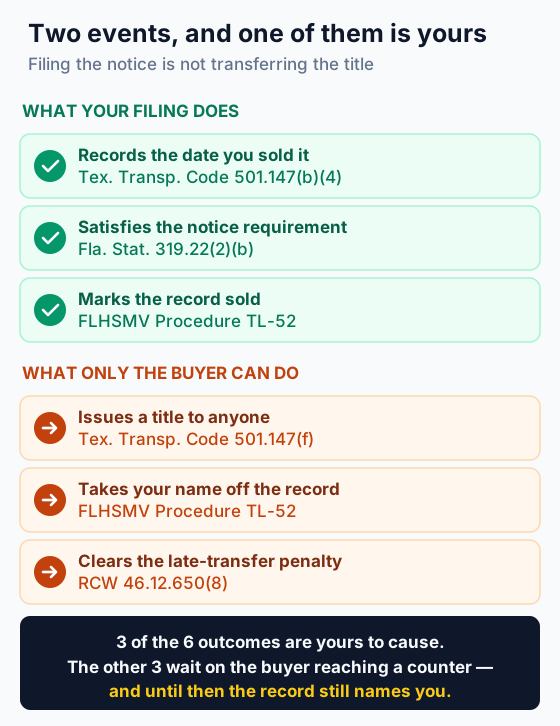
Not a transfer
The department may not issue a title until the purchaser applies
Tex. Transp. Code 501.147(f)
Complete defense
What Texas calls proof that you filed the form
Tex. Transp. Code 501.147(g)
1 of 5
States studied here with no seller filing at all
N.Y. Veh. & Traf. Law 420
Four names, one filing, and that is why you cannot find it
The first obstacle is vocabulary. There is no national name for this document, so searching the wrong phrase against the wrong state returns nothing and leaves you assuming your state does not require it.
| State | What it is called there |
|---|---|
| California | Notice of Transfer and Release of Liability |
| Washington | Report of Sale |
| Texas | Vehicle Transfer Notification |
| Florida | Notice of Sale, form HSMV 82050 |
| New York | No seller filing exists |
Release of liability is a California phrase. Washington says report of sale, which sounds like a tax filing. Texas says vehicle transfer notification, which sounds like a courtesy. Florida just calls it a notice of sale. The names are not synonyms in tone, and the tone is misleading in both directions: the Texas version is the strongest of the four and has the mildest name, while the Californian version has the most reassuring name and the most conditional effect.
What it does not do, stated plainly
The single most common assumption about this filing is that it completes the sale from your side. It does not, and two states say so in language you cannot misread.
Tex. Transp. Code 501.147(f) provides that the department may not issue a title or register the vehicle until the purchaser applies for a title to the county assessor-collector. Your notice is filed, acknowledged and recorded, and the title still sits exactly where it sat.
Florida’s procedure manual describes the same fact from the clerk’s side. FLHSMV Procedure TL-52 instructs staff that once the notice is processed the database is updated to show the vehicle as sold, and then adds: the seller’s name will remain on the DMV database until the certificate of title is submitted for transfer.
Read those together and the shape of the thing becomes clear. The notice writes a fact into the record — this car was sold, on this date, to this person. It does not rewrite the ownership field, because the state will not change ownership on the say-so of the party leaving. The buyer has to appear. If the buyer never appears, your name stays where it is for as long as that takes.
Five days or thirty, and nothing tells you which
Every state publishes its own deadline and none of them publishes anyone else’s, so the spread is invisible unless you go looking. It is 6 to one.
| State | Deadline and authority |
|---|---|
| California | 5 calendar days — Cal. Veh. Code 5900(a) |
| Washington | 5 business days — RCW 46.12.650(2) |
| Texas | 30 calendar days — Transp. Code 501.147(c) |
| Florida | 30 calendar days — Fla. Stat. 319.22(2)(b) |
| New York | No filing required — N.Y. Veh. & Traf. Law 420 |
The practical consequence is that advice does not travel. Somebody who has sold three cars in Texas learns a thirty-day habit, moves to California, sells a car on a Friday and is already late by the following Wednesday. The habit is the problem, not the ignorance.
Five business days is not five days
Washington is worth isolating because it demonstrates how a deadline can be quietly longer or shorter than the number printed beside it.
RCW 46.12.650(2) requires an owner to notify the department in writing within five business days after a vehicle is sold, given, traded, donated, turned over to an insurer or wrecking yard, or disposed of. Subsection (3) then defines when the report is properly filed: it must be received within five business days and carry a date or stamp by the department showing it was received on or before the fifth business day.
Washington’s own consumer page tells sellers to submit the report within 5 days of the sale date. Five business days from a Friday sale is the following Friday. Five days is the following Wednesday. Neither statement is wrong on its own terms and they describe different obligations, and it is the statute that governs.
Note also what the statute measures: received, not sent. A form mailed on day four that lands on day six is not properly filed. That is a different risk from a postmark rule, and it is why the electronic route is worth using wherever a state offers one.
Texas is the only state that calls it a complete defense
If you want to see what this filing looks like when a legislature commits to it fully, read Texas. It is unusually generous and almost nobody quotes it.
Tex. Transp. Code 501.147(g) provides that a transferor who files the appropriate form has no vicarious civil or criminal liability arising out of the use, operation, or abandonment of the vehicle by another person, and then goes further: Proof by the transferor that the transferor filed a form under this section is a complete defense to an action brought against the transferor for any act or omission arising out of use, operation or abandonment after the filing.
Then the sentence that decides whether any of that helps you: A copy of the form filed under this section is proof of the filing of the form.
There is a condition attached, in 501.147(c): the presumption that the purchaser is the owner and carries the liability applies only if the department received a notice including the buyer’s full name, address, and telephone numberbefore the thirtieth day after possession changed hands. A notice missing the buyer’s phone number is not the notice the statute describes. Collect it at the curb, not afterwards.
California gives you five routes and advertises one
California is the state that named this document, and its statute is far more forgiving than its own consumer guidance suggests.
Cal. Veh. Code 5602 says an owner who has made a bona fide sale and delivered possession is not, by reason of any of the provisions of this code, the owner for the purpose of civil or criminal liability for the parking, abandoning, or operationof the vehicle afterwards — provided the seller has done either of two things. The first is simply to have made proper endorsement and delivery of the certificate of ownership. The second is to have mailed the department one of several notices, or the registration documents and fees for the new owner.
- Proper endorsement and delivery of the certificate of ownership
- Mailing the notice under Cal. Veh. Code 4456(b)
- Mailing the notice under Cal. Veh. Code 5900
- Mailing the notice under Cal. Veh. Code 5901
- Sending the documents and fees to register the car to the new owner
That is 5 distinct ways to arrive at the same protection, and the notice most people worry about is one of them. Signing the title over properly and handing it to the buyer satisfies the section on its own.
Two details from Cal. Veh. Code 5900 are worth knowing. Subsection (b) folds the federal odometer disclosure at 49 U.S.C. 32705(a) into the same notice, so the mileage you report here is a federal disclosure, and reporting a figure you know to be false with intent to defraud is the violation. Subsection (c) puts the duty on whoever is in physical possessionof the vehicle if that is not the registered owner — which catches consignment and family arrangements that nobody thinks of as a sale.
The state where the agency and the statute disagree
This is the sharpest finding on the page, and it matters most in exactly the situation that costs the most money.
Washington’s Department of Licensing tells sellers that filing the report of sale protects you from being liable for towing charges or civil and criminal liabilities incurred by the new owner. That is the reason most people file it.
RCW 46.12.650(4)(b) says something else. A report of sale is not proof of a completed vehicle transfer for purposes of the collection of expenses related to towing, storage, and auction of an abandoned vehicle in situations where there is no evidence indicating the buyer knew of or was a party to acceptance of the vehicle transfer.
The statute then names what does work, and it is not the report: A contract signed by the prior owner and the new owner, a certificate of title, a receipt, a purchase order or wholesale order, or other legal proof or record of acceptance of the vehicle by the new owner may be provided to establish who is responsible.
There is a companion clause that shows how well Washington understands the failure mode. Under RCW 46.12.650(9), a buyer who misses the title deadline escapes the late penalty in 6 circumstances, one of which is that the owner did not know of the filing of a report of sale by the previous owner and signs an affidavit saying so. The legislature has anticipated a report of sale existing for a transfer the buyer did not know had happened, and written the buyer an exit. That is not the profile of a document a seller should treat as conclusive.
Florida: filed, satisfied, and still on the record
Florida is the clearest illustration of the gap between satisfying a requirement and getting your name off a file.
Fla. Stat. 319.22(2)(b), as quoted at the head of FLHSMV Procedure TL-52, requires an owner or co-owner who has transferred or sold a motor vehicle and delivered it to notify the department within 30 days using the prescribed form, and provides that notice by such owner shall satisfy the notice requirement for limitation of liability. That is real, and it is the reason to file.
But two sentences later the same manual tells the clerk that the seller’s name will remain on the DMV database until the certificate of title is submitted for transfer. The requirement is satisfied and the record still names you. Those are different things, and conflating them is what produces the surprised phone call eight months later.
Florida also carves out two situations where the notice is not required at all: when the vehicle is traded in or sold to a licensed motor vehicle dealer, and when an insurance company takes possession of the motor vehicle due to a policy of insurance. In both, an institution is on the other side and the state expects it to handle the paperwork.
The state that does not have this filing at all
It is worth knowing that this obligation is not universal, because a seller who assumes it is will go looking for a New York form that does not exist.
N.Y. Veh. & Traf. Law 420 handles the problem structurally instead. Upon the transfer of ownership or destruction of a vehicle, its registration shall expire, and the seller, or the owner in the case of destruction, shall remove the number plates from the vehicle. Nothing is filed. The registration is extinguished by operation of law and the plates physically leave with you.
That is a genuinely different design, and it is worth understanding why it works. In New York the registration follows the person, not the car; the seller keeps the plates and may move them to another vehicle for a transfer fee. Because the plate leaves, the thing that identifies the vehicle to a parking enforcement officer or a toll camera leaves too. The filing states are solving the same problem from the other end, by keeping a record of when the plate stopped being yours in spirit even though it drove away on the car.
A dealer on either side changes who files
Almost every question about this filing is asked by a private seller, but a large share of real transactions have a dealership on one side, and the rule changes when they do.
| State | What happens when a dealer is involved |
|---|---|
| California | End of the fifth calendar day, not counting the day of sale, electronically |
| Texas | On a sale to a dealer, the dealer submits the notice of transfer |
| Florida | On a trade-in, the dealer files within 30 days using section 7 of HSMV 82040 |
| Washington | A dealer may, but is not required to, file on the owner's behalf |
California’s version is the strictest and the least known. Cal. Veh. Code 5901(a) requires a dealer or lessor-retailer to give notice of a transfer not later than the end of the fifth calendar day thereafter not counting the day of sale, and to do it electronically in a manner approved by the department. That is a different deadline from the private seller’s five days, on a different channel, and the statute even defines the trigger: a sale is deemed completed and consummated when the buyer has paid or signed a purchase contract and has taken physical possession.
Washington is at the opposite end. RCW 46.12.650(5) provides that a dealer may, but is not required to, file a report of sale for an owner who trades a vehicle in, and that a dealer who does file must collect the fee from the owner on top of everything else. If you trade a car in Washington, nobody is obliged to file for you.
The copy you keep is the asset, not the filing
Two states, from opposite directions, arrive at the same instruction, and together they make the practical point of this whole page.
Texas: A copy of the form filed under this section is proof of the filing of the form.Florida’s manual, describing what the clerk does with the paper you hand across the counter: However, the Department does not retain this form. It is the customer’s responsibility to retain the form for their records.
One state says your copy is the proof. The other says your copy is the only copy. Neither is going to be able to help you in three years if you did not keep it, and a dispute about a car you sold does not usually arrive in the first three months. It arrives when a toll authority, a parking authority or a tow yard finally catches up with a record that still has your name in it.
- 1File electronically if the state allows itCalifornia updates the vehicle record within 1 business day of an electronic notice and Texas accepts a website submission that does not need to bear a signature or a date of signing. Electronic filing produces a timestamped confirmation with no argument about postmarks.
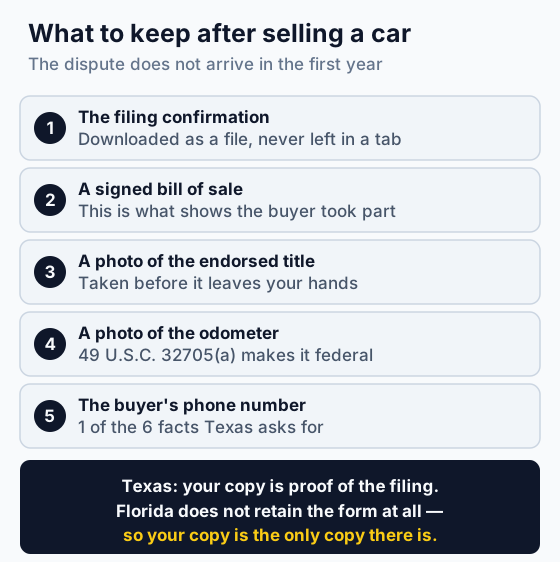
- 2Save the confirmation as a file, not a tabA PDF or a screenshot, stored where you keep tax records. A confirmation page you did not download is not evidence, and the session that produced it will not be there next year.
- 3Keep a signed bill of sale as wellThis is the document that shows the buyer participated. Washington's statute lists exactly that class of document as what establishes responsibility for an abandoned vehicle, and the report of sale is not on the list.
- 4Photograph the odometer and the signed titleThe mileage you disclose is a federal disclosure under 49 U.S.C. 32705(a). Photograph the reading on the day, and photograph the endorsed title before it leaves your hands.
- 5Record the buyer's telephone numberTexas conditions its presumption on the notice carrying the buyer's full name, address and telephone number. Collect all 6 facts the form asks for while the buyer is still standing there.
What it costs, and the one state that charges
Most people assume this filing is free everywhere, because in most places it is. That assumption causes a specific failure: a form posted without payment is not a form filed.
3 of the 4 states with a filing charge nothing for it. Washington charges. RCW 46.17.050 requires the applicant to pay a filing fee, a license plate technology fee and a license service fee before a report of sale under RCW 46.12.650(2) is accepted, and the Department of Licensing publishes the total as $18. Washington’s own form declines to print a figure at all, telling sellers to contact a local vehicle licensing office for fee amounts.
Combine that with the receipt rule in the same chapter — the report is properly filed only when the department has received it and stamped it within the window — and the Washington failure mode writes itself. A check in an envelope that arrives on day six is not a late filing. It is not a filing.
If you sold the car years ago and never filed
This is the most common real situation, and the honest answer is better than the panic suggests in some states and worse in others.
Texas is explicit that failing to file is not itself a wrong. Tex. Transp. Code 501.147(e) provides that the section does not impose or establish civil or criminal liability on the owner of a motor vehicle who transfers ownership of the vehicle but does not disclose the transfer to the department. You lose the complete defense at subsection (g). You do not acquire a new offense.
California’s 5 alternative routes mean the same thing in practice. If you endorsed the title properly and delivered it, 5602(a)is satisfied on its own terms and the missing notice does not undo that. What you have lost is the clean, dated, state-held record of the transaction — which is exactly what you would want in front of you if someone now says the car was yours in March.
- File the notice late anyway, if the state accepts one — a dated record beats none
- Dig out anything the buyer signed, and treat that as the primary evidence
- Check whether the title was ever transferred, and when
- If plates were still on the car, find out whether they were ever surrendered
- Write down the date of sale and the buyer's details now, while you still remember
The third item is the one that changes the situation most. If the buyer did transfer the title, the record already names them and the exposure has largely closed by itself. If the record still names you years later, the sale never completed on paper — and that is the pattern described on title jumping, where a car is resold repeatedly without any of the intermediate buyers ever appearing on a title.
Ownership had already moved; the record just had not caught up
One sentence from Texas explains why the whole area feels contradictory, and it is worth sitting with.
Tex. Transp. Code 501.0234(f) provides that notwithstanding compliance with this chapter, equitable title to a vehicle passes to the purchaser of the vehicle at the time the vehicle is the subject of a sale that is enforceable by either party.
In other words, the beneficial ownership moved at the moment the deal became binding. It did not wait for a form, a counter or a certificate. Everything else on this page is administrative machinery for getting a public record to agree with something that already happened privately.
That is why filing helps and does not settle. A court asking who owned the car is asking about the sale, and the state’s record is evidence of the sale rather than the sale itself. It is also why the documents that show the buyer’s participation outrank the document you filed alone: they go to the transaction, and your filing goes to the record of it. The difference between the two documents is set out on car title vs registration.
The towing bill is the exposure that actually bites
Ask what people are really afraid of and it is rarely a lawsuit. It is a bill from a municipality for a car they have not seen in two years, and there is a reason that is the exposure that survives the paperwork.
A tow, storage and auction bill is generated by a process that starts with a license plate and a database lookup. Nobody at the yard is examining a chain of title. They read the registered owner off a record and send the invoice there, and the amount grows daily while the letters go to an address the record has for you.
That is precisely the carve-out Washington wrote into RCW 46.12.650(4)(b), and it is the honest picture everywhere: this is the claim your solo filing is least able to stop, because it is the claim generated by the record rather than argued about in front of anyone.
Washington also runs a quiet audit of exactly this gap. Under RCW 46.12.650(4)(a)(v) the department must send the Department of Revenue a quarterly report listing vehicles for which a report of sale has been received but no transfer of ownership has taken place. The state knows how many cars are sitting in the gap between a seller’s notice and a buyer’s application, and it reports the list every three months.
Plates, registration and insurance are three separate ends
The notice is one of several things that need closing, and finishing it can create a false sense that everything is done. It is worth separating them, because they are governed by different rules and one of them can cost you a license.
- 1The platesWhether they stay on the car is a state-by-state question with no pattern. New York extinguishes the registration on transfer and requires the seller to remove the plates. Other states transfer plates with the vehicle. Getting this wrong leaves your number on a car you do not control.
- 2The registrationSurrendering plates and canceling a registration are not always the same transaction, and a refund often depends on doing it before expiry rather than after.
- 3The insuranceDo not cancel until the plates are dealt with. Several states treat a lapse in insurance on a still-registered vehicle as its own violation, with penalties that have nothing to do with the sale.
- 4The notice itselfFiled within 5 to 30 days depending on the state, with the confirmation saved.
- 5The title endorsementSign it correctly and photograph it. In California this alone satisfies the liability section; everywhere it is the document the buyer needs to complete the transfer that finally moves your name off the record.
The ordering matters more than it looks. Canceling insurance first, before the plates are off and the registration is closed, is the sequence that turns a tidy sale into a suspension notice.
The same event, read from the buyer's side
If you are the buyer, the seller’s notice is not a formality happening elsewhere. It starts a clock on you, and in one state it has already changed your legal position.
Under Tex. Transp. Code 501.147(c), once a proper notice is on the record the purchaser shown there is rebuttably presumed to be the owner and to be subject to civil and criminal liability arising out of the use, operation, or abandonment of the vehicle. Rebuttable means you can argue with it. It also means the starting position is against you.
Washington puts a hard deadline on the other side of the same event. RCW 46.12.650(6)(a) gives a buyer 15 days from delivery to apply for a new certificate of title, and subsection (8) adds that failing to apply within 45 days is a misdemeanor — a single continuing offense for each day that passes beyond it.
What the record shows afterwards, and what it does not
A vehicle history record is where these events become visible to somebody who was not party to them. Title events are reported by state agencies, so a transfer recorded in one state can be read by someone in another.
What that gives you is chronology. You can see that a title event occurred, roughly when, and in which state, and compare that against the story you are being told. A car sold in March whose title did not move until the following February is a car with a gap, and gaps are where the situations on this page live.
What it will not show is your notice. A release of liability is an administrative entry in one state’s own file; it is not a title event and it does not propagate. It is also worth being honest that reporting is neither instant nor uniform, so a very recent transfer may not have appeared yet. Use the record as one input against the documents and the person in front of you, never as a verdict on either. You can run the VIN free on CheckerVIN before you commit to anything.
Where this information comes from
- California Vehicle Code 5602 — owner not liable after bona fide saleGives the seller alternative routes to the protection: proper endorsement and delivery of the certificate of ownership at (a), or delivering to the department the notice under 4456(b), 5900 or 5901, or the documents and fees to register the car to the new owner, at (b). Limits the shield to liability arising 'by reason of any of the provisions of this code' for the 'parking, abandoning, or operation' of the vehicle.
- California Vehicle Code 5900 — notice of transfer by the ownerThe five calendar day deadline at (a). Subsection (b) folds in the federal odometer disclosure under 49 U.S.C. 32705(a) and provides that inaccurate mileage is a violation only where done with intent to defraud. Subsection (c) shifts the duty to the person in physical possession where that is not the registered owner.
- California Vehicle Code 5901 — notice of transfer by a dealerRequires notice 'not later than the end of the fifth calendar day thereafter not counting the day of sale' and electronically, a different deadline and channel from the private seller's. Subsection (d) defines when a sale is deemed completed and consummated.
- California DMV — Notice of Transfer and Release of LiabilitySource of the agency's own framing — liability for parking and traffic violations and civil litigation becoming the purchaser's responsibility, the one business day record update for an electronic filing, and the statement that in a suit or complaint the court determines whether the seller complied.
- RCW 46.12.650 — releasing interest, reports of sale, transfer of ownershipThe five business day deadline at (2) and the received-and-stamped test at (3). Subsection (4)(b) is the towing carve-out and the list of documents that do establish responsibility. (4)(a)(v) requires a quarterly report to the Department of Revenue of vehicles reported sold but never transferred. (5) makes dealer filing optional. (6)(a) sets the buyer's 15-day title deadline, (8) the 45-day misdemeanor, and (9) the six exceptions to the late penalty.
- RCW 46.17.050 — fees associated with a report of saleRequires payment of the filing fee, license plate technology fee and license service fee before a report of sale under RCW 46.12.650(2) is accepted — the reason Washington is the only state here where an unpaid filing is not a filing.
- Washington State Department of Licensing — Sell a vehiclePublishes the $18 fee, tells sellers to submit the report 'within 5 days of the sale date' where the statute says five business days, and states that filing protects the seller from liability for towing charges — the claim RCW 46.12.650(4)(b) qualifies.
- Texas Transportation Code 501.147 — vehicle transfer notificationSubsection (b) lists the six facts the notice must carry. (c) sets the 30-day window and creates the rebuttable presumption that the purchaser is the owner. (e) provides that not filing imposes no liability. (f) confirms no title issues until the purchaser applies. (g) is the complete defense, and the sentence that a copy of the form is proof of the filing.
- Texas Transportation Code 501.0234 — duty of a dealer on saleSubsection (f) provides that notwithstanding compliance with the chapter, equitable title passes to the purchaser at the time of a sale enforceable by either party — the clearest statement anywhere that the record follows the transaction rather than creating it.
- FLHSMV Procedure TL-52 — Mark Title SoldRevision 08/14/20. Quotes Fla. Stat. 319.22(2)(b) for the 30-day notice and the limitation of liability, and 319.23(6) for the dealer trade-in filing. States that the seller's name remains on the DMV database until the title is submitted for transfer, that the department does not retain form HSMV 82050, and that the requirement does not apply on a trade-in to a licensed dealer or where an insurer takes possession.
- New York Vehicle and Traffic Law 420 — transfer of registrationProvides that on transfer of ownership or destruction the registration expires and the seller shall remove the number plates — the reason New York has no seller notification filing to look for.
- 49 U.S.C. 32705 — odometer disclosure requirementsThe federal disclosure Cal. Veh. Code 5900(b) and 5901(b) both incorporate, which is why the mileage entered on a transfer notice is a federal statement and not a state formality.
Frequently asked questions
What is a release of liability?
A notice you send the state saying you sold a specific vehicle to a specific person on a specific date. It goes by four names — California calls it a Notice of Transfer and Release of Liability, Washington a Report of Sale, Texas a Vehicle Transfer Notification and Florida a Notice of Sale. It does not transfer ownership, it does not change the title, and it does not cancel your registration. It updates the state's record of who was driving away in the car, so that what happens next is attributed to the right person.
How long do I have to file a release of liability?
Between 5 and 30 days, and which one you get is decided entirely by which state issued the plate — a 6-fold spread for the same act. California requires notice within five calendar days and Washington within five business days, which are different lengths of time. Texas and Florida both allow 30 days. New York asks for nothing, because its registration expires on transfer by operation of law and the plates leave with the seller.
Does a release of liability transfer ownership?
No, and this is the misunderstanding that costs people money. Texas states outright that the department may not issue a title or register the vehicle until the purchaser applies. Florida's procedure manual is blunter still: the seller's name will remain on the DMV database until the certificate of title is submitted for transfer. Filing the notice tells the state a sale happened. Only the buyer's title application moves the record, and if the buyer never files, the record never moves.
What happens if I do not file a release of liability?
It depends on the state, and the range is wide. Texas says plainly that the section does not impose or establish civil or criminal liability on an owner who transfers a vehicle but does not disclose the transfer. California offers 5 alternative ways to reach the same protection, of which the notice is only one — proper endorsement and delivery of the title is itself sufficient under Cal. Veh. Code 5602. So not filing is not automatically fatal. It removes the cleanest evidence you had, in a dispute where evidence is the whole game.
Does filing a release of liability protect me from a towing bill?
Not reliably, and Washington puts the exception in the statute. RCW 46.12.650(4)(b) provides that a report of sale is not proof of a completed vehicle transfer for purposes of collecting towing, storage and auction expenses where there is nothing showing the buyer knew of or accepted the transfer. The state then lists what does work: a signed contract, a certificate of title, a receipt, a purchase order, or other proof the buyer took the car. Washington's own consumer page says filing protects you from towing charges, so read the statute rather than the page.