The short answer
- Is it the DMV?
- Often not. In 5 of the 6 states here the application goes to a county officer — a court clerk, a treasurer, a tax assessor-collector or a tax collector.
- Can any office serve me?
- Ohio says any clerk, unconditionally. Texas says any assessor-collector who is willing to accept it, which is not the same promise.
- Is a private office real?
- In 2 of the 6 it can be. Washington subagencies and Florida license plate agents hold appointments. A business without one is a courier.
6 kinds of office
Across the 6 states read here, no two share a model
Statute and procedure manuals, not agency summaries
A court clerk
Who signs and seals an Ohio certificate of title
Ohio Rev. Code 4505.06(A)(3)
If willing
The condition Texas attaches to an out-of-county office
Tex. Transp. Code 501.023(a)(2)
6 weeks
Mississippi's published wait for a standard title
Or 72 hours for 4.3x the fee

There is no national title office
“Title office” is not a national institution. It is a regional phrase — strongest in Ohio, where the office genuinely is called that — attached to a function every state performs through a different body. That is why searching the phrase returns a map rather than an answer, and why advice from a friend in another state is so often confidently wrong.
The function itself is narrow and identical everywhere: somebody has to receive an application for a certificate of title, satisfy themselves that the applicant is the owner, and cause the document to exist. What varies is who that somebody is, whether they are a county officer or a state one, whether the same body that examines the application is the body that issues the title, and whether the office can lawfully be a private business.
All four of those vary independently, which is how 6 states produce 6 distinct arrangements with no two alike.
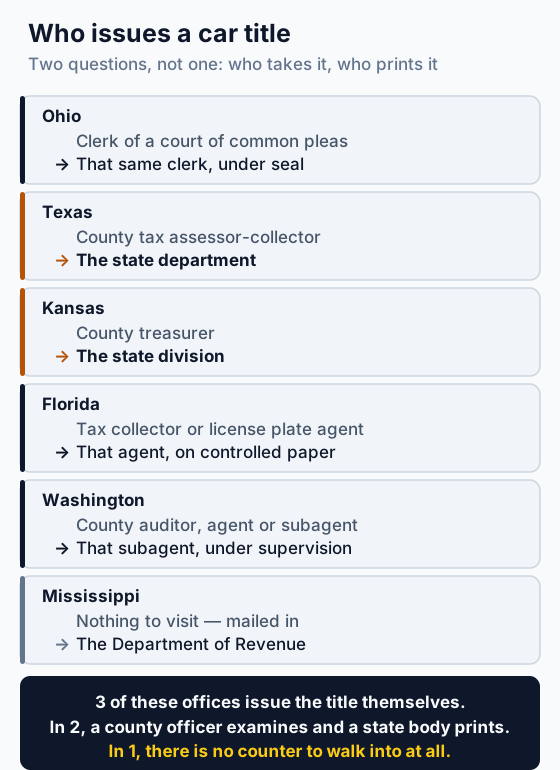
Six states, six different offices
| State | Where the application goes |
|---|---|
| Ohio | Clerk of any court of common pleas — Ohio Rev. Code 4505.06(A) |
| Texas | County tax assessor-collector — Tex. Transp. Code 501.023(a) |
| Kansas | County treasurer — K.S.A. 8-135(c)(1) |
| Florida | Tax collector or license plate agent — FLHSMV Procedure TL-46 |
| Washington | County auditor, agent, or appointed subagent — RCW 46.01.140(1), (4) |
| Mississippi | No counter — the application is mailed in — Miss. Dept. of Revenue, Motor Vehicle Titles |
Read the second column of that table again and notice what is missing: the letters DMV. They appear nowhere, in any of the 6rows. The state motor vehicle agency is involved in most of them — it prescribes the form, keeps the record, and in several states it is the body that actually issues the document — but it is not where a member of the public hands over the paperwork.
Why it is so often not the DMV
There is a reason for the split, and it is older than the DMV. A certificate of title is a document about ownership, and ownership records in the United States were historically kept by counties — deeds by a recorder, taxes by a treasurer or collector, judgments by a court clerk. When states began titling cars, many of them handed the job to the county officer who already kept ownership records rather than building a parallel state counter network.
Registration went the other way. Plates, fees and enforcement are a state matter, so they stayed with the state agency. The result is that in a large part of the country the two halves of what people think of as one errand are performed by two different levels of government, in two different buildings, on two different schedules.
Ohio: the title is a court document
Ohio is where the phrase comes from, and its arrangement is the most unusual in the country. Ohio Rev. Code 4505.06(A)(1) provides that an application for a certificate of title shall be made in a form prescribed by the registrar of motor vehicles and shall be sworn to before a notary public or other officer empowered to administer oaths, and that the application shall be filed with the clerk of any court of common pleas.
Two things follow from that sentence. The application is a sworn statement, not a form — you are making an oath about ownership. And the body that receives it is a court, which is why the Ohio office is a division of the Clerk of Courts rather than of a motor vehicle agency.
The issuing step matches. Once the clerk is satisfied the applicant is the owner, division (A)(3) requires that within 5 business days after the application is filed the clerk shall issue a physical certificate of title over the clerk’s signature and sealed with the clerk’s seal, unless the applicant asks for an electronic title instead. An Ohio car title is signed and sealed by a court officer.
The consequences are practical. Because it is a court office, the same counter handles matters an ordinary motor vehicle counter would send to probate — survivorship, transfer-on-death designations under Rev. Code 2131.13, and watercraft as well as vehicles. And because the application must be sworn, notarization is part of the transaction rather than something you were supposed to arrange beforehand.
Whether any office has to serve you
This is the question that actually decides your morning, and the two states that address it most clearly give different answers.
Ohio is unconditional. The application shall be filed with the clerk of any court of common pleas— any of them, anywhere in the state, regardless of where you live. Division (A)(2) simply requires a clerk who is not the clerk of your county of residence to transmit the transaction data to the automated title processing system. There is even a quiet financial disincentive built in: under division (B)(2) a clerk may retain a poundage fee of 1.01per cent on taxes paid by a resident of the clerk’s county, and shall not retain a poundage fee from payments of taxes by persons who do not reside in the clerk’s county. The out-of-county customer is worth less to the office and must still be served.
Texas is where the language turns conditional. Tex. Transp. Code 501.023(a) gives three routes.
| Route | What it depends on |
|---|---|
| The county where the owner is domiciled | Where you live |
| The county where the vehicle was purchased or encumbered | Where the transaction happened |
| Any county assessor-collector who is willing to accept the application | Whether that office agrees |
That third route is the sharpest practical fact on this page. The statute says any county assessor-collector who is willing to accept the application. Willingness is a legal condition, not a formality, and it means the nearest office to you may lawfully decline a transaction it has no obligation to take. If you are relying on convenience rather than domicile or point of purchase, telephone first.
Texas: the county takes it, the state issues it
Texas separates the two halves of the job. The county tax assessor-collector receives your application, but the certificate is a state document. Tex. Transp. Code 501.021(a) speaks of a motor vehicle title issued by the department, and the county’s role is defined by what it must do next.
Section 501.023(b) gives that a hard edge: the assessor-collector shall send the application to the department or enter it into the department’s titling system within 72 hours after receipt of the application. The county is a receiving and verifying office with a statutory transmission duty, not the issuer.
For a reader this matters in one specific way. When a Texas title is late, there are two places it can be stuck, and they are run by different governments. Knowing that the county had 72 hours to pass it along tells you which one to ask first.
Kansas: examined in one place, issued in another
Kansas draws the same line as Texas but assigns the judgment differently, and the statutory language is unusually explicit about who decides what.
Under K.S.A. 8-135(c)(1), the county treasurer shall use reasonable diligence in ascertaining whether the facts stated in such application are true, and if satisfied that the applicant is the lawful owner of such vehicle, or otherwise entitled to have the same registered in such applicant’s name, shall so notify the division, who shall issue an appropriate certificate of title.
Read that sequence carefully. The county treasurer makes the ownership judgment. The state division performs the issuance, on notification, and the statute gives it no independent satisfying-itself step at that point. The person who decides whether you own the car is a county tax official, and the body that prints the document is acting on that official’s conclusion.
The same subsection contains the flat prohibition that catches most people out: no certificate of title shall be issued for a vehicle having any unreleased lien or encumbrance thereon, unless the transfer of such vehicle has been consented to in writing by the holder of the lien or encumbrance. No amount of choosing the right office gets around an unreleased lien, which is why checking for a lien belongs before the trip rather than after it.
Florida: your title is printed from a safe
Florida is the state where you can most easily see that the office in front of you is issuing a controlled document rather than processing a request. Its procedure manual is written for the counter staff, and it describes an inventory regime.
FLHSMV Procedure TL-46 instructs that blank certificate of title documents may only be stored in a storage container (safe or vault) at a designated location which has been inspected, documented using the department’s Security Analysis form, approved and authorized by the Division of Motorist Services Support. Blank titles are ordered through the issuance system in increments of 2,000, shipped by courier to the main county agency for distribution to branches.
The accountability is daily. Voided certificates must match the Title Audit Report, must be stamped “VOID” on the face of the title and retained with that report for 1year for auditing purposes, and the unused stock numbers must run consecutively from the previous day’s balance. The manual states the principle plainly: any agency authorized to issue Florida certificate of title must securely store and account for all title paper from receipt to distribution.
The phrase “any agency authorized to issue” is the one to hold on to, because in Florida that includes offices that do not look governmental at all.
Washington: an appointment, not a business
Washington has the most revealing statute of the six, because the legislature had to write down what a privately run public office is and is not.
RCW 46.01.140(1) requires a county auditor or other agent appointed by the director to enter into a standard contract and to provide all services authorized by the director for vehicle certificates of title and vehicle registration applications and issuance under the direction and supervision of the director. Subsection (4) then extends the same structure downward to subagents, who contract with the county auditor and work under the direction and supervision of the county auditor or agent and the director.
So the storefront with its own name and its own opening hours is performing the state function, under contract, supervised. It is not a middleman. That answers the question most Washington readers are actually asking when they type the phrase into a search box.
Then comes subsection (5), and it is remarkable. A subagent who no longer wants the appointment may recommend a successor — specifically a sibling, a spouse, a child or a subagency employee— but the recommended successor must participate in the open competitive process used to select an applicant. A subagent may not receive any direct or indirect compensation or remuneration from any party or entity in recognition of a successor nomination and may not receive any financial benefit from the transfer or termination of an appointment. The legislature then says it outright: the appointment of a successor does not create a proprietary or property interest in the appointment.
A statute only needs to say that when people have been treating the thing as property. The office you walk into may be a family business in every ordinary sense and still not be owned, because what makes it a title office is an appointment the state can end.
Is that private-looking office real
Here is the test, and it is not about the signage, the queue, the card reader or whether the staff wear uniforms. It is about appointment.
- It holds a contract or appointment from the state — a Washington subagency, a Florida license plate agent, a designated agent. It can complete the transaction and, in Florida, print the document.
- It appears on the state agency's own office locator. Appointed offices are listed by the agency because the agency is responsible for them.
- It collects the state fee as the state fee, and any service charge is separate and disclosed. An appointed office is collecting money on the state's behalf.
- It has no appointment and does not appear on the state list. It can prepare paperwork and stand in a queue for you, and nothing more.
The distinction is invisible from the street in exactly the states where it matters most. Of the 6 here, 2 allow a privately run office to hold the appointment, and in both of them that office is doing the real work under supervision. In the others a private business offering title services is doing something legitimate but much smaller.
What a paid title service can and cannot do
Unappointed businesses in this trade are not a scam by definition. They sell time and familiarity, which are real things to sell when a counter has a three-hour queue and a form has a section people routinely fill in wrongly. What matters is being clear about what you are buying.
- 1They can prepare and check the paperworkReviewing an assignment for a missing date, an unsigned lien release or a name that does not match identification is genuinely useful, and it is the most common reason a counter visit fails.
- 2They can queue and file on your behalfWith the right authorization they can hand the application across the counter. This is a courier service and it is worth what an hour of your time is worth, not more.
- 3They cannot decide that you are the ownerThat judgment belongs to the officer named in the statute — the Kansas treasurer, the Ohio clerk, the Texas assessor-collector. Nobody can sell you a favorable outcome on it.
- 4They cannot issue a title unless they hold an appointmentIssuing is a controlled act performed on accountable stock. In Florida an authorized agent prints it from a safe under daily audit; an unappointed business has no stock and no authority.
- 5They cannot shorten a statutory processing timeWhere a state publishes a faster tier it sells it itself, at its own published price. A private promise to beat a state's stated timetable is a promise about something the seller does not control.
The state with no counter at all
Every model above assumes a building. Mississippi does not.
The Department of Revenue describes the title as a secure, negotiable document representing ownership of a motor vehicle or a manufactured housing unit issued by the Mississippi Department of Revenue, and for a replacement it instructs the applicant to complete the form, pay the fee and mail both to a post office box in Jackson. There is no title counter to find because the transaction is a postal one.
The department publishes the consequence without dressing it up. A standard title is typically issued within 6 weeks once a completed application, including all required documentation, is received — roughly 42 days, against the 5 business days an Ohio clerk has to work with. Electronic titles run three to four weeks. An electronic lien title is issued the next business day.
For anyone whose mental model of this errand is a queue and a ticket number, that is the most useful thing on this page. In some states the answer to “where is the title office” is that there is not one, and the search itself is the mistake.
What speed costs where you can buy it
Mississippi also prices the wait, which makes it the clearest illustration of what a fast title actually is.
| Mississippi title | Published fee and time |
|---|---|
| Standard | $9 — about 6 weeks |
| Fast Track | $39 — within 72 hours |
The document is identical. The paper, the security features and the legal effect do not change. What 4.3times the fee buys is position in a queue, which is worth saying plainly because it reframes every other expedited title product you will be offered. Florida’s equivalent is the fast title procedure quoted above, run at the counter on the same accountable stock.
It also sets the benchmark for judging a private service. If a state sells expedited handling itself at a published price, that price is the ceiling on what the queue is worth.
The title office and the plate office
In the county-office states the title and the registration are frequently not the same trip, and people discover this at the second counter rather than the first.
Ohio is the clearest case, because the split is jurisdictional rather than administrative. The title comes from the clerk of a court of common pleas under Rev. Code 4505.06. Plates and registration are the motor vehicle agency’s function. Two levels of government, two buildings, and the title has to exist first because it is the ownership document the registration is granted against.
The ordering is the part worth internalizing. Nearly everywhere, the sequence is title first, then registration, then plates, and each step consumes the output of the previous one. Turning up to register a car you have not titled is the single most common wasted trip in this whole area, and it is not a queueing mistake but a sequencing one.
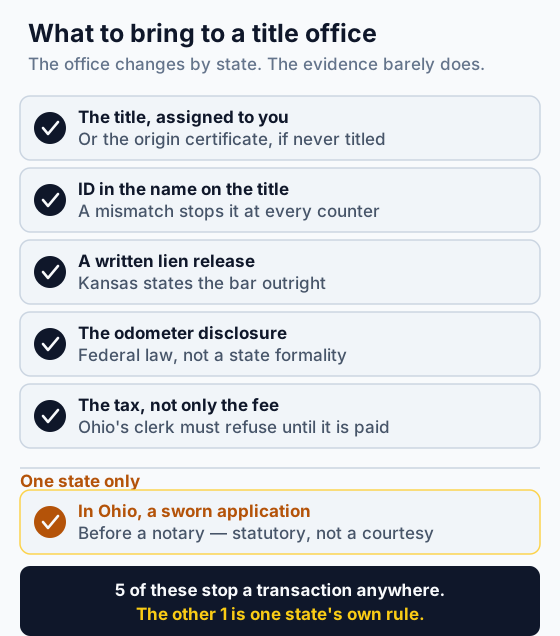
What every office asks for, whichever one it is
The models differ; the evidence does not, because every one of these officers is answering the same question about whether you own the car.
- The certificate of title, properly assigned to you, or the manufacturer's certificate of origin if the vehicle has never been titled.
- Identification in the name that will appear on the title. A mismatch between the assignment and the identification stops the transaction everywhere.
- Written lien release, or the lienholder's written consent, if the record shows an encumbrance. Kansas states the prohibition outright and every state applies some version of it.
- The odometer disclosure, which is a federal statement rather than a state formality, and is part of the assignment on modern titles.
- Payment of tax as well as fee. Several of these offices are tax offices first, and in Ohio the clerk must refuse the filing outright until the sales tax is paid.
- In Ohio, an application sworn before a notary — the office notarizes on site, but the oath is a statutory requirement rather than a courtesy.
The clock running while you look
Finding the right office is not a neutral activity, because in most states a deadline started the moment the car was handed over.
Ohio sets it in the same section that names the office. Under division (A)(5)(b), in all cases of transfer other than a manufactured or mobile home, the application for certificate of title shall be filed within 30 days after the assignment or delivery of the motor vehicle. Miss it and division (A)(6) directs the clerk to collect a late fee of $5 on top of everything else.
The dealer side of the same statute shows how much more seriously the state takes a professional’s delay. A dealer obtaining a title for a buyer with a security interest must submit within 7 business days, and is liable to the secured party for $10 per day beyond that, rising to $25 per day after 21 days — 2.5 times the initial rate, payable to the lender rather than the state.
The private buyer’s $5and the dealer’s escalating daily liability are answering different problems, but both make the same point: the search for the right counter is happening inside a window, and the window is shorter than the time people usually take to get around to it.
What actually happens when you go to the wrong office
Three different failures get described with the same sentence — “they turned me away” — and they have different fixes.
- 1Wrong kind of office entirelyYou went to the motor vehicle agency in a state where a county officer takes title applications. Nothing was wrong with your paperwork. Find the county office named in your state's statute and go again.
- 2Right kind of office, no obligation to serve youThe Texas situation. The office is the correct type but is not your county of domicile or of purchase, and is not willing to accept the application. Use one of the other two routes rather than arguing this one.
- 3Right office, incomplete evidenceAn unreleased lien, an unsigned assignment, identification in a different name. This is the only one of the three where going back to the same counter is the answer, once the missing document exists.
Only the third is about you. The first two are about the structure of your state, which nobody explains at the door.
Finding yours, and what we cannot do for you
There is no national directory of these offices, and any site claiming to have one is merging six incompatible systems into one list. The reliable route is short.
- 1Establish which model your state usesSearch your state's name with 'certificate of title application' and read the statute or the agency's own page. The word you are looking for is the officer: clerk, treasurer, assessor-collector, tax collector, auditor.
- 2Use the agency's own locator, not a directoryAppointed offices appear on the state agency's list because the agency is accountable for them. An office that is not on that list is not appointed, whatever its sign says.
- 3Telephone the specific branchAsk two questions: whether they will accept your transaction given where you live and where you bought the car, and what they require you to bring. Both answers vary by branch even inside one county.
Where this information comes from
- Ohio Rev. Code 4505.06 — application for certificate of titleDivision (A)(1) requires the application to be sworn before a notary and filed with the clerk of any court of common pleas. (A)(2) covers out-of-county filing and data transmission. (A)(3) requires issuance within five business days over the clerk's signature and seal. (A)(5)(b) sets the 30-day filing deadline, (A)(6) the $5 late fee, and (A)(5)(a)(iii) the dealer's $10 then $25 per day liability to a secured party. (B)(2) is the 1.01 per cent poundage fee and the bar on retaining it from non-residents.
- Texas Transportation Code 501.023 — application for titleSubsection (a) gives the three routes: the county of domicile, the county of purchase or encumbrance, or any county assessor-collector willing to accept the application. Subsection (b) imposes the 72-hour duty to forward the application to the department or enter it in the titling system.
- Texas Transportation Code 501.021 — title for motor vehicleSubsection (a) describes the title as issued by the department, confirming that the county assessor-collector receives and verifies rather than issues. Subsection (b) is the false-information warning printed on the face of every Texas title.
- Kansas Statutes 8-135 — transfer of title or interestSubsection (c)(1) makes the county treasurer the officer who ascertains ownership and then notifies the division, which issues the certificate, and contains the flat prohibition on issuing a title over an unreleased lien without the lienholder's written consent.
- FLHSMV Procedure TL-46 — fast title issuance and title accountingRevision 07/26. Written for employees of the Tax Collector, License Plate Agent and the department. Requires blank title stock to be held in an approved safe or vault, ordered in increments of 2,000, with daily balancing against the Title Audit Report, voided titles stamped VOID and retained one year, and states that any agency authorized to issue a Florida title must account for all title paper.
- RCW 46.01.140 — county auditors, agents and subagentsSubsection (1) puts county auditors and appointed agents under a standard contract and the director's supervision for certificate of title services. Subsection (4) applies the same to subagents under the auditor. Subsection (5) governs successorship, bars any financial benefit from transferring an appointment, and states that a successor appointment creates no proprietary or property interest.
- Mississippi Department of Revenue — Motor Vehicle TitlesSource of the published processing times — about six weeks for a standard title, 72 hours for a $39 Fast Track title against the standard $9 fee, three to four weeks for an electronic title and next business day for an electronic lien title — and of the instruction to mail a replacement application to the department in Jackson.
- Wood County Clerk of Courts — Title OfficeAn Ohio title office as it presents itself: a division of the Clerk of Courts handling motor vehicles, watercraft, surviving spouse transfers without probate and transfer-on-death designations, listing registration offices separately from itself.
- Ohio Rev. Code 2131.13 — transfer-on-death designationThe provision Rev. Code 4505.06(A)(3) points to for beneficiary-form ownership, and part of why the Ohio title counter handles questions that would otherwise be probate matters.
- 49 U.S.C. 32705 — odometer disclosure requirementsThe federal disclosure that travels with the assignment to whichever office takes the application, and the reason the mileage entry is not a state formality.
Frequently asked questions
What is a title office?
It is whichever body your state has made responsible for taking a certificate of title application, and there is no national answer. In Ohio it is the clerk of a court of common pleas, so the title is a court document sworn before a notary. In Texas it is the county tax assessor-collector, in Kansas the county treasurer, in Florida the tax collector or a license plate agent, and in Washington a county auditor or a privately run subagency holding a state appointment. In Mississippi there is no counter to visit — the application is mailed to the Department of Revenue. Of the 6 states read here, 5 route the work through a county office and only 1 handles it centrally.
Is the title office the same as the DMV?
Often not. Ohio's title application is filed with the clerk of a court of common pleas under Rev. Code 4505.06(A), and the clerk issues the certificate over their own signature and seal. Kansas routes it through the county treasurer, Texas through the county tax assessor-collector. In those states the motor vehicle agency maintains the record but a county officer is the one who takes your paperwork. Assuming the DMV counter is the right counter is the most common way people lose a morning.
Can I go to a title office in a different county?
In Ohio, yes and without conditions — Rev. Code 4505.06(A)(1) says the application shall be filed with the clerk of any court of common pleas, and (A)(2) simply requires an out-of-county clerk to transmit the data. Texas is more qualified. Section 501.023(a) lets you apply in the county where you are domiciled, the county where the vehicle was purchased or encumbered, or to any county assessor-collector who is willing to accept the application. That last route depends on a willingness the statute does not require anyone to have, so call before you drive.
Are private auto title services legitimate?
It depends entirely on whether the business holds a state appointment. In Washington a subagency is privately run but appointed by the director under RCW 46.01.140(4) and works under the supervision of the county auditor, so it is the official channel. Florida license plate agents, including private tag agents, are authorized agents of the department and can print your title on controlled stock. A business with no appointment is a courier: it can fill in forms and stand in line for you, but it cannot issue anything, and it charges a fee on top of the state fee for doing so.
How long does a title office take to issue a title?
The range is enormous. An Ohio clerk must issue the certificate within 5 business days of the application under Rev. Code 4505.06(A)(3), and in practice hands it over the counter. Mississippi publishes about 6 weeks for a standard title, because the application is mailed to the Department of Revenue rather than handled at a counter, and sells a Fast Track title issued within 72 hours for $39 against the standard $9. Same document, 4.3 times the fee, and the difference is purely queue position.