The short answer
- What is a salvage certificate?
- A state document recording who holds a vehicle that is too damaged to be a normal titled car. It establishes ownership. It does not grant the right to register or drive.
- Is it the same as a salvage title?
- Often not. Several states issue a certificate first and a branded title only after repair and inspection. Others use one branded title throughout.
- Why does the distinction matter?
- Because one of the two documents can lead back to a registered vehicle and the other may not. Read the instrument's actual name, not the word salvage.
What the document is actually saying
A salvage certificate is a state’s record that a specific vehicle has left the population of ordinary titled cars. Something happened to it — a collision, a fire, a flood, an insurer declaring a total loss — and the state now describes it with a different instrument from the one it used before.
What the certificate does is establish who holds the vehicle. What it generally does not do is authorize anyone to register it, insure it for road use, or drive it. That is the working distinction, and it is consistent even where the paperwork is not.
Ownership
What it grants
It records who holds the vehicle
Not the road
What it withholds
Registration generally requires repair, inspection and a new title
24 hours
How fast it is reported
States send titling information to NMVTIS every 24 hours — 28 CFR 25.54
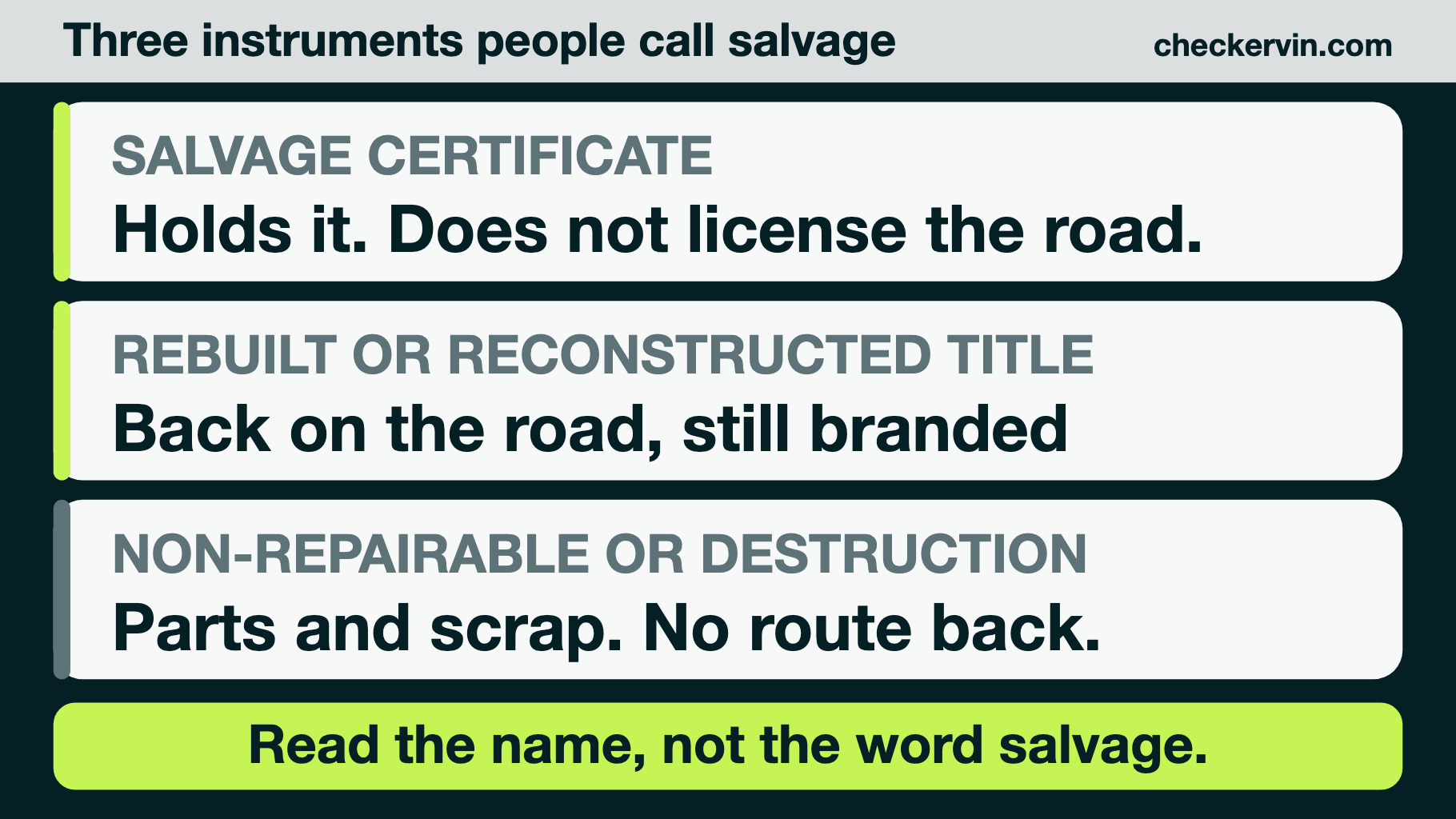
Why it is not simply a title with a stamp on it
The consumer guides that rank for this question almost all answer about salvage titles, and in some states that answer is fine because the state uses a branded title throughout. In others it is wrong in a way that matters.
Where the two are separate, the sequence runs: the vehicle is declared a total loss, the state issues a certificate recording ownership of a non-roadworthy vehicle, and only after repair and a passed inspection does a new titleissue — usually branded rebuilt or reconstructed. The certificate is the middle of that story rather than the end of it.
What federal law actually defines
The document names belong to the states, but the underlying categories are defined federally, because the national title system has to recognize them across state lines. The definitions are precise and they are worth reading rather than paraphrasing.
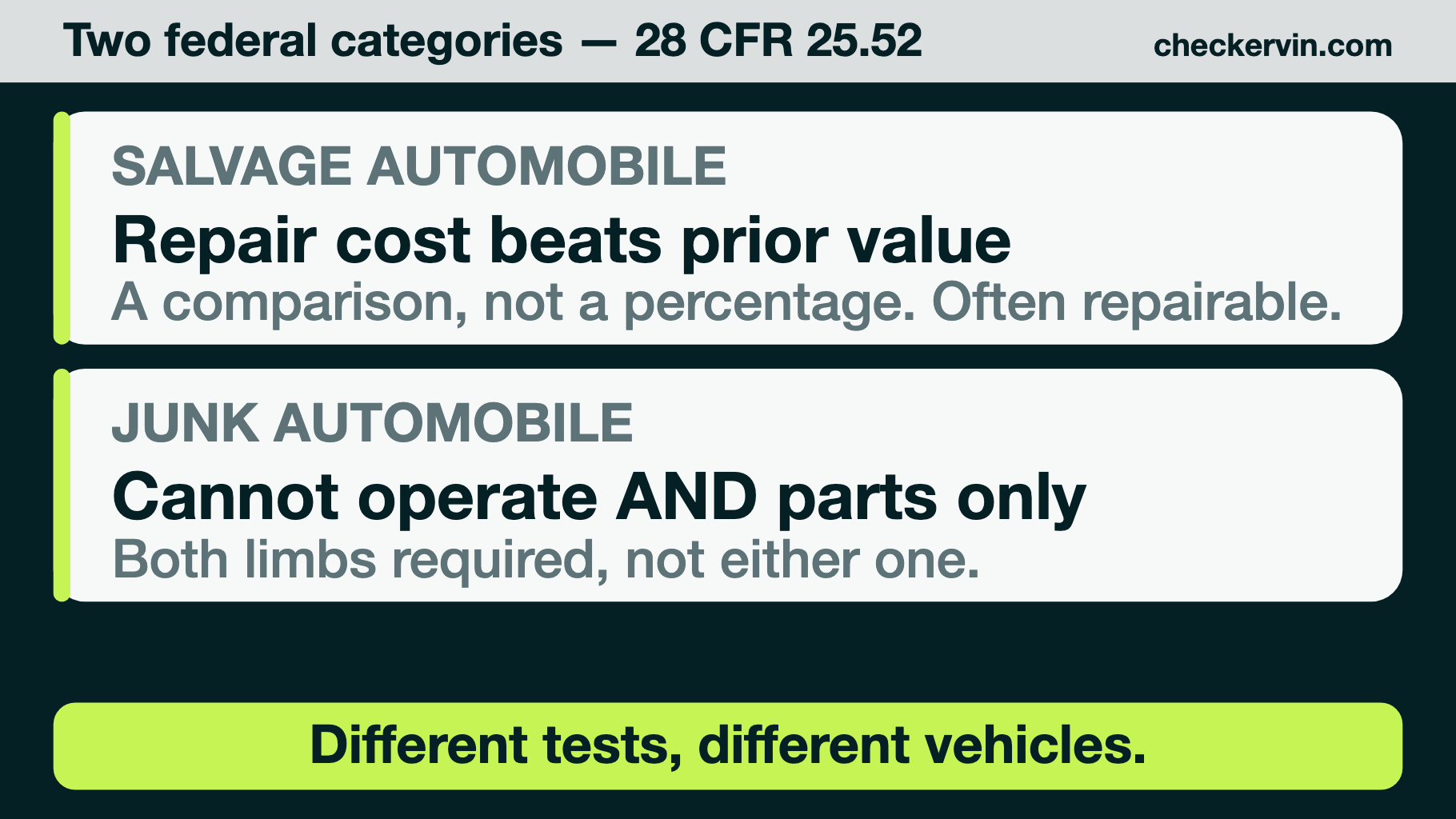
28 CFR 25.52 defines a salvage automobileas one “damaged by collision, fire, flood, accident, trespass, or other event, to the extent that its fair salvage value plus the cost of repairing the automobile for legal operation on public streets, roads, and highways would be more than the fair market value of the automobile immediately before the event that caused the damage.” The same definition adds that salvage automobiles “include automobiles determined to be a total loss under the law of the applicable state.”
Two things are worth noticing in that sentence. It is a comparison rather than a percentage, so the arithmetic depends on what the vehicle was worth the moment before the damage. And it folds in state total-loss determinations, which is how a car totaled under a state formula becomes a salvage automobile for federal purposes even where the federal test alone might not have been met.
Junk and salvage are different categories, not synonyms
The same federal definitions draw a second line that consumer writing routinely collapses, and this one has consequences.
| Category — 28 CFR 25.52 | The test |
|---|---|
| Salvage automobile | Damaged such that "fair salvage value plus the cost of repairing the automobile for legal operation" exceeds "the fair market value of the automobile immediately before the event." Includes vehicles determined to be a total loss under state law. |
| Junk automobile | A vehicle that "(1) Is incapable of operating on public streets, roads, and highways; and (2) Has no value except as a source of parts or scrap." Both limbs, not either. |
A salvage automobile is defined by an economic comparison and may be repairable. A junk automobile is defined by being finished — incapable of operating and worth nothing but parts. The two tests describe different vehicles, and the paperwork follows: a salvage instrument can precede a repair, and a junk instrument generally does not.
What you can and cannot do while holding one
- You can own, store and transfer the vehicle. The certificate exists precisely so ownership stays traceable while the car is not a road vehicle.
- You can sell it to a rebuilder, a yard or a buyer who understands what they are taking on — and the document travels with it.
- You can dismantle it for parts, which is what a large share of these vehicles are actually for.
- You generally cannot register or drive it on that instrument alone.
- You generally cannot insure it for road use, because it is not a road-legal vehicle in the state's records.
- You cannot repair it back into a clean title. The brand survives the repair — that is the entire point of the system.
The route back to the road, where one exists
- 1Establish which instrument you are actually holdingA repairable salvage instrument and a non-repairable or destruction one look similar and end very differently. This determines whether the rest of the list applies at all.
- 2Repair the vehicle and document the partsKeep receipts, especially for major components. The inspection stage asks where parts came from, and unsupported parts are a common reason it fails.
- 3Pass the state's inspectionThis is an identity and roadworthiness check — confirming the vehicle is what it claims to be and that its parts are not stolen. It is not a judgment about repair quality.
- 4Receive a new title, still brandedUsually rebuilt or reconstructed. The vehicle can now be registered. The brand stays on the record permanently and follows the VIN through every future sale.
If somebody is offering you one
A vehicle on a salvage instrument can be a legitimate purchase — rebuilders buy them deliberately and knowingly. The failures happen when the buyer does not understand which document is in play.
- Ask which instrument the seller holds, by name, and look at it rather than accepting a description.
- Confirm whose name is on it. A seller who is not the holder cannot pass ownership, and this is where the paperwork most often collapses.
- Establish what the damage was. Structural damage and water are the two categories where a repaired vehicle carries the most residual risk.
- Price the inspection and the retitling into the purchase, not just the repair.
- Check the federal record independently, because the brand should be there regardless of which state issued the document.
It is on the federal record, and it stays there
The reason a salvage brand cannot be quietly left behind in another state is that the reporting is continuous and comes from two directions at once.
Under 28 CFR 25.54, each state must provide titling information for all automobiles it maintains — including the VIN and the brands — to the national system “at a frequency of once every 24 hours.” That is a daily feed rather than an occasional upload.
And under 28 CFR 25.56, junk yards, salvage yards and recyclers must separately report a monthly inventory of every junk or salvage automobile they obtained, carrying the VIN, the date it was obtained, who it came from, and whether it was crushed or disposed of and to whom. So a vehicle that reaches a yard generates a record from the yard as well as from the state.
Together those two obligations are why title washing is harder than it used to be, and why checking the federal record rather than a single state’s is the check worth running.
Three separate reporting streams, and one honest gap
The record does not depend on any single party remembering to file something, which is why the status is hard to shake. Three obligations run in parallel and they catch the vehicle at different moments.
| Who reports | What and how often — 28 CFR Part 25 |
|---|---|
| The states | Titling information for all automobiles the state maintains, including the VIN and any brands, at a frequency of once every 24 hours. This is the backbone of the record. |
| Junk and salvage yards | A monthly inventory of every junk or salvage automobile obtained in the prior month — the VIN, the date obtained, who it came from, and whether it was crushed or disposed of and to whom. |
| Insurance carriers | A monthly inventory of automobiles the carrier took possession of and decided were junk or salvage — but only those of the current model year or the four prior model years. |
If the record is wrong, it cannot simply be deleted
This is the provision nobody writes about, and it matters enormously to anyone who believes a brand was applied to their vehicle in error.
28 CFR 25.57 addresses exactly that case, and its answer is not what most people expect. Paragraph (b) is explicit that to avoid the possibility of fraud, the operator may not allow any entity to delete a prior report of junk — the record is append-only by design. There is no route where the wrong entry disappears and the history reads clean again.
What the regulation offers instead is documentation. Where a vehicle has been erroneously reported as salvage or junk and subsequently destroyed, owners of the legitimate vehicles are encouraged to seek a vehicle inspection in the current state of title, “whereby inspection officials can verify via hidden VINs the vehicle’s true identity,” and to file those inspection reports with the state and retain them “so that the vehicle’s true history can be documented.”
Two things follow from that. The hidden VINs — the stamped locations beyond the dash plate — are what an official uses to establish identity when the paperwork is contested, which is why they exist and why tampering with them is treated so seriously. And the practical remedy for a wrong record is to build a documented counter-record and keep it, not to try to have the original erased. Anyone offering to clean a brand off a VIN is describing something the system is specifically designed to refuse.
Why the names differ from state to state
The federal definitions above set the categories. They do not tell a state what to call its paperwork, and states have not converged.
The result is that the same underlying situation produces a salvage certificate in one state, a certificate of title carrying a salvage brand in another, and a separately named non-repairable instrument in a third. The consequences attach to the instrument, not to the word, so a description that travels between states loses the part that mattered.
We are deliberately not publishing a fifty-state table of document names. They change, and a stale table on a topic where the wrong answer means an unregisterable vehicle is worse than no table. Your state’s motor vehicle agency names its own instruments and is the only source worth acting on for that question.
Reading the document in front of you
- The instrument's exact printed name — this is the field that decides everything else.
- The VIN, checked against the vehicle rather than assumed.
- The holder's name, and whether it matches the person offering it to you.
- The issuing state, because the route back to the road is that state's procedure.
- Any additional brand recorded alongside salvage — flood and fire carry their own long-term consequences.
- What the federal record says about the same VIN, independently.
Where this information comes from
- 28 CFR Part 25 Subpart C — NMVTISThe salvage and junk definitions at 25.52, state reporting at 25.54 and yard reporting at 25.56
- NMVTIS — U.S. Department of JusticeThe federal title record where brands surface across state lines
- NHTSA recall lookupOpen safety recalls by VIN, free — worth clearing before any rebuild
- NHTSA vPIC VIN decoderThe factory build, including the restraint systems a rebuild must restore
Keep reading
Frequently asked questions
What does a salvage certificate mean?
It means a state has recorded that this vehicle was damaged or declared a total loss badly enough that it is no longer a normal titled car. The document acknowledges who holds the vehicle without granting the right to register and drive it. Whether it can ever return to the road depends on which instrument your state issued and what it permits, which is why the name on the paper matters more than the word salvage.
Is a salvage certificate the same as a salvage title?
Often not, and treating them as identical is the mistake this page exists to prevent. Several states issue a certificate that is an ownership document for a non-roadworthy vehicle and a separate title once it has been repaired and inspected. Other states use one branded title throughout. Both arrangements are called salvage in ordinary speech, and the consumer guides that rank for this question mostly answer about titles.
Can a car with a salvage certificate be registered and driven?
Not in that state. A vehicle holding a salvage certificate is generally not registerable until it has been repaired, passed the state's inspection and been issued a new title — usually branded rebuilt or reconstructed. If the document is a non-repairable or destruction instrument instead, there is no route back at all and the vehicle is legally parts.
How does federal law define a salvage automobile?
28 CFR 25.52 defines it as an automobile damaged by collision, fire, flood, accident, trespass or other event to the extent that its fair salvage value plus the cost of repairing it for legal operation would be more than its fair market value immediately before the event. It also expressly includes automobiles determined to be a total loss under applicable state law.
Will a salvage certificate show up on a VIN check?
It should. States are required to send titling information to the federal NMVTIS system every 24 hours, including the VIN and any brands. Junk and salvage yards separately report monthly inventories with VINs. So the status follows the vehicle across state lines rather than staying with the state that issued it, which is the whole reason the system exists.
Check the VIN before you take it on
Decode any VIN free for the factory build and open safety recalls — the starting point before a damaged vehicle becomes your project.
Run a free VIN check