The short answer
- What is genuinely urgent?
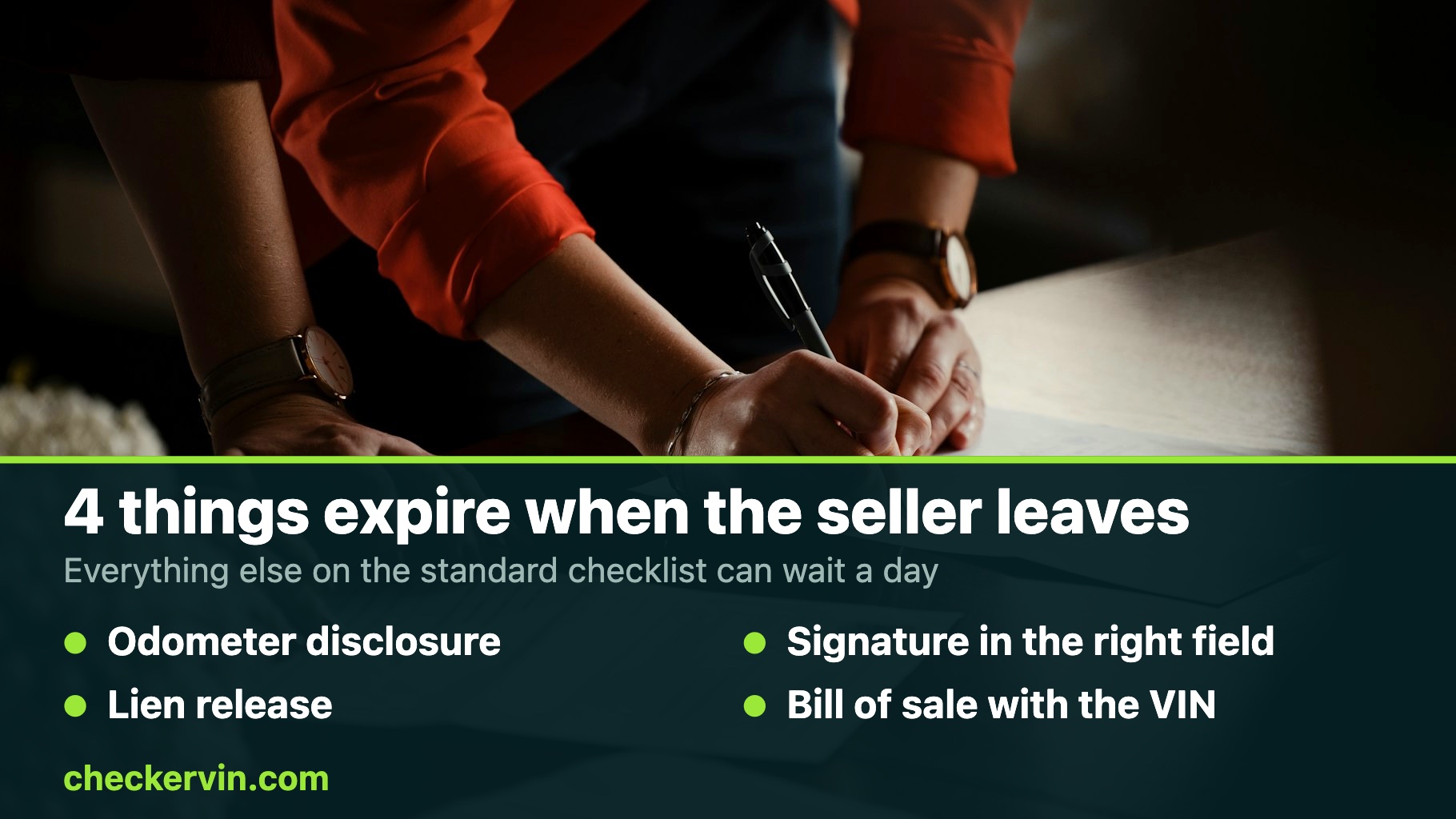
- Anything that needs the seller: the odometer disclosure, the signature, the lien release, the bill of sale. Everything else can wait a day.
- What can wait safely?
- Registration and inspection sit on a state clock with penalties but no cliff. The recall repair has no deadline at all — it follows the vehicle.
- Can I undo the purchase?
- Assume not. There is no general cooling-off right on a vehicle sale, which is why the sequence below matters.
4
Items that need the seller
And expire when they leave
At transfer
When mileage is disclosed
Federal rule, not a later filing
No deadline
On the free recall repair
It runs with the vehicle
State
Who sets the registration clock
Ask your own agency, not an article
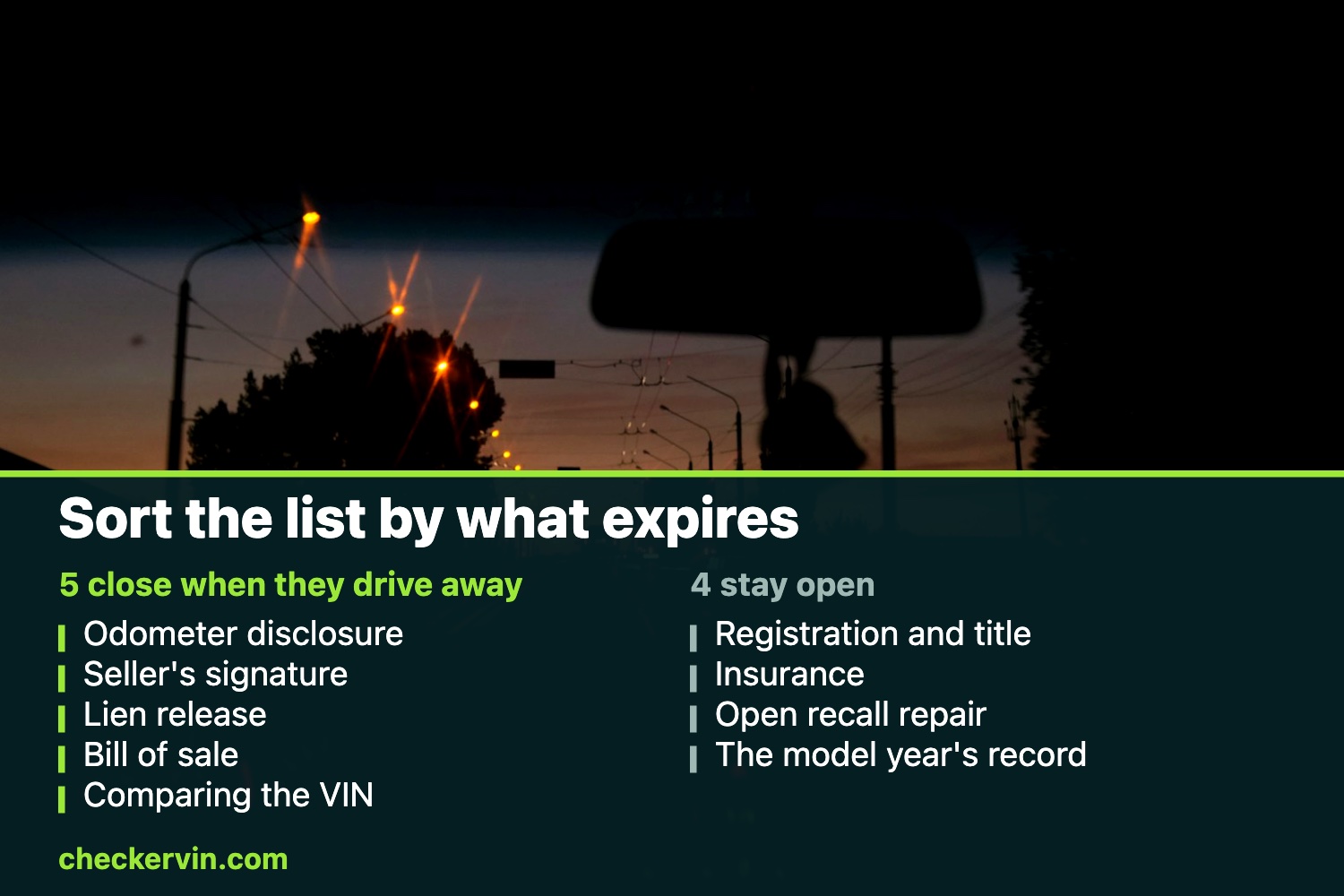
Sort the list by what expires, not by what feels urgent
Every guide to this subject is organized around the motor vehicle office, because that is the visible destination. It produces a list where transferring the title and buying insurance sit at the top and the paperwork you needed ten minutes ago is not mentioned at all — since by the time anyone writes the list, the transaction is already assumed to be complete.
A more useful sort is by reversibility. Some of this can be done any time. Some of it requires a specific person to be standing next to you, and that person is about to drive away in a car you paid for. Those items are not more important because they are more difficult; they are more important because there is no second attempt.
What closes, and what stays open
| The item | Does the window close? |
|---|---|
| Odometer disclosure on the title | Closes. It is made by the transferor at the moment of transfer — there is no later |
| Seller's signature in the right place | Closes. Chasing a signature from someone who has been paid is a different task |
| Lien release from the lender | Closes in practice. The seller has the relationship with the lender; you do not |
| Bill of sale with the VIN on it | Closes. Nobody writes one a week later |
| Comparing the VIN across the car | Closes when the car is yours — after that a mismatch is your problem |
| Registration and title transfer | Open, but on a state clock with penalties |
| Insurance | Open, and should be immediate for other reasons |
| Open recall repair | Open. The obligation runs with the vehicle, not with the owner |
| Reading the model year's complaint record | Open. Useful before, still useful after |
Five of the nine close. Only one of those five appears on a typical post-purchase checklist, which is a reasonable summary of why people end up at a counter holding a document nobody will accept.
The disclosure that cannot be obtained later
Federal odometer law is unusual in that it attaches to a moment rather than to a filing period. A transferor — any person who transfers ownership of a motor vehicle by sale, gift, or any means other than the creation of a security interest, and any agent signing for them — states the mileage in connection with the transfer of ownership.
The form carries its own warning in the prescribed text: federal law, and state law where applicable, requires the mileage to be stated in connection with the transfer of ownership, and failure to complete it or providing a false statement may result in fines or imprisonment. That warning is doing work. It is the reason a completed disclosure is worth something, and the reason a seller who has already been paid has no appetite for signing one afterward.
When no disclosure is owed at all
Worth knowing before you demand something the seller does not owe. The requirement is subject to exemptions, and one of them turns on model year in a way that catches a lot of ordinary used cars.
- Vehicles of model year 2010 and earlier: exempt once transferred at least ten years after January 1 of their model year — which now means all of them.
- Vehicles of model year 2011 and later: still covered, for twenty years from January 1 of the model year.
- Any vehicle rated above 16,000 pounds gross vehicle weight.
- Anything not self-propelled, which covers a towed trailer.
So on an older car there may be nothing to secure, and knowing that saves an argument. On a 2011-or-newer vehicle there is, and it is worth the two minutes at the curb. The detail of that cliff, and why it exists, sits on our page about buying a car out of state, where the same disclosure is one of only two records that cross a state line.
Signature, lien and the bill of sale
- 1The signature, in the correct placeTitles have designated fields and a signature in the wrong one can invalidate the transfer. Read the field labels before either of you writes anything, and do not accept a title signed by someone who is not present — a title signed by an absent prior owner is the classic setup for a transfer that cannot be completed.
- 2The lien release, if there ever was oneIf a lender was recorded against the vehicle, you need documentary evidence that the interest is discharged. The seller has the relationship with that lender and you do not, so this is the single item where waiting costs the most. A lien that survives the sale sits ahead of your ownership.
- 3A bill of sale carrying the VINDate, price, both names, and the vehicle identification number written out. It establishes when your registration clock started and it is the document that makes everything else provable.
- 4One last VIN comparisonDash plate, door jamb and the paperwork, read against each other while the seller is still there. After the handover, a disagreement between them stops being a question you can ask and becomes a problem you own.
Week one: the state clock
Now the errands, which are real but forgiving. Registration and title transfer run on a deadline set by your state, and the deadlines genuinely differ — some count business days rather than calendar days, some treat a new resident differently from a buyer, and the penalties for missing them range from trivial to a fixed additional charge that is not trivial at all.
We are not going to print a number here, because it would be wrong for most readers. Get it from your own state’s motor vehicle agency, and start counting from the date on the bill of sale rather than from the day you got around to it. Insurance should be in place before you drive the car regardless of what the registration deadline says.
How to check whether the title transfer actually completed
Handing over the paperwork is not the same as the transfer being recorded, and the gap between the two is where a surprising number of purchases quietly sit. The authoritative answer belongs to your own state, because titling is a state act — but there is a federal cross-check most buyers never hear about, and it answers a slightly different question that is often more useful.
Under 28 CFR § 25.53(b), the national title system must let a user establish, instantly and reliably, the validity and status of a document purporting to be a certificate of title and whether an automobile bearing a known VIN is titled in a particular state. The consumer report built on it carries the current state of title and the last title date.
- 1Ask your own state first — it is the only authority on your transferYour motor vehicle agency holds the application you filed and its status. Bring the VIN, the date on the bill of sale and whatever receipt you were given when you lodged it. This is the answer; everything below is corroboration.
- 2Read the last title date on the federal recordIf the record still shows a title issued before your purchase, in the seller's state, the transfer has not landed. That is a different and more useful signal than 'my new title has not arrived in the post yet', because it tells you whether anything was recorded at all.
- 3Check which state the vehicle is titled inBuying across a state line makes this worth confirming explicitly. A vehicle still recorded as titled in the state you bought it from, weeks after you filed at home, is a transfer that has stalled somewhere rather than one in transit.
- 4Keep the dated bill of sale where you can find itAlmost every remedy for a stalled transfer starts by establishing when you bought the car, because that is what the state's own deadline runs from.
Why a transfer stalls, in order of how often
When a title transfer does not complete, it is nearly always one of a short list of causes — and each has a different fix, which is why identifying which one you have matters more than resubmitting the same paperwork.
| What went wrong | What it looks like, and where it is covered |
|---|---|
| The seller was not the recorded owner | The name on the title is somebody else and the state will not record a transfer from a person who never held it — see our page on title jumping |
| A lien was never released | A lender still holds an interest recorded against the vehicle, so the state has an encumbrance to clear before it can issue to you |
| The odometer disclosure was missing or wrong | The statement is made at the transfer by the transferor, and a defective one can send the whole application back |
| An inspection or emissions certificate was required | Several states condition registration, and sometimes titling, on a current test — whether yours does is a state question, and our smog check history page covers where those records live |
| The signature was in the wrong field | Titles have designated spaces and a signature in the wrong one can invalidate the assignment outright |
| The deadline passed | The clock runs from the purchase date on your bill of sale, and late filing adds penalties in most states rather than voiding the transfer |
Notice how many of them are decided at the curb rather than at the counter. Four of the six were fixable in the ten minutes before the seller left and are considerably harder afterward, which is the argument this whole page is built on.
Why an unfinished transfer means somebody else gets your recall letter
Here is the reason the two halves of this page belong together, and it is the argument for filing promptly that nobody makes. The paperwork is not only about proving you own the car. It decides who the manufacturer writes to when something is found to be wrong with it.
Under 49 CFR § 577.7, a vehicle manufacturer must send a recall notification by first class mail to each person who is registered under State law as the owner of the vehicle, where the name and address are reasonably ascertainable through state records or other sources available to it. Only where the owner cannot reasonably be ascertained does the manufacturer fall back to notifying the most recent purchaser it knows about — which, on a car that has just changed hands privately, is very often the person who sold it to you.
The timing makes it sharper. The same section requires the notification to be furnished no later than 60 days from the date the manufacturer files its defect or noncompliance report, and requires a second notification within a reasonable time if the remedy was not available when the first went out. A transfer left sitting for a couple of months is long enough to miss a campaign opening and its follow-up.
Two practical consequences. File the transfer early rather than at the deadline, for a reason that has nothing to do with penalties. And because no notification system is perfect even when the record is right, run the free recall lookup on the VIN yourself rather than waiting for post — it is the same check whoever the envelope was addressed to.
The repair that follows the car, not the owner
Run the free recall lookup on your new VIN. If a campaign is open, the remedy is performed without charge by a franchised dealer, and it does not matter that the campaign was announced under a previous owner — the obligation attaches to the vehicle.
This is the one item on the list with no clock on it at all, which is exactly why it gets forgotten. In the NHTSA extract behind our model pages there are 613 campaigns across 73model years of mainstream cars, crossovers and trucks, so finding one is unremarkable. Book it, and note that the free-repair obligation does have an outer limit measured from the vehicle’s first sale.
If you already paid for a repair that turns out to be a recall
This one arrives late and is worth knowing in advance, because it is the rare case where money already spent can come back. A fault gets diagnosed, you pay a shop to fix it, and weeks or months later the manufacturer announces a recall covering exactly that component.
Federal law anticipates it. Under 49 U.S.C. § 30120(d), a manufacturer’s remedy program shall include a plan for reimbursing an owner or purchaser who incurred the cost of the remedy within a reasonable time in advance ofthe manufacturer’s notification. Reimbursement is not a goodwill gesture the manufacturer may offer; the plan is a required part of the remedy program.
So keep service invoices for the first year in the same folder as the title and the bill of sale, particularly for anything on a component the model year’s complaint record already flags. A recall arriving after your repair is far more common on a vehicle whose owners were reporting the fault in numbers, which is exactly the pattern that record shows you.
Month one: learning what you bought
- Read the model year's complaint record rather than the nameplate's — a single year of an otherwise good model can be the outlier.
- Identify which component that model year draws the most reports on, and have it looked at specifically at the first service.
- Work out what factory coverage is left, measured from the in-service date rather than the model year.
- Establish which mileage-specified services have and have not been done, and get the ones that are overdue.
- Keep the bill of sale, the title copy, the odometer disclosure and the recall paperwork together — that folder is what you hand the next buyer.
The last one is not housekeeping. Everything this page tells you to secure at the curb is something a future buyer will want from you, and the seller who has it is the seller who gets asked fewer questions.
Where this information comes from
- 49 CFR Part 580 — odometer disclosure requirementsThe transferor definition, the prescribed statement and its warning, and the § 580.17 exemptions
- 49 U.S.C. § 30120 — remedies for defects and noncomplianceSubsection (d): the remedy program must include a plan for reimbursing an owner who paid for the remedy in advance of notification
- 49 CFR Part 577 — defect and noncompliance notification§ 577.7 on the 60-day deadline and on mailing to each person registered under State law as the owner, falling back to the most recent known purchaser
- NHTSA recall lookupOpen campaigns against your new VIN, free, with no deadline to use it
- FTC — Dealer's Guide to the Used Car RuleWhat a dealer must have given you, and why a private seller owes none of it
- 28 CFR § 25.53 — responsibilities of the operator of NMVTISSubsection (b): the system must establish the validity and status of a document purporting to be a certificate of title, and whether a VIN is titled in a particular state
- NMVTIS — consumer information and approved providersThe federal title record, if you did not buy one before the purchase
Keep reading
Frequently asked questions
What should I do immediately after buying a used car?
Before the seller leaves, secure the things that cannot be obtained afterward: the odometer disclosure completed on the title, the seller's signature in the correct place, a lien release if there was a lender, and a bill of sale carrying the VIN. Registration, insurance and inspection can all be done later in the week. Paperwork from a person who has already been paid cannot.
Why does the odometer disclosure matter so much?
Because federal law places it at the transfer itself. The transferor states the mileage in connection with the transfer of ownership, on a form carrying a printed warning that a false statement may result in fines or imprisonment. It is not a document that gets issued later — it is the record of that specific moment, and a missing one is a gap in the car's mileage history forever.
What if the car has an open recall?
This one is genuinely not urgent in the paperwork sense, because the remedy obligation runs with the vehicle rather than with whoever owned it when the campaign was announced. Book it whenever suits you. It is worth checking early anyway: the extract behind our model pages holds 613 campaigns across 73 model years, so encountering one is ordinary rather than rare.
How long do I have to register the car?
That is a state question with real penalties attached, and the deadlines genuinely differ — some states count business days, some count calendar days, and some treat a new resident differently from a buyer. Get the number from your own state's motor vehicle agency rather than from any article, and start the clock from the purchase date on the bill of sale.
Can I return a used car after buying it?
Usually not, and the widespread belief in a cooling-off period is the single most expensive misunderstanding in private vehicle sales. Assume the sale is final unless something in writing says otherwise, which is precisely why the checks belong before the money and the paperwork belongs before the seller leaves.
Start the folder with a free decode
Decode any VIN free for the factory build, specifications and open safety recalls. No account, no card. Full vehicle history reports are launching soon.
Run a free VIN check