The short answer
- What is myCARFAX?
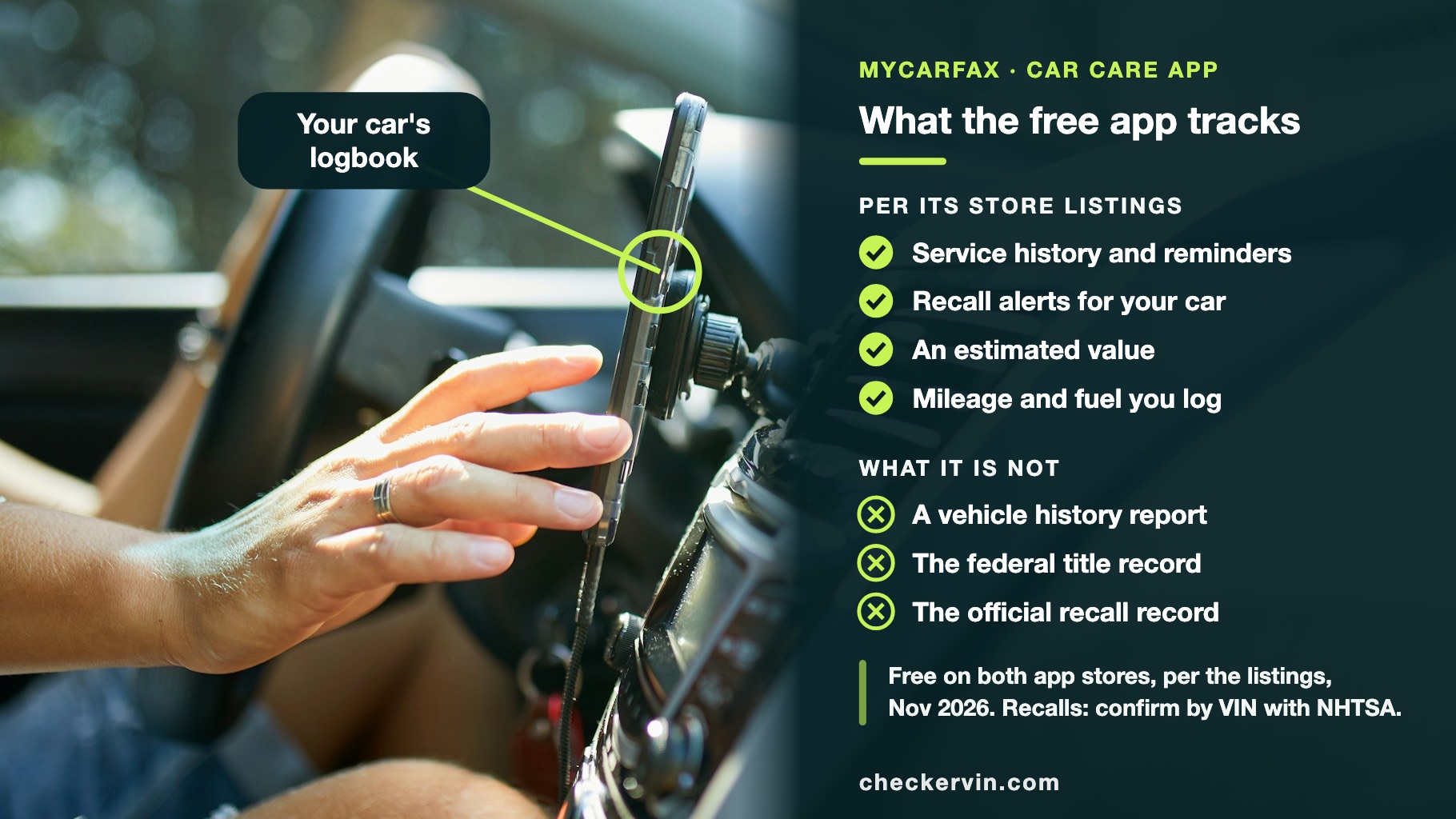
- The older name for Carfax Car Care, a free app from CARFAX, Inc. that logs maintenance, sends service reminders and recall alerts, and shows an estimated value for cars you own.
- Is it free?
- Yes, both app stores list it as free. Carfax history reports are a separate, paid product unless a dealer provides one.
- Is its recall alert official?
- No. The official recall record for a VIN is NHTSA's lookup. Use the app's alert as a reminder and confirm open recalls by VIN.
Free
Price on both app stores
App only; reports are separate
2012
First App Store release
14 years of listings
53M+
Car Care consumers
Per a 2026 SEC filing, as of December 31, 2025
NHTSA
The official recall record
Free by VIN, no account
myCARFAX and Carfax Car Care: one app, two names
If you are looking for myCARFAX, the app you will find is called CARFAX Car Care. On Google Play it appears as “CARFAX Car Care App”, and its Android package identifier is still com.carfax.mycarfax. That leftover name is why searches for “my carfax” and “carfax car care” land in the same place. Both listings name CARFAX, Inc. as the developer.
Apple’s record shows the iPhone app first released on August 22, 2012, and a Carfax press release of August 7, 2025 also dates the launch to 2012. The iPhone version we read was 5.11, updated November 17, 2026; the Android listing was last updated October 29, 2026. Apple files it under Lifestyle, Google under Auto & Vehicles, and the iPhone build needs iOS 17.0 or later.
Ownership changed recently. Carfax press releases into March 2026 described the company as part of S&P Global Mobility. S&P Global’s 8-K says the separation of Mobility Global Inc. was completed on July 1, 2026, and Mobility Global’s own quarterly report now lists CARFAX as one of its two business segments. The app and the brand did not change hands to anyone new; the parent company did.
Is myCARFAX free, and how does a free app pay for itself?
The app is free. The App Store price field reads “Free”, the Google Play listing opens with “the free CARFAX Car Care app”, and Carfax’s August 2025 release says anyone can download it for free. Neither listing carries an in-app purchase label.
What the app does not include is a Carfax vehicle history report. Those remain a separate product, sold to consumers as single reports and multi-report packages, and often handed to shoppers free because a dealer subscribes. Our free Carfax report guide covers the legitimate ways to get one without paying.
So where is the money? Mobility Global’s 10-Q is direct about the role the app plays. It calls Car Care a digital engagement point that surfaces “what service is needed, when, and likely cost estimates ahead of choosing a dealer or aftermarket shop”, and it says the CARFAX segment’s revenue is driven mainly by dealer subscription products. In plain terms, the app keeps owners in front of service businesses. That is not sinister, but it explains why the app nudges you toward shops and trade-in offers.
What the store listings say the Carfax Car Care app does
Both listings print the same six feature headings. Below, each promise is summarized, followed by what it means once you rely on it.
| Feature, as listed | What it promises, and what that means in practice |
|---|---|
| A customized dashboard | When oil, tires, filters and inspections are due, plus the car's estimated value. Reminders are only as good as the mileage the app knows; the value is an estimate, not an appraisal. |
| Service alerts | View the car's service history and get reminded when maintenance is due. History shows what reached Carfax or what you typed in yourself. |
| Repair cost estimates | What you should expect to pay for maintenance and repairs. A guide price, not a quote from the shop that will do the work. |
| Trusted service centers | Ratings and reviews of auto shops nearby. Shop discovery, which is also how the app connects drivers to service businesses. |
| Safety recalls | A notification if a recall is issued on your vehicle. A convenience alert; NHTSA's VIN lookup remains the official record. |
| Mileage and fuel tracking | Update the odometer and track fuel efficiency. Readings you enter are your own log, not a verified odometer record. |
The iPhone listing adds a seventh line about trading in your car or shopping for a new one at a dealership. None of the features is unusual on its own; the value is having them in one place, keyed to your VIN, without paying.
Where the Carfax service history in the app comes from
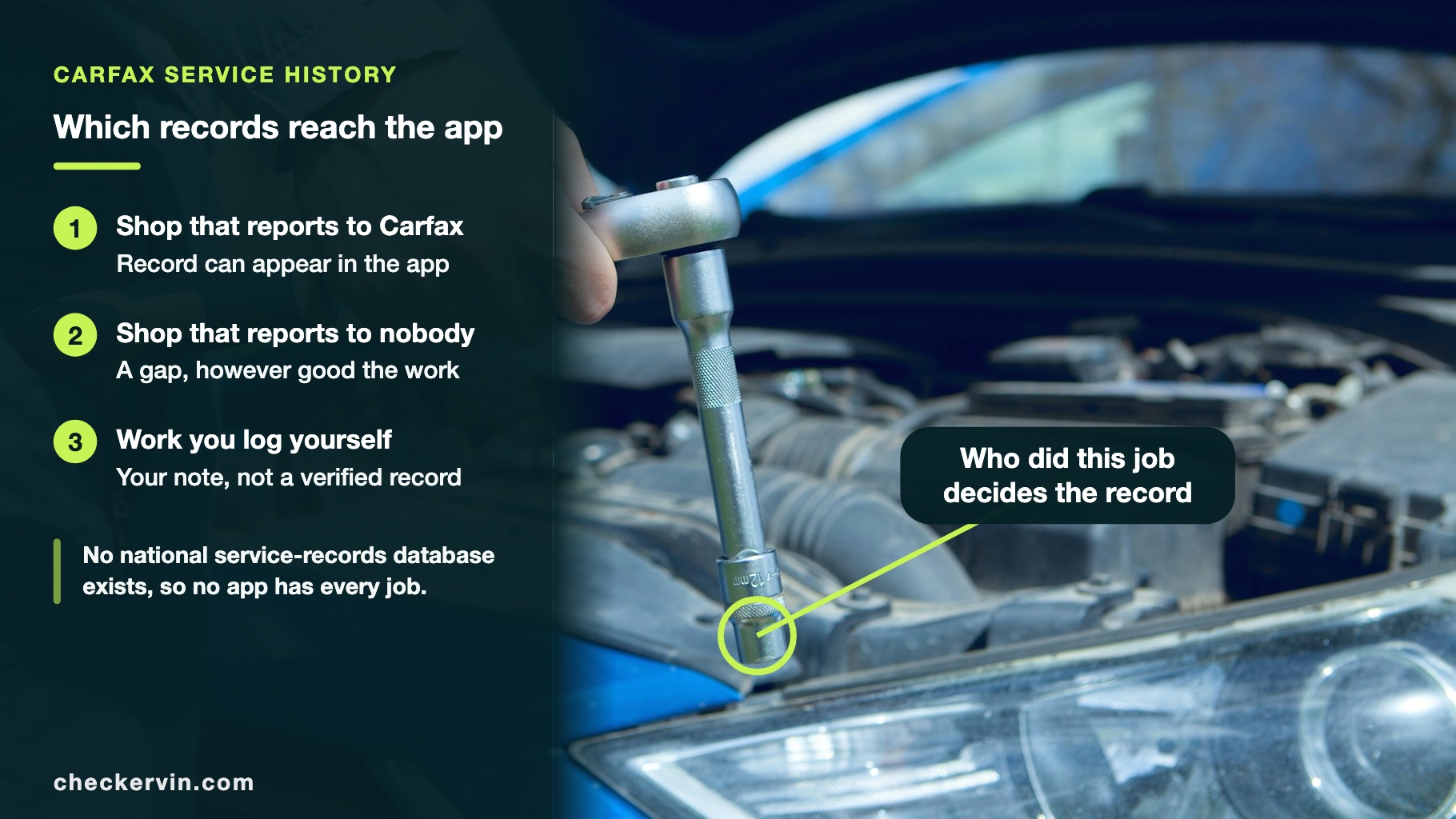
“View your car’s service history” is the feature most owners install the app for, and it is the one most worth understanding. The listing does not say where the records come from, and carfax.com would not load for us, so we cannot quote Carfax on its shop network. What we can say from how the product is built: the history you see is made of service records that have reached Carfax from businesses that report to it, plus whatever you add by hand.
That makes Carfax service history uneven by design. A car serviced at reporting dealers and chains can show years of oil changes. The same car maintained by an independent shop that reports to nobody, or by an owner in a driveway, shows gaps that say nothing about how well it was kept. Our vehicle maintenance report guide explains why no complete service history by VIN exists anywhere: there is no national database and no federal duty to report a repair.
Carfax recall alerts vs. the official recall check by VIN
The listing’s promise is short: get notified if a recall is issued on your vehicle. For an owner, that reminder has real value, because unrepaired recalls usually stay unrepaired through simple inertia. Carfax’s March 2026 release also points readers to the Car Care app for maintenance reminders alongside recall checking.
But a Carfax recall alert is a second-hand copy of a government record. The authoritative source for whether a specific car has an open recall is NHTSA, which takes a 17-character VIN and reports recalls left unrepaired on that vehicle, free and without an account. NHTSA also publishes its own SaferCar app. Its App Store listing, under the seller name National Highway Traffic Safety Administration, says it lets you enter a VIN for each vehicle you own and opt in to recall notifications.
| Question | Carfax Car Care app vs. NHTSA (lookup or SaferCar app) |
|---|---|
| Who publishes it | CARFAX, Inc. vs. the federal safety regulator |
| Covers a car you don't own yet | Car Care: no, only cars in your account. NHTSA lookup: yes, any VIN, any time |
| Account | Car Care: yes (email address and user ID declared). NHTSA lookup: none |
| Is it the official record | Car Care: no. NHTSA: yes |
| Also tracks maintenance | Car Care: yes. NHTSA: no |
For a buyer, the comparison settles itself: the car is not in your Car Care garage yet, so a Carfax recall check through the app is not available to you. Run the VIN through our free recall check by VIN, which reads NHTSA data, or through NHTSA directly.
What data the Carfax Car Care app collects, per its privacy labels
Each store makes developers declare their data practices. These are Carfax’s own declarations as shown on November 25, 2026. Apple prints a note that it has not verified them, and Google says developers may update them over time.
| Apple App Store: App Privacy | Declared by the developer |
|---|---|
| Data used to track you | Identifiers |
| Data linked to you | Contact info (email address, name), user content (photos or videos, other user content), identifiers (user ID, device ID) |
| Linked-data purposes listed | Third-party advertising, analytics, app functionality, customer support |
| Data not linked to you | Precise location, product interaction, crash data and other diagnostics |
| Google Play: Data safety | Declared by the developer |
|---|---|
| Data shared with third parties | None declared (“The developer says this app doesn't share user data with other companies or organizations”) |
| Data collected | Email address and user IDs; app interactions; crash logs; photos (optional); files and docs (optional) |
| Security practices | Data encrypted in transit; you can request that data be deleted |
The two labels do not read the same. The Apple label lists identifiers used to track you across other companies’ apps and websites and names third-party advertising as a purpose. The Google label declares no sharing with third parties. The two stores use different categories and definitions, so the gap may be one of wording rather than practice. We could not read Carfax’s privacy policy to settle it, because the page was blocked.
How many people use it? Three numbers, three sources
You will see different user counts for the same app, and none of them is wrong so much as differently counted. Here is each one with where it was printed.
| Figure | Where it appears, and when |
|---|---|
| Join 50 million+ drivers | App Store listing description, read November 25, 2026 |
| Join 30 million+ drivers | Google Play listing description, read November 25, 2026 |
| more than 50 million car owners | Carfax press release counting app and online users, August 7, 2025 |
| over 53 million consumers | Mobility Global 10-Q for the quarter ended September 30, 2026, as of December 31, 2025 |
The press release counts people who used Car Care through the app and online, which is why it runs higher than the Android listing alone. None of these counts is an audited active-user figure, and none says how many of those cars have a complete service record.
What the Car Care app is not
It is not a vehicle history report. It does not show the title brands, accident records or ownership history a paid report sells, and it is not a way into the federal title database either. The Department of Justice, which runs the NMVTIS provider program, puts it plainly on its list of approved providers:
So nothing in a Carfax account, app or report gives a private buyer the NMVTIS record. That comes from one of the 12businesses the department lists for public customers. The difference between Carfax’s own data and the federal record is covered in depth in our Carfax review, and how often its records miss events in is Carfax accurate.
Buying a car: what a seller's myCARFAX history proves
Private sellers sometimes show their Car Care screen as proof of maintenance. It can be good evidence. It can also be a list the seller typed in last week. Treat it like any logbook: valuable where it can be corroborated, weightless where it can’t.
- 1Ask which entries came from a shopA record a reporting shop sent in carries the shop's name and date. An owner entry is a note. Ask the seller to tell you which is which, then ask for the paper receipts behind the important ones.
- 2Check that mileage only goes upDates and odometer readings should climb together. A reading lower than the one before it is either a typo or something to investigate before you go further.
- 3Look for the big intervalsTiming belt, transmission fluid and coolant services matter more than oil changes. Their absence from the app may just mean an independent shop did them, so ask.
- 4Run the VIN yourselfOpen recalls and the remaining factory warranty come from the VIN, not from the seller's phone. Take the VIN off the car, not off the listing.
- 5Get the title record and an inspectionThe federal NMVTIS record from a DOJ-listed provider covers title brands. An independent pre-purchase inspection covers what no record holds.
Getting the most from Car Care as an owner
If you own the car, the app earns its place. The habits below keep the record useful, for you now and for the person you sell to later.
- Add work done at independent shops yourself, with the date and mileage
- Photograph receipts and keep them outside the app as well
- Treat the estimated value as a starting point, not a sale price
- Confirm any recall alert by VIN on NHTSA before booking the repair
- Check your factory warranty end date before paying for a covered repair
- Decide on tracking and data-deletion settings when you install, not later
Safety recall repairs are done free at a franchised dealer, and covered warranty work is free while coverage lasts, so knowing both before a service visit can save real money. Our VIN warranty check explains how the in-service date sets the clock.
Check recalls and warranty by VIN now, free
The app needs the car in your garage. A VIN check doesn’t. Enter any VIN below and CheckerVIN returns, free:
- Factory build and specifications decoded from the VIN
- Factory warranty terms
- Open NHTSA safety recalls
- Photos filed against the VIN
- Market and listing prices
Check recalls and warranty free
Decoded from official manufacturer and NHTSA records
Where this information comes from
- Apple App Store — CARFAX Car CareListing description, release history, price field and the developer-declared App Privacy labels, read November 2026
- Google Play — CARFAX Car Care AppListing description, update date and the Data safety declarations, read November 2026
- Carfax press release — 50 million Car Care users (PR Newswire, Aug. 7, 2025)Launch year, user count and the statement that the app is free
- Carfax press release — free recall search service (PR Newswire, Mar. 2, 2026)Car Care maintenance reminders and the S&P Global Mobility boilerplate at that date
- Mobility Global Inc. — Form 10-Q, quarter ended September 30, 2026 (SEC)The CARFAX segment, its revenue drivers and the Car Care consumer count
- S&P Global Inc. — Form 8-K filed July 2, 2026 (SEC)Completion of the Mobility Global separation on July 1, 2026
- NMVTIS — approved data providersThe DOJ statement that consumers cannot get NMVTIS reports from Carfax, and the public provider list
- NHTSA recall lookupThe official recall record by VIN
- Apple App Store — SaferCar (NHTSA)NHTSA's own app for VIN-based recall notifications
- How we made this pageWritten by the CarCheckerVIN editorial team with AI assistance from the Carfax Car Care app store listings, Carfax press releases, SEC filings by S&P Global and Mobility Global, the Department of Justice NMVTIS list and NHTSA; carfax.com blocked our requests and is not a source; facts checked November 2026.
Keep reading
Frequently asked questions
Is myCARFAX free?
Yes. Both the App Store and Google Play list the CARFAX Car Care app as free to download, and Carfax's own press releases call it the free CARFAX Car Care app. The app is not a vehicle history report, though. Carfax history reports are a separate product sold as single reports and multi-report packages, or provided free when a dealer pays for one.
Is myCARFAX the same as the Carfax Car Care app?
They are the same service. The app is listed today as CARFAX Car Care (CARFAX Car Care App on Google Play), but its Android package identifier is still com.carfax.mycarfax, which is why many owners still search for it as myCARFAX. Both store listings name CARFAX, Inc. as the developer.
Does the Carfax Car Care app send recall alerts?
Its store listings say it will notify you if a recall is issued on your vehicle. Treat that as a convenience. The authoritative answer for a specific car is NHTSA's recall lookup by VIN, and NHTSA's own SaferCar app can also notify you about recalls for each VIN you save in it.
What is the best way to do a Carfax recall check on a car I'm buying?
Run the VIN through NHTSA's free lookup, which reports recalls left unrepaired on that specific vehicle, or through our free recall check, which reads NHTSA data. A recall alert inside an owner app only covers cars that owner has added, so as a buyer you cannot see it, and it is not the official record anyway.
Does Carfax have my car's full service history?
Probably not all of it. The Car Care app shows service history that has reached Carfax plus anything you enter yourself. Work done at shops that do not report to Carfax, or done in your driveway, is missing unless you add it. There is no national service-records database and no federal duty for shops to report repairs anywhere.
What personal data does the Carfax Car Care app collect?
On the App Store, Carfax declares that identifiers may be used to track you, and that contact info, user content and identifiers may be linked to you, including for third-party advertising and analytics. On Google Play it declares email address, user IDs, app interactions, crash logs and optional photos and files, with no data shared with third parties. Both are developer statements; Apple notes it has not verified them.
Should I trust a seller's myCARFAX service records?
Use them as a starting point. Records that came from a reporting shop are useful evidence that work was done; entries the owner typed in are only as good as the receipts behind them. Ask for the receipts, check that dates and mileage climb in order, run the VIN for open recalls and the federal title record, and get an independent inspection.
The app tracks your car. Check any car by VIN.
Decode any VIN free for the factory build, specifications, warranty and open safety recalls. Full vehicle history reports are launching soon.
Run a free VIN check