The short answer
- What does Enterprise promise?
- A 7-day or 1,000-mile buyback, less a $200 restocking fee; a 12-month, 12,000-mile limited powertrain warranty; 12 months of roadside assistance.
- Are all the cars ex-rentals?
- No. Enterprise's fine print says cars also come from lease fleets, auctions and trade-ins, and may have had rideshare use.
- What should I check myself?
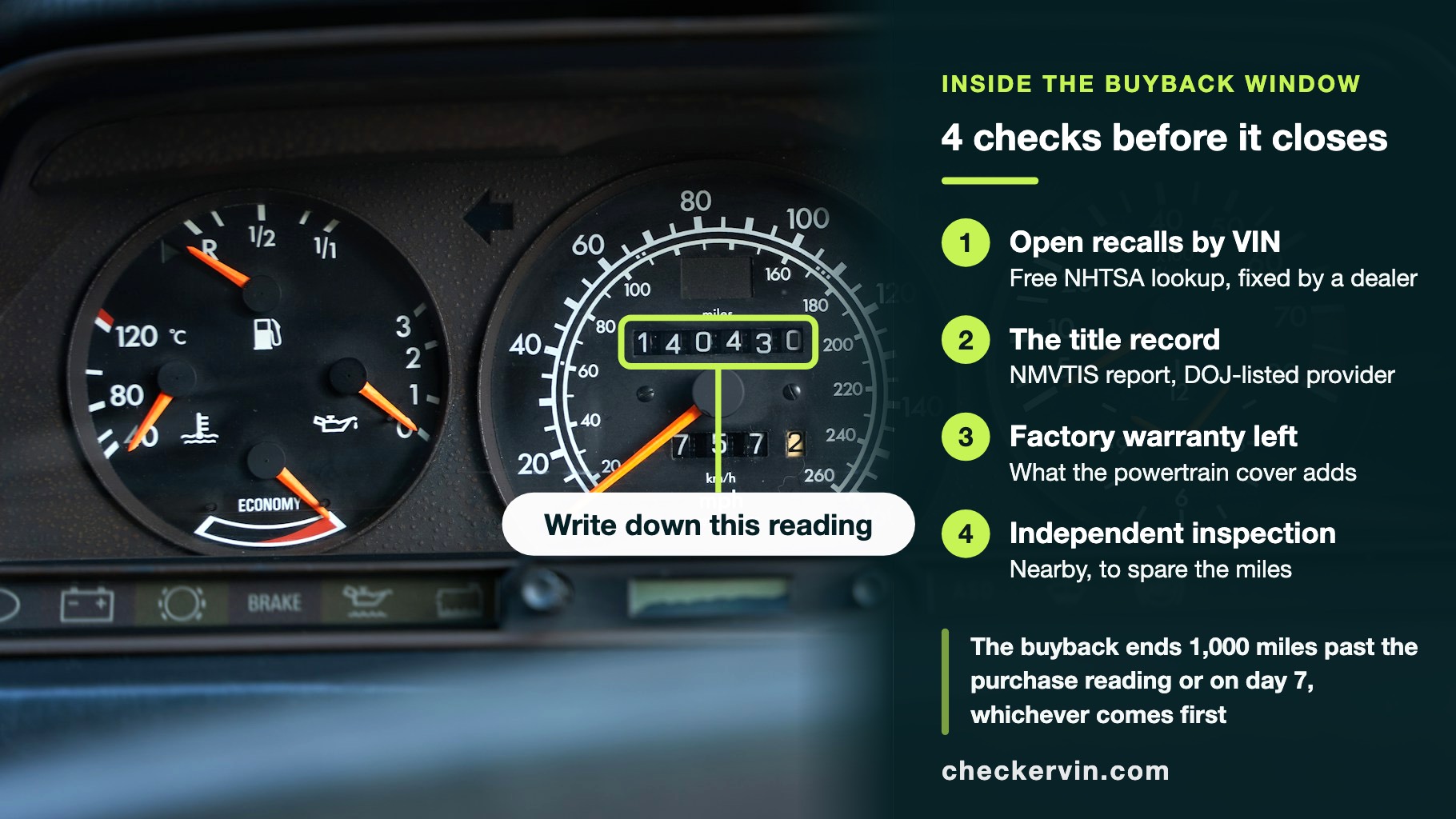
- Inside the seven days: open recalls by VIN, an NMVTIS title report, remaining factory warranty and an independent inspection.
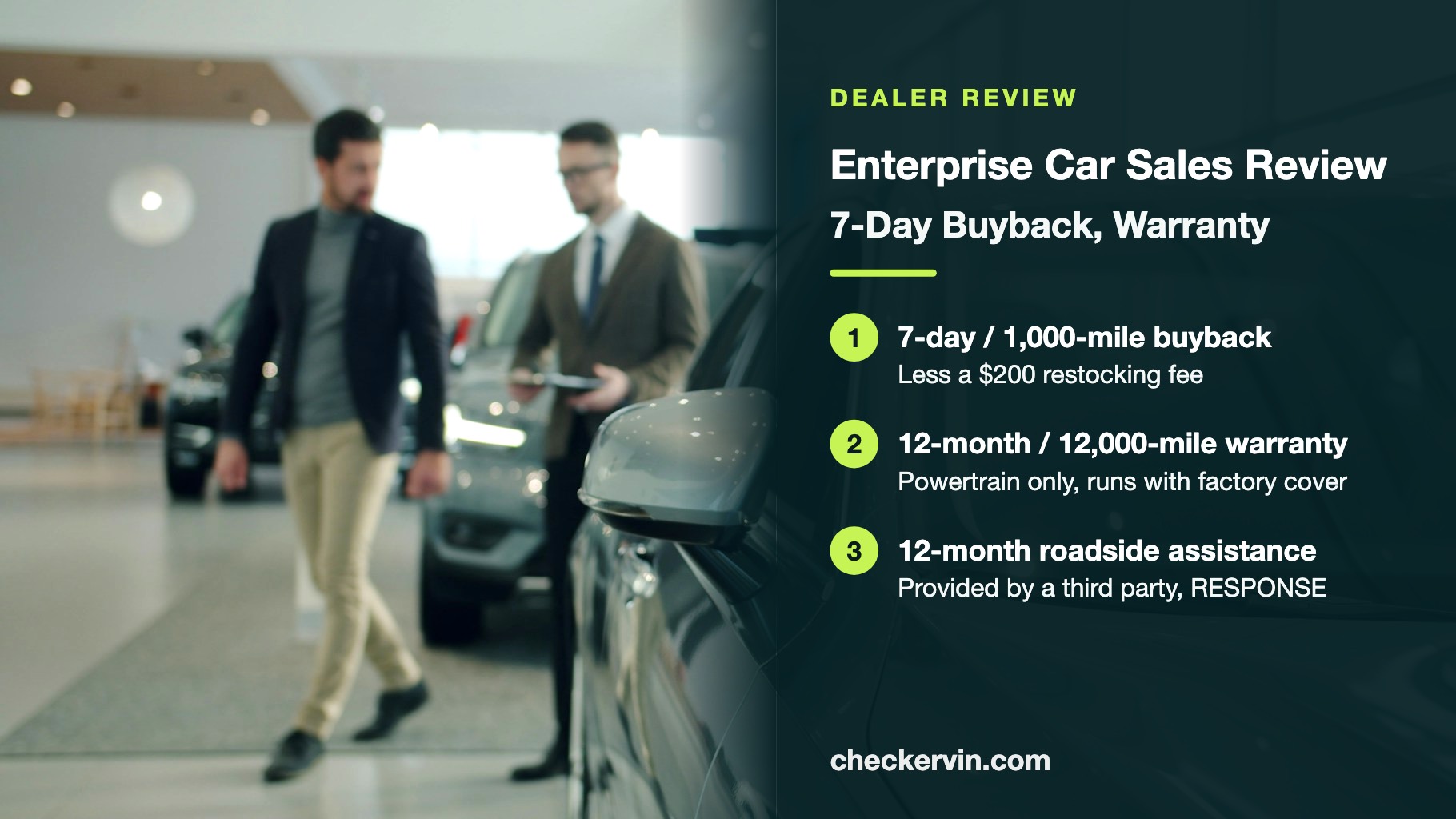
7 days
Buyback window
Or 1,000 miles, less a $200 fee
12 mo
Limited powertrain warranty
Or 12,000 miles, first reached
12 mo
Roadside assistance
Unlimited mileage, per Enterprise
165+
Dealerships
Enterprise's own count, November 2026
Enterprise Car Sales review: the short verdict
Enterprise Car Sales offers more in writing than a typical used-car lot: a buyback window, a short powertrain warranty, a year of roadside help and a plain disclosure that the car may have been a rental, a lease or a rideshare vehicle. Those terms are real and they are written down, which is more than most dealers give you.
They are also narrower than the headline words suggest. The buyback is not free: Enterprise keeps a restocking fee. The warranty covers the powertrain only and runs alongside whatever factory coverage the car already has, so on a young car it may add little. The inspection is the seller’s. And the recall law that makes ex-rentals attractive applies to cars sold out of the rental fleet, not to every car on an Enterprise lot. Treat the seven days as the time to check the car, not the time to decide whether you like it.
Who is behind Enterprise Car Sales
Enterprise Car Sales is the retail used-car arm of Enterprise Mobility, the company behind Enterprise Rent-A-Car. Enterprise Mobility is privately held, so there is no annual report on file with the SEC to read. What it publishes itself is brief:
| Enterprise Mobility, by its own figures | What it says |
|---|---|
| Began | With a small fleet of cars in 1957 |
| Revenue | $42 billion, fiscal 2026 |
| Global fleet | 2.6 million+ vehicles |
| Rental branches | 9,500+, in 95+ countries and territories |
| Ownership | Privately held; the page describes a Taylor family legacy |
| Car sales | Listed among its offerings |
The used-car business itself is smaller and has grown. A February 2021 Enterprise Mobility release put it at 147U.S. locations selling what it called a “wide selection of high-quality inventory of 1-3-year-old cars, SUVs and trucks.” The English used-cars page on enterprise.com now says “more than 165dealerships nationwide.” That scale is the reason its terms are standardized and printed as footnotes, and the reason they are worth reading closely.
Where the cars come from: not only the rental fleet
Most people searching for Enterprise Car Sales assume every car is a retired Enterprise rental. Enterprise’s own disclosure is broader. The unnumbered fine print on its used-cars page says the vehicles were previously part of the Enterprise rental fleet or an affiliated company’s lease fleet, or were purchased by Enterprise from sources including auto auctions, customer trade-ins or other sources. It then lists the possible previous use: rental, lease, transportation network company or other use.
Two things follow. A “transportation network company” is the legal term for a rideshare platform, so a car on the lot may have been driven for ride-hailing; ask. And because the cars come from 5kinds of source, the question “was this one of your rentals?” has a specific answer for each car, which the salesperson should be able to give you. It matters for the recall section below, because the federal rental-recall rule follows the rental fleet, not the dealership.
If you want the wider argument about whether an ex-rental is a sensible purchase at all, and what the law guarantees on one, our guide to buying a used rental carcovers it. This page stays with Enterprise’s own terms.
The Enterprise Car Sales buyback policy, clause by clause
Footnote 3 on Enterprise’s used-cars page sets out the buyback. Read as separate clauses, it says more than the phrase “7-day buyback” does:
| The clause | What it means for you |
|---|---|
| 7 days after the date of purchase | The clock starts the day you buy, not the day you first drive it far |
| Or 1,000 miles beyond the odometer reading at purchase | Note the reading on the day; a long trip to a distant mechanic uses the allowance |
| Whichever comes first | The window can close on miles before day seven |
| The exact price originally paid | A refund of the price, as Enterprise words it |
| Minus a $200 restocking fee | Returning the car is not free |
| As allowed by law; restrictions apply | Conditions exist beyond the footnote; ask for them in writing |
Enterprise’s Spanish-language page describes the same buyback as a no-questions-asked return within seven days and calls the deduction a documentation and cleaning fee rather than a restocking fee. That page is older copy, and the English footnote is the one we treat as current. Either way, the fee figure is Enterprise’s own, printed on its own page; it is not something we could see in a contract.
For scale, CarMax describes a 10-day money-back guarantee (see our CarMax review) and Carvana a seven-day return policy (our Carvana review). None of these is a legal right. The FTC’s three-day cooling-off rule does not cover a car bought at a dealership, which is why the buyback is worth exactly what the footnote says and no more. Our guide can I return a used car? explains that rule.
The 12-month, 12,000-mile limited powertrain warranty
Footnote 1 describes the warranty: a limited powertrain warranty that begins on the vehicle purchase date and extends for 12 months or 12,000 miles, whichever comes first. Then comes the sentence that matters most: coverage runs concurrently with the manufacturer warranty.
“Powertrain” is the engine, transmission and the parts that send power to the wheels. It is not bumper-to-bumper coverage, so electronics, air conditioning, infotainment and most of what goes wrong on a young car sit outside it. “Limited” means exclusions, which are in the warranty document rather than the footnote.
“Concurrently” is the word to think about. Enterprise’s own 2021 release described its stock as 1-3years old. A car that young may still be inside its factory powertrain warranty, and if so the two run side by side rather than one after the other, and the Enterprise warranty adds less than its length suggests. The way to find out is to look up the car’s factory coverage by VIN: our warranty check by VIN explains how, and the free scan below returns factory warranty terms.
Enterprise also sells optional protection products; its 2021 release mentions buyers choosing “financing and protection products” at signing. We could not read the current product list or terms, and we do not print prices for them. As with any service contract, the exclusions list decides what is covered.
The Buyers Guide on the window is part of your contract
Every Enterprise car on a lot should carry a federal Buyers Guide in its window. The FTC’s Used Car Rule applies to dealers that sell more than five used vehicles in a 12-month period, which covers Enterprise many times over. The guide tells you whether the car is sold as is or with a warranty, and the FTC says the information on it is part of the sales contract and takes precedence over conflicting terms in it.
So the Buyers Guide is where the powertrain warranty should appear in writing, with its duration and the systems it covers. If the guide and the salesperson disagree, the guide wins. The same form also tells buyers to ask for an inspection by an independent mechanic before they buy, which, with a buyback window, you can do in the first days after you buy.
Roadside assistance: who actually provides it
Footnote 2 says the Enterprise 12-Month Unlimited Mileage Roadside Assistance Package is provided by RESPONSE, a Florida Entity, and that some limitations and restrictions apply. In other words, Enterprise arranges the cover and a separate company answers the call.
That is normal for roadside programs, but it is worth knowing which number to ring and what counts as a covered event before you need it. On a young car, also check whether the manufacturer’s coverage includes roadside help of its own, so you know which program to call first.
No-haggle pricing, and the price claims around it
Enterprise’s Spanish-language used-cars page describes buying a car without haggling, with its lowest price clearly shown on each vehicle. The Alamo used-car page, which points shoppers to Enterprise Car Sales, says pricing is “clearly posted on every vehicle” and claims that 75% of vehicles available for sale are priced below the Kelley Blue Book Typical Listing Price. That is Enterprise’s claim about its own stock, undated on the page, and we cannot test it.
A posted price removes one source of stress and one source of leverage. What it does not tell you is whether this car, at this mileage and trim, is a good buy. Compare the same model year and mileage at two or three other sellers, and confirm the trim and options from the factory build before you compare, because ex-fleet cars are often plain specifications and a listing can be generous with a trim name. We print no car prices on this page.
The inspection claim: an ASE-certified technician
The enterprise.com used-cars page says every vehicle Enterprise sells has passed a rigorous inspection performed by an ASE-certified technician. The Alamo page says the same thing in shorter words. ASE certification is a real and common credential for mechanics.
It is still the seller inspecting its own stock to its own checklist, and the checklist is not on the pages we could read. In December 2016 the FTC settled charges against three other used-car dealers that, it alleged, touted their inspections without adequately disclosing that some cars had open recalls, which is a reminder that “inspected” and “recall-free” are different claims. A pre-purchase inspection by a mechanic you hire answers to you, and inside the buyback window it can still change the outcome.
Maintenance records: what we could not confirm
A common argument for buying a former rental is that fleets service their cars on a schedule. Enterprise makes claims of this kind on its sales site, and the Alamo page describes rental-fleet cars as “meticulously cared for.” We could not load the Enterprise Car Sales pages that set out what it records or shares, so we cannot tell you whether a buyer receives a service history, or in what form.
The practical answer is to ask for the maintenance record for the specific car, in writing, before signing. A fleet that services on schedule should be able to print it. If the car came from an auction or a trade-in rather than the fleet, the record may not exist at all, and that is worth knowing too. Scheduled servicing, however good, does nothing about a design defect, which is what a recall addresses.
Open recalls on an ex-rental: what the law covers, and what it does not
Federal law treats rental companies more strictly than used-car dealers. Under 49 U.S.C. § 30120(i), once a rental company has been notified of a recall on a vehicle in its possession, it may sell, lease or rent that vehicle only after the defect has been remedied. The rental provisions were added by the Raechel and Jacqueline Houck Safe Rental Car Act of 2015, part of Public Law 114-94, enacted December 4, 2015.
The law carries an Enterprise history. Senate Report 113-253, on an earlier version of the bill, says the Houck sisters were killed in 2004 driving a rental car that had been recalled for a power-steering hose defect and not repaired, and that “Enterprise later conceded that its negligence was the sole proximate cause of the fatal injuries.” The same report says the bill had support from both major and smaller rental companies.
For a buyer, three limits matter more than the history:
- The rule binds the rental company for cars in its own fleet. A car Enterprise bought at auction or took in trade, which its fine print says happens, was never one of its rentals.
- For those non-fleet cars Enterprise sells as any used-car dealer does, and federal law puts no recall-repair duty on used-car dealers.
- The rule applies at the moment of sale. A recall announced after you buy is yours to have fixed at a franchised dealer.
The full mechanics, including the 24-hour deadline and what happens when parts are not yet available, are on our used rental car page, and the position for ordinary used sales is on buying a car with an open recall. The takeaway is short: run the VIN through NHTSA’s recall lookup yourself, on the day you buy, and book any open campaign during the buyback window.
Regulators and the public record
We searched the FTC and the Consumer Financial Protection Bureau, and ran a general search for state attorney general actions, for any enforcement action naming Enterprise Car Sales. In November 2026 those searches turned up none. That is a statement about what we found, not proof that no complaint or case exists; a buyer with a specific concern can search their own state attorney general’s site.
We do not print review-site star ratings. They mix rental and sales experiences under one brand name, they move week to week, and they cannot be checked. The written terms and the checks below can.
Trade-ins, financing and buying online
Enterprise’s February 2021 release described a “Start My Purchase” feature that lets buyers browse stock, see optional protection products, get trade-in estimates and monthly payment estimates, schedule a test drive and apply for financing online, then finish at a location. It said many customers complete the purchase in 45minutes or less. The Alamo page also describes selling or trading in a current vehicle and “turnkey financing options.”
We could not read current financing terms or the lenders involved. A fast signing is convenient; it is also when add-ons get agreed to without much reading. Arrange a loan pre-approval from your own bank or credit union first, get a trade-in offer from at least one other buyer, and keep the price of the car, the trade and the loan as three separate conversations.
The checks to run inside the seven days
The buyback is the most valuable thing on the list, because it turns checks you would normally run before buying into checks you can run after, with a way out. Spend it on what Enterprise’s own promises leave open:
- Open recalls by VIN, through NHTSA's free lookup; book any open campaign at a franchised dealer
- The title record: one NMVTIS report from a provider on the DOJ's list
- Remaining factory warranty by VIN, to see what the Enterprise powertrain cover actually adds
- An independent inspection, close to home so the trip does not eat the mileage allowance
- Prior use in writing: rental, lease, rideshare, auction or trade-in, and the service record if it exists
- The purchase date and odometer reading, so you know exactly when the window closes
A former rental does not show up as such in the federal title record, whose indicators are title, brands, odometer, total loss and salvage. Enterprise’s own disclosure is the best record of prior use you will get, which is why it belongs in your paperwork. For the title record itself, the DOJ names 12 businesses approved to sell NMVTIS reports to the public: Bumper, Carsforsale, CarVertical, CheckThatVIN, ClearVin, EpicVin, GoodCar, TitleCheck, VinAudit, VinData, VinReport, Vinsmart.com. The department says the order is alphabetical and implies no preference. Our how to buy a used car guide puts the whole sequence in order.
Where CarCheckerVIN fits
We do not sell cars, and we do not sell a title report today. Here is what our free scan returns for any VIN, including one on an Enterprise listing:
- Factory build and specifications decoded from the VIN
- Factory warranty terms
- Open NHTSA safety recalls
- Photos filed against the VIN
- Market and listing prices
Two parts of that scan matter on an Enterprise car in particular. The factory warranty terms tell you how much the 12-month powertrain cover overlaps with coverage the car already has, and the factory build confirms the trim and options a fleet car really left the plant with.
Run the free build, warranty and recall check
Decoded from official manufacturer and NHTSA records
Who Enterprise Car Sales suits
It suits a buyer who wants a young car at a posted price, with written terms and a short way out, and who will actually use the seven days. It suits less well someone who reads “former rental” as a guarantee that recalls are cleared, or reads “warranty” as comprehensive coverage. If you want manufacturer-backed coverage instead, compare with a certified program: our certified pre-owned vs used guide sets out the difference.
Where this information comes from
- Enterprise — used cars (English), footnotes 1-3 and fine printBuyback, $200 restocking fee, limited powertrain warranty, roadside provider, ASE inspection claim, sourcing and prior use, 165+ dealerships; retrieved November 26, 2026
- Enterprise — used cars (Spanish)No-haggle wording; names the buyback deduction a documentation and cleaning fee; older copy
- Enterprise Mobility — financial informationFounded 1957, fiscal 2026 revenue, global fleet, branches, private ownership
- Enterprise Mobility release, February 22, 2021147 locations, 1-3-year-old inventory, online trade-in and financing steps
- Alamo — used car salesPosted pricing, the Kelley Blue Book pricing claim, trade-ins and financing
- 49 U.S.C. § 30120 — remedies for defects and noncompliance (Cornell LII)Subsection (i): rental companies may sell only after the recall remedy
- 49 U.S.C. § 30101, notes — short title of 2015 amendment (Cornell LII)Raechel and Jacqueline Houck Safe Rental Car Act of 2015, Pub. L. 114-94, § 24109
- Senate Report 113-253 (govinfo)The 2004 Houck crash and rental-industry support for the bill
- FTC — CarMax and two other dealers settle charges, December 16, 2016Inspection claims and undisclosed open recalls
- FTC — Dealer's Guide to the Used Car RuleWho must post a Buyers Guide, and its effect on the contract
- NMVTIS — approved data providers (DOJ / BJA)Consumer-tier providers; retrieved November 26, 2026
- NHTSA — check for recalls by VINThe free federal recall lookup
- How we made this pageWritten by the CarCheckerVIN editorial team with AI assistance from Enterprise's and Enterprise Mobility's own pages, federal statute, a Senate report, FTC and DOJ records and other public sources; facts checked November 2026. enterprisecarsales.com did not load for us, so its FAQ and policy pages could not be read.
Keep reading
Frequently asked questions
Is it a good idea to buy a car from Enterprise Car Sales?
It can be, if you use what Enterprise gives you. Its cars come with a 7-day, 1,000-mile buyback, a 12-month, 12,000-mile limited powertrain warranty and 12 months of roadside assistance, and its fine print discloses that a car may have been a rental, lease or rideshare vehicle. What it does not give you is an independent inspection, the federal title record or a guarantee that no recall has opened since the car left the fleet. Run those checks inside the seven days.
What is the Enterprise Car Sales buyback policy?
Enterprise's fine print says that for 7 days after purchase or 1,000 miles beyond the odometer reading at purchase, whichever comes first, the car may be returned for the exact price originally paid minus a $200 restocking fee, as allowed by law. Restrictions apply, and Enterprise tells buyers to ask a sales consultant for the details.
What does the Enterprise Car Sales warranty cover?
Enterprise describes a limited powertrain warranty that begins on the purchase date and runs for 12 months or 12,000 miles, whichever comes first, concurrently with the manufacturer's warranty. Powertrain coverage is narrower than bumper-to-bumper coverage, and because it runs alongside the factory warranty, check by VIN how much factory coverage the car still has.
Are Enterprise Car Sales cars all former rentals?
No. Enterprise's own disclosure says its used vehicles were previously part of its rental fleet or an affiliated company's lease fleet, or were bought from auto auctions, customer trade-ins or other sources, with possible previous use including rental, lease, transportation network company or other use. Ask which applies to the car you are looking at.
Can you negotiate at Enterprise Car Sales?
Enterprise's Spanish-language used-cars page describes buying without haggling, with its lowest price shown on each vehicle. We could not load the English sales site to confirm current wording, but the model is a posted price rather than a negotiated one. Your leverage is comparison: the same model and mileage elsewhere, and a financing offer arranged before you visit.
Do Enterprise Car Sales cars have open recalls?
Federal law bars a rental company from selling a car from its fleet with an unremedied recall it has been notified about. That protects the fleet car at the moment of sale, but not a car Enterprise bought at auction or took in trade, and not a recall announced after the sale. Run the VIN through NHTSA's lookup yourself, during the buyback window.
Check the VIN on any Enterprise car
Decode any VIN free for the factory build, warranty, open safety recalls and market prices. Full vehicle history reports are launching soon.
Run a free VIN check