The short answer
- What comes first?
- The VIN decode, before you travel. Free, seconds, and it can end a bad purchase before it costs you a day.
- What is the ordering rule?
- Cheapest and most reversible first. Deposit, payment and signature are last because they are the hardest to undo.
- What does one lookup cover?
- Never everything. Build and recalls are one record; brands, liens and odometer are others. Knowing which is which is the skill.
Free
Everything in the first stage
Before you travel
10 min
The physical checks at the car
No tools, no money
Last
Where deposit and signature belong
Hardest to reverse
140+
Federal instruments cited across this site
Behind these steps
The order that saves the most money
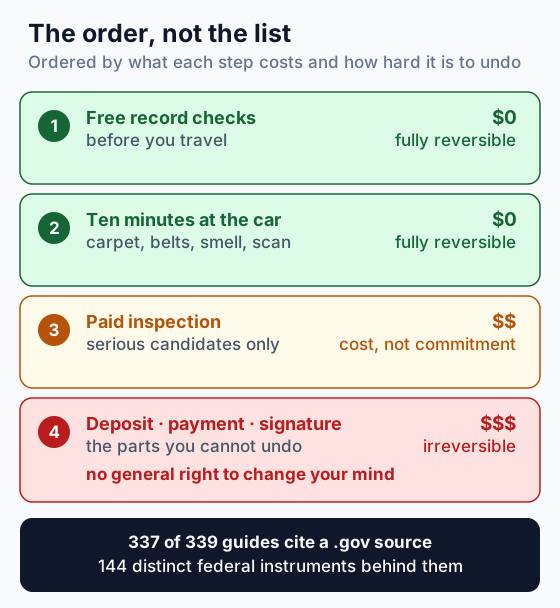
Consider what each step costs and what it can rule out. A VIN decode costs nothing, takes seconds, and can eliminate a car entirely. A round trip to view costs half a day. A paid inspection costs real money. A deposit is awkward to recover. A signature is hardest of all to undo.
Sequencing those by cost and reversibility rather than by convenience is the whole method, and it is why most expensive used-car mistakes are ordering errors rather than knowledge errors. People generally know they should check for a lien. They check after agreeing a price.
Everything free, before you travel
These cost nothing and are done from wherever you are. Each answers a different question, and none of them substitutes for another:
| The check | What it establishes, and where |
|---|---|
| Decode the VIN | Factory build, specifications and open safety recalls. Confirms the listing describes the car it claims to, and surfaces a repair the manufacturer owes you |
| Check for a title brand | Whether a state recorded salvage, flood, lemon or similar. See what is a branded title for why the vocabulary differs by state |
| Check for a lien | Whether somebody else has an interest in the vehicle. This is the one that survives a great many other problems |
| Look at the odometer record | Whether the mileage story is consistent across the documents that recorded it |
| Read the listing against the decode | Trim, engine, drivetrain and body style that do not match the federal record are the cheapest red flag there is |
- Do all of these before you agree to view, not after
- A mismatch between listing and decode ends the conversation at zero cost
- An open recall is not a reason to walk — it is a free repair and a price conversation
- None of these requires the seller's cooperation, which is exactly why they come first
- And none of them tips off a seller that you are checking, which occasionally matters
Run the decode that starts the sequence
Decoded from official manufacturer and NHTSA records
Where the free checks stop, stated plainly
The single most useful thing to understand about vehicle records is that no one lookup covers everything, and services that imply otherwise are selling the implication. Our own decode returns the factory build, specifications and open safety recalls. It does not return title history, ownership chain, odometer records or accident history — those are different records held in different places, and full vehicle history reports are launching soon.
The deeper limit applies to every provider, paid or free: records contain records, not events. A crash that produced no insurance claim produces no entry. Flood damage on an uninsured car frequently produces no brand at all. A clean report is evidence about what was filed, not proof about what happened, which is why the physical stage that follows is not optional.
Reading the listing against the decode
This is the cheapest filter in the whole process and almost nobody runs it. The federal decoder returns what the manufacturer recorded about that VIN. The listing is what the seller typed. Putting the two side by side takes a minute and settles a surprising number of questions before any of them cost you anything.
| What to compare | What a mismatch usually means |
|---|---|
| Trim and series | The most commonly inflated field in a listing. A base car described by a higher trim name is a pricing problem, not always a dishonesty problem — but it is a conversation to have before you travel |
| Engine and cylinders | Where the decode is specific and the listing is vague, the decode wins. Where the decode returns two possibilities, neither of you can settle it from the VIN alone |
| Body class and doors | Rarely wrong, and worth checking precisely because it is rarely wrong — a mismatch here suggests the listing was copied from another vehicle |
| Model year | Model year and date of manufacture are different things, and several federal rules run on the build date rather than the model year |
| Plant and country | Occasionally settles whether a car is the market variant the seller believes it is |
Two cautions so this is used well. A blank field in the decode is not evidence against the listing — the federal record leaves a great many fields empty, and blanks mean the manufacturer did not report that item rather than that the car lacks it. And where the decode itself returns two mutually exclusive options for a field, the VIN cannot settle it, which is a limit of the number rather than a fault in the tool.
What to bring
The list is short, cheap and mostly answers questions that are awkward to answer later. None of it is specialist equipment, and the whole kit costs less than a single hour of a mechanic’s time — which is the trade this sequence is built around.
- A phone with the decode already open, so the listing can be compared at the car rather than from memory
- A cheap scan tool, or the wireless adapter that pairs with a phone — around twenty dollars, and it reads readiness monitors as well as codes
- A flashlight, which is what turns the carpet and underbody checks from a gesture into a check
- Something to write on, because the things you notice in the first five minutes are the ones you forget by the end
- Your own record of what you have already established, so you are only testing what is still open
- And the seller's name and the address you are going to, sent to somebody who is not going with you
What you do not need is expertise. Every check in this sequence is designed to be run by somebody who is not a mechanic, which is the point of doing them before paying one. The paid inspection exists to answer what remains after the free checks have eliminated the cars that never deserved it.
The ten minutes at the car
These need no tools and no money, and they test the vehicle rather than the paperwork — which makes them the only stage that reaches the undocumented half of a car’s history.
- 1Lift a corner of the carpet and check the paddingDamp, silt or a tide line beneath the carpet is the flood signal that detailing does not reach. Pull a seat belt fully out and look at the webbing near the spool while you are there.
- 2Seal the cabin, then smell itClose it up for fifteen minutes while you do everything else, then open the driver's door and put your head near the footwell before the air changes.
- 3Scan it, and read the readiness monitorsA cheap reader shows whether the codes were cleared recently — which is a different and more useful fact than whether the dashboard is lit.
- 4Exercise every electrical itemWindows, mirrors, seats, wipers on all speeds, every light. Treat anything intermittent as significant rather than trivial.
- 5Check the VIN on the car against the paperworkDash, door jamb and documents should agree. They usually do, and the case where they do not is the one worth catching.
Paying, and what each method changes
How you pay changes which rules apply to the transaction, which is not obvious and occasionally expensive:
| How you pay or buy | What changes |
|---|---|
| Cash above $10,000 | The dealer must file a federal return naming you — and the definition of cash reaches some instruments below the threshold |
| Seller-arranged finance on an online order | The delivery clock moves from 30 days to 50 under the federal mail-order rule |
| A dealership visit | The federal three-day cooling-off rule does not apply — it is excluded by description |
| An off-site sales event | The same rule may apply, because it turns on where you agreed rather than what you bought |
Each of those is covered in full on its own page: paying cash, buying online, and whether you can return it. The point here is only that the payment method is a decision with consequences, not an administrative detail to settle at the end. Deciding it early also removes the most common source of pressure at the desk, which is being asked to choose quickly between options you have not compared.
The irreversible steps, and why they are last
A deposit, a signature and a payment are the three things you cannot casually undo, and the federal protections most buyers imagine exist around them largely do not. There is no general cooling-off right on a dealership purchase. There is no automatic return window. What you have instead is whatever the contract says, plus the checks you did beforehand.
- Read what the contract says about cancellation, deposits and financing conditions before signing
- Establish whether delivery is conditional on financing being finalised, and what happens if it is not
- Do not spend money on transport or insurance until the deal is actually closed
- Treat pressure to complete today as a reason to leave — every check on this page costs less than the pressure is worth
- And keep the deposit small enough that walking away stays a real option rather than a theoretical one
Routes by where you are buying
The sequence above is the same everywhere, but the rules that surround it are not. Where you buy changes which federal protections attach, what paperwork exists, and which specific question is most likely to be the expensive one. These are the starting points:
| Where | Start here |
|---|---|
| From a dealer | Private seller vs dealer — which protections attach to which kind of sale |
| From a private seller | The same, plus curbstoning for the case where a business is presenting as an individual |
| Online, delivered | Buying a car online — the delivery clock and what the record checks have to carry alone |
| At auction | Auction history, and what an auction record does and does not preserve |
| A repossessed vehicle | Buying a repossessed car — what the sale clears, and the lien that survives it |
| A work truck over 10,001 lbs | Buying a used box truck — the inspection that must be on board before you can use it |
| An imported vehicle | Imported car VIN check — the 25-year rule clears one agency of three |
| An electric car | Used electric car check — why accident history carries more weight |
Why these steps, and not a different list
Every claim in this sequence is answered somewhere on this site by a page that cites the document it rests on. That is a deliberate constraint rather than a boast: of the 330-plus guides on this site, all but a couple cite at least one .gov source, and the set names more than 140 distinct federal instruments — parts of the Code of Federal Regulations and sections of the United States Code — most often from NHTSA, the federal title system, govinfo and the eCFR. The figures in the diagram above are recomputed from the source tree every time it is generated, because a typed count goes stale the day another guide ships.
The reason that matters to somebody buying a car is narrow and practical. Used-car advice is unusually full of confident claims that turn out to be folklore: the three-day return that does not exist, the 25-year rule that clears one agency of three, the LATCH anchors that are required at two positions rather than three. Each of those is a case where the received version and the written rule disagree, and the written rule is checkable.
The four expensive mistakes, in order of how often they happen
None of these are knowledge failures. Everybody in them knew the check existed. What went wrong in each case is that the check happened after the step it was supposed to inform, which is why this page is arranged as a sequence rather than as a list.
- 1Traveling before decodingA free check that takes seconds regularly eliminates a car that would have cost a day. Do it while the listing is still open in front of you.
- 2Treating one clean report as the whole answerDifferent records hold different facts, and the events nobody filed appear in none of them. This is why the physical stage exists.
- 3Paying before the lien checkAn interest somebody else holds in the vehicle survives an enormous amount, and it is cheap to establish beforehand and expensive afterwards.
- 4Signing on the assumption you can undo itThe general right to change your mind is the single most widely believed thing about buying a car that is not true.
Where this information comes from
- NHTSA recall lookupThe free VIN-level check that belongs at the start of the sequence
- NHTSA vPIC decoderThe federal build and specification record behind a free decode
- NMVTIS — the federal title recordTitle brands and the approved providers that sell access to them
- FTC — buying a used car from a dealerFederal consumer guidance on the dealer purchase itself
Keep reading
Frequently asked questions
What is the first thing to do when buying a used car?
Run the VIN before you travel. A free decode returns the factory build, the specifications and open safety recalls, which settles whether the listing describes the car it claims to and whether there is a free repair outstanding. It costs nothing and it is the only step that can end a bad purchase before you have spent a day on it.
What order should the checks go in?
Cheapest and most reversible first. Free record checks before travel, physical inspection at the car, paid inspection only on a serious candidate, and the irreversible steps — deposit, payment, signing — last. Most expensive used-car mistakes are ordering errors rather than knowledge errors.
What can a free VIN check actually tell me?
The factory build and specifications, and whether safety recalls are open. It does not tell you title brands, liens, accident history or odometer records — those live in different records, and this site is explicit about which check answers which question rather than implying one lookup covers everything.
Is a pre-purchase inspection worth it?
On a serious candidate, it is the highest-value money in the process, because it is the only step that tests the car rather than the paperwork. Run every free check first so you are only paying to inspect vehicles that have already survived the cheap filters.
What is the most common expensive mistake?
Doing the checks in the wrong order — traveling before decoding, paying before checking for a lien, or signing before reading what the contract says about cancellation. Each of those turns a free problem into a paid one.
Start where it costs nothing
Decode any VIN free for the factory build, specifications and open safety recalls. No account, no card. Full vehicle history reports are launching soon.
Run a free VIN check