The short answer
- What does certified pre-owned mean?
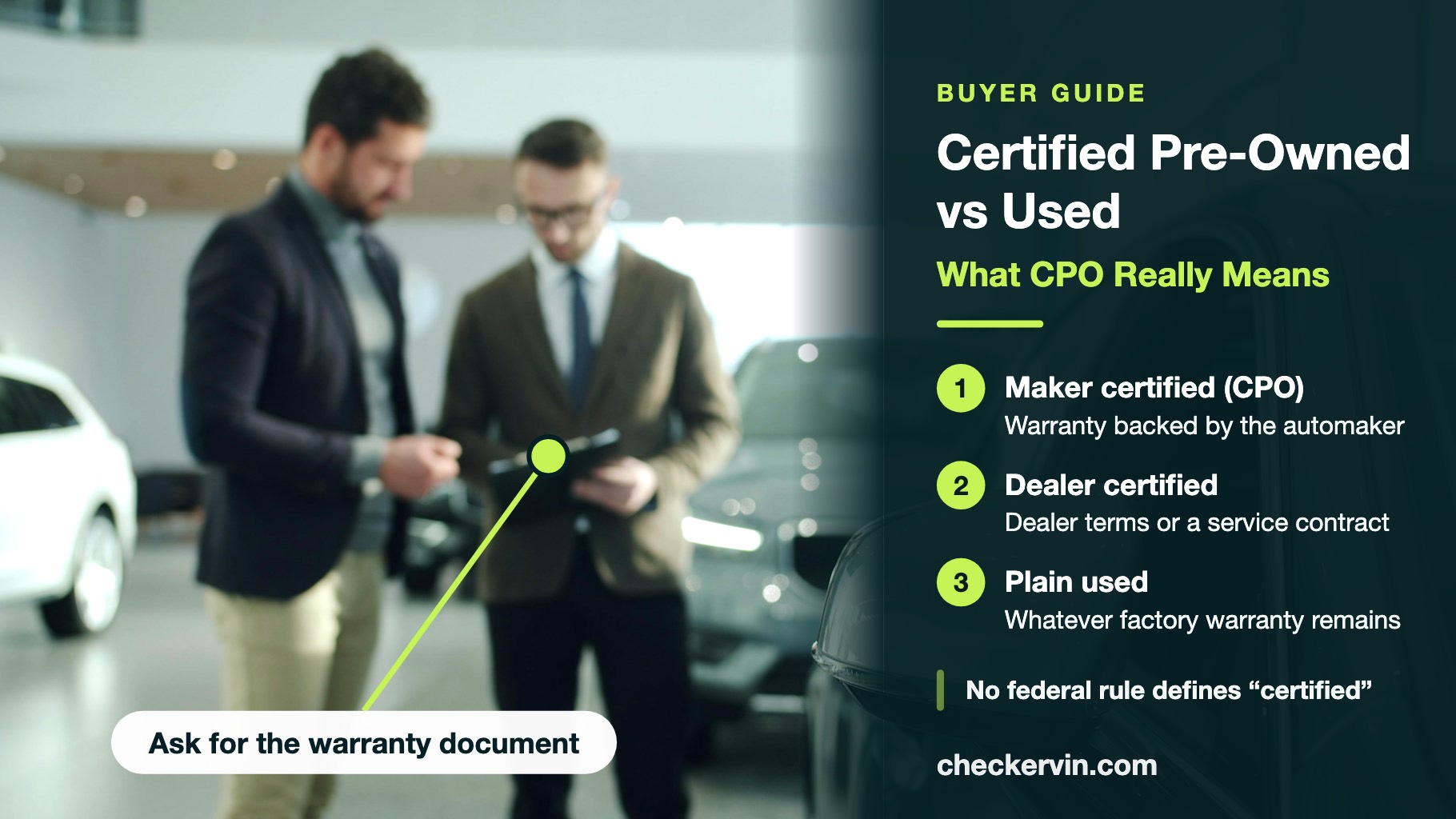
- A used car a seller has inspected and backed with an extra promise, usually a warranty. No federal rule defines it; the program's own terms do.
- Is a CPO car safer than a used one?
- Not automatically. The FTC acted in 2016 against certified-car ads that did not disclose open safety recalls, and federal law does not bar selling used cars with them.
- What should I still check?
- Open recalls by VIN, the NMVTIS title record, remaining factory warranty and an independent inspection, whatever the sticker says.
None
Federal definition of "certified"
Program terms decide what it means
2016
FTC orders on CPO ads
GM's ads omitted open recalls
9
California bars on "certified"
Vehicle Code § 11713.18
7 yr
Mazda CPO powertrain
Counted from the original sale
The short answer
A certified pre-owned car is a used car with extra paperwork attached. The best of that paperwork is genuinely valuable: a manufacturer-backed warranty that any franchised dealer for the brand will honor, with no deductible, that passes to the next owner. The weakest is a dealer’s own label on a car sold with a service contract from a company you have never heard of. Both are allowed to say “certified” in most of the country.
So the useful question is never “certified or not?” It is: certified by whom, against what standard, and backed by which warranty, starting from which date? None of those answers changes the three checks that sit outside every program we read: the open recall list for this VIN, the federal title record, and a mechanic who works for you.
What does certified pre-owned mean?
There is no federal definition. The FTC’s Used Car Rule (16 CFR Part 455), the main federal regulation for dealer sales, does not use the word “certified” anywhere in its text. What it regulates is warranties: whether the car is sold with one, as is, or with implied warranties only, and how those terms are disclosed on the window sticker. A certification program is a marketing promise layered on top of that.
In practice the label covers three quite different things:
| What the seller calls it | What usually stands behind it |
|---|---|
| Manufacturer certified (CPO) | The automaker's own program: eligibility limits, an inspection standard and a used-vehicle warranty it backs |
| Dealer certified | A dealer's or dealer group's own program, often with a dealer warranty or a third-party service contract |
| "Certified" used loosely | An inspection claim with no defined program, which is where state law and the FTC Act come in |
Two things are common to all three. First, the seller decides what “inspected” means, and the point count in an ad is the seller’s own number. Second, none of them is an independent check: the business that certifies the car is the business selling it, or the manufacturer whose dealers sell it.
Maker-certified vs dealer-certified
The difference that matters most to a buyer is who pays when something breaks, and where you can take the car to claim.
| Manufacturer CPO | Dealer-certified |
|---|---|
| Rules written by the automaker | Rules written by the dealer or dealer group |
| Warranty backed by the automaker | Backed by the dealer, or by a service contract sold with the car |
| Claims at any franchised dealer for the brand | Claims where the contract says, sometimes only at the selling dealer |
| Usually limited to recent, lower-mileage cars of that brand | Any make, any age the dealer chooses |
| Terms published on the maker's site | Terms in the dealer's paperwork |
A dealer program is not worthless by definition. Some dealer groups back their own warranties and honor them well. But you are relying on one business rather than a manufacturer’s dealer network, and the FTC’s 2016 cases included both kinds: a carmaker’s CPO program and two dealer groups advertising their own certified and warranty-backed cars.
The quickest test is to ask the salesperson one question and get the answer in writing: “If the engine fails in month ten, who pays, and which shops can do the repair?” A manufacturer CPO answer names the automaker and any brand dealer. Anything else needs the contract read in full.
How a CPO warranty actually works
The phrase “CPO warranty” usually means two separate coverages, and the two programs we could read show how differently they can be built.
| Mazda Certified Pre-Owned | What Mazda's page says |
|---|---|
| Inspection | 160-point, by a factory-trained Mazda technician |
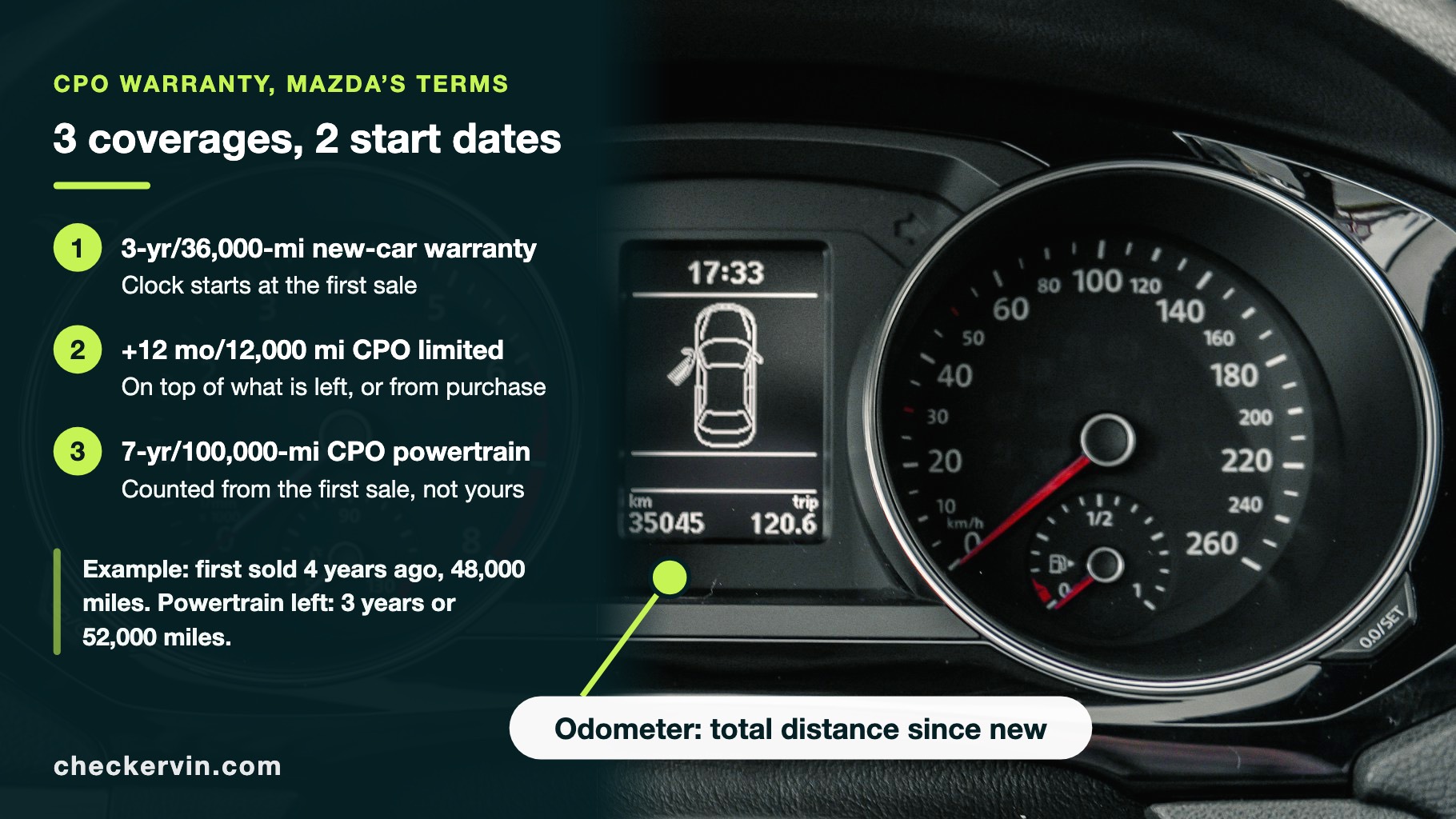
| CPO limited warranty | 12 months or 12,000 miles on top of any remaining 3-year/36,000-mile new-vehicle warranty; from purchase if that has expired |
| CPO powertrain warranty | 7 years or 100,000 miles from when the car was first sold new |
| Deductible | None on covered repairs at Mazda dealers |
| Transfer | Both warranties transfer to later owners at no cost |
| History report | A Carfax report and Carfax Buyback Guarantee |
| Toyota Certified Used Vehicles | What Toyota's disclaimers say |
|---|---|
| Gold eligibility | Up to 6 model years old or 85,000 miles or less |
| Comprehensive (Gold) | 12 months or 12,000 miles from the TCUV purchase |
| Powertrain, Gold | 7 years or 100,000 total vehicle miles |
| Powertrain, Silver | 12 months or 12,000 miles from the TCUV purchase |
| History report | A Carfax report is a required part of every certified car |
Read side by side, three things stand out. Toyota runs two tiers under one name, so “Toyota certified” on a listing does not tell you which powertrain coverage you get; ask whether the car is Gold or Silver. Toyota’s page does not state Silver’s eligibility limits, and it points to a TCUV Warranty Supplement for full terms, which is the document to ask the dealer for. And Mazda’s page disagrees with itself in one spot: the summary it gives search engines mentions a 150-point inspection while the page body says 160. Small, but it is the reason to read the signed paperwork rather than the marketing.
Whose clock the warranty runs on
This is the detail that decides how much a CPO warranty is worth on a specific car, and it is set by a date the VIN can confirm: when the car was first sold or put into service.
Take a hypothetical Mazda first sold new 4 years ago, now showing 48,000 miles. Its 3-year/36,000-mile new-vehicle warranty has already expired, so under Mazda’s terms the 12-month/12,000-mile CPO limited warranty starts on the day you buy it. The 7-year/100,000-mile powertrain warranty counts from the original sale, which leaves 3 years or 52,000 more miles, whichever comes first.
The same certificate on a car first sold two years later would carry two more years of powertrain cover. That is why the in-service date matters more than the model year: a car that sat unsold, or served as a dealer demonstrator, can have a first-sale date that does not match what you would guess from its age. Our VIN warranty check guide explains how to get that date from any franchised dealer, and our free scan shows the factory warranty terms for the VIN.
What federal rules say about a certified car
The Used Car Rule applies to any dealer, which it defines as a person or business that sells a used vehicle after selling or offering five or more in the previous twelve months. It requires a Buyers Guide on each used car, and that form is where a certified car’s warranty is supposed to show up.
Below the dealer’s own warranty section, the current form carries optional boxes under “NON-DEALER WARRANTIES FOR THIS VEHICLE”. One reads “MANUFACTURER’S USED VEHICLE WARRANTY APPLIES”, which is the box for a maker’s CPO coverage. Others cover a still-running original factory warranty and any other used-vehicle warranty. The rule lets the dealer mark these boxes but does not require it, so an empty box does not prove there is no CPO warranty, and a ticked one is a prompt to ask for the warranty document.
Two other lines in the rule matter here. The final version of the Buyers Guide becomes part of your contract and overrides anything contrary in it (§ 455.3). And the rule makes it a deceptive practice for a dealer to misrepresent a warranty’s terms. If the Guide on a certified car says “as is”, that is the term you are buying under. Our as-is, no warranty guide takes the rest of the form box by box.
When the FTC acted on certified cars
On January 28, 2016 the FTC announced settlements with General Motors, Jim Koons Management and Lithia Motors. Its complaint said GM advertised Certified Pre-Owned vehicles at local dealerships with the line “Our 172-Point Vehicle Inspection and Reconditioning Process is conducted only by highly trained technicians” without disclosing that some of those cars had open safety recalls, including an ignition switch defect the FTC said could affect engine power, power steering, braking and airbag deployment.
The orders bar each company from claiming its used cars are safe or rigorously inspected unless they are free of open recalls or the recalls are clearly disclosed close to the claim, and they last 20 years. GM had to notify buyers of Certified Pre-Owned cars bought from July 1, 2013 that their car might have an open recall.
In a statement dated December 15, 2016, the Commission made the orders against General Motors, Jim Koons Management, Lithia Motors final and announced proposed orders against CarMax, West-Herr Automotive Group, Asbury Automotive Group. It also set out the gap the cases exist to fill: federal law requires every new car sold in the U.S. to be free of recalls, but it does not prohibit dealers from selling used cars with open recalls, and no federal agency can ban that sale across the industry without a change in law. The FTC can act only on misleading advertising. The CarMax side of that story, including a later multistate settlement, is on our CarMax review.
California: a worked example of a certified-car law
California is the clearest example we found of a state putting minimum conditions on the word itself. AB 68, the Car Buyer’s Bill of Rights (Chapter 128, Statutes of 2005), added Vehicle Code § 11713.18, operative July 1, 2006. It applies to licensed dealers and covers any term implying a car has been certified under a used-vehicle certification program. Under the text as enacted, a dealer may not advertise or sell a used car as certified if:
- The dealer knows or should know the odometer does not show actual mileage, for example because it was rolled back or replaced
- The vehicle was reacquired by the manufacturer or a dealer under a state or federal warranty law (a lemon-law buyback)
- The title carries a brand such as salvage, junk, nonrepairable or manufacturer repurchase
- It was damaged by impact, fire or water in a way that substantially impairs its use or safety, even after repair
- The dealer knows or should know it has frame damage
- The dealer did not give the buyer a completed inspection report, listing every component inspected, before the sale
- The dealer disclaims the implied warranty of merchantability
- The vehicle is sold "as is"
- The word "certified" is used in any other way that is untrue or misleading
A violation can be pursued under the Consumers Legal Remedies Act, the Unfair Competition Law, the false-advertising statute (Business and Professions Code § 17500) or other law, and the remedies stack. The section does not apply to used motorcycles or off-highway vehicles. The California DMV’s current summary of the law adds a practical line: if a car cannot be certified, ask the dealer why.
Notice what is not on the list. In 2016 a bill, AB 287, would have added an unremedied manufacturer’s recall to these conditions. That clause was removed before the bill passed as the Consumer Automotive Recall Safety Act, which restricts loaner and rental cars instead. Neither the 2005 text nor the DMV’s current summary lists an open recall, so in California, as federally, a certified car can still carry one.
Outside California
We did not survey every state, and we will not guess at statutes we have not read. What holds everywhere is the federal floor: the Used Car Rule’s Buyers Guide on dealer sales (Maine and Wisconsin use their own version of the form, the FTC notes) and Section 5 of the FTC Act against misleading claims. Beyond that, a state’s dealer-licensing law, its deceptive-practices statute and its attorney general’s consumer office decide what a certified claim has to live up to.
A useful habit wherever you live: read California’s list as a checklist anyway. Asking a dealer “has this car had frame damage, a branded title or a lemon-law buyback, and can I have the completed inspection report?” costs nothing, and a seller who cannot answer has told you something.
What certification does not replace
Every program and statute we read leaves the same three jobs with the buyer.
| Check | Why the certificate does not cover it |
|---|---|
| Open recalls by VIN | Federal law does not require a used car to be recall-free, and only a manufacturer-authorized facility can do the free repair |
| The NMVTIS title record | Both maker programs we read supply a Carfax report, and the DOJ says consumers cannot get NMVTIS reports from Carfax |
| Independent inspection | The FTC advises one even when a dealer has certified the car, because the certifier is also the seller |
| Remaining factory warranty | CPO coverage stacks on the original warranty, which runs from the first-sale date, not the model year |
The title point is the one most buyers miss. A Carfax report collects what Carfax collects, and it can be useful. It is not the National Motor Vehicle Title Information System, the federal database of state title brands, junk and salvage reports. For that record, the DOJ names 12 businesses approved to sell NMVTIS reports to the public: Bumper, Carsforsale, CarVertical, CheckThatVIN, ClearVin, EpicVin, GoodCar, TitleCheck, VinAudit, VinData, VinReport, Vinsmart.com. The department lists them alphabetically and says the order implies no preference. Our NMVTIS report guide explains what each title indicator means.
Is certified pre-owned worth it?
We do not print prices, and a CPO premium varies too much by brand, model and dealer to generalize honestly. What can be said is where the value comes from, so you can price it yourself against a comparable used car of the same model:
| Certification earns its keep when | It adds little when |
|---|---|
| The original factory warranty has expired or nearly so | Years of the original factory warranty remain anyway |
| The CPO powertrain term still has years left from the first-sale date | The first-sale date leaves little of the powertrain term |
| Coverage is manufacturer-backed, with no deductible | The label rests on a third-party service contract |
| The warranty transfers, which helps at resale | Coverage ends with you |
| The car has costly systems you would otherwise self-insure | The car is simple and its known faults are cheap |
A fair comparison is the CPO car against the same model sold used with whatever factory coverage remains, plus the cost of your own inspection and title report. If the gap is close to what a manufacturer-backed powertrain warranty would be worth to you, certification is a reasonable buy. If it is not, a well-checked ordinary used car is the better deal, and the checks are the same either way.
The return question comes up too. A certificate does not create a right to return the car; any return window is a store policy, and the FTC’s three-day cooling-off rule does not cover a dealership sale. Our guide to returning a used car covers that in detail.
Questions to ask before you sign on a certified car
- Is this certified by the manufacturer, or by your dealership? Which program and tier?
- Who backs the warranty, and can any brand dealer do the repair?
- From what date and mileage does each coverage start: my purchase, or the original sale?
- Is there a deductible, and does the coverage transfer if I sell?
- May I have the completed inspection report and the full warranty document before signing?
- Is any manufacturer's used vehicle warranty box marked on the Buyers Guide?
- Are there open recalls on this VIN, and has the remedy been done?
- May my own mechanic inspect the car before I buy?
A dealer that hands over the inspection report, the warranty booklet and the keys for an independent inspection without fuss is a good sign in itself. One that resists any of them belongs on our list of used car red flags.
Where CarCheckerVIN fits
We do not certify cars, and we do not sell a title report today. Here is what our free scan returns for any VIN, certified or not:
- Factory build and specifications decoded from the VIN
- Factory warranty terms
- Open NHTSA safety recalls
- Photos filed against the VIN
- Market and listing prices
On a certified car, the warranty and build sections do the most work. The build confirms the trim and options the listing claims, and the factory warranty terms are the base the CPO coverage is stacked on, so you can see how much of the original warranty is left before you weigh what certification adds.
Run the free warranty, build and recall check
Decoded from official manufacturer and NHTSA records
Where this information comes from
- FTC — GM, Jim Koons Management and Lithia Motors settle FTC actions, January 28, 2016GM's Certified Pre-Owned "172-Point" ads, the open recalls, what the orders bar and the notice to buyers
- FTC — Statement of the Commission Concerning Auto Recall Advertising Cases, December 15, 2016Federal law requires new cars to be recall-free but not used cars; final and proposed orders
- 16 CFR Part 455 — Used Motor Vehicle Trade Regulation Rule (eCFR)Dealer definition, the non-dealer warranty boxes on the Buyers Guide, and the form overriding the contract
- FTC — Buying a Used Car From a DealerIndependent inspection advised even on a dealer-certified car; Maine and Wisconsin Buyers Guides
- California AB 68, Car Buyer's Bill of Rights — chaptered text (Ch. 128, Stats. 2005)Adds Vehicle Code § 11713.18, the conditions that bar calling a used car certified
- California DMV — Car Buyer's Bill of RightsThe state's current summary of the certified-car conditions
- California AB 287 (2016) — amended version of August 19, 2016The final text no longer amends § 11713.18; the earlier recall-certification clause was dropped
- Mazda Certified Pre-OwnedInspection, CPO limited and powertrain warranties, deductible, transfer; retrieved November 25, 2026
- Toyota Certified Used VehiclesGold and Silver tiers, warranty terms and history report; retrieved November 25, 2026
- NMVTIS — approved data providers (DOJ / BJA)Consumer-tier providers; consumers cannot get NMVTIS reports from Carfax; retrieved November 25, 2026
- NHTSA — check for recalls by VINThe free federal recall lookup
- How we made this pageWritten by the CarCheckerVIN editorial team with AI assistance from FTC orders and guidance, 16 CFR Part 455, California's statute and DMV summary, Mazda's and Toyota's CPO pages, the DOJ NMVTIS list and other public records; facts checked November 2026. California's current code site did not load for us.
Keep reading
Frequently asked questions
What does certified pre-owned mean?
It means a seller has put a used car through some inspection and attached some extra promise, usually a warranty. No federal rule defines the term. A manufacturer's CPO program sets its own age, mileage and inspection standards and backs its own warranty; a dealer can also call cars certified under a program of its own. California is one state that sets minimum conditions for using the word.
Is certified pre-owned worth it?
It depends on what the certification adds to this particular car. A maker's program that extends powertrain coverage, charges no deductible and transfers to the next owner adds real value, especially on a car with expensive systems. It adds much less if the original factory warranty already has years left, or if the certified label rests on a third-party service contract. Price the coverage against the car, not the badge.
What is the difference between a CPO warranty and the factory warranty?
The factory warranty came with the car when new and runs from its first sale. A CPO warranty is a separate used-vehicle warranty the manufacturer adds at certification. Mazda, for example, says its CPO limited warranty adds 12 months or 12,000 miles on top of any remaining 3-year, 36,000-mile new-vehicle warranty, while its 7-year, 100,000-mile CPO powertrain warranty counts from the original sale.
Can a certified pre-owned car have an open recall?
Yes. The FTC said in December 2016 that federal law requires new cars to be free of recalls but does not stop dealers selling used cars with open recalls. Its 2016 orders against General Motors and others were about advertising inspections without disclosing recalls. Run the VIN through NHTSA's free recall lookup yourself, certified or not.
Can a certified car have been in an accident?
It can, depending on the program and the state. California's statute bars the word for cars with frame damage, a branded title or damage that still impairs safety after repair, but not for every car that was ever in a collision. Read the program's rules, and check the title record yourself through a provider on the DOJ's NMVTIS list.
Is a dealer-certified car the same as a manufacturer CPO car?
No. A manufacturer's CPO warranty is backed by the automaker and honored at its franchised dealers nationwide. A dealer's own certification is backed by that dealer or by whatever service contract it sells with the car, under its own terms. Ask in writing who stands behind the coverage.
Check the VIN before you pay for the certificate
Decode any VIN free for the factory build, remaining factory warranty, open safety recalls and market prices. Full vehicle history reports are launching soon.
Run a free VIN check