The short answer
- Is there a three-day right?
- Yes, but it is defined by where you agreed, not by what you bought. A dealership visit is expressly excluded from it.
- When would it apply?
- When a seller personally solicited you and you agreed away from their premises — a home, a workplace, or a hotel, fairground or convention center.
- What if I bought at a dealer?
- Your rights come from the contract and from state law, not from this rule. Read what you signed before assuming anything.
Where
What decides it
Not what was sold
Excluded
A visit to fixed permanent premises
16 CFR 429.0(a)(1)
3rd day
Cancellation runs to midnight of
Business days
10 point
Minimum bold type for the notice
16 CFR 429.1(a)
The short answer, before the detail
If you bought a car by going to a dealership and agreeing a deal there, the federal cooling-off rule does not give you a right to cancel. Not after one day, not after three. Any right you have comes from what you signed, from a financing condition that has not yet been satisfied, or from your state — and those are separate things.
That is the answer for most people reading this. The rest of the page is worth your time for two reasons: because the rule genuinely does apply to some vehicle sales and it is worth knowing which, and because the shape of it explains what to do before signing rather than after.
The test is where you agreed, not what you bought
The rule is 16 CFR Part 429, titled in the regulation itself as the Rule Concerning Cooling-Off Period for Sales Made at Homes or at Certain Other Locations. The title is the whole idea. It is not a used-car rule, a big-purchase rule, or a consumer-goods rule in general. It is a rule about place.
429.0(a) defines a door-to-door sale as a sale, lease or rental of consumer goods or services in which the seller or a representative personally solicits the sale — including in response to an invitation from the buyer — and the buyer’s agreement or offer to purchase is made at a place other than the place of business of the seller.
Two conditions, both required. Somebody solicited you personally, and you agreed somewhere that is not their premises. A vehicle is capable of satisfying both, and an ordinary dealership purchase satisfies neither.
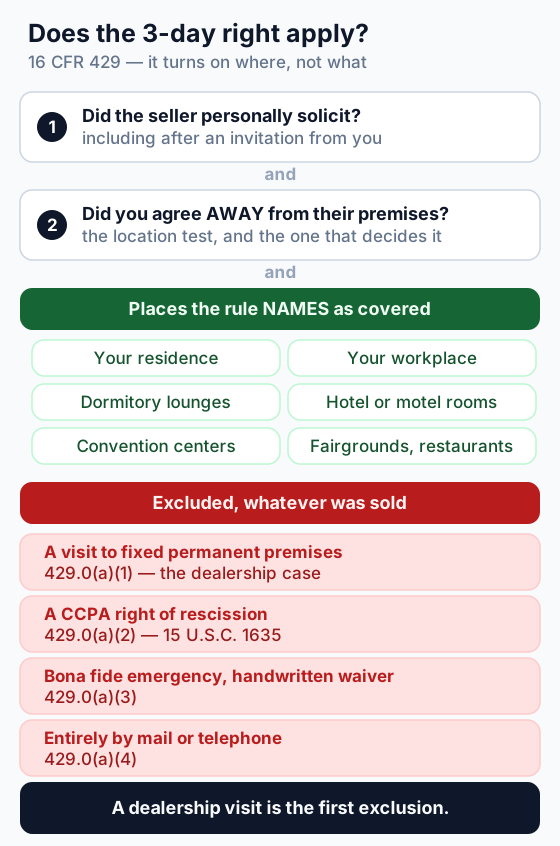
The places the rule actually names
The regulation does not leave “a place other than the place of business of the seller” to the imagination. It gives examples, and they are worth reading closely because one cluster of them describes a familiar way of selling vehicles:
| Location named in 429.0(a) | What it looks like in a vehicle sale |
|---|---|
| The buyer's residence | A seller who comes to you with paperwork ready |
| Facilities rented on a temporary or short-term basis — hotel or motel rooms, convention centers, fairgrounds, restaurants | An off-site sales event: the tent sale in a mall parking lot, the fairground weekend, the hotel ballroom event |
| The buyer's workplace | An employer-hosted sales day or a seller who visits you at work |
| Dormitory lounges | Campus sales events aimed at students |
That second row is the one to hold on to. A dealer who moves inventory to a rented lot for a weekend, personally solicits buyers there, and signs deals on the spot is operating in exactly the setting the regulation describes — not at a fixed permanent location where the goods are exhibited on a continuing basis.
Why a dealership purchase is excluded, in the rule's own words
The definition carries its exclusions inside it. The first one is the decisive one for most readers. The term door-to-door sale does not include a transaction:
Read that against a normal purchase. You visited the dealership. Cars were exhibited there on a continuing basis. Negotiations happened during that visit. Every element is satisfied, which is why there is no federal cooling-off period on a dealership sale — not as an oversight, but by design. The rule exists to protect people from pressure applied in places they cannot easily walk away from, and a showroom is a place you can leave. The rule is about the circumstances of the agreement, not about the size of the regret that follows it.
This is also why the belief is so persistent and so expensive. It sounds like a consumer protection that would obviously apply to the largest purchase most people make in a showroom. The regulation is aimed at a different problem entirely.
The thresholds, and the solicitation requirement
Two more elements have to be satisfied before the right attaches, and both are easy to miss.
- Price: $25 or more if the sale is made at the buyer's residence, or $130 or more if made at other locations — any vehicle sale clears both
- Solicitation: the seller or a representative must have personally solicited the sale
- The rule expressly includes solicitations made in response to, or following, an invitation by the buyer
- Both the solicitation element and the location element must be met — one alone is not enough
That third point matters more than it looks. A buyer who called the seller and asked them to come is still within the definition, because the rule counts solicitations following an invitation by the buyer. Being the one who made contact does not take the sale outside the rule; agreeing at the seller’s permanent premises does.
The other three exclusions
Alongside the fixed-premises exclusion, 429.0(a) removes three further categories. None is common in a vehicle purchase, but knowing them prevents a wrong conclusion:
| Exclusion | What it covers |
|---|---|
| A Consumer Credit Protection Act right of rescission — 429.0(a)(2) | Transactions where 15 U.S.C. 1635 already gives a right to rescind, so the rule does not duplicate it |
| Bona fide immediate personal emergency — 429.0(a)(3) | The buyer initiated contact, needs the goods urgently, and gives a separate dated handwritten statement expressly waiving the three-day right |
| Entirely by mail or telephone — 429.0(a)(4) | No other contact between buyer and seller before delivery, so no in-person solicitation occurred |
The emergency exclusion is the one worth recognizing, because it is the only route by which a covered sale can lose the cancellation right — and it requires the buyer’s own handwriting, dated and signed, describing the situation and expressly acknowledging the waiver. A pre-printed waiver in a stack of paperwork is not that.
What a covered seller has to give you, and in what type size
Where the rule does apply, 429.1 makes it an unfair and deceptive act or practice for the seller to fail to do specific things — which means the obligations are enforceable rather than advisory.
- 1A completed receipt or contract copy, at the time of executionNot later, not posted on. It must show the date of the transaction and the seller's name and address.
- 2In the same language as the oral sales presentationThe regulation gives Spanish as its example. A sale conducted in one language and papered in another does not comply.
- 3The cancellation statement in bold face type of a minimum size of 10 pointsPlaced in immediate proximity to the signature space, or on the front page of the receipt if no contract is used.
- 4The wording itselfSubstantially: you, the buyer, may cancel this transaction at any time prior to midnight of the third business day after the date of this transaction.
- 5A duplicate notice of cancellation formThe seller chooses how to provide it, but on cancellation the buyer must still be able to retain a complete copy of the contract or receipt.
There is a practical reading of all that detail. If you are at an off-site sales event and the paperwork carries no bold cancellation notice near the signature line, that is itself information — either the seller has concluded the rule does not apply, or the requirement has not been met.
Counting the three days, and the definitions that decide coverage
Where the right does apply, the counting is not what most people assume, and the regulation defines the term rather than leaving it to custom.
Saturday is a business day. Only Sunday and the listed federal holidays are excluded, which means a Thursday transaction runs out at midnight on Saturday rather than the following Tuesday. People who assume a Monday-to-Friday count give themselves two days they do not have, and on a three-day window that is the whole thing.
Three further definitions in the same section decide whether the rule reaches a transaction at all, and they are worth checking against your own facts:
| Defined term | What the regulation says, and why it matters here |
|---|---|
| Consumer goods or services — 429.0(b) | Purchased, leased or rented primarily for personal, family or household purposes. A vehicle bought primarily for a business is a different question, and the answer turns on the primary purpose rather than on how it is titled |
| Place of business — 429.0(d) | The main or permanent branch office or local address of the seller. This is the anchor the location test swings on, and it is about permanence rather than about signage |
| Purchase price — 429.0(e) | The total price paid or to be paid, including all interest and service charges. Any vehicle clears the thresholds comfortably, but the definition tells you the test is the financed total rather than a sticker figure |
The consumer-goods definition is the one that quietly excludes a category of buyer. If the vehicle was acquired primarily for a trade or business, the transaction is outside the rule regardless of where it was signed, because the rule reaches consumer purchases. That is a distinction worth being honest about before relying on a three-day window.
Four things people confuse with a cooling-off period
| What it actually is | How it differs |
|---|---|
| A dealer's own return policy | A contractual promise, often with mileage and day limits and sometimes a fee. It exists because the dealer offered it, and it varies by dealer |
| A conditional or spot delivery | You have the car while financing is finalized. If it is not approved on the stated terms the deal may unwind — that is a contract condition, not a right to change your mind |
| A state lemon law | Aimed at defects that persist after repair attempts, mostly on new vehicles, with its own notice and timing requirements. Not a return window |
| Warranty or misrepresentation claims | About what the car is or what you were told, not about regret. These can be strong, and they are slower than a three-day cancellation |
If a financing condition is the reason you are asking, our guide to a deal that falls through covers what the contract paperwork has to carry and what happens next. If the issue is something you discovered about the vehicle rather than about the deal, the post-purchase guide sets out which clocks are already running.
If your sale is one the rule covers
Two things decide whether this goes smoothly: speed, and producing a record. The right is short, and a cancellation you cannot evidence is worth very little if the seller later disputes when it was sent.
- Act inside three business days — the right runs to midnight of the third, not three calendar days
- Use the notice of cancellation form if you were given one, and keep a copy of everything you send
- Send it in a way that produces a dated record rather than by a phone call alone
- Keep your complete copy of the contract or receipt — the rule says you must be able to retain one
- If no cancellation notice was provided at all, say so in writing, because that failure is itself the seller's problem under 429.1
What to do instead, before you sign
The reason this page is worth reading before a purchase rather than after is that the protection people imagine does not exist, and the checks that would have replaced it are free and take minutes. A cooling-off period is a way of undoing a decision made without information. The alternative is to have the information first.
- Decode the VIN for the factory build, specifications and open safety recalls before you travel
- Check for a title brand and run an independent lien check rather than relying on the seller's paperwork
- Take the ten minutes of physical checks that records cannot give you
- Read what the contract says about cancellation, deposits and financing conditions before signing, not after
- Treat any pressure to sign today as a reason to leave — that pressure is exactly what the federal rule exists to counter elsewhere
- At an off-site event, look for the bold cancellation notice near the signature line before you sign, not after
Run the free checks before you commit
Decoded from official manufacturer and NHTSA records
Where this information comes from
- 16 CFR 429.0 — definitionsThe door-to-door sale definition, the named locations, the price thresholds and all four exclusions
- 16 CFR 429.1 — the RuleThe seller's obligations, the 10-point bold cancellation statement, and the notice of cancellation form
- FTC — buying a used car from a dealerFederal consumer guidance on the dealer purchase itself
- NHTSA recall lookupThe free check worth running before you sign rather than after
Keep reading
Frequently asked questions
Can I return a used car within three days?
Not because it is a car. The federal cooling-off rule at 16 CFR 429 gives a three-business-day right to cancel certain sales, but it is defined by where the agreement was made rather than by what was sold. A purchase agreed during a visit to a dealership's fixed permanent premises is expressly excluded.
Does the FTC cooling-off rule cover car dealerships?
No. 16 CFR 429.0(a)(1) excludes a transaction made pursuant to prior negotiations in the course of a visit by the buyer to a retail business establishment having a fixed permanent location where the goods are exhibited on a continuing basis. That describes an ordinary dealership visit, which is why the belief in a universal three-day right is wrong.
When would the three-day right apply to a vehicle sale?
When the seller personally solicited the sale and the agreement was made away from the seller's place of business. The rule's own examples include hotel and motel rooms, convention centers, fairgrounds and restaurants — which is a fair description of an off-site tent sale — as well as the buyer's home or workplace.
What must a covered seller give me?
Under 16 CFR 429.1 a covered seller must furnish a completed receipt or contract copy at the time of execution, in the same language as the oral sales presentation, with a cancellation statement in bold face type of a minimum size of 10 points, plus a duplicate notice of cancellation form. The statement says you may cancel prior to midnight of the third business day.
What can I do if I bought at a dealership and want out?
Look at the contract rather than the federal rule. Some dealers offer their own return policy, some deals are conditional on financing that has not been finalized, and state law may give you rights the federal rule does not. None of those is a cooling-off period, and none of them is automatic.
The checks that work better than a return window
Decode any VIN free for the factory build, specifications and open safety recalls. No account, no card. Full vehicle history reports are launching soon.
Run a free VIN check