The short answer
- Is Carvana legit?
- Yes. It is an NYSE-listed company that files with the SEC and holds dealer licenses in dozens of states. Two states have taken action over its title and registration handling.
- Can you return a Carvana car?
- Its annual report describes a seven-day return policy. The conditions are in its terms and your purchase agreement, which we could not load, so read them first.
- What should you check yourself?
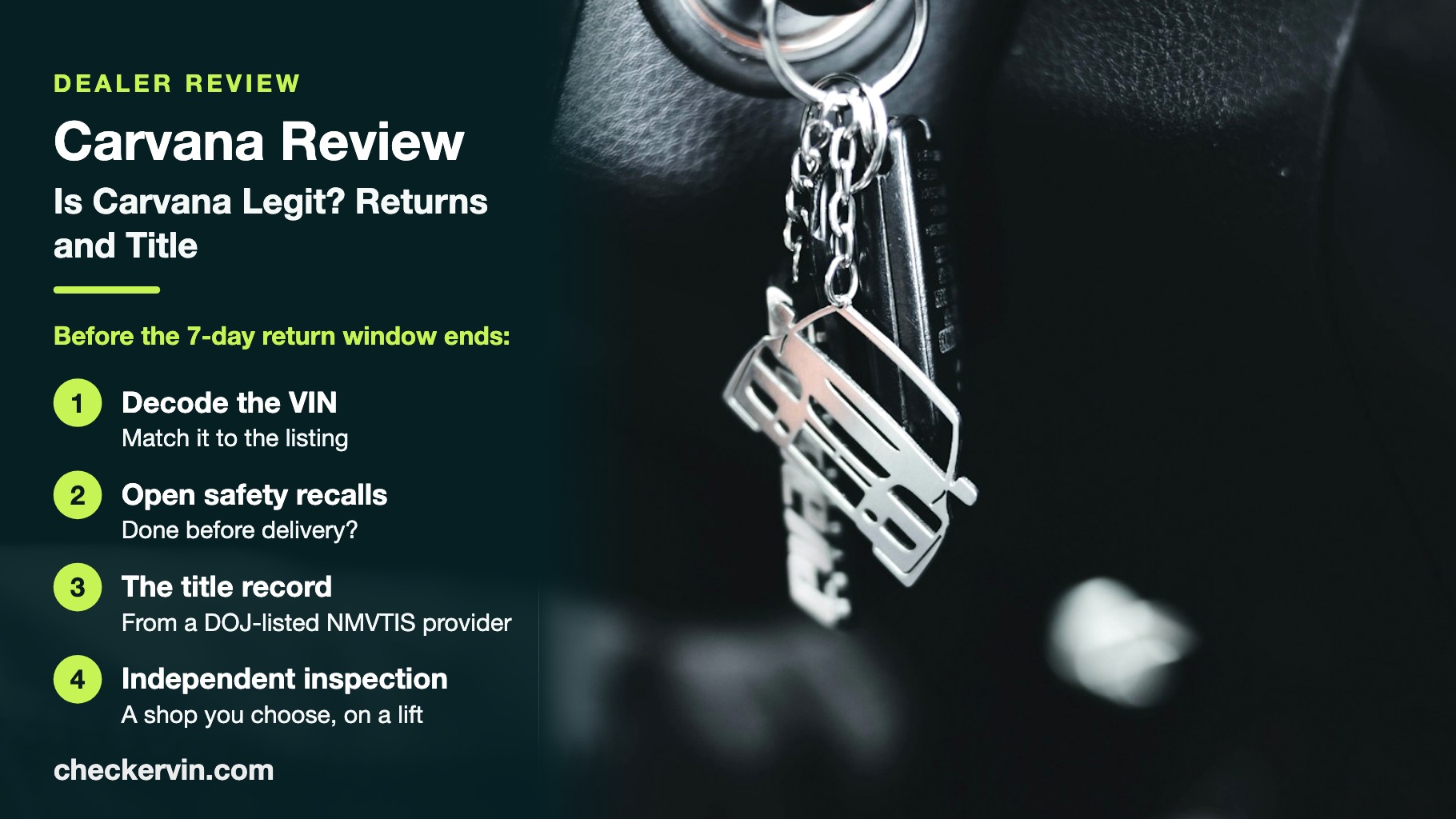
- Decode the VIN, look up open recalls, pull the title record from a DOJ-listed NMVTIS provider, and get an independent inspection inside the return window.
596,641
Retail units sold in 2025
Per its 10-K
7 days
Return policy window
Per its 10-K; terms on its site
40
States with a licensed facility
As of Dec 31, 2025
$1.5M
Connecticut settlement, 2025
Title and registration delays
The short verdict
Carvana is a large, real, regulated used-car retailer, and the parts of its model that protect a buyer are the seven-day return policy and the limited warranty its filings say comes with every purchase. The part with a documented history of trouble is paperwork: titles and registrations delivered late, which two state agencies acted on and which Carvana’s own annual report lists as a source of complaints.
So the useful question is not whether Carvana is legit. It is how to use the seven days so that you, rather than the seller, have checked the car and its title before the window closes. That is what most of this page is about.
What Carvana is, from its own annual report
Carvana Co. is a Delaware holding company formed in 2016; its Class A stock trades on the New York Stock Exchange as CVNA. Its 10-K for 2025 calls it an e-commerce platform for buying and selling used cars, and says it started selling to customers in Atlanta in January 2013. The scale it reports is large:
| What the filing reports | Figure |
|---|---|
| Retail vehicles sold in 2025 | 596,641, up 43.3% from 416,348 in 2024 |
| Retail vehicles sold, July to September 2026 | 217,385 (10-Q) |
| Retail vehicles sold, first nine months of 2026 | 602,103 (10-Q) |
| Retail vehicles sold since 2012 | 2.8 million, with $84.1 billion in total revenue |
| Cars listed on its website | More than 75,000 as of December 31, 2025 |
| Logistics network | 316 metropolitan statistical areas |
| Reconditioning capacity | About 1.5 million vehicles a year |
| Former ADESA auction sites acquired in 2022 | 56, of which 16 now have reconditioning capability |
The model is vertically integrated. Carvana buys cars from consumers, auctions and wholesale suppliers, trucks them to its own inspection and reconditioning centers, photographs them for a 360-degree online tour, finances many of the sales itself, and delivers on its own haulers or through its multi-story car vending machines. It also sells vehicle service contracts, GAP waiver coverage in most states, and insurance through a partnership with Root.
Is Carvana legit? What the record supports
On the facts a buyer can verify, yes. A company listed on the NYSE files audited annual and quarterly reports with the SEC, and Carvana’s say that certain states treat its business as subject to vehicle dealer licensing, that it has chosen to be licensed in others, and that as of December 31, 2025 it had at least one licensed facility in 40 states. A business that sells hundreds of thousands of cars a year under state dealer licenses is not a scam, whatever an individual purchase turned out like.
Legit and problem-free are different claims, though, and the same filings are candid about the gap. The 10-K says the attorney general offices of various states conduct inquiries “from time to time” about its inspection, reconditioning, advertising, sale, delivery, titling, registration, lending practices and post-sale service, and that such inquiries have resulted in claims against the company. It also discloses a June 2025 SEC subpoena that it believes relates mainly to allegations in a short seller’s report, which the company calls inaccurate, incomplete and misleading. Those are disclosures, not findings, and the page treats them that way.
The Carvana inspection, in the company's own words
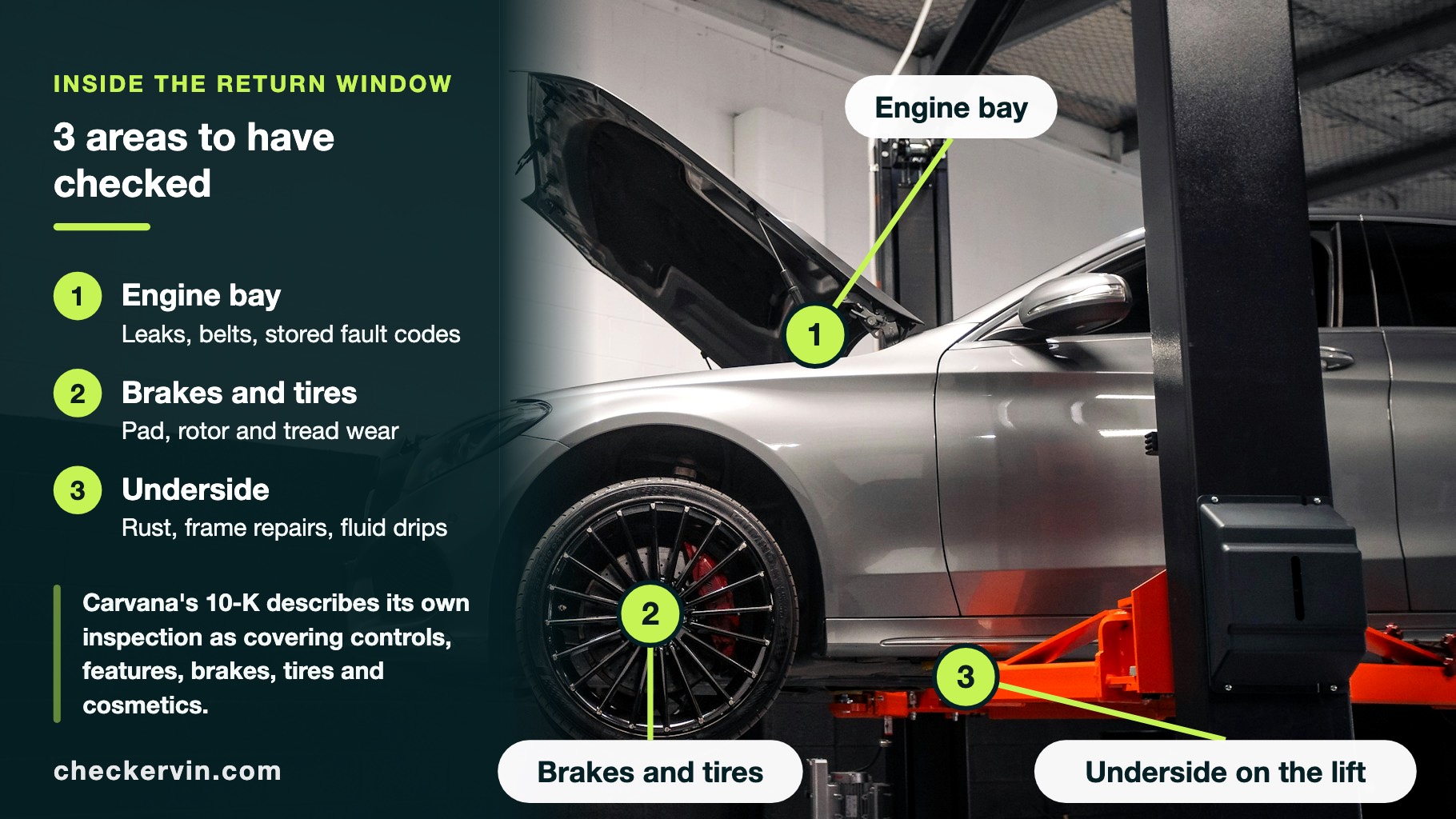
Carvana’s marketing describes its inspection in its own terms on its website, which we could not load. Its annual report describes it more plainly. Once a car reaches a reconditioning site, the 10-K says, Carvana begins “an inspection process covering controls, features, brakes, tires, and cosmetics.” It then estimates the reconditioning cost to bring the car up to its standards, applies a uniform set of cosmetic standards across sites, and sells cars that do not meet those standards wholesale rather than retail.
Two things follow. First, the inspection is real and has a consequence: a car that fails is meant to leave through the wholesale channel, not the website. Second, it is the seller’s inspection, done by the seller’s technicians to the seller’s standard. That is normal for any dealer, and it is exactly why a second opinion from a shop that works for you still matters. The filing’s list leads with controls, features and cosmetics; an independent pre-purchase inspection spends most of its time under the car and in the engine bay.
Carvana’s photo tour is the other half of its condition disclosure. The 10-K says its patented photo technology lets customers view vehicle imperfections in high-definition photography. Treat the annotated photos as a checklist to compare against on delivery day: every mark shown should be there, and nothing else should be.
The Carvana 7-day return policy
The seven-day return policy is the center of the pitch, and the 10-K mentions it three times. Customer advocates handle “returns or exchanges under our seven-day return policy”; the policy is named as one of the things that make buyers trust a car they have never seen; and the company’s headline sales figure is defined as retail units sold “net of returns under our seven-day return policy.” That last detail is a useful signal: returns are routine enough to be netted out of the number investors watch most closely.
What the filing does not give is the fine print. Whether there is a mileage limit or a fee, who pays to move the car back, whether the seven days start at delivery or at signing, and how financing and a trade-in are unwound are all set by Carvana’s terms and your purchase agreement. Its site blocked us, so we do not state any of them. Read them before you buy, and save a copy of the version you agreed to.
Connecticut’s attorney general published excerpts from consumer complaints alongside its 2025 settlement. One buyer wrote that Carvana was notified of undisclosed damage within seven days and refused to take the car back; another described a dispute over refunding a delivery fee after canceling. Those are complaints quoted by the state, not findings against the company, but they show where disputes arise: over what the policy covers and when. Knowing the terms in writing is what settles that.
The limited warranty, the add-ons, and the Buyers Guide
Carvana’s quarterly report for September 2026 says a limited warranty is “included with every purchase” and that since 2017 it has been administered by DriveTime, to which Carvana pays a per-vehicle fee. Its length and exclusions are set out on Carvana’s site, which we could not read, so the page does not state them.
Beyond that, the 10-K lists optional products offered during checkout: a vehicle service contract that covers certain mechanical repairs after the manufacturer’s warranty expires, GAP waiver coverage for buyers financing with Carvana in most states, and auto insurance through Root. All three are optional; price each one against outside quotes rather than accepting it as part of the flow.
One federal rule sits underneath every dealer sale, online or not. The FTC’s Used Car Rule requires a dealer to prepare a Buyers Guide for each used car it offers to consumers, and 16 CFR 455.3 says the information on that window form is incorporated into the contract of sale and overrides any contrary provisions in the contract. Ask to see the Buyers Guide for the exact car before you sign: it is where the warranty terms you are actually getting are written down.
Title and registration: the part that drew state action
When you buy from a dealer, the dealer usually handles the title transfer and registration. Carvana’s 10-K is unusually direct about the risk in that step for an online seller. It relies on third-party vendors and systems for parts of the transaction, including submitting title and registration paperwork to vendors or state entities, and it says: “we have been the subject of various complaints relating to the timely delivery of certificates of title and registration, and vehicle quality.” The company says it does not consider those claims material.
The same filing lists putative class actions alleging violations of state laws on the titling and registration of vehicles sold to customers, among other matters. Two state agencies have gone further and published what they found, which is set out in the next section. The practical lesson is the same whether you buy from Carvana or anyone else who handles the paperwork for you: the car arriving and the title being in your name are two separate events, and the second one deserves its own follow-up. Our explainer on title versus registration covers what each document does.
Official actions on the record
We searched federal and state sources for official action involving Carvana and read each document we cite in full. Only official sources are summarized here.
| Agency and date | What the official record says |
|---|---|
| Connecticut Attorney General — January 14, 2025 | A $1.5 million settlement after hundreds of complaints involving extended delays in title and registration documents, delayed payments to sellers and deceptive representations of car conditions and features. It created a $1 million restitution fund and a $500,000 penalty, $250,000 of it suspended on compliance, and bars Carvana from selling in Connecticut unless it provides valid title and registration documents at the time of sale. The state said Carvana cooperated fully. Filed in Hartford Superior Court, subject to court approval |
| Illinois Secretary of State — January 24, 2023 | Carvana admitted violating Illinois law and agreed to new safeguards. Illinois was the first state to suspend its license, in May 2022, after customers alleged out-of-state temporary registration permits and late title transfers. Carvana surrendered its $250,000 bond and accepted Secretary of State Police inspections, and the state can summarily suspend its license again for non-compliance |
| U.S. Securities and Exchange Commission — June 2025 | A subpoena disclosed in Carvana's own 10-K, which the company believes relates mainly to a short seller's allegations that it disputes. It says it is cooperating. No SEC finding has been published |
| Federal Trade Commission | No case naming Carvana in the FTC's Cases and Proceedings library when searched on November 25, 2026 |
| Consumer Financial Protection Bureau | No enforcement action naming Carvana in the CFPB's database when searched on November 25, 2026 |
Connecticut’s release explains what the delays meant in practice. Carvana represented that it handled the title and registration process, but in many cases the registration took months; buyers were sometimes given a succession of out-of-state temporary registrations, and some had to park their cars or risk driving unregistered. The attorney general attributed part of it to a company that grew faster than it could manage during the pandemic. Illinois’s Secretary of State said unregistered plates left drivers at risk of being ticketed.
Both releases tell affected buyers what to do. Connecticut directs buyers who purchased after January 1, 2019 and incurred fines or costs from a delayed title transfer to submit a written claim under the settlement; Illinois asks buyers with title problems to file a complaint with the Secretary of State Police. If you are in another state, your attorney general’s consumer protection office and your motor vehicle agency are the places to start.
Does Carvana give a vehicle history report?
We could not confirm whether Carvana includes a vehicle history report with its listings, because its site blocked us. Its 10-K does not mention one. It describes the photo tour and “integrations with various vehicle data providers for vehicle feature and option information,” which is equipment data, not title or accident history.
If a listing does offer a report, look at who produced it and what it draws on. For the title record specifically, the federal system is NMVTIS, which collects data from state titling agencies, insurers, and junk and salvage yards and recyclers. The Department of Justice publishes the businesses approved to sell its reports, and on November 25, 2026 the consumer tier named 12: Bumper, Carsforsale, CarVertical, CheckThatVIN, ClearVin, EpicVin, GoodCar, TitleCheck, VinAudit, VinData, VinReport, Vinsmart.com. Carvana is a dealer, not a data provider, so it would not be on that list. Pulling the title record yourself is still the step that does not depend on the seller.
What we could not verify, and why
Every request we sent to carvana.com in November 2026 returned a block page. Rather than guess or repeat what other sites say about its terms, these are left open:
| Not verified here | What to look for in Carvana's terms |
|---|---|
| Return policy fine print | Mileage limit, any fee, who pays transport, and when the seven days start |
| Limited warranty terms | How long it lasts and what it excludes |
| Inspection point count | Any number Carvana uses in its marketing |
| History report with listings | Whether a report comes with a listing, and from which provider |
Each of these is something you can read for yourself on its site and in the purchase agreement before you commit, and each is worth saving as a screenshot or PDF with the date on it.
Your own checks, before and after delivery
Whoever sells you the car, these checks are the ones that do not rely on the seller. Most can be done from the listing’s VIN before you pay a deposit; the last one needs the car in front of a mechanic.
- 1Decode the VIN and match it to the listingThe year, engine, drivetrain and trim decoded from the VIN should match what the listing says. A mismatch is a question to ask before you buy, not after.
- 2Look up open safety recallsRun the VIN through NHTSA's recall lookup or our free check. An open recall is a free repair at a franchised dealer, but you want to know before delivery whether it has been done.
- 3Pull the title record from a DOJ-listed NMVTIS providerThis shows title brands such as salvage or flood, the latest reported odometer reading and the title history across states. It answers the questions a seller's own inspection does not.
- 4Read the Buyers Guide and the return termsThe Buyers Guide is part of the contract under 16 CFR 455.3. Save it with the return policy and purchase agreement as they stood when you signed.
- 5Book an independent inspection inside the return windowArrange the shop before delivery day so the car is on a lift within the first days, with time left to decide.
Decode the VIN and check recalls free
Decoded from official manufacturer and NHTSA records
Using the seven days well
Seven days is shorter than it sounds once delivery, a working week and a shop’s booking calendar are counted. A plan made before the car arrives turns the return policy from a hope into an inspection period.
- Before delivery, book a pre-purchase inspection with a shop you choose and confirm how long it takes
- On delivery, photograph the odometer, the VIN plate and every panel, and compare against the listing photos
- Check that the VIN on the car matches the one on your paperwork and the listing
- Note the expiry date on any temporary registration, and ask in writing when the title and plates will be issued
- Keep driving to a minimum if the agreement sets a mileage limit on returns
- Get the shop's findings in writing, and decide with at least a day to spare
- If you return the car, get written confirmation of the return and of how any financing and trade-in are unwound
If something turns up after the window closes, the warranty and the Buyers Guide are what you have. Our guide to what to do after buying a used car sets out which deadlines start once you take delivery.
Carvana and CheckerVIN
Carvana sells cars; we do not. What we do is give you an independent look at the VIN of any car you are considering, including one on Carvana’s site, before you pay.
| CheckerVIN today | Where it comes from |
|---|---|
| Factory build and specifications | Decoded from the VIN, free |
| Factory warranty terms | Free |
| Open NHTSA safety recalls | Free |
| Photos filed against the VIN | Free |
| Market and listing prices | Free |
| Title, damage, odometer and ownership history | Launching soon, not available yet |
Who Carvana suits, and who should slow down
Carvana suits a buyer who values selection and doing the deal from home, and who is willing to treat the seven days as working time: inspection booked, paperwork read, VIN checked. Its filings describe a business built for exactly that kind of transaction, at very large scale.
It suits less well a buyer who needs registered plates on a fixed date, such as for a job that starts on Monday, or who cannot get the car to an independent shop within the window. For them, the title-and-registration history in the official record is the part to weigh. Our step-by-step guide to buying a used car covers the same checks for any seller, and the pre-purchase inspection guide explains what a good one includes.
Where this information comes from
- Carvana Co. Form 10-K for fiscal 2025 (SEC)Scale, inspection scope, seven-day return policy, licensing, title and registration risk, legal proceedings
- Carvana Co. Form 10-Q, quarter ended September 30, 2026 (SEC)2026 retail units and the limited warranty administered by DriveTime
- Connecticut Attorney General — Carvana settlement, January 14, 2025The $1.5 million settlement, its terms and the complaints behind it
- Illinois Secretary of State — Carvana settlement, January 24, 2023License suspension, admission and settlement terms
- DOJ — approved NMVTIS data providersThe businesses approved to sell NMVTIS title reports to consumers
- DOJ — NMVTIS for consumersWhat the federal title record holds and who reports into it
- 16 CFR Part 455 — FTC Used Car Rule (eCFR)The Buyers Guide and its place in the contract of sale
- NHTSA recall lookupOpen safety recalls by VIN
- How we made this pageWritten by the CarCheckerVIN editorial team with AI assistance from Carvana's SEC filings, Connecticut and Illinois agency releases, the Department of Justice NMVTIS pages and other public records; facts checked November 2026. Carvana's own website blocked our requests, so no claim here comes from it.
Keep reading
Frequently asked questions
Is Carvana legit?
Yes, in the plain sense: Carvana Co. is a public company listed on the NYSE that files audited reports with the SEC, and its 10-K says it holds at least one licensed dealer facility in 40 states. Legit is not the same as trouble-free. Connecticut's attorney general settled with it in 2025 over title and registration delays, and Illinois suspended its dealer license in 2022 before a 2023 settlement.
What is Carvana's 7-day return policy?
Carvana's own annual report describes a seven-day return policy under which customers can return or exchange a vehicle, and it counts retail sales net of those returns. The conditions, such as any mileage limit or fee and when the seven days start, are set out on its website and in the purchase agreement. We could not load those pages, so read them before you buy.
What does the Carvana inspection check?
Its 10-K says the inspection covers controls, features, brakes, tires and cosmetics, followed by reconditioning to a uniform cosmetic standard, and that cars which fail its standards are sold wholesale instead. It is the seller's own inspection. An independent shop working for you is a separate check.
Does Carvana give a vehicle history report?
We could not confirm it. Carvana's site blocked us, and its 10-K describes 360-degree photos that show imperfections and data integrations for features and options, not a history report. If a listing offers a report, note who produced it. Either way, pull the federal title record yourself from a provider on the Department of Justice NMVTIS list.
Why do some Carvana buyers report title and registration delays?
Carvana's 10-K itself says it has been the subject of complaints about the timely delivery of titles and registration, and that it relies on vendors and state agencies for that paperwork. Connecticut's attorney general described buyers receiving a succession of out-of-state temporary registrations. Ask for the title status in writing and note the expiry date on any temporary tag.
Can I get an independent inspection on a Carvana car?
The practical way is to book one inside the return window: have a shop you choose put the car on a lift soon after delivery, and decide whether to keep it before the seven days run out. Check the purchase agreement first for any mileage limit, since driving to a shop uses miles.
Are Carvana reviews good or bad?
We do not reprint star ratings from review sites. What can be checked is the official record: the SEC filings describe the business and its open matters, and two state agencies have published settlements over title and registration. We found no FTC case and no CFPB enforcement action naming Carvana when we searched in November 2026.
Check any Carvana listing's VIN free
Decode any VIN free for the factory build, specifications, warranty and open safety recalls. Full vehicle history reports are launching soon.
Run a free VIN check