The short answer
- How long do I have?
- 20 days from accepting work in California or establishing residency — whichever comes first, which can be before you arrive.
- What can stop it entirely?
- A car under 7,500 miles at purchase that was built to federal rather than California emission standards. No fee fixes that.
- Can I do it online?
- No. The verification requires somebody to physically inspect the vehicle, and your old plates have to be surrendered.
20 days
To apply, from employment or residency
Cal. Veh. Code 6700(a)
7,500 miles
Under this at purchase, the car is 'new'
DMV Fast Facts FFVR 29
$53
Base registration fee, before everything else
Cal. Veh. Code 9250
160%
Top late penalty on the license fee
Cal. Veh. Code 9554
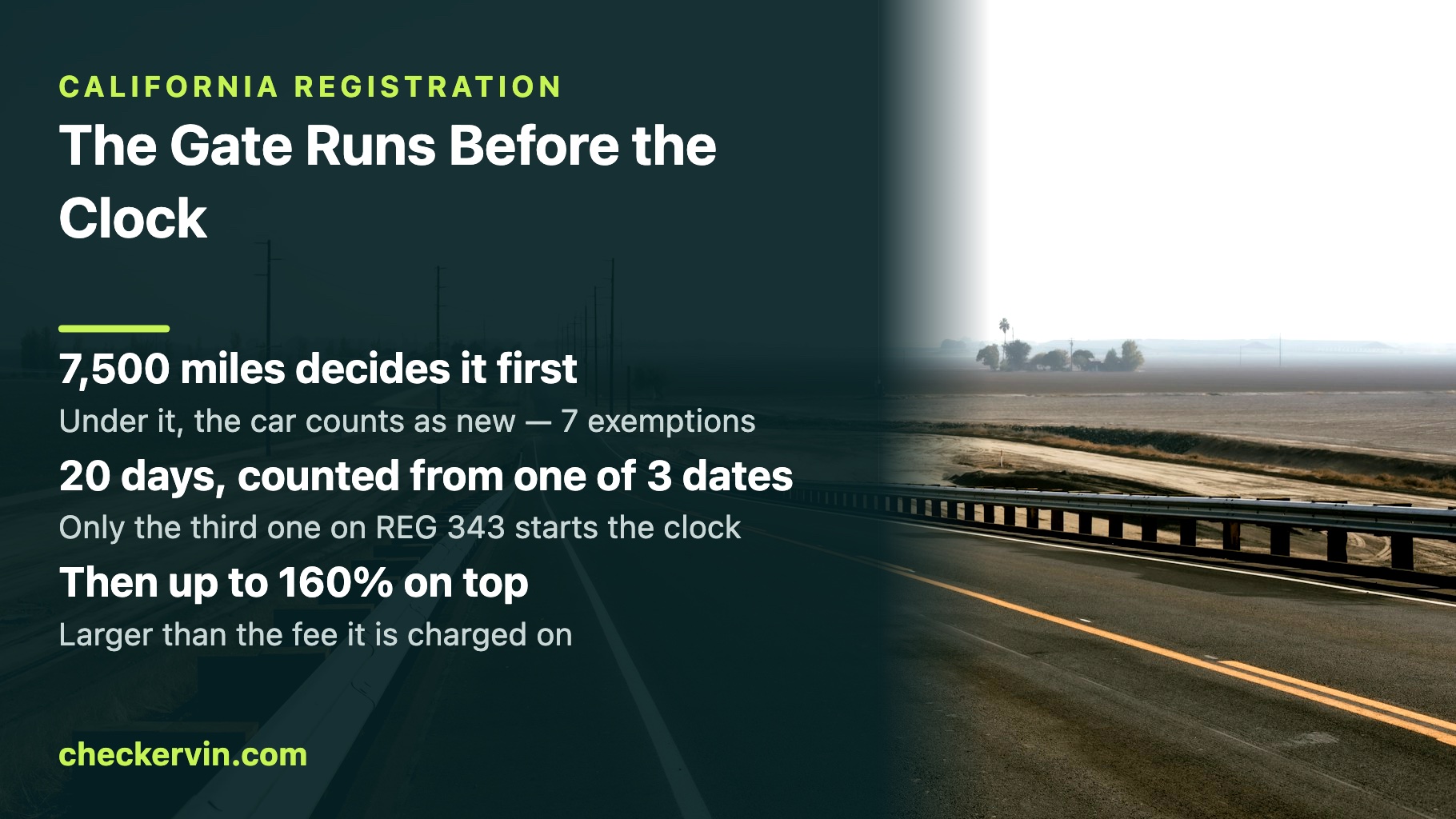
The question that comes before all the others
Almost every guide to this subject opens with a document list. That is the wrong order, because there is a prior question that decides whether the document list matters at all: is this a car California is willing to register?
For most vehicles the answer is yes and you can skip ahead. For a specific and common category — a nearly-new car bought outside California — the answer can be no, permanently, and no amount of paperwork changes it. The DMV’s own guidance says the department cannot accept an application to register a vehicle in California that does not qualify for registration. It is worth five minutes to establish which situation you are in before you book anything.
The 7,500-mile rule
California does not use the ordinary meaning of the word new. Its Fast Facts sheet FFVR 29 states the definition without hedging: California considers any vehicle with less than 7,500 miles on the odometer at the time of purchase or trade by a California resident or business, to be a new vehicle. This is true whether or not the vehicle has been registered in another state.
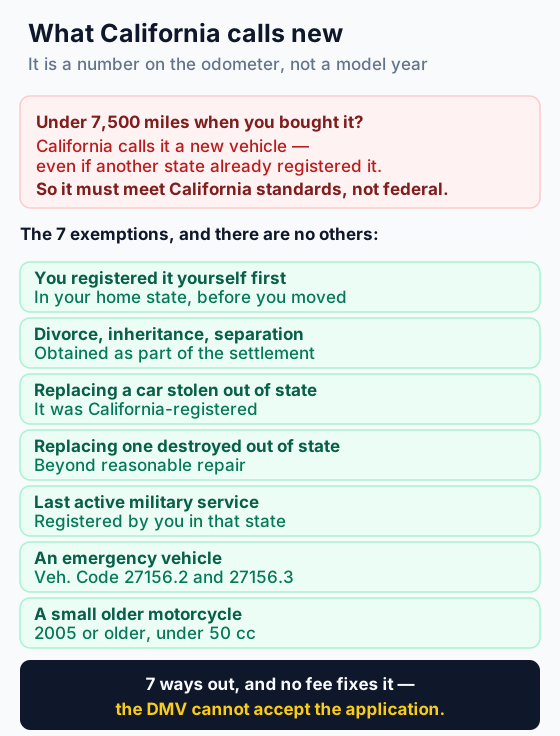
The consequence is emissions. A new vehicle must be certified to California standards rather than merely federal ones, and as FFVR 29 explains, not all new vehicles are manufactured to be sold in California. Many manufacturers make vehicles to be sold only in the other 49 states. These vehicles (49-state) are made with smog equipment that meets federal emission standards, but not California standards.
So the trap has a precise shape. A car with 6,000 miles, titled and plated in Nevada, bought by a Californian, is a new 49-state vehicle in California’s eyes. It is entirely legal in Nevada. It cannot be registered here.
Reading the label yourself, before anybody else does
You do not need an expert for this and you should not take a seller’s word for it. FFVR 29 gives the test in one sentence: to find out whether a car, truck, or motorcycle is California certified, check the emission label under the hood… The label should read that the vehicle conforms to California regulations, or that it is legal for sale in California.
The label is a small sticker, usually on the underside of the hood or on the strut tower, and the wording is the whole answer. California’s own inspection form treats it the same way — section 9 of Form REG 31 makes the verifier check exactly one of vehicle meets US EPA standards only, vehicle meets US EPA standards and California standards, or vehicle meets California standards only. A 49-state car declares itself in that box.
The seven ways around it
FFVR 29 lists the exemptions, and one of them is the reason most people moving to California never notice the rule exists. If you are moving here from another state, you may register a new 49-state vehicle if it was first registered by you in your home state, or for military personnel, in the last state of your military service. When applying for vehicle registration in California, you must provide evidence that the vehicle was registered.
Read the last sentence carefully, because it turns a legal question into an evidence question. The exemption is not that you moved. It is that youregistered the car, in your name, in your old state, and can prove it. A car bought in the last weeks before a move and never registered anywhere does not qualify, and neither does one titled in a relative’s name.
The remaining exemptions are narrow and specific: a vehicle obtained as part of a divorce, inheritance or legal separation settlement; one bought to replace a California-registered vehicle stolen while you were out of state; one bought to replace a California-registered vehicle destroyed or made inoperative beyond reasonable repair while out of state; an emergency vehicle under sections 27156.2 and 27156.3; a vehicle registered by you in the state of your last active military service; and a street motorcycle or motor-driven cycle of model year 2005 or older with an engine under 50 cubic centimeters.
The 20 days, and the event that starts them
Assuming the car qualifies, the deadline is short. Vehicle Code section 6700(a) permits a non-resident to operate a vehicle registered elsewhere until gainful employment is accepted in this state or until residency is established in this state, whichever occurs first, and then requires that the application be made within 20 days of that event.
Notice that the twenty days do not run from your arrival, from the day the car crossed the border, or from the day you first drove it here. They run from a job or from residency, whichever is earlier. A person who accepts a California position in March and physically moves in June has been running a clock since March.
A second statute covers the case where the vehicle is registered elsewhere but a California resident is using it regularly: section 6700(c) requires that resident to register it within 20 days after its first operation within this state. And section 4152.5covers the general case in one sentence, adding a detail worth knowing — the filing shall be deemed an original application, not a transfer. California is not continuing your old registration; it is starting a new one.
The three dates the form actually wants
The application itself, Form REG 343, is more precise about this than any guide to it. Its Date Information block does not ask for one date. It asks for 3.
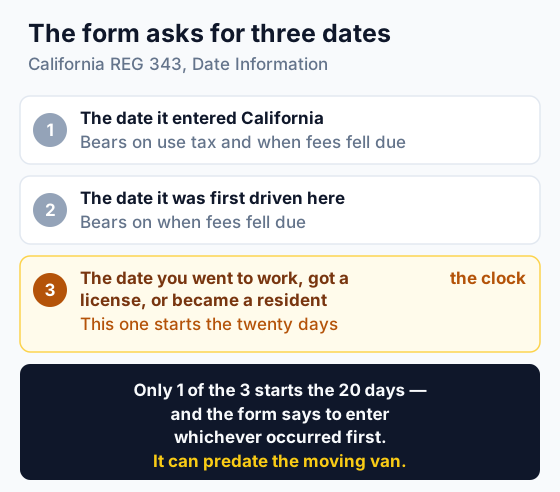
The form asks for the date the vehicle entered or will enter California, the date it was first operated in California, and then the one that matters: the date you went to work in California, obtained a CA driver license, or became a resident, with the instruction to enter the date whichever occurred first.
That third field is section 6700(a) rendered as a blank line, and it is answered in your own handwriting. The first two are not idle: they bear on use tax and on the date fees became due. But only the third one carries the 20 days.
The VIN verification
California wants somebody to look at the car. The instrument is Form REG 31, Verification of Vehicle, and its header carries an instruction in capitals: NOT TO BE COMPLETED BY APPLICANT.
The form must be legible and completed IN FULL by an authorized signer while PHYSICALLY inspecting complete and assembled vehicles, and its list of what a licensed verifier may verify begins with nonresident vehicles— which is what your car is until California titles it. Treat the verification as part of the process rather than something to ask about later.
The form is also brittle by design. Its warning reads that any missing sections, alterations, cross-outs, or erasures (even when initialed) will void this form and a new verification must be completed, and every one of its nine numbered sections must carry at least one checked box. A neat correction is not a correction; it is a second appointment. The full anatomy of the form, and what its asterisked findings trigger, is on VIN inspection.
Who is allowed to sign the verification
Four categories, named on the form itself: an authorized DMV representative, California licensed vehicle verifier, authorized auto club employee, or peace officer who has been properly trained to perform vehicle verifications. Two of the four are not government, which is why a private verifier can often see you sooner than a field office.
What a private verifier may not touch is the more useful list, and it is on the same form. A licensed verifier is forbidden from verifying vehicles whose federal certification label disagrees with the VIN or is illegible, damaged, tampered, altered, missing or never issued; revived salvage or revived junk vehicles; specially constructed vehicles; used motorcycles with an unavailable California record; vehicles with documents from a foreign country; and motorcycles with engine changes.
The form’s instruction for everything else is unambiguous: all other vehicle verifications or verifications with no supporting ownership document must be referred to the DMV or CHP for inspection. If your car is a rebuild, an import, or came without paperwork, paying a private verifier buys you a form that will be rejected.
The smog certificate
Separately from the certification question above, California requires a smog certificate for a vehicle arriving from another state. Vehicle Code section 4000.2 directs the department to require, on registration of a vehicle previously registered outside this state, a valid certificate of compliance or a certificate of noncompliance, as appropriate.
Two things follow. First, this is a test of the individual car’s current emissions performance, which is a different question from whether the model was ever certified for sale here — a car can be California-certified and still fail a smog test because something on it has stopped working. Second, the statute carves out model years exempted from biennial inspection under Health and Safety Code section 44011, so the newest vehicles are treated differently.
The buyer-side version of this question — how to judge whether a specific used car will pass, and what a modified car’s executive order numbers mean — is on California VIN check. The test log itself, where one exists, is on smog check history.
What goes in the envelope
With the qualifying questions settled, the paperwork is ordinary.
- The completed REG 343, Application for Title or Registration, with all three dates filled in
- The out-of-state certificate of title — California grants full faith and credit to a currently valid title from the state of last registration, including the liens recorded on it
- The completed REG 31 verification, signed by somebody authorized, under penalty of perjury
- A valid smog certificate of compliance, or of noncompliance where that is what applies
- Your out-of-state license plates, for surrender
- Proof of the sales tax you paid to another state, if you want credit against use tax
- For a pickup over 8,001 lbs unladen or 11,499 lbs GVWR, or a commercial vehicle at 10,001 lbs or more, a REG 4008 declaration of gross vehicle weight
Your old plates have to go back
This is a statutory requirement rather than a courtesy, and it surprises people who assumed they would keep the plates as a souvenir. Vehicle Code section 4301 says the applicant shall surrender to the department all unexpired license plates, seals, certificates, or other evidence of foreign registration as may be in his possession or under his control, and adds that where the applicant fails to surrender them, the department may require a certification from the jurisdiction of last registry.
REG 343 asks you to declare what happened to them — expired, surrendered to DMV, destroyed, retained, or returned to the issuing state. Some states require their plates back too, so check before you throw them away; returning them to the old state and declaring that on the form is often the tidier route.
Use tax, and the credit for tax you already paid
California charges use tax on a vehicle brought in from elsewhere, and it is not an afterthought at the counter. Vehicle Code section 4300.5 makes the application for registration of a vehicle previously registered outside the state one that shall be accompanied by payment of the amount required to be paid under the Revenue and Taxation Code. The tax travels with the application.
There is relief for tax already paid. REG 343 asks, for vehicles entering the state within one year of purchase, whether sales tax was paid to another state, and states that the amount will be credited toward any Use Tax in CA. It also notes that a vehicle last registered in another state may be eligible for a Use Tax exemption, and points to the California Department of Tax and Fee Administration rather than the DMV for the detail.
Two practical consequences. Keep the out-of-state purchase paperwork showing tax paid, because the credit is evidential. And treat the one-year mark as a real boundary in the form’s own wording rather than as a rule of thumb.
What it actually costs
The number that gets quoted is the base registration fee, and it is the smallest component. Vehicle Code section 9250 sets it: a registration fee of fifty-three dollars ($53) shall be paid to the department for the registration of each vehicle or trailer coach.
| Component | What decides it |
|---|---|
| Base registration fee — $53 | Fixed by Vehicle Code section 9250 |
| Vehicle license fee | Calculated from the vehicle's value under the Revenue and Taxation Code, so it varies enormously between cars |
| County and district fees | Where you live |
| Use tax | The vehicle's price, less credit for sales tax proved paid elsewhere |
| Smog certification | Set by the licensed station, not by the state |
| VIN verification | Set by whoever performs it — Form REG 31 names no fee |
| Weight fees | Commercial vehicles and heavier pickups only |
The vehicle license fee is the one that makes the total unpredictable, because it is a function of value rather than a flat charge. Anyone quoting you a single all-in figure for registering an out-of-state car in California without knowing what the car is worth is guessing.
The penalty for filing late, which is two penalties
Every page about this prints the twenty days. Almost none prints what day twenty-one costs, which is the only reason the deadline has force. Vehicle Code section 9554 runs two penalties side by side.
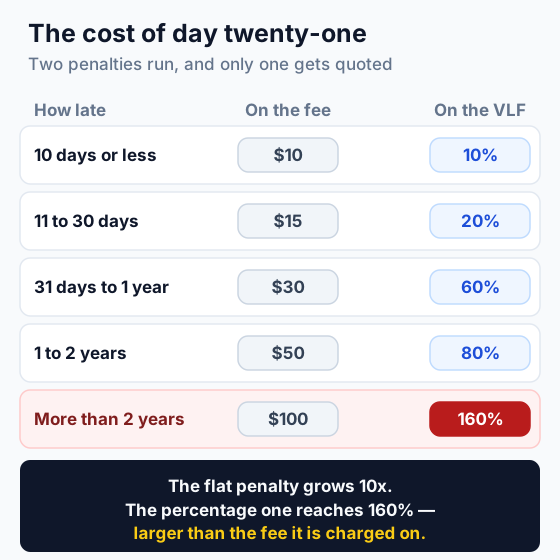
The flat penalty attaches to the registration fee and is trivial: $10 at ten days or less, rising to $100 beyond two years. That is the column every summary quotes, and quoting it alone makes lateness look cheap.
The second column attaches to the vehicle license fee and weight fees and is a percentage: 10 per cent, then 20, then 60, then 80, then 160 per centbeyond two years. Because the vehicle license fee is a function of the car’s value, that percentage is charged on the largest line in the transaction — and at the top band the penalty exceeds the fee it is levied on.
If you have already missed the deadline, file anyway and file now. The bands are cumulative in the sense that every one you cross costs more, and there is no band in which waiting improves the position.
If you do not have a California license yet
This is one of the most common worries about the sequence, and the statute is more relaxed about it than the folklore. Vehicle Code section 4150 requires the driver’s license or identification card number, if any of the owner. Those two words do real work: the statute does not require a California license, it requires the number you have.
REG 343 matches that, giving each owner a license number field with a state column beside it, which accepts any state’s number. The vehicle obligation and the license obligation are separate duties on separate clocks, and neither statute makes one a precondition of the other.
That said, a counter may ask for local proof of address for its own purposes, and having the license already usually removes friction even where nothing requires it. Do not, however, let a license appointment several weeks out push the vehicle application past its own deadline — those are the days that carry the section 9554 penalties.
Why none of this happens online
People reasonably expect a modern DMV to handle this on a website, and the reason it cannot is not technological. Three of the required steps are physical by definition.
- 1Somebody has to look at the carForm REG 31 requires completion while physically inspecting complete and assembled vehicles, and forbids the applicant from completing it. That cannot be uploaded.
- 2The plates have to be handed overSection 4301 requires surrender of all unexpired plates, seals, certificates or other evidence of foreign registration in your possession or control.
- 3The out-of-state title has to change handsCalifornia grants full faith and credit to the title issued by the state of last registration, which means taking custody of it rather than viewing a scan.
Online renewal, which does exist, is a different transaction on a registration California has already issued. An out-of-state vehicle is filing an original application — section 4152.5 says so in terms — and originals are handled in person.
If you are buying rather than moving
Everything above assumes you already own the car. If you are about to buy one that sits outside California, the order of operations changes, because two of the questions on this page should be settled before money moves rather than after.
- Read the emission label under the hood yourself, or get a clear photograph of it, before you agree a price
- Check the odometer against the 7,500-mile threshold, because a low-mileage 49-state car is the specific thing California will refuse
- Confirm the seller holds a currently valid title in their own name — California grants full faith and credit to that document, and to any liens on it
- Ask whether the car has ever been a salvage or revived salvage, because a licensed verifier is forbidden from verifying one
- Get the out-of-state sales tax paperwork, because it is the evidence for your use tax credit
The transaction mechanics of an interstate purchase — transit permits, bills of sale, the odometer disclosure on the title itself — are on buying a car out of state. If the seller cannot produce a title at all, that is a different and much longer road, set out on registering a car without a title.
What to check before you commit
Two of the failure modes on this page are discoverable in advance for nothing, and both are worth the few minutes.
The first is the vehicle itself. Confirm the VIN is structurally valid and decodes to the car described, which a free VIN lookup will tell you. If the number does not describe the vehicle in the photographs, nothing downstream repairs that, and you would rather find out before an inspector signing under penalty of perjury does.
The second is the record. A brand recorded in another state travels with the vehicle, and a revived salvage is precisely the category California will not let a private verifier touch. A salvage title VIN check answers that before you have a car parked outside a field office. If the vehicle has crossed several state lines on its way to the listing, title washing explains what to look for in the sequence of titles.
Neither of those replaces the REG 31, and we would not suggest otherwise. They tell you whether the appointment is worth booking.
Where this information comes from
- California Vehicle Code 6700 — non-resident vehiclesPermits operation on foreign plates until gainful employment is accepted or residency established, whichever occurs first, and requires the application within 20 days of that event.
- California Vehicle Code 4152.5 — vehicles last registered elsewhereRequires the application within 20 days of the date registration became due, and states that it shall be deemed an original application.
- California Vehicle Code 4000.2 — certificate of complianceRequires a valid certificate of compliance or noncompliance on registration of a vehicle previously registered outside California, subject to the model-year exemptions in Health and Safety Code section 44011.
- California Vehicle Code 4300.5 — use tax with the applicationRequires the application to be accompanied by payment of the amount due under the Revenue and Taxation Code for the applicant's use of the vehicle.
- California Vehicle Code 4301 — surrender of foreign registrationRequires surrender of all unexpired plates, seals, certificates or other evidence of foreign registration in the applicant's possession or control.
- California Vehicle Code 9554 — late registration penaltiesSets the flat penalty on the registration fee at $10, $15, $30, $50 and $100 by band, and the percentage penalty on the vehicle license fee and weight fees at 10, 20, 60, 80 and 160 per cent.
- California Vehicle Code 4150 — application contentsRequires the owner's driver's license or identification card number, 'if any' — the qualifier that accommodates an owner without a California license.
- California DMV Fast Facts FFVR 29 — buying or moving a vehicle to CaliforniaDefines a vehicle under 7,500 miles at purchase as new whether or not another state registered it, explains 49-state vehicles, gives the emission-label test, and lists the exemptions including the one for vehicles the owner first registered in their home state.
- California Form REG 343 — Application for Title or RegistrationAsks for three dates in its Date Information block, provides the sales-tax credit declaration for vehicles entering within a year of purchase, and requires the disposition of out-of-state plates.
- California Form REG 31 — Verification of Vehicle (REV. 5/2025)Not to be completed by the applicant; names the four authorized signers; lists nonresident vehicles first among permitted verifications and sets out the six categories a licensed verifier may not touch.
Keep reading
Frequently asked questions
How long do I have to register my out-of-state car in California?
Twenty days, and the count does not start when you arrive. Vehicle Code section 6700(a) lets you drive on your old plates until gainful employment is accepted in California or residency is established, whichever occurs first, and then requires the application within 20 days of that event. Accepting a job that starts in California can begin the clock before you have moved anything.
Can California refuse to register my car at all?
Yes, and this is the part that catches buyers. California treats any vehicle with fewer than 7,500 miles at the time of purchase as a new vehicle, whether or not another state registered it first. A new vehicle has to be certified to California emission standards, not just federal ones, and the DMV's own guidance says it cannot accept an application to register a vehicle that does not qualify. There are 7 exemptions, and the main one for movers is that you registered the car yourself in your home state before moving.
Do I need a VIN verification to register an out-of-state car in California?
Treat it as required. Form REG 31 lists nonresident vehicles first among the verifications a licensed vehicle verifier is permitted to perform, and the form must be completed in full by an authorized DMV representative, a California licensed vehicle verifier, an authorized auto club employee, or a trained peace officer, while physically inspecting the vehicle. The applicant may not complete it.
How much does it cost to register an out-of-state car in California?
The base registration fee is $53 under Vehicle Code section 9250, and it is the smallest part. On top of it sit the vehicle license fee, which is calculated from the vehicle's value, any county and district fees, the smog certification, the VIN verification if you pay somebody to do it, and use tax under section 4300.5 — reduced by any sales tax you can prove you already paid to another state.
What happens if I register late in California?
Two penalties run at once, and only the small one gets quoted. Vehicle Code section 9554 adds a flat penalty to the registration fee — $10 at ten days or less, rising to $100 beyond two years — and separately adds a percentage penalty to the vehicle license fee and weight fees, running from 10 per cent to 160 per cent over the same bands. At the top band the percentage penalty is larger than the fee it is charged on.