The short answer
- Who can do one?
- Whoever the state names. In 3 of the five states below only a government signature counts; in California and Oregon a licensed private party may sign.
- What does it cost?
- $9 to $55 where a state publishes a figure. Two of the five publish none, so ask before you book rather than after.
- What if it fails?
- It is referred to law enforcement rather than returned to you. That is the part the state pages leave out.
No federal rule
Physical inspection is entirely state law
28 CFR 25.54 requires a database check, not a look
$9–$55
Published fee range across the states below
Oregon, Kansas, Colorado
2 of 9
Sections of California's form that can halt it
REG 31 (REV. 5/2025)
Class C felony
Removing a Washington total-loss marking
RCW 46.12.560(1)(c)
What a VIN inspection is, in one paragraph
Somebody the state trusts stands next to your car, finds the identification number on it, and writes down what they see: where it is, how it is fixed to the vehicle, what condition it is in, and whether it is the same number as the one on the title in your hand. Washington’s statute states the object without decoration — the inspection must verify that the vehicle identification number is genuine and agrees with the number shown on the certificate of title and registration certificate.
That is the whole job. It is not a safety check, not an emissions test, and not a valuation. It is a comparison between an object and a document, performed by somebody with no stake in the answer, and everything else on this page follows from how seriously individual states take that comparison.
Why a state wants to look at the car at all
A state issuing a title is making a public assertion that a specific vehicle exists and that a specific person owns it. Everything downstream — the lien, the insurance policy, the eventual sale — hangs off that assertion. The only part of it a clerk cannot verify from a screen is the first half: that the vehicle exists and is the one described.
There is a federal check, and it is worth being precise about what it does. 28 CFR 25.54 requires states to report titling information into the national system and to query that system before issuing a title in defined circumstances. It is a records check. It does not require anyone to walk outside and look at a car. No federal rule mandates a physical VIN inspection at all. Every requirement described below was written by a state legislature or a state agency, which is exactly why they do not agree with one another.
The gap the physical inspection closes is narrow and important. A database can tell a state that VIN 1G1... was last titled in Arizona and carries no brand. It cannot tell the state that the plate riveted to the dashboard of the car in the parking lot was taken off a different vehicle last month. Only somebody looking at the rivets can raise that question, and the forms below are built almost entirely around raising it.
What actually triggers one
The common belief is that moving states triggers an inspection. Sometimes it does, and it is not the general rule. What recurs across the statutes is a narrower principle: the state inspects when the paper trail is thin, foreign, interrupted, or self-contradictory.
| Situation | Why the state wants eyes on it |
|---|---|
| The vehicle arrives with an out-of-state title | The issuing state's records are not this state's records, and the document was printed somewhere it cannot audit |
| The vehicle was a total loss or salvage | Something was rebuilt, and the parts came from vehicles with their own histories |
| The vehicle was assembled, homemade or a kit | There is no manufacturer's number to compare against, because there was no manufacturer |
| The number is altered, missing or unreadable | The comparison the inspection exists to perform cannot be made at all |
| The vehicle was imported | It was built for another market's rules and may carry no US certification label |
| There is no ownership document | The applicant is asking the state to create a title from nothing but the object |
Kansas is a clean example of the principle written down. Its Highway Patrol requires an inspection where the vehicle carries an out-of-state or foreign title, where it has been assembled, reconstructed, reconstituted or restored from one or more vehicles, or where the identification number is in doubt. Three categories, and all three are versions of the same worry.
The most complete trigger list any state prints
If you want to see the logic laid out rather than summarized, read RCW 46.12.560. Washington enumerates its triggers in three separate subsections and between them they name 16 distinct conditions, which is more than any DMV page in the country publishes in one place.
- 1Three conditions on the salvage sideA vehicle declared a total loss or salvage under Washington law; a vehicle rebuilt after the title came back to the department where the owner did not keep it; or a vehicle arriving with documents from another state showing a total loss with no valid registration reissued afterwards.
- 2Seven conditions on first titlingAssembled, glider kit, homemade, kit vehicle, street rod, custom vehicle, or a vehicle subject to ownership in doubt. Each is a case where no manufacturer's record exists to check the number against.
- 3Six conditions of the number itselfAltered, defaced, obliterated, omitted, removed, or otherwise absent. This group is different from the other two: only the State Patrol may handle it, and the outcome is not a pass but a new number.
Notice what is absent from all 16. Simply arriving from another state with a clean title is not on the list. Washington inspects the wreck, the homemade car and the damaged plate — it does not inspect the ordinary car that crossed a border. Compare that with Kansas and Colorado, where the out-of-state title is itself the trigger, and you have the reason no national answer exists.
What does not trigger one
It is worth naming the exemptions, because assuming an inspection you do not need costs an appointment and a fee.
- A brand-new vehicle with a manufacturer's certificate of origin — Kansas exempts these outright, because the document and the vehicle came from the same place at the same time
- All-terrain vehicles, wheeled all-terrain vehicles and utility-type vehicles in Washington, exempted by statute from the identification number inspection
- Renewing a registration you already hold — the inspection belongs to titling, not to keeping a car on the road
- A transfer between two people within a state that inspects only on entry
Who is allowed to sign it
This is the question behind almost every search on the subject, and the honest answer is that it depends on which line you are standing in. Below are five states read from their own forms, statutes and agency pages.
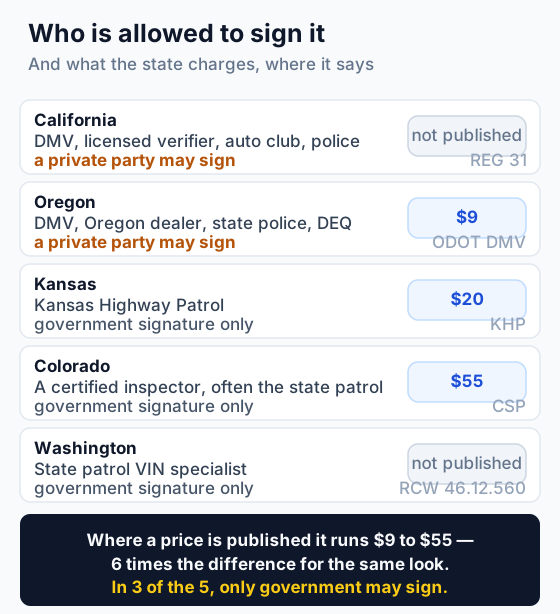
The single rule that survives every jurisdiction is the one that makes the exercise meaningful: you cannot verify your own vehicle, and neither can the person selling it to you. The value of the signature is that it belongs to somebody with nothing to gain from the answer.
When a private party may sign, and what that changes
California and Oregon both license private parties to perform verifications, and the practical difference is enormous: it is the difference between waiting for an appointment and driving to a shop.
California’s Form REG 31 names the four acceptable signers in its own header. The form must be completed by an authorized DMV representative, California licensed vehicle verifier, authorized auto club employee, or peace officer who has been properly trained to perform vehicle verifications, while PHYSICALLY inspecting complete and assembled vehicles. Two of those four are not government.
Oregon spreads the authority differently. Its DMV performs inspections, licensed Oregon dealers may perform them on most vehicles they sell, another state’s motor vehicle agency or a law enforcement officer may do it if the vehicle is out of state, and the Department of Environmental Quality may do it — but only where an emissions test is required at the same time. That last condition is the sort of thing that turns a wasted trip into a single visit if you know it in advance.
What it costs
Where a state publishes a figure at all, the range across the table above runs from $9 to $55 — roughly 6times the difference for the same person performing the same comparison. Oregon charges $9. Kansas charges $20. Colorado charges $55, and the Colorado State Patrol’s own notice sets that figure from 1 July 2026, so an older page quoting a lower number is out of date rather than wrong.
Two of the five publish nothing, for two different reasons. California’s REG 31 sets no fee because the form is not a price list and a licensed private verifier sets their own charge. Washington’s statutory figure — five dollars, under RCW 46.17.135— is not an inspection fee at all: it is what you pay when the State Patrol has had to assign a number to a vehicle that no longer had one. Quoting it as the cost of an inspection would be repeating a mistake several aggregator pages have already made.
Budget for the fee as the smallest part of the cost. The expensive part is the appointment, and in several states the appointment is not scheduled on your timetable.
What the inspector actually fills in
Almost no state publishes what its inspector writes down. California does, and because it does, its form is the best available answer to the national question. Form REG 31 (revised May 2025) has 9 numbered sections, and its instructions require that all numbered sections (1–9) below must have at least one box checked in each section. Blank is not an option; sections that do not apply are marked N/A.
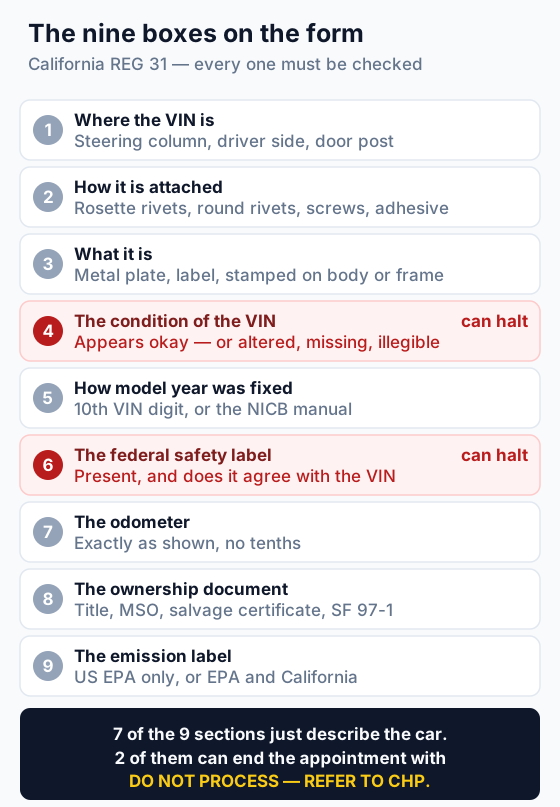
Read the shape of it rather than the individual boxes. Sections one, two and three ask where the number is, how it is attached — rosette rivets, round rivets, screws, adhesive, stamped — and whether it is a plate, a label, or struck into the body or frame. None of that is about the number. All of it is about whether the number has ever been off the car.
Section seven records the odometer exactly as shown with no tenths. Section eight records which document the number was physically compared to: a certificate of title, an MSO or MCO, a salvage certificate, a US Government Standard Form 97-1, or a registration card. Section nine records what the emission label says, and distinguishes a vehicle meeting US EPA standards onlyfrom one meeting California standards — the check that catches a 49-state car before it becomes somebody’s registration problem.
The two sections that carry consequences are four and six, and they are the subject of the next two parts of this page.
The second document the inspector is reading
Section six of the REG 31 is not about the VIN plate. It is about the US Federal Certification Label, required on 1970 and newer model years, and it asks two questions in sequence: what condition the label is in, and whether it agrees with the VIN.
That is the entire logic of a VIN inspection compressed into one box. The federal certification label is a separate object, applied by the manufacturer in a different place on the vehicle, and federal rules require it to be affixed so that it cannot be removed without destroying or defacing it. Somebody swapping a dashboard plate has to find and match that label too, and the two carrying different numbers is the single most incriminating thing an inspector can find.
Where those numbers disagree, the form does not record a discrepancy for later resolution. It stops. The details of what the label is, where it lives and what it says are on VIN verification; what matters here is that California made the comparison a numbered, mandatory box on a form a private verifier signs under penalty of perjury.
The vehicles a licensed verifier is not allowed to touch
This is the part the commercial listings do not advertise, and it is the most useful thing on this page if you are about to pay a shop. California’s REG 31 sets out what a licensed vehicle verifier may verify in two short items, and what they are forbidden to verify in six.
| A licensed verifier may verify | A licensed verifier may not verify |
|---|---|
| Nonresident vehicles | Any vehicle whose US Federal Certification Label disagrees with the VIN, or is illegible, damaged, tampered, altered, missing or never issued |
| Any vehicle or trailer, excluding used motorcycles, with a supporting ownership document and no California record | Revived salvage or revived junk vehicles |
| Specially constructed vehicles | |
| Used motorcycles with an unavailable California record | |
| Vehicles with documents from a foreign country | |
| Motorcycles with engine changes |
The form’s own instruction on everything else is unambiguous: All other vehicle verifications or verifications with no supporting ownership document must be referred to the DMV or CHP for inspection. If your vehicle is a rebuilt salvage, a home-built car, or anything that arrived from outside the United States, a private verifier cannot help you regardless of what their listing says, and paying one is money spent on a form that will be rejected.
If you are buying rather than registering, the same list is a useful sorting device: it is a state telling you which categories of vehicle it does not trust a private inspection to settle. Two of them — revived salvage and revived junk — are covered from the buyer’s side on buying a car with a rebuilt title.
What a failure actually starts
Every state page on this subject explains where to go and what to bring. None of them explains what happens if the answer is no, which is the only part with consequences attached. A failed VIN inspection is not a resubmission. It is a handover.
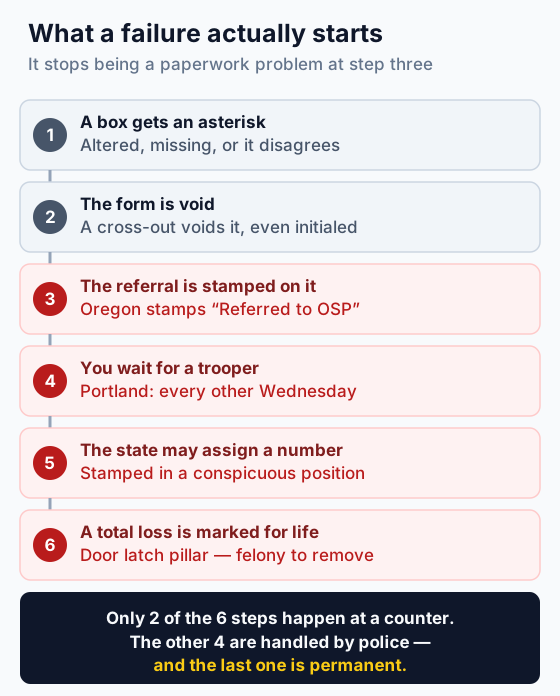
On the REG 31 the mechanism is typographic. Certain options in sections four and six carry an asterisk — cannot locate*, altered/tampered*, missing*, illegible/damaged*, disagrees with VIN*— and the form prints what the asterisk means in a box of its own: DO NOT PROCESS — *REFER TO CHP.
The form is also unusually brittle by design, and this catches honest people. Its warning reads that any missing sections, alterations, cross-outs, or erasures (even when initialed) will void this form and a new verification must be completed. A verifier who miswrites a digit and corrects it has not created a correction. They have created a void form and a second appointment.
When the state issues the car a new number
The sixth group in Washington’s statute — altered, defaced, obliterated, omitted, removed, or otherwise absent — has an outcome the other groups do not. The State Patrol does not pass or fail the vehicle. It shall assign a new vehicle identification number to the vehicle and place or stamp the new number in a conspicuous position on the vehicle, and the department then uses that number as the official identification number for the car.
Two things follow that are worth knowing before it happens to you. The first is that the vehicle’s original number ceases to be its operative identity, so every record keyed to the old number — including its own history — is now reachable only through a number that did not exist last week. The second is that a state-assigned number is visibly not a manufacturer’s number, and any future buyer running a VIN lookup will find a record that begins abruptly. That is not a defect in the record. It is the record accurately describing what happened.
The marking that does not come off
Washington’s rebuilt inspection ends with something physical. The statute directs a State Patrol identification number specialist to ensure that all major component parts used in the reconstruction were obtained legally, and to securely attach a marking at the driver’s door latch pillar indicating the vehicle was previously destroyed or declared a total loss.
If you are looking at a used car in Washington, that pillar is worth a glance and takes two seconds. If the paperwork is clean and the pillar carries a marking, or the paperwork mentions a rebuild and the pillar is bare, you have learned something the seller was not planning to volunteer. What the brand means for value and insurability is on salvage title VIN check.
The invoices behind a rebuilt inspection
A rebuilt-vehicle inspection is not really an inspection of the vehicle. It is an audit of where the vehicle came from, and Washington is unusually explicit about the evidence it demands. A person presenting a rebuilt vehicle must provide original invoices for new and used parts, and the statute specifies what each invoice has to contain and who it may come from.
- From a vendor registered with the department of revenue or its equivalent where the parts were bought, showing business name and address, a description of the parts, the date of sale, and the amount including all taxes paid
- From a licensed vehicle wrecker, or a comparable business in the jurisdiction outside Washington where the part was bought
- From a private individual — who must hold the certificate of title to the vehicle the parts came from, unless they came from a collector's parts car
- Bills of sale from private individuals must be notarized, and must name both parties, describe the donor vehicle by make, model, year and serial number, and state the price
Read that list as a description of the problem it was written to solve. Every requirement points at the same failure mode: parts arriving from a vehicle nobody can account for. A person who cannot produce an acceptable release of interest or proof of ownership for a part is not turned away — the statute routes them to an ownership-in-doubt application, which is a longer and more supervised road to the same title. The general version of that route is on registering a car without a title.
Washington is at the strict end of this. Other states run the rebuilt process as a records exercise rather than an examination, and in at least one the identification-number check on a rebuild can be self-certified. That comparison — and why a rebuilt inspection is an anti-theft measure rather than a quality assessment — is set out on rebuilt title inspection, which is a different question from the one this page answers.
The appointment is the slow part, not the inspection
The inspection takes a few minutes. Getting somebody to perform it can take weeks, and in the states where only law enforcement may sign, the constraint is trooper availability rather than office hours.
Oregon publishes the reality plainly enough that it is worth quoting the structure. Its DMV instructs you to contact the Oregon State Police for an inspection only if DMV gave you a VIN inspection form with a “Referred to OSP” stamp, and then lists every OSP location with its availability. Most read based on Trooper availability or by appointment only. Portland’s published slot is every other Wednesday, 7:30am to 2:30pm. Salem’s is every other Friday afternoon. McMinnville does Fridays.
Colorado says the same thing in the language of software. Its booking page warns that the portal only displays appointment slots within a two-month time frame, and that if you cannot find a time, it is because no appointments are available. An empty calendar is not a bug to work around; it is the queue.
That is not an Oregon peculiarity, it is Oregon being unusually honest in public. If your state routes inspections through its highway patrol, assume the same shape and start the process before the registration deadline rather than near it. The deadlines themselves, which run from twenty days to ninety depending on the state, are on registering a car in another state.
What to bring, and what to do the night before
The inspection compares an object to a document, so the failure modes are: the document is missing, or the object is not readable.
- 1Bring the ownership document itselfNot a photocopy and not a photograph. California's form names the acceptable types — certificate of title, MSO or MCO, salvage certificate, US Government SF 97-1, or registration card — and the inspector has to physically compare the number on the vehicle to it.
- 2Clean the two places the number livesThe dashboard plate under the windshield and the certification label in the driver's door opening. A layer of grime on either is a legitimate reason for an inspector to record illegible, and illegible is one of the findings that stops the process.
- 3Bring the car, assembledCalifornia's form specifies verification while physically inspecting complete and assembled vehicles. A project on a trailer with the doors in the trunk is not a vehicle for this purpose.
- 4If it is a rebuild, bring the paper trailOriginal parts invoices, notarized bills of sale for anything bought privately, and the titles or documentation for donor vehicles. This is the part that takes weeks to assemble and cannot be done in the queue.
- 5Decode the number firstConfirm the VIN you have is structurally valid and describes the vehicle in front of you. If it does not, you want to know that at home rather than in front of somebody filling in a form under penalty of perjury.
What an inspection cannot tell you, and what a check cannot
It would be convenient for us to suggest that running a VIN check is an alternative to a VIN inspection. It is not, and anybody telling you otherwise is selling something. The two answer different questions and neither one covers the other’s ground.
An inspector standing at the car can see what no database holds: whether the plate has been disturbed, whether the rivets are original, whether the certification label matches, whether the number was struck into the frame by a factory or by somebody in a shed. That evidence exists only in the metal, and it is the evidence a state acts on when it refers a vehicle to the police.
A record check sees what no inspector can: a total-loss settlement paid in another state, a lien recorded three owners ago, a title branded and then reissued clean somewhere with weaker rules. A vehicle can pass a VIN inspection perfectly and still be a car you should not buy, because everything wrong with it happened to the paperwork rather than to the plate.
The sensible order is to run the record first, because it is free and takes a minute, and then let the inspection do the thing only an inspection can. Start with a free VIN lookup to confirm the number decodes to the vehicle, and read title washing if the car has crossed more than one state line on its way to you.
Where this information comes from
- California Form REG 31 — Verification of Vehicle (REV. 5/2025)Names the four authorized signers, requires a box checked in all nine numbered sections, sets the permitted and prohibited verifications for licensed verifiers, and prints DO NOT PROCESS - *REFER TO CHP against the asterisked findings.
- RCW 46.12.560 — inspection by state patrol or other authorized inspectorEnumerates the triggers in subsections (1), (5) and (6); requires the inspection to verify the number is genuine and agrees with the title; directs assignment of a new number; and makes removal of the total-loss marking a class C felony.
- RCW 46.17.135 — vehicle identification number reassignment feeSets a five dollar fee where the State Patrol has reassigned an identification number under RCW 46.12.560. It is not a fee for the inspection itself.
- Oregon DMV — vehicle identification number inspectionsSets the nine dollar fee, names DMV, Oregon dealers, DEQ and out-of-state agencies as inspectors, and states that Oregon State Police should be contacted only where DMV has stamped the form 'Referred to OSP'.
- Oregon DEQ — DMV registration and VIN inspectionConfirms DEQ may perform the identification number inspection only where an emissions test is required at the same time.
- Kansas Highway Patrol — motor vehicle inspectionsNames the three triggers — out-of-state or foreign title, assembled or reconstructed vehicles, and an identification number in doubt — exempts a brand-new never-titled vehicle with an MSO or MCO, and prices the normal out-of-state inspection at $20.
- Colorado State Patrol — VIN inspectionsStates that the certified VIN inspection fee increased to $55.00 effective July 1, 2026, and that the booking portal shows only a two-month window — no slot displayed means no appointment available.
- 28 CFR 25.54 — responsibilities of the states under NMVTISRequires states to report titling information and to run a title verification check before issuing a title in defined cases. It requires a records check and does not mandate any physical inspection.
Keep reading
Frequently asked questions
What is a VIN inspection?
A physical inspection in which someone the state authorizes looks at the vehicle in front of them and records where the identification number is, how it is attached, what condition it is in, and whether it matches the ownership paperwork. Washington's statute puts the purpose plainly: the inspection must verify that the vehicle identification number is genuine and agrees with the number shown on the certificate of title and registration certificate.
Who can perform a VIN inspection?
It is set state by state and the answer is not consistent. Of the five states set out on this page, 3 accept only a government signature — the highway patrol, the state patrol, or a motor vehicle employee. California and Oregon also let a licensed private party sign: California accepts a licensed vehicle verifier or an authorized auto club employee, and Oregon accepts an Oregon dealer or the Department of Environmental Quality where an emissions test is happening anyway. You can never verify your own vehicle.
How much does a VIN inspection cost?
Where the state publishes a price it ranges from $9 to $55 across the states below — Oregon charges $9, Kansas $20 and Colorado $55, about 6 times the spread for the same look at the same plate. Two of the five publish no single figure. California's Form REG 31 sets no fee at all, and a licensed private verifier is not a government office with a posted price list, so ask before you book.
What happens if a VIN inspection fails?
It stops being a motor vehicle matter. On California's REG 31 the findings that matter carry an asterisk, and the asterisk means do not process and refer the vehicle to the California Highway Patrol. Oregon stamps the form 'Referred to OSP' and only a stamped form gets a state police appointment. Where the number is gone entirely, Washington directs the state patrol to assign a new identification number and stamp it in a conspicuous position on the vehicle.
Is a VIN inspection the same as a VIN check?
No, and they answer opposite questions. An inspection examines the metal: is this number real, is the plate original, does it match the paper. A VIN check examines the record: what has been reported about this number by title agencies, insurers and salvage yards. Neither substitutes for the other. An inspector cannot see a flood claim filed in another state, and no database can tell you the plate on the dashboard was fitted last week.