The short answer
- Will the DMV check a VIN?
- Rarely as a lookup. Most states process a record request — a form, a fee and a permitted reason — not a search box.
- Is it free?
- The state record usually is not. The free check people are looking for is federal, and it is genuinely free.
- Will it show accidents?
- No. Nobody reports ordinary collisions to a motor vehicle agency. Damage reaches the record only as a title brand.
50+
Agencies the phrase covers
No single DMV exists
Free
Cost of the federal decode
No account, no card
0
Collision reports a state holds
Damage arrives only as a brand
There is no such agency as the DMV
The phrase is a convenience, and it hides the thing that makes this question hard to answer. Vehicle titling and registration are state functions. There are more than fifty agencies doing the job, they are not called the same thing, they do not hold the same records, and they do not publish the same tools.
So “can the DMV check a VIN” has no single answer, and any page that gives you one is describing one state and hoping. What can be said generally is what a state agency holds and what it is permitted to do with it — and that turns out to be enough to set expectations correctly before you start looking.
What a state actually holds on a vehicle
A state agency’s vehicle file is a paperwork record rather than a history. It exists to answer who may lawfully operate the vehicle and who has a claim on it.
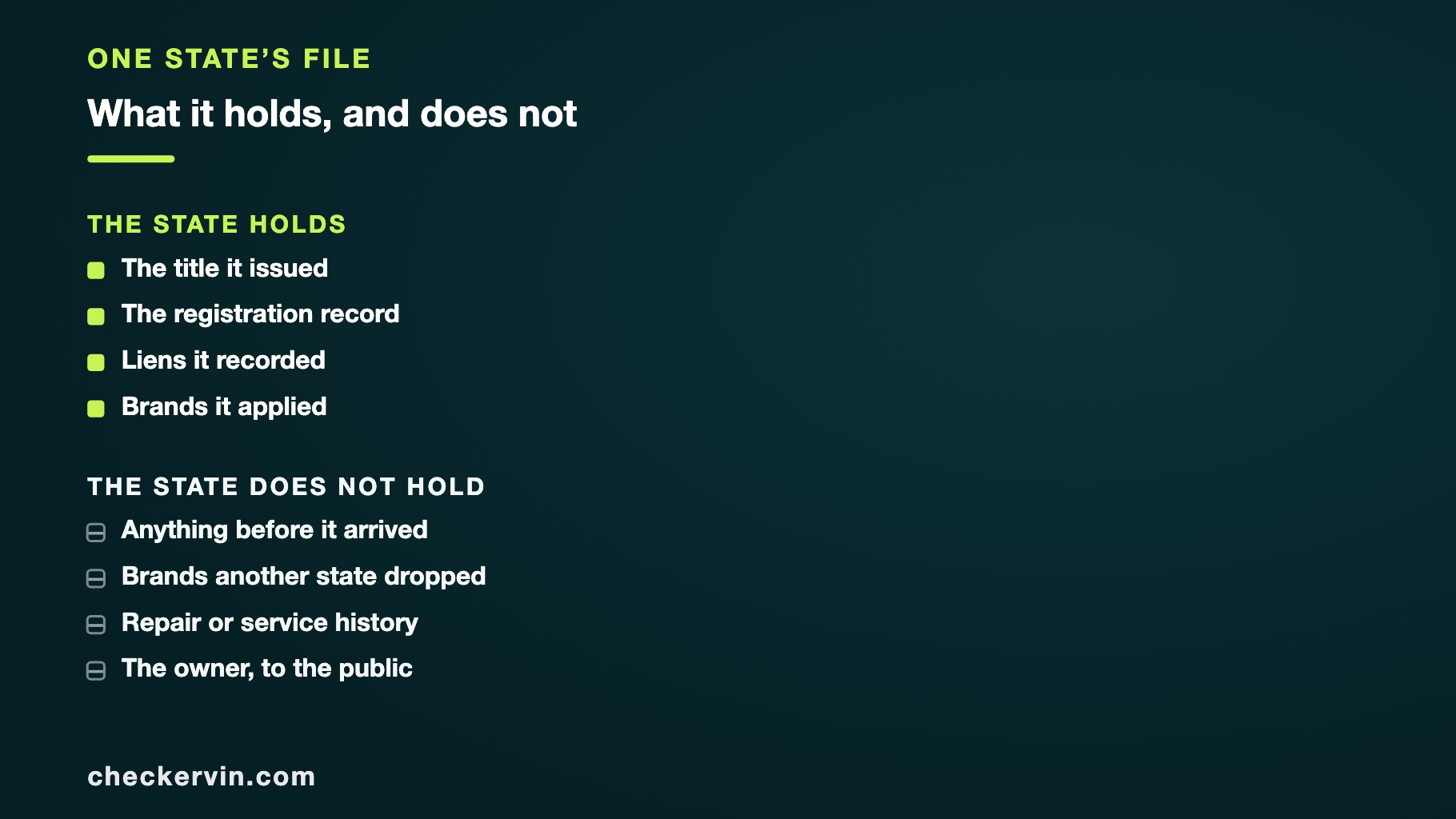
- The title record for vehicles titled in that state
- The registration record, and whether it is current
- Liens recorded against the title
- Any brand that state applied when it issued the title
That is genuinely useful information, and for some questions it is the only authoritative source. A recorded lien is the clearest example: it follows the vehicle rather than the seller, and the state that recorded it is where it lives.
What the same file does not contain surprises people more:
- Anything about the vehicle before it was titled in that state
- Records another state applied and did not pass forward
- Repair or service history, which no government body collects
- The identity of the current owner, to a member of the public
The first two lines are the reason a single state record is a poor substitute for a history. A car titled in three states over its life leaves a record in each, and the state holding it now knows what it was told at the point of transfer — not what happened before that. That gap is exactly what the federal title system was created to close, and the NMVTIS report covers how.
Why it is a request rather than a lookup
The second half of the answer is legal rather than technical. Motor vehicle records carry personal information, and federal law limits what a state may disclose and to whom. The default is that it may not; access runs through a list of permitted uses.
That is why the thing you find is a form rather than a search box. A state can publish a tool that answers a narrow question about a vehicle — is a title issued, is a lien recorded — without disclosing anything about a person. It cannot publish an open window into the file, and a member of the public buying a car privately is not on the list of people entitled to one.
Why a vehicle tool can exist where a person lookup cannot
It is worth being precise about the line, because it explains the shape of every tool a state does publish.
The federal restriction is on personal informationin a motor vehicle record. Among the permitted uses is one covering matters of motor vehicle and driver safety and theft — and a title status or lien indicator can be published without disclosing anything about a person at all. That is the gap a public state tool lives in: a fact about the vehicle, stripped of the human attached to it.
The full permitted-use list, and the three items people routinely misread, are on motor vehicle records. What matters here is only the consequence: state tools answer vehicle questions, not people questions, by design rather than by omission.
A state can tell you nothing about a car it never titled
This is the limit that catches buyers most often, and it is absolute rather than a matter of degree. A state agency’s file starts when the vehicle enters that state’s system. Before that, it holds nothing.
So checking with your own state about a car currently titled three states away is not a weak check — it is not a check at all. And checking with the car’s current state tells you what that state was told when the vehicle arrived, which may be considerably less than its full history if a brand was not carried forward.
| What you want to know | Which record holds it |
|---|---|
| Is a title issued in the state the car is in now? | That state's own tool or record request |
| Is there a lien recorded against it? | The state that recorded it |
| Was it branded somewhere else, earlier? | The federal title system, not any single state |
| Has it been titled in several states? | The federal title system |
The bottom two rows are the whole argument for a federal record existing, and they are the reason a cross-state purchase deserves one before money moves. Our page on buying a car out of state covers the paperwork side of the same problem, and title washing covers what happens when a brand does not survive the crossing.
The free check people are looking for is federal
Most of the search traffic for a free DMV VIN check is looking for something that exists — just not at a state agency. The federal government publishes a VIN decoder that is free, needs no account and no card, and returns the build the manufacturer filed along with any open safety recalls matched to the number.
That is a real check and it rules out a real category of problems. What it does not do is the history half, which is where the confusion starts: people arrive expecting a government history report, find a government decoder, and conclude the free option is useless. It is not useless. It is answering a different question, well, for nothing.
Our page on the NHTSA VIN decoder covers exactly what it returns, including the result codes that tell you how much to trust the answer.
Check any VIN free
Decoded from official manufacturer and NHTSA records
Three routes, three different prices
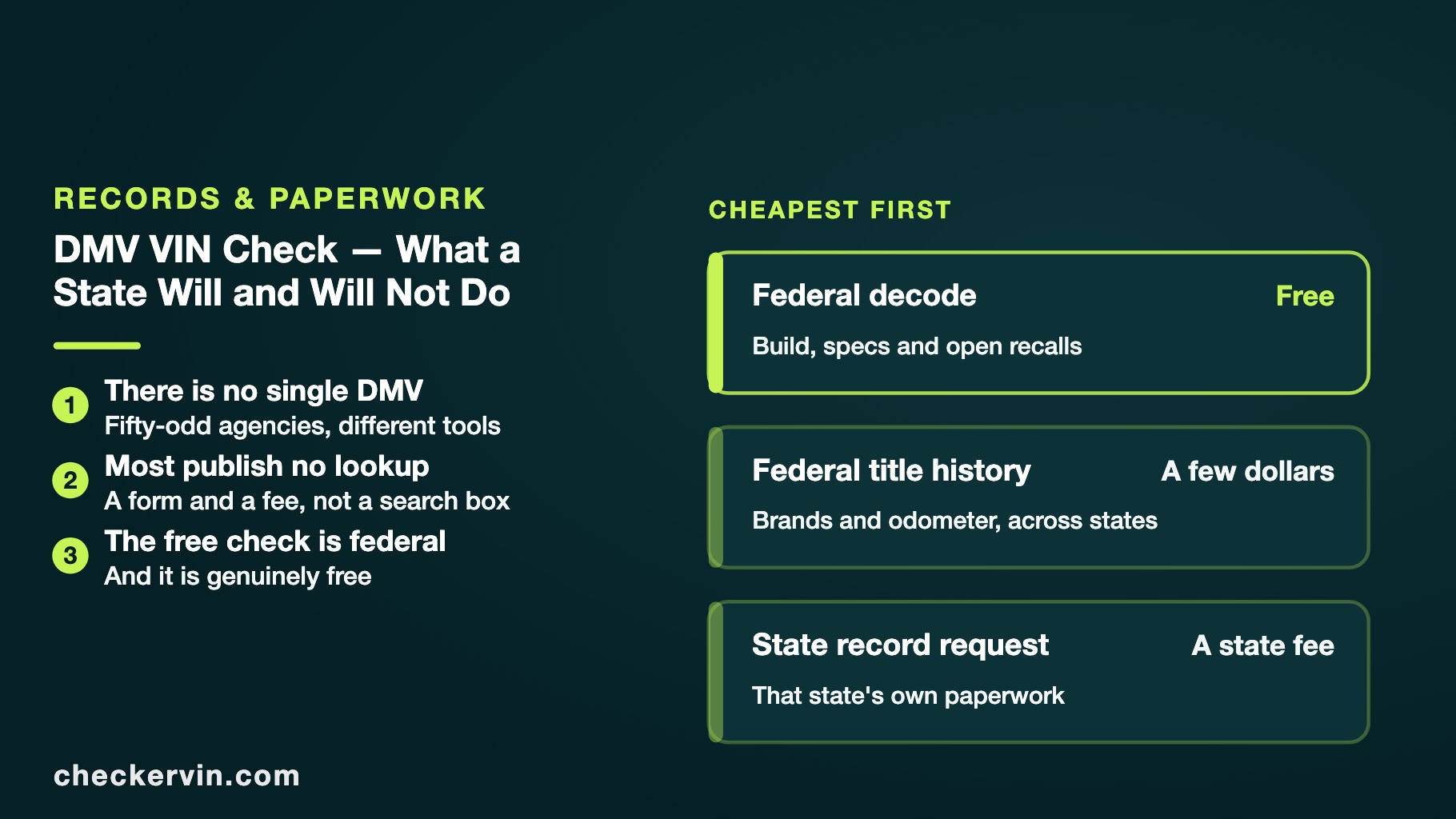
Setting the options side by side makes the choice obvious, and it is not the one most people start with.
| Route | Cost and what it returns |
|---|---|
| The federal decoder | Free — Make, model, year, body, engine, plant — and open safety recalls |
| A state title or record request | A fee, set by the state — That state's title and registration record for the vehicle |
| The federal title history system | A few dollars, through an approved provider — Title, brand, odometer and total-loss records reported across states |
Run them in that order and each step costs more than the last while answering a question the previous one could not. Starting at the bottom — paying for a record before running the free decode — is how people end up buying an answer they already had.
Where a state tool does exist, and what it returns
Some states do publish something public, and it is worth knowing the shape of it before you go looking. The tools that exist are narrow by design: a title status check, a registration status check, sometimes a lien indicator.
What they return is an administrative fact about that state’s own file — whether a title has been issued, whether it is held electronically, whether a lien is recorded. They are not history searches and they stop at the state line. That is not a shortcoming; it is the only thing a state agency is in a position to answer.
We have written these up state by state where there is something to write up. The Florida, Texas, California and New Yorkpages each explain what that state’s tool actually returns rather than what the name suggests, and vehicle registration lookup covers the registration side.
The other DMV VIN check, which is a physical one
One more thing shares the phrase and causes a good deal of confusion, because it is a genuine DMV VIN check — just not a database one.
A VIN verification is an in-person inspection. Somebody authorized to do it looks at the number on the vehicle, compares it against the paperwork, and signs a form saying the two match. States require it in specific situations: a vehicle arriving from out of state, a rebuilt vehicle returning to the road, a title with an unusual history behind it.
The order that costs least
Putting it together for somebody looking at a specific car.
- 1Decode the number free, and read the recallsCosts nothing, takes a minute, and an open recall is free work attached to the vehicle. Do it before you travel to see the car.
- 2Read the title document itselfIt is the one record already in the seller's hands, and federal rule requires security features you can check without any agency's help.
- 3Buy the federal title historyA few dollars through an approved provider, and it covers brands, odometer and total-loss records reported across states rather than one.
- 4Request the state record only if you need that state's paperworkWorth it for a specific document or a recorded lien. Not worth it as a first move, and not a substitute for the step above.
- 5Book a verification if the state requires oneThat is a physical inspection with a form at the end, and it is about registering the car rather than deciding whether to buy it.
For reading the document in step two, the car title check covers the security features federal rule requires and where alteration concentrates.
Where this information comes from
- NHTSA vPIC — VIN decoding APIThe free federal decode described above
- 18 U.S.C. § 2721 — Prohibition on release and use of certain personal informationWhy a state record is a request with a permitted reason rather than a public lookup
- NMVTIS — the federal title history systemThe records that cross state lines, and the approved providers who sell access
- NHTSA recalls by VINFree, and the remedy is free as well
Frequently asked questions
Can the DMV run a VIN check for me?
Usually not in the way people mean. Most state agencies do not publish a VIN lookup that a member of the public can type a number into and read a history from. What they will do is process a request for a copy of the record they hold on a vehicle, which is a form, a fee and a permitted reason rather than a search box.
Is a DMV VIN check free?
The record request generally is not — states charge for copies. The free check people are usually looking for is federal rather than state: the government's VIN decoder returns the factory build and open safety recalls for nothing, with no account and no card. If a page promises a free DMV VIN check, look carefully at which of those two it is actually giving you.
How do I check a VIN with the DMV in my state?
Start on that state's own site rather than an aggregator, and look for the record request process rather than a lookup tool. What is available varies enormously — some states publish a title status check, some a registration check, some nothing public at all. The name of the agency varies too, which is one reason a single answer to this question does not exist.
Why will the DMV not tell me who owns a car?
Because federal law starts from the position that it may not. Personal information in a motor vehicle record is protected, and disclosure is limited to a list of permitted uses. Curiosity is not on that list, and neither is a private sale. What a state can give you about the vehicle is different from what it can give you about the person.
Does a DMV VIN check show accidents?
A state record shows what that state recorded — a title, a brand it applied, a registration, a lien. It does not hold a collision history, because nobody reports ordinary collisions to a motor vehicle agency. Damage reaches the record only when it produces a title brand, which is a much higher bar than a repair.
What is a DMV VIN verification?
A different thing that shares the words. A verification is an in-person inspection where an authorized person confirms the number on the vehicle matches the paperwork, usually required when a car arrives from out of state or has an unusual history. It is a check of the vehicle against the documents, not a search of a database.
What is the cheapest way to check a VIN properly?
Run the free federal decode and recall check first, because it costs nothing and rules out a category of problems. Then buy the federal title history record through an approved provider, which is a few dollars and covers the questions the decode cannot. A state record request is worth it when you need that state's own paperwork specifically.
Keep reading
Run the free check before you pay for anything
Factory build, specifications and open safety recalls, decoded from the VIN. No account, no card.
Run a free VIN check