The short answer
- Can you look up a vehicle's registration?
- Status, often — several states run free official tools that return whether registration is current from a VIN or plate. Owner identity, no — that sits behind the federal Driver's Privacy Protection Act in every state.
- Which states have real lookup tools?
- Florida, Georgia, Wisconsin, Ohio and Connecticut run the most useful public checkers, with several others offering renewal-status pages. The table below maps them.
- Why check registration before buying?
- Because lapsed registration is a bill with a story: renewal fees, possible late penalties, and in testing states an inspection the car may not pass. All of it becomes the buyer's problem at transfer.
Status
What states will show
Current, expired, suspended
Never
Owner identity from a lookup
DPPA, in every state
Free
The official state tools
Where they exist at all
VIN
The better key to search on
Plates recycle; VINs don't
What a registration lookup is — and is not
Registration is the state’s permission for a specific vehicle to use public roads, renewed on a cycle with fees and, in many states, an inspection attached. A registration lookup asks one question: is that permission current? It is a different question from who owns the car (privacy-protected), whether the title is clean (the national NMVTIS record), or what the car is (the VIN decode). Confusing these is how buyers end up thinking one search covered everything.
Status is public-ish; owners are not
The line every state draws comes from the federal Driver’s Privacy Protection Act: personal information in motor-vehicle records — names, addresses — is released only for enumerated permitted uses, while facts about the vehicle can be published more freely. That is why Florida can hand anyone a title-status report from a VIN while refusing to say whose car it is, and why every “find the owner from a plate” website is either lying or breaking the law. The full legal framework is in our license plate lookup guide.
What the law protects, and what it expressly does not
The section above states the conclusion. The statute states the reason, and it is worth reading because it explains the shape of every tool on this page — why a state can publish a status checker and still refuse to tell you a name.
Start with scope. Under 18 U.S.C. § 2725(1), a “motor vehicle record” is any record pertaining to a driver’s permit, a motor vehicle title, a motor vehicle registration, or a DMV-issued identification card. A registration record is squarely inside the Act. Whatever a state publishes about one, it publishes under this framework.
Then the definition that does the work. § 2725(3) defines personal informationas information identifying an individual — photograph, social security number, driver identification number, name, address, telephone number, medical or disability information. Two things in that sentence are easy to miss and both matter:
| The clause | What it does |
|---|---|
| “but not the 5-digit zip code” | A zip code is carved out of the definition, which is why aggregate registration data by area is publishable |
| “does not include information on vehicular accidents, driving violations, and driver’s status” | The whole category of status information sits outside the protected definition — which is what makes a status lookup lawful |
That second clause is the load-bearing one for this page. The Act does not protect vehicle facts and then grant exceptions for lookups. It defines the protected thing as information that identifies a person, and then explicitly puts accidents, violations and status outside it. A registration status tool is not operating in a gray area or under a carve-out. It is handling data the statute never classified as personal in the first place.
There is also a stricter inner tier. § 2725(4) defines highly restricted personal informationas an individual’s photograph or image, social security number, and medical or disability information. Those three move under tighter rules than a name and address do, which is part of why states differ in how much they redact from an otherwise similar record.
Registration, title and insurance are three different things
Most confusion about what a registration lookup proves comes from treating three separate documents as one. They are issued by different processes, they answer different questions, and a car can be perfectly in order on one while failing badly on another.
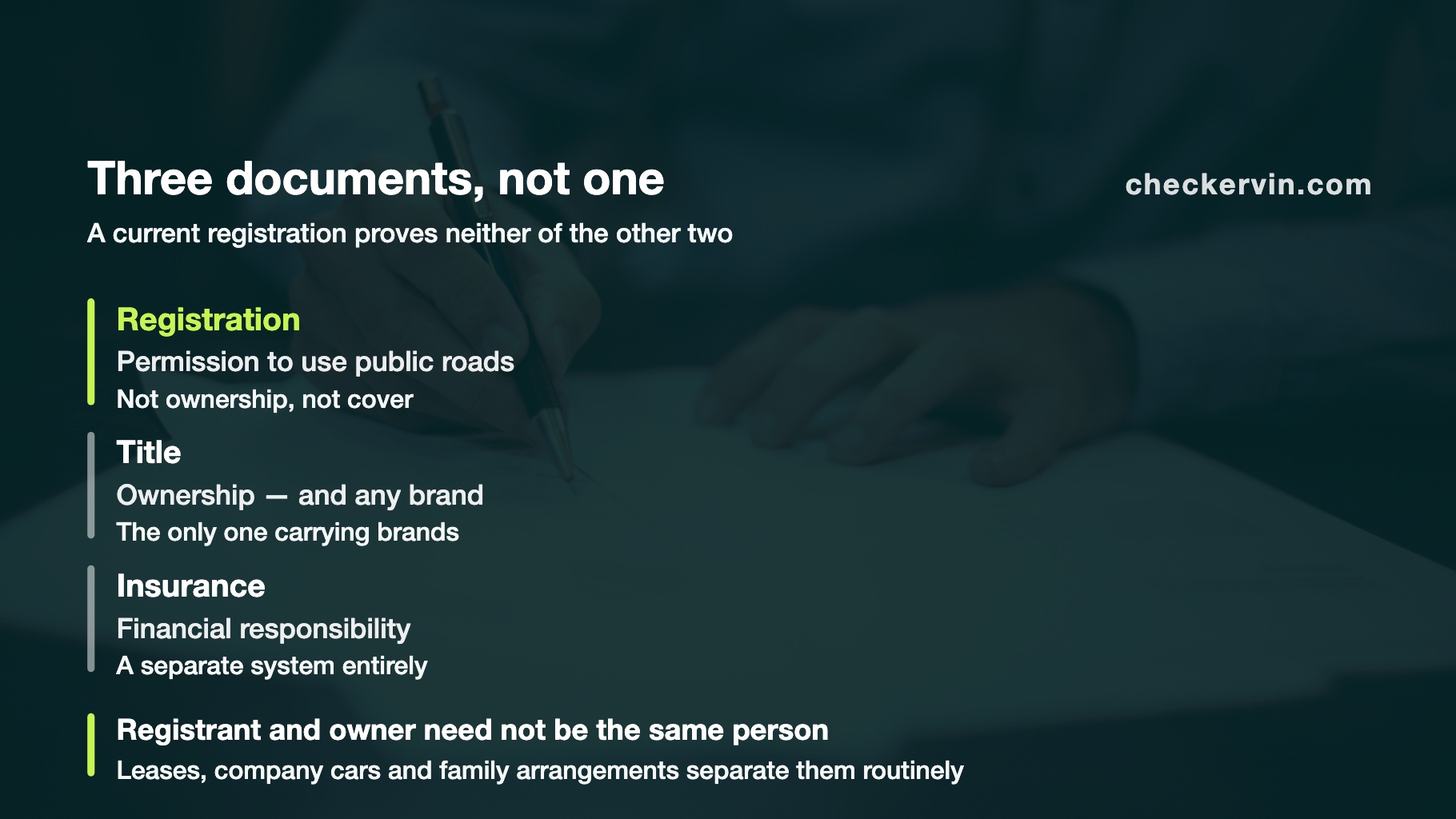
| The document | What it actually establishes |
|---|---|
| Registration | Permission to operate the vehicle on public roads. Periodic, tied to fees and in some states to an inspection or emissions test. |
| Title | The ownership record. Long-lived rather than periodic, and the only one of the three that carries brands. |
| Insurance | Proof of financial responsibility. A separate system, verified electronically in many states but not part of the registration record itself. |
The consequences for a buyer follow directly. A current registration is not evidence of a clean title, because branding lives on the title and a branded car registers like any other. It is not evidence of insurance, because although many states check insurance at renewal, coverage can lapse the day after. And it is not proof that the person holding it owns the car, because a registrant and an owner are not required to be the same party — a leased vehicle, a company car and a family arrangement all separate them routinely.
Read that list as a set of questions rather than a set of doubts. If the registration is current, you have learned something real about how the car has been kept. You have simply not learned the thing the title answers, which is why the federal title record is the check that sits beside this one rather than after it.
Official state tools, state by state
| State tool | What it returns |
|---|---|
| Florida — Motor Vehicle Information Check (FLHSMV) | Title status, registration standing and brand flags from a VIN, free |
| Georgia — DRIVES e-Services (DOR) | Registration and insurance status checks tied to the vehicle record |
| Wisconsin — DMV vehicle inquiry | Registration status and expiration from plate or VIN |
| Ohio — BMV online services | Registration and title lookups against state records |
| Connecticut — DMV verification tools | Registration and insurance compliance status |
| Nevada, Texas, California and others | Renewal-status and insurance-verification pages for the vehicle's own record |
Two patterns to notice. First, the deep tools skew to states that link registration to something enforceable — Florida’s brand flags, Georgia and Connecticut’s insurance verification. Second, most states without a public tool still verify instantly at the counter: the registration card in the seller’s hand, matched against title, VIN plate and ID, is a lookup you can run in any state, in the driveway.
What the status actually tells you
- Current — the owner has kept fees, insurance and any required inspections up to date; the paperwork half of ownership works
- Expired — a bill is riding on the car: renewal, late penalties, and in testing states an inspection it may be avoiding
- Suspended — usually an insurance lapse caught by electronic verification; ask what the car was doing during the gap
- Mismatch — a plate or card that does not match the VIN in front of you is a stop-everything signal, not a paperwork quirk
Reading an expired registration on a car for sale
Lapsed tags are the most common finding a registration check produces, and the reading depends on the state. In smog states — California above all — an expired registration on a running car is presumptively an emissions problem until the seller proves otherwise, because renewal rides on a passing test there. In fee-heavy states like Colorado, walking away from an expensive renewal is common on late-model cars. And everywhere, the catch-up — fees, penalties, inspections — transfers with the car. Price it, or make the seller clear it before closing.
Why the VIN beats the plate here too
Plates recycle — between vehicles in seller-keeps-plate states, at every sale in Washington, on a ten-year cycle in Florida. The VIN never does, which is why the serious state tools key on it and why your checking sequence should too: decode the VIN, run the recall and theft screens, pull the national title record, and run the state status tool where one exists. The plate is scenery; the VIN is the record.
Decode any VIN free
Decoded from official manufacturer and NHTSA records
Why the mail arrives before the plates do
Buy a car and the letters start — extended warranty offers, service reminders from places you have never visited, sometimes addressed to you before the registration paperwork has come back. People reasonably assume the dealer sold their details. Often the dealer did nothing, and the answer sits in the same statute as everything else on this page.
Your address is in a motor vehicle record because a registration requires one. That makes it personal information under the definition above, and the Act sets out the narrow circumstances in which it can move. Two of them are the ones that produce mail:
| The provision | What it permits |
|---|---|
| § 2721(b)(12) | Bulk distribution for surveys, marketing or solicitations — but only if the State has obtained the express consent of the person the information pertains to |
| § 2721(b)(13) | Release to any requester that demonstrates it has obtained the written consent of the individual concerned |
Read what those two have in common. Both run on consent, and in the first case the consent has to have been obtained by the State— which is why some states ask, on the registration form itself, whether you agree to your information being used for marketing. That checkbox is not administrative clutter. It is the hinge the entire provision turns on.
There is a second lesson in this for anyone reading a lookup result. The reason your address is in that record at all is that registration is an address-based system. The state needs somewhere to send the renewal. That is also why a registration record is a poor guide to where a car has actually lived — it records where the registrant receives mail, which is not always where the vehicle sat, and on a leased or company car may be an office several states away.
The resale rule, and why the owner-lookup business cannot work
The section below describes what those sites do. This one explains why the model cannot be lawful at the consumer end, and it is a more useful thing to know than a list of warning signs, because it applies to every such site rather than to the ones you happen to recognize.
Personal information does leave motor vehicle departments legitimately — insurers settling claims, litigants, licensed investigators working inside the statute. Those are authorized recipients. What 18 U.S.C. § 2721(c) controls is what happens next, and it is strict in a specific way.
- An authorized recipient may resell or redisclose personal information only for a use that is itself permitted under the Act
- Any authorized recipient that resells must keep records for five years
- Those records must identify each person or entity that received the information
- They must also record the permitted purpose for which it will be used
- And they must be produced to the motor vehicle department on request
Read that as an operating requirement rather than a prohibition. A legitimate reseller of this data knows, for every record it has ever passed on, who received it and which permitted purpose justified it, and can hand that ledger to a state agency five years later.
Now apply it to a website that offers to return a name and address to any visitor with a card. Either it is not an authorized recipient at all, in which case it does not have the data and is selling you something else. Or it is claiming to maintain a five-year ledger naming every anonymous consumer who ever bought a lookup, together with the permitted purpose each of them qualified under. Neither version describes a business that can deliver what the advertisement promises.
The lookup you can run in any state, in the driveway
Every tool above depends on your state having built one. The check that works everywhere needs no website at all, costs nothing, and catches more problems than the online tools do — because it compares documents against each other rather than querying one of them.
Ask for the registration card and the title, and read them against the car and against the person selling it. Four comparisons, in this order:
- 1VIN plate against both documentsCharacter by character, from the dashboard and the door jamb. A mismatch here ends the conversation — it is the one finding on this page that is never a paperwork quirk.
- 2Name on the title against the person sellingIf they differ, there should be a straightforward explanation and a document supporting it. A title in someone else's name with no power of attorney is a title the seller cannot sign over.
- 3Name on the registration against the name on the titleThese legitimately differ — leases, company vehicles, family arrangements. The point is to hear which one applies rather than to assume.
- 4Registration expiry against the storyA registration that lapsed months ago on a car described as a daily driver is asking a question the seller should be able to answer easily.
None of that requires a lookup tool, a fee or a state that happens to publish a checker. It is also the sequence that most reliably separates an ordinary private sale from one worth walking away from, because the failures it catches — a VIN that does not match, a seller who does not appear on the title — are the ones no database was ever going to warn you about in time.
Where the documents agree and the story holds, the online tools become what they should be: confirmation rather than investigation. And the remaining question, the one the registration record was never going to answer, is what the title itself says — which is the federal title record, and a few dollars.
The registration-lookup scam pattern
Search any registration phrase and paid sites bloom above the state tools, selling “instant registration reports” for $20 to $40. The tell is always the same: they promise owner information no lawful service can sell, they charge for status facts the state publishes free, and their data is scraped and stale. Use the state portal — it is the source the resellers are scraping — and keep your card number for something real.
Where this information comes from
- FLHSMV — Motor Vehicle Information CheckFlorida's free title and registration status tool
- Wisconsin DMV — vehicle inquiryRegistration status and expiration lookups
- Driver's Privacy Protection Act, 18 U.S.C. § 2721The federal line between vehicle facts and owner identity
- NMVTIS — national title recordThe title-side complement to any registration check
Keep reading
Frequently asked questions
Can I look up a vehicle's registration status for free?
In many states, yes — through the state's own portal. Florida's Motor Vehicle Information Check, Georgia's DRIVES e-Services, Wisconsin's vehicle inquiry, Ohio's BMV lookup and Connecticut's verification tool all return status from a VIN or plate-and-document combination. What no state offers is the owner's identity — that stays behind the federal privacy law.
Is a registration lookup the same as a VIN check?
No. Registration status says whether the state's paperwork on the car is current — a fact about the owner's compliance. A VIN check covers the vehicle itself: build, recalls, theft records and the national title history. A careful buyer runs both, because each catches problems the other cannot see.
Can I find out who owns a car from its registration?
Not as a private individual. Registration records containing personal information fall under the federal Driver's Privacy Protection Act, released only for enumerated permitted uses. Status tools work precisely because they return vehicle facts while withholding the person.
What does it mean if a car for sale has expired registration?
Money and questions. Renewal usually requires fees and, in testing states, a passing emissions or safety inspection — so lapsed tags often mean the seller stopped investing in the car or it cannot pass a test. The catch-up cost typically lands on the buyer at transfer, which makes it a negotiation line, not a footnote.
Does a registration lookup show a lien on the car?
No, and this is the gap that costs buyers real money. A lien is recorded against the title, not the registration, so a vehicle can be currently registered while a lender still holds an interest in it. Paying a private seller for a car with an undischarged lien can leave you with the vehicle and the lender still holding a claim against it. The title is where that question is answered, which is a separate check from anything on this page.
Can I run the lookup from the VIN instead of the plate?
On most state tools, yes, and where both are offered the VIN is the better input. A plate can be transferred between vehicles, surrendered, reissued or simply mistyped, while the VIN belongs to the car for as long as it exists. If a seller gives you a plate and hesitates over the VIN, that hesitation is itself worth noticing.
Can I check if a car is registered before buying it?
In states with public status tools, yes — run the VIN through the state portal before you view the car. Everywhere else, ask the seller for the registration card and match its dates, VIN and name against the title and their ID. A seller who cannot produce the card has answered a question too.
Registration is the paperwork — the VIN is the car
Decode any VIN free for the factory build, specifications and open safety recalls. No account, no card.
Run a free VIN check