The short answer
- How does a Carfax VIN check work?
- You enter the 17-character VIN (or a plate, which has to be resolved to a VIN first), Carfax matches it against its own database, and offers a report on that vehicle. Consumer reports are sold per report.
- Where do I find the VIN?
- Federal rule 49 CFR 565.13 puts it inside the car, readable through the windshield next to the driver-side pillar, on cars, SUVs and light trucks.
- What is it not?
- It is not the federal NMVTIS title record. The Department of Justice says consumers cannot get NMVTIS reports from Carfax.
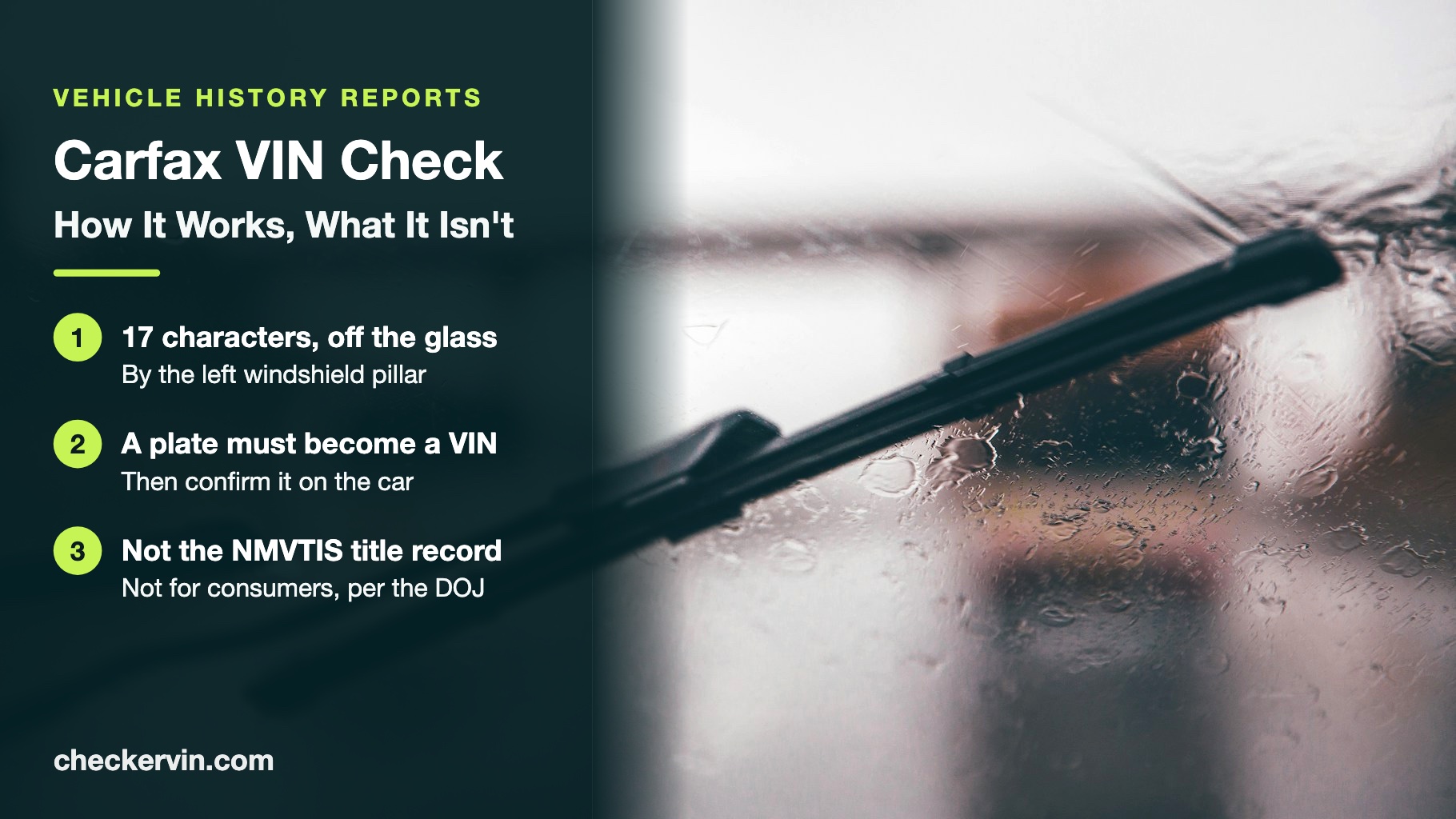
17
Characters in every modern VIN
49 CFR 565.13(b)
Per report
How consumers pay Carfax
Per its owner's SEC filing
Dealers only
Who gets NMVTIS from Carfax
Per the Department of Justice
Free
Carfax's own recall search
carfax.com/recall, per Carfax
What a Carfax VIN check actually queries
When you check a VIN on Carfax, the only thing you are asking is: what has been reported to Carfax about the vehicle that carries this number? The VIN is the key; Carfax’s database is the lock. Nothing about the search reaches into a state title office in real time, and nothing about it inspects the car.
That framing explains most of what follows. A search by VIN works because each modern VIN is unique to one vehicle for 60 years, a guarantee written into federal regulation. A search by plate works only after the plate has been turned back into that VIN. And the report you get is as complete as the reporting behind it, which Carfax itself describes in its app-store listing as “more than 151,000 data sources and over 35 billion records.” That is Carfax’s claim about its own database, not a figure we can audit, and our Carfax review goes into how a private database like this is built and where its coverage thins out.
Who runs Carfax now
Older articles, and Carfax’s own press releases through spring 2026, describe Carfax as part of S&P Global Mobility. That changed this year. According to the first quarterly report filed by Mobility Global Inc. with the Securities and Exchange Commission, S&P Global completed the separation of its mobility business on July 1, 2026, and Mobility Global began trading on the New York Stock Exchange as an independent company under the symbol MBGL.
The same filing makes CARFAX one of the company’s two reportable segments, and says the brand served more than 40,000 dealer customers as of December 31, 2025. It describes the business as predominantly subscription-based, with dealer products such as Advantage, Car Listings and CARFAX For Life, and lists “CARFAX consumer pay-per-report purchases” among its smaller one-time revenue streams. Put plainly: most of Carfax’s money comes from dealers, and a consumer who runs a VIN check pays per report. That is useful to know before you search, for a reason covered further down.
A Carfax VIN check, step by step
We could not load carfax.com in November 2026, so we are not describing its current search box or screen layout, which change often. The sequence below is the part that does not change: it is dictated by how VINs, plates and paid reports work.
- 1Read the VIN off the car, not the listingUse the plate visible through the windshield, and compare it with the door-jamb label and the title. A VIN typed into a listing or a text message is the most common source of a wrong report.
- 2Enter all 17 charactersNo spaces, no dashes. If a character looks like an O or an I, it is a zero or a one: those letters are not allowed in a VIN.
- 3Or start from a plate and state, then confirm the VINA plate search has to land on a VIN before any history can be found. Whatever VIN it returns, match it to the dashboard before you trust the report.
- 4Check whether a report already existsCarfax says every used-car listing on its own site and app is linked to a free report, and most dealers subscribe. Look before you pay.
- 5Buy a single report only for the car you are serious aboutConsumer reports are sold per report. Run the free checks first so the money goes on the car that survived them.
- 6Read the report against the car in front of youCompare the VIN, the odometer and the reported damage with what you can see. Then have the car inspected; no report reaches unreported damage.
Where to find the 17 characters a Carfax lookup needs
The rule that decides where the VIN sits is 49 CFR 565.13, part of the federal VIN regulation NHTSA administers. For passenger cars, multipurpose passenger vehicles (which covers most SUVs and vans), low-speed vehicles and trucks of 4,536 kg (10,000 lb) gross vehicle weight rating or less, the VIN must be inside the passenger compartment and readable through the glass, without moving any part of the vehicle, by someone standing outside next to the left windshield pillar. Each character has to be at least 4 mm tall.
| What the regulation requires | Why it matters for your search |
|---|---|
| Exactly 17 characters — § 565.13(b) | A 16- or 18-character entry is a typo, not a rare car |
| A check digit in position 9 — § 565.13(c) | Lets a system catch many single-character mistakes |
| No two VINs alike for 60 years from the 1980 model year — § 565.13(d) | Why one VIN maps to exactly one history |
| Readable through the windshield by the left pillar — § 565.13(f) | You can read it on any lot without opening the car |
| Letters only from a set that leaves out I, O and Q — § 565.13(g) | Any O or I you think you see is a 0 or a 1 |
The windshield plate is the one location the regulation fixes. Manufacturers repeat the VIN in other places, such as the driver’s door-jamb label and the title and registration documents; our guide to where the VIN number is on a car maps them. The habit worth forming is to read the windshield and door-jamb numbers yourself and check they match each other and the title, before you search anything.
Why a Carfax VIN lookup comes back empty or wrong
A search that returns no vehicle, or the wrong vehicle, almost always has a mundane cause. Working through them in order saves buying a report on a car you are not looking at.
- A transcription error. The excluded letters are the usual culprits: O for 0, I for 1, Q for 0. Re-read the number from the glass, not from a photo.
- A character dropped or doubled. Count to 17; the regulation allows no blanks and no extra characters.
- A VIN copied from the listing, which can be a different car on the same lot. Searching the right number on the wrong car is worse than a failed search.
- An older vehicle. The 60-year uniqueness rule in § 565.13(d) runs from the 1980 model year, and a car built before the 17-character format may carry a serial number that a 17-character search cannot parse.
- A genuinely thin history. A car that rarely visited businesses reporting to Carfax can produce a short report. That is a property of the reporting, not proof of neglect or of a clean past.
The check digit in position nine is what makes the first two causes catchable. The regulation defines it as a calculated value whose purpose is “verifying the accuracy of any VIN transcription,” so a decoder that rejects a VIN as invalid is usually telling you about a typo before you pay for anything.
Carfax with a plate number: how a license plate lookup really works
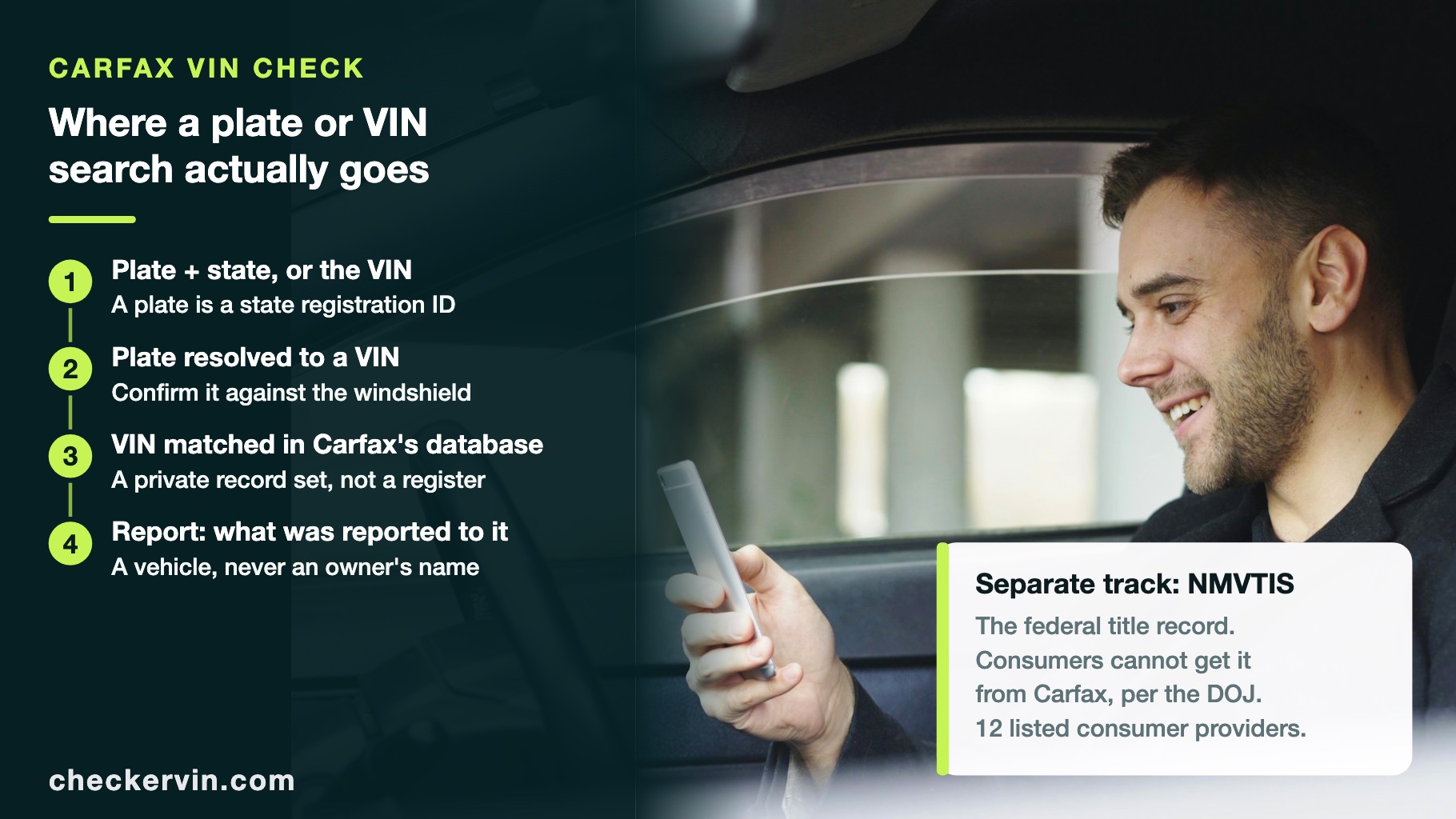
A good share of people searching Carfax start from a license plate, usually because the plate is what they can see in a listing photo or on the street. The step that matters happens out of sight: a plate is a state registration identifier, not a vehicle identifier, so any license plate lookup, on Carfax or anywhere else, has to resolve the plate and state to the VIN the plate is registered to. Only then can it search a history.
That dependency on state registration data is where plate searches go wrong:
| What happens to plates | What it does to a plate search |
|---|---|
| In states where the plate stays with the owner, it can move to the owner's next car | The plate may now point to a different vehicle than the one in the photo |
| Each state issues its own plates, so the same characters can exist in more than one | The wrong state returns a different vehicle entirely |
| A car sold across a state line gets a new plate from the new state | The plate in an old listing photo may no longer be on the car |
None of that is a reason to avoid starting from a plate. It is a reason to treat the VIN a plate search returns as a lead to confirm. Walk to the car, read the windshield, and if the numbers differ, the report you were about to buy is about somebody else’s car. We could not load Carfax’s site in November 2026 to see how its own plate search presents this, so we describe the mechanism rather than the screen.
What a Carfax license plate lookup cannot return
The other half of the plate question is what comes back. The federal Driver’s Privacy Protection Act, at 18 U.S.C. § 2721(a), bars a state motor vehicle department and its contractors from knowingly disclosing personal information from a motor vehicle record except for the uses the law permits. The definition in § 2725(3) covers a person’s name, address, telephone number, photograph, Social Security number, driver identification number and medical or disability information.
So a plate search, from Carfax or anyone else, is a route to a vehicle, not to an owner. The report is about the car: its events, its readings, its title brands. Any site that offers the owner’s name and address from a plate is either overselling or operating under one of the permitted uses, which an ordinary car shopper does not have. Our license plate lookup guide sets out what is legal and who can lawfully get owner information.
Carfax VIN decoder? What decoding is, and what a report is
“Carfax VIN decoder” is a common search, and it mixes two different jobs. Decoding reads what the manufacturer built into the number. Under the VIN regulation, positions four to eight describe the vehicle’s attributes; for a passenger car that is the make, line, series, body type, engine type and restraint systems. Position nine is the check digit, position ten encodes the model year, and the remaining characters identify the plant and the individual vehicle. A decoder turns that into plain specifications, and the data behind it is published by NHTSA for free.
A Carfax report does a different job: it records what happened to the car after it left the factory, as reported to Carfax. Someone who only wants to know the engine, trim or model year does not need a history report at all. Someone who wants to know whether the car was crashed or branded needs more than a decoder. Knowing which question you have decides whether you pay.
Decode the VIN free before you buy any report
Decoded from official manufacturer and NHTSA records
What is free and what is paid in a Carfax VIN check
We do not print Carfax’s prices: they change, and we cannot vouch for them. What can be stated from Carfax’s own materials is the shape of the offer.
| Free, per Carfax's own materials | Paid |
|---|---|
| Reports linked to every used-car listing on Carfax's site and app | A report you buy yourself, sold per report |
| Recall search at carfax.com/recall, per its March 2026 release | Dealer subscriptions, which pay for the reports dealers hand out |
| The Carfax Car Care app, which it calls free | Business accounts; its dealer app is for business subscribers only |
The left column is the useful one. Carfax’s April 2026 release says shoppers can “view millions of new and used car listings, all linked to a free CARFAX Report” on its site and app, and its app listings say every used-car listing includes one. If the car you are looking at is listed there or with a subscribing dealer, the report has usually been paid for already. When to ask, and why a free report is never quite free, is covered in our free Carfax report guide; we will not repeat it here.
What we could not verify is what Carfax shows before you pay, such as any count of records found. Its website blocked our requests, and we do not describe a screen we have not seen. Check the checkout for current options before you buy.
What Carfax says a VIN Carfax report contains
Carfax’s consumer app listings, on both the App Store and Google Play, list what a report includes. Condensed, in its own terms:
| Section | What Carfax says it covers |
|---|---|
| Accidents and damage | Reported accidents and damage, with severity and point of impact |
| Airbags and flood | Whether airbags deployed, flood damage and other potential issues |
| Owners | How many owners the car has had and what it was used for |
| Odometer | A history of odometer readings |
| Title | Title information such as salvage, junk or lemon |
| Service | The vehicle's service history |
| Inspections | State emissions and inspection results |
Its April 2026 release adds a redesigned report header in three parts: past ownership, service and damage history; a present “History-Based Value” tied to that VIN’s history; and a future reliability indicator. Each line of a report is a record somebody filed, which is why the same car can look different on two services. How accurate those records tend to be is a separate question, taken up in is Carfax accurate.
What a Carfax VIN check is not: the federal title record
The federal title record is the National Motor Vehicle Title Information System, NMVTIS, which state titling agencies, insurers and junk and salvage yards report into. A Carfax VIN check does not deliver it to a consumer, and the Department of Justice, which runs the system, says so on its provider page:
The same page lists Carfax in the commercial-only tier, with the note that it offers NMVTIS data to commercial customers in California only. On November 25, 2026, the consumer tier named 12 businesses: Bumper, Carsforsale, carVertical, CheckThatVIN, ClearVin, EpicVin, GoodCar, TitleCheck, VinAudit, VinData, VinReport, VINsmart. The department says the list is alphabetical and implies no preference.
Why it matters on a VIN search specifically: the department describes an NMVTIS report as “intentionally concise,” built around a few fraud and theft indicators, and its value is that it keeps every brand any reporting state applied, so moving a car across a state line does not wash the brand away. It is also candid that coverage is incomplete, with about 87 percent of the U.S. vehicle population in the system, and warns that the same gaps can exist in private databases. A clean Carfax result and a clean NMVTIS result are two different statements from two different record sets. The NMVTIS report guide explains each indicator.
Before you search Carfax by VIN, look for the report that exists
The SEC filing explains why so many Carfax reports reach shoppers at no charge. Carfax’s revenue is driven mainly by dealer locations enrolled in subscription products, and its dealer app lets subscribers scan a VIN barcode or type a VIN and get a report on the spot. A subscribing dealer can produce the report for the car you are standing next to in about the time it takes to ask.
- On a dealer listing, look for a report link before you search yourself
- On a lot, ask for the report on that specific VIN, and check the date printed on it
- On Carfax's own listings, the company says the report is already linked
- In a private sale, assume no report exists unless the seller bought one
A report the seller supplied is still worth having, but it is the seller’s choice of report, pulled when they chose. Running your own free checks alongside it costs nothing.
The free checks to run before any Carfax VIN check
Several questions a buyer brings to a Carfax search have free answers, and some have answers a history report does not improve on.
| Free check | What it answers |
|---|---|
| CheckerVIN free scan | Factory build and specifications, warranty, open recalls, photos filed against the VIN and market prices |
| NHTSA recall lookup | Open safety recalls on that VIN; the remedy is free at a dealer |
| NHTSA vPIC decoder | The manufacturer's decode of the VIN pattern |
| NICB VINCheck | A free theft and salvage screen from the National Insurance Crime Bureau |
| A listed NMVTIS provider | The federal title record, for a fee, from the consumer tier above |
The NICB site did not load for our automated check in November 2026; what VINCheck covers and its search limits are set out in our NICB VIN check guide. Run in that order, the free layer tells you whether the car is the car it claims to be, whether it has an open recall and whether an insurer has flagged it, before you spend money on history.
A Carfax VIN check and CarCheckerVIN, side by side
We are a competitor, so here is the comparison without the flattering parts left out.
| CarCheckerVIN today | Carfax VIN check |
|---|---|
| Price: free, no card field | Price: sold per report to consumers; free on many listings |
| Factory build and specifications: yes | Factory build and specifications: not its focus |
| Open safety recalls: yes | Open safety recalls: yes, free at carfax.com/recall |
| Value: market and listing prices | Value: a history-based value, per Carfax |
| Accident, title and odometer history: launching soon, not available yet | Accident, title and odometer history: yes, from its own database |
| Service history: no | Service history: yes, where shops report to it |
| NMVTIS title record: no | NMVTIS title record: not for consumers, per the DOJ |
What our free scan returns today:
- Factory build and specifications decoded from the VIN
- Factory warranty terms
- Open NHTSA safety recalls
- Photos filed against the VIN
- Market and listing prices
Run the free decode and recall check
Decoded from official manufacturer and NHTSA records
After the search: check the report against the car
A Carfax VIN report is only as useful as the match between the paper and the metal. A few comparisons take five minutes and catch the problems a report cannot flag by itself.
- The VIN on the report matches the windshield plate, the door-jamb label and the title, character for character
- The last reported odometer reading is lower than what the dashboard shows now
- The year, body style and engine on the report match the car, which a free decode confirms
- Any reported damage has a visible repair where the report says the impact was
- A title brand on the report matches the brand, if any, printed on the title document
Then book an independent inspection. Damage that was repaired privately and never claimed produces no record at any provider, at any price, and a mechanic is the only check that reaches it.
Where this information comes from
- NMVTIS — approved data providers (DOJ / BJA)Consumer tier, Carfax's commercial-only California listing and the statement that consumers cannot get NMVTIS reports from Carfax; retrieved November 25, 2026
- NMVTIS — information for consumers (DOJ / BJA)The intentionally concise report, the 87 percent coverage figure and the false-negative warning
- 49 CFR Part 565 — Vehicle Identification Number requirements (eCFR)Section 565.13: 17 characters, check digit, 60-year uniqueness, windshield location and allowed characters
- 18 U.S.C. § 2721 — Driver's Privacy Protection ActLimits on disclosing personal information from state motor vehicle records; definition at § 2725(3)
- Mobility Global Inc. — Form 10-Q, quarter ended September 30, 2026 (SEC EDGAR)The July 1, 2026 separation from S&P Global, the CARFAX segment, dealer count and consumer pay-per-report revenue
- CARFAX — New & Used Cars (App Store listing)Free reports on listings, what a report includes, and Carfax's database-size claim
- CARFAX for Dealers (App Store listing)Scan or enter a VIN for an instant report; business subscribers only
- CARFAX — free recall search tops 10 billion checks (PR Newswire, March 2, 2026)Free consumer recall check at carfax.com/recall, built with the Alliance for Automotive Innovation
- CARFAX — report adds future reliability (PR Newswire, April 7, 2026)Listings linked to a free report and the past, present and future report header; read via a verbatim repost
- NHTSA recall lookupFree open-recall search by VIN
- NHTSA vPIC VIN decoderThe federal decode of a VIN pattern, free
- How we made this pageWritten by the CarCheckerVIN editorial team with AI assistance from the Department of Justice's NMVTIS pages, 49 CFR Part 565, the Driver's Privacy Protection Act, Mobility Global's SEC filing, and Carfax's own app listings and press releases; carfax.com blocked our requests. Facts checked November 2026.
Keep reading
Frequently asked questions
How do I check a VIN on Carfax?
Read the 17-character VIN off the car itself, through the windshield by the driver-side pillar, and enter it in Carfax's search. Carfax looks the number up in its own database and offers a report for that vehicle. A consumer report is sold per report, and many dealer and Carfax listings already carry a free one, so check the listing before you buy.
Can I search Carfax by license plate?
A plate search still ends at a VIN. The plate is a state registration identifier, so any service that accepts one has to resolve it to the VIN it is currently registered to before it can find a history. Plates move between cars, so confirm the VIN that comes back against the one on the dashboard. We could not load Carfax's site in November 2026 to verify its current plate form.
Is a Carfax VIN lookup free?
The lookup leads to a paid product. Mobility Global, the company that owns Carfax, describes consumer sales as pay-per-report purchases. Reports are free when someone else has paid: Carfax says every used-car listing on its own site and app is linked to a free report, and dealers subscribe. Carfax's recall search at carfax.com/recall is free.
Is Carfax a VIN decoder?
Not in the usual sense. A decoder reads what the manufacturer encoded in the VIN itself: make, model line, body, engine, restraint systems, model year and plant. A Carfax report is a history of events reported to Carfax after the car was built. Decoding is free from NHTSA's vPIC tool and from our VIN check.
Does a Carfax VIN check include the NMVTIS title record?
Not for a consumer. The Department of Justice's NMVTIS page says consumers cannot receive NMVTIS vehicle history reports from Carfax, and lists Carfax as offering NMVTIS data to commercial customers in California only. Private buyers get the federal record from one of the approved consumer providers on that page.
Why does Carfax say no records were found for my VIN?
Usually a typo. A VIN never contains the letters I, O or Q, so a 0 read as an O or a 1 read as an I produces a number that belongs to no car. The ninth character is a check digit, which lets a system spot many transcription errors. If the VIN is right, a car older than the 17-character era, or one with very little reporting, may simply hold few records.
Start with the free layer
Decode any VIN free for the factory build, specifications, warranty, open recalls and market prices. Full vehicle history reports are launching soon.
Run a free VIN check