The short answer
- What is the Carfax value?
- Carfax's History-Based Value: a market estimate for one car, adjusted for the accidents, owners, service records, title brands and odometer entries on its Carfax history.
- How is it different from Kelley Blue Book?
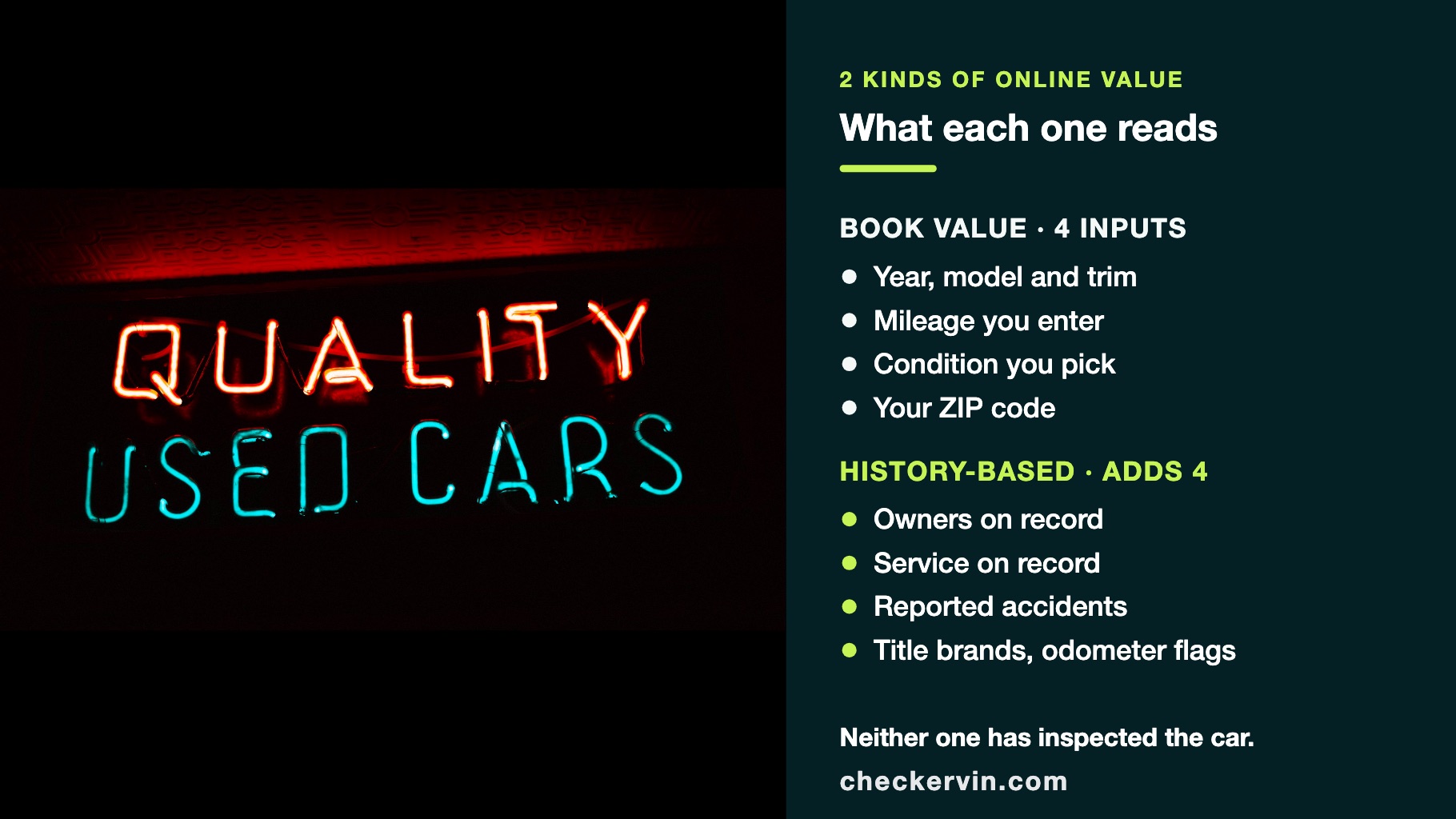
- A book value prices a typical example of the model from the details you enter. Carfax's value reads the car's own record and adjusts for it automatically.
- Is it the price?
- No. It is a model's estimate. The price is set by the buyer, the seller, local listings and what an inspection finds.
VIN-specific
How Carfax describes its value
Two cars of one trim can differ
9
Inputs Carfax has named
Across releases from 2018 to 2026
No formula
What Carfax has published
Inputs named, weights not
Estimate
What the number is
Not an appraisal and not a price
What the Carfax value actually is
When people search for a “Carfax value,” “car value Carfax” or what a car is worth on Carfax, they are almost always after the same thing: the dollar estimate that sits beside a car on a Carfax listing or near the top of a Carfax report. Carfax’s name for it is the History-Based Value. It is not a separate record about the car. It is a pricing model that takes what Carfax knows about the market for a model and then adjusts it using the history Carfax holds on that particular vehicle.
The idea is set out most plainly in a 2018 release from Auction123, a dealer software company that added the value to its tools. In it, Carfax’s value is described as using Carfax information combined with local market trends to produce a unique price for each vehicle, rather than simply matching a car to others in the market with the same year, make, model, trim and condition. A September 2020 release from automotiveMastermind, then a sister company under the same parent, went further and called it a VIN-specific valuation tool where, by accounting for vehicle history, “no two vehicles can be priced the same.”
That second claim is the whole product in one line. A conventional book value treats two cars of the same configuration and mileage as the same car until somebody tells it otherwise. Carfax’s value starts from the premise that the record already tells it otherwise, and adjusts before anyone has typed anything about accidents or owners. The same 2020 release says it produces retail, wholesale and certified prices, and at that time covered vehicles from model year 2000 or newer. We could not confirm the current coverage on Carfax’s own pages.
What Carfax says goes into the number
Carfax has never published a formula for its value, and we would not trust a page that claimed to know one. What it has done, across several releases, is name the inputs. Collected together, Carfax has named 9 distinct inputs. Each row below is what one release said, with the release it came from:
| Input Carfax has named | Where Carfax said it |
|---|---|
| The vehicle's VIN-specific history | Named in Carfax releases from 2020 through April 2026 |
| Number of owners | Fewer owners valued higher, per the October 2018 Auction123 release |
| Service history | More detailed service history valued higher, same 2018 release |
| Accidents and damage | "One of the many factors", per the January 2020 release |
| Title brands, odometer problems, structural damage | Named as major issues it adjusts for, February 2022 lender release |
| Installed features | Shown to lenders as part of the value from February 2022 |
| Year, make, model, mileage and condition | Listed in the September 2020 automotiveMastermind release |
| Driver's home location and local market | Same 2020 release; "local market trends" in 2018 |
| Current market conditions | Same 2020 release |
Two things stand out in that list. First, about half of it is the same material every valuation tool uses: year, model, mileage, condition, location and the state of the market. That part is not what makes the value history-based. Second, the history inputs are all things a database can know only if somebody reported them. An owner count comes from title and registration events. Service history comes from shops that share their records. Accidents come from claims, police reports and reporting body shops. The value is only as history-aware as that reporting.
Which way each kind of record pushes the value
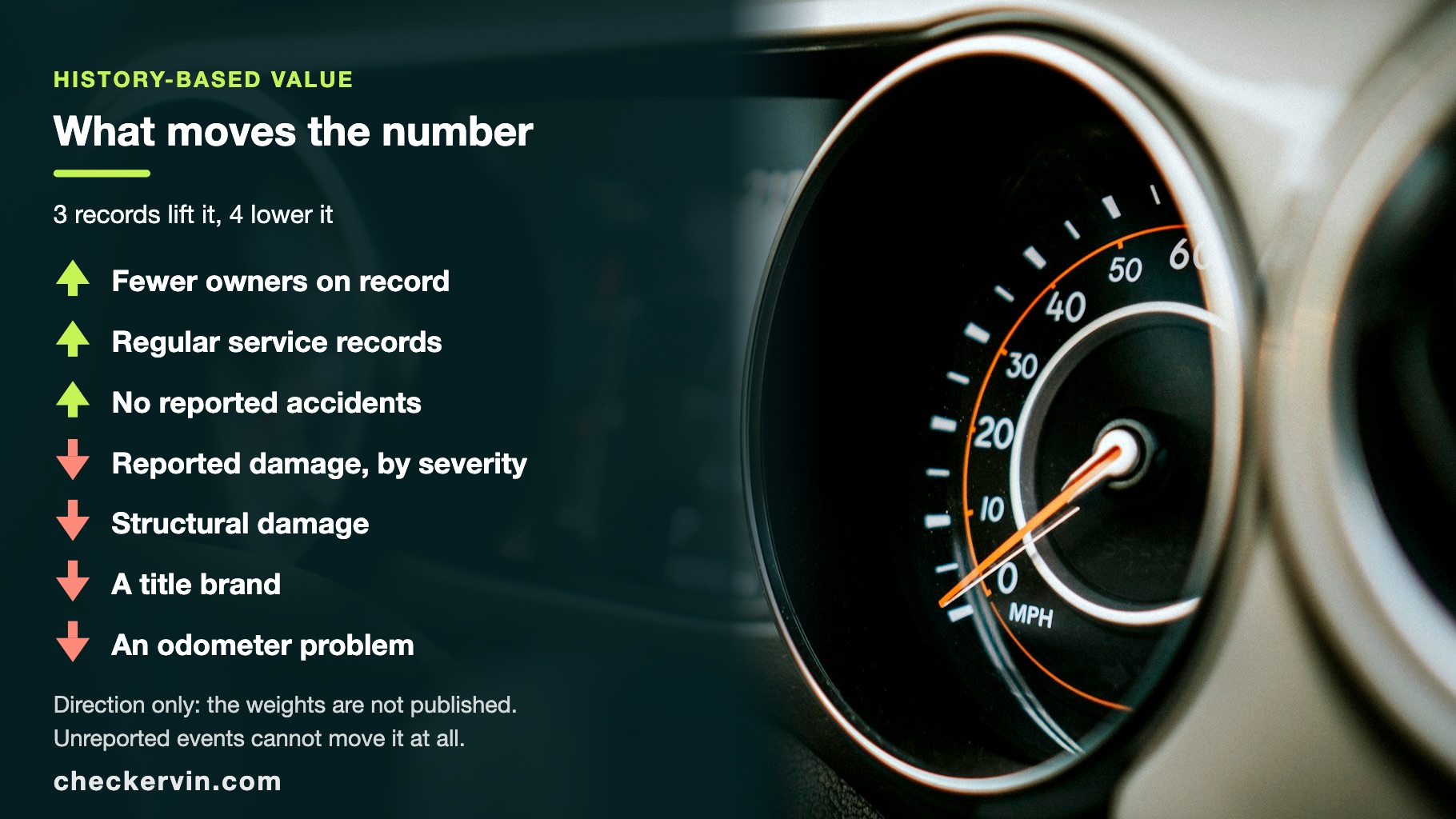
Carfax’s releases say more about direction than size. Read together, they let you predict whether a given entry on a report is likely to lift or lower a history-based value, even though nobody outside Carfax can tell you by how much.
| Record on the history | Direction Carfax describes |
|---|---|
| Fewer owners | Higher. The 2018 release says the value identifies the worth of cars with fewer owners |
| Detailed, regular service records | Higher, in the same release: more detailed service history |
| No reported accidents | Higher, same release; accidents are named as a factor again in 2020 |
| Reported damage, especially severe | Lower. The January 2020 release stresses checking how severe the damage was |
| Structural damage | Lower. Named as a major issue the value adjusts for in 2022 |
| A title brand such as salvage or rebuilt | Lower. Named as a major issue in 2022 |
| An odometer problem | Lower. Named as a major issue in 2022 |
Carfax has put one rough size on the accident effect, and it is worth quoting exactly because it is Carfax’s claim, not ours. Its January 2020 release said “the average impact on retail price is about $500” for a car with reported damage, and that the average jumps to $2,100 for a vehicle with severe damage in its past. The release does not say how those averages were measured or across which cars, and they are six years old. Use them for what they show, which is that Carfax itself treats severity as the variable that matters, and not as a deduction to apply to any car you are looking at.
Location is the odd one out. It is not history, but Carfax names it consistently: the driver’s home location in 2020, local market trends in 2018. A four-wheel-drive truck and a convertible do not price the same in every region, and a model that is scarce locally can carry a premium that a national average would hide.
Why two cars of the same trim get different Carfax values
The practical effect of a history-based model shows up when you compare two listings that look identical on paper. Same year, same trim, similar mileage, same city, and yet the Carfax value beside each is different. That is not a glitch. It is the model doing what Carfax built it to do, and you can usually work out why by reading the two reports side by side.
| Car A has | Car B has |
|---|---|
| One previous owner | Three previous owners, one of them a rental or fleet |
| Service entries at regular intervals | Long gaps with no service records at all |
| No accidents or damage reported | A reported accident with damage described as moderate |
| A clean title | A clean title |
| Mileage readings that climb steadily | Mileage readings that climb steadily |
On Carfax’s own description, every difference in the top three rows points the same way: Car A should carry the higher value. The bottom two rows are identical, so they should not separate the cars at all. Notice what the comparison does not include: which car has the worn tires, the slipping transmission or the repainted fender that no shop ever reported. Those are invisible to the model, and they can outweigh everything in the table.
The useful habit is to treat a gap between two Carfax values as a pointer, not a verdict. It tells you which entries on the reports to read closely and ask the seller about. It does not tell you which car is the better buy.
Where the Carfax value shows up
The same number turns up in several places, aimed at different people, and it helps to know which one you are looking at.
| Where you see it | What Carfax has said about it |
|---|---|
| Carfax used-car listings | Rates each car as a Great, Good or Fair Value compared with the asking price (July 2020 and May 2021 releases) |
| The Carfax report itself | A redesigned report header shows Past, Present and Future; History-Based Value is the Present (April 2026 release) |
| Dealer tools | Tens of thousands of dealers use it, per the 2020 and 2021 releases; dealers compare their pricing to it |
| Lender tools | Thousands of auto lenders use it for loan-to-value, collections and remarketing (February 2022 release) |
The listing rating is the one most shoppers meet, and it is easy to misread. “Great Value” means the asking price sits favorably against Carfax’s own estimate for that car. It is a comparison between two numbers, one of which Carfax produced. It is not a statement about the car’s mechanical condition, and if the history behind the estimate is missing an accident, a car can look like a bargain against a value that is too high.
The lender use deserves a moment too. A dealer and a lender reading the same value are reading it for opposite reasons: the dealer to price stock, the lender to decide how much to advance against the car. Our NADA value guide covers how lenders use book values at the loan-to-value moment, which is where a history-based value now competes.
Carfax value by VIN
The VIN is the key to the whole thing, which is why “Carfax value by VIN” is such a common search. A book value can be produced from a year, make and model picked from menus. A history-based value cannot, because the history is filed against the seventeen characters of one car’s VIN. Without the VIN there is nothing to adjust for, and the estimate collapses back into an ordinary market figure.
We tried to read Carfax’s current consumer page for looking up a car’s worth, and its help articles on how the value is calculated and why a value sometimes does not display. All of them returned an access-denied error to us on November 25, 2026, and we did not try to get round it. So we cannot tell you what the lookup asks for today, whether it accepts a license plate, or which vehicles it currently leaves out. Two things are safe to say anyway:
- Have the mileage ready. Every release that lists the inputs includes it, and no valuation means much without it
- Check the VIN against the car before you trust the result: dashboard plate, door-jamb label and title should all match
- If no value appears, the car may sit outside the coverage; the 2020 release described model years 2000 or newer
- Read the history entries alongside the value, because they are what moved it
Decoding the VIN independently is a cheap check that the car is the configuration the seller says it is. A trim or engine mismatch changes any valuation more than most people expect, and our car value by VIN guide explains why the VIN settles the build but never the worth.
Is the Carfax value free?
Carfax’s January 2020 release described History-Based Value as “a free valuation tool,” and the listing ratings built on it appear on Carfax’s search results without a purchase. We could not confirm the current terms on carfax.com in November 2026, so read that as what Carfax said then, not as a guarantee about today.
The value and the full history report are different products, and the second is where the money is. Carfax sells reports to consumers as single reports and multi-report packages, and a report is free to you when a dealer provides it: the July 2020 release says every vehicle listed on its search comes with a free Carfax report provided by the selling dealer. We do not print Carfax’s prices, because they change and a page that quotes them ages into being wrong. Our free Carfax report guide covers the legitimate ways to see one without paying.
Carfax value against a book value
Kelley Blue Book and J.D. Power, the guide that used to carry the NADA name, are the values most people compare Carfax’s against. They answer a slightly different question. A book value estimates what a typical example of a configuration sells for, and then adjusts for the mileage, condition and options you supply and the ZIP code you are in. A history-based value starts from a market figure too, but then adjusts for the record without being asked.
| The question | Book value vs Carfax value |
|---|---|
| Where does the starting figure come from? | Both: market transaction data for the model |
| Who reports the accidents? | Book: you, if the tool asks. Carfax: its own history records |
| Who reports owners and service? | Book: usually nobody. Carfax: its records, where reported |
| Who grades condition? | Both depend on someone describing it; neither has seen the car |
| Does it read a title brand? | Book: not from a record. Carfax: named as an adjustment in 2022 |
| Can two identical-looking cars differ? | Book: only if the inputs differ. Carfax: by design |
Neither one is reliably higher. A car with a spotless one-owner record may come out above a book value that assumed an average history; a car with a reported accident may come out below one where the seller ticked “no accidents.” The honest use of both is to read the gap between them as information. If the Carfax value is well below a book value you ran yourself, the report probably holds something you did not enter.
We cover who owns each book and who it is built for elsewhere, so we will not repeat it: see Kelley Blue Book value by VINfor the consumer book and its owner, and the NADA guide linked above for the lender’s book.
Carfax value and diminished value after an accident
Diminished value is the loss a car suffers because it now has an accident on its record, even after a perfect repair. A history-based value is, in effect, a model of that same market reaction: Carfax adjusts the number down because the record shows damage, which is exactly what the next buyer does.
That makes it tempting to treat a before-and-after Carfax value as a diminished value figure. Be careful. A claim against an insurer is subject to proof, and an estimate produced by a model whose weights are not published is a weak exhibit on its own. It may be one useful input alongside comparable listings and a written opinion from a dealer or an independent appraiser who has seen the car. Our diminished value calculator page explains the insurance formula, who you are claiming against, and what evidence regulators expect.
Why every online value is an estimate, Carfax included
Every online value, from Carfax, a book or a dealer’s trade-in tool, is a model built from sales of other cars. None of them has driven yours. Three limits apply to all of them, and a history-based model adds a fourth:
- 1It has not seen the carTires, brakes, rust, a weeping gasket, a stain on the headliner: condition is described by somebody or assumed, never measured by the model.
- 2It is built from past salesMarket data lags the market. A value can be a few weeks behind a sudden swing in demand for a model or a season.
- 3It averages a regionYour local market may be thinner or richer in that model than the area the model draws on.
- 4It inherits the gaps in the historyA history-based value can only adjust for what was reported. We explain how records go missing or wrong in our Carfax accuracy guide, and every one of those gaps flows straight into the value.
That last point is covered in detail in is Carfax accurate?, so the short version will do: a missing accident makes the value too high, and a wrongly keyed entry can make it too low.
What actually sets the price you pay
The price is set on the day, by two people and the evidence in front of them. The FTC’s guide to buying from a dealer puts its weight on evidence about the car itself. It tells buyers to ask for out-the-door prices in writing before visiting, research the car’s repair records and mileage, and pay an independent mechanic for an inspection, adding that “you can use the estimated repair costs to negotiate the price of the car.” It also says plainly that a history report “is not a substitute for an independent vehicle inspection.”
In practice the number that sticks is shaped by, roughly in this order:
- What an independent inspection finds, priced as repairs the next owner will pay for
- Comparable cars for sale near you, same trim and similar mileage, at their asking prices
- The record: title status, reported damage and service gaps, which buyers discount for
- Who is buying: a dealer allows for reconditioning and resale risk, a private buyer does not
- How the deal is paid for: a lender's own valuation can cap what it will finance
- Timing: season, local demand and how quickly the seller needs to move the car
A Carfax value earns its place in that list as a reading of the third item. It is a good prompt for questions and a poor substitute for the first two.
Who publishes the Carfax value now
Carfax has changed hands at the corporate level more than once while the value has existed. Its 2020 and 2021 releases describe it as part of IHS Markit; its April 2026 release describes it as part of S&P Global Mobility. On July 1, 2026, S&P Global completed the separation of its Mobility division into an independent public company, Mobility Global Inc., trading on the New York Stock Exchange as MBGL, and trade press covering the separation lists Carfax among Mobility Global’s brands.
Scale is the argument Carfax makes for its value. Its April 2026 release quotes its chief executive citing more than 35 billion records from over 151,000 data sources. Those are Carfax’s figures and we have no way to audit them. The point for a shopper is simpler: a bigger database means more reported events can reach the value, but no database can hold an event nobody reported.
One more line matters for anyone using Carfax to check a title. The Department of Justice, which runs the federal title database, states that consumers cannot receive NMVTIS vehicle history reports from Carfax, which provides that data to dealerships. Our Carfax review sets out what that means; the list of businesses that do sell the federal record to the public is below.
A second reading by VIN, free, and where we stop
The best defense against any single estimate is a second one from a different method. CheckerVIN’s free scan shows current market and listing prices for a VIN, so you can set Carfax’s figure against what comparable cars are actually being offered for. It also returns the rest of what we can verify today:
- Market and listing prices for the VIN
- Factory build and specifications decoded from the VIN
- Factory warranty terms
- Open NHTSA safety recalls
- Photos filed against the VIN
For the federal title record, which is what tells you whether a car was branded salvage, junk or flood anywhere, the Department of Justice listed 12 businesses approved to sell NMVTIS reports to the public on November 25, 2026. The department says the order implies no preference:
- Bumper.com
- Carsforsale.com
- Carvertical.com
- Checkthatvin.com
- Clearvin.com
- EpicVin.com
- GoodCar.com
- Titlecheck.us
- Vinaudit.com
- Vindata.com
- VinReport
- Vinsmart.com
Check market prices, specs and recalls by VIN
Decoded from official manufacturer and NHTSA records
Where this information comes from
- NMVTIS — approved data providers (DOJ / BJA)Consumer-tier provider list and the statement that consumers cannot get NMVTIS reports from Carfax; retrieved November 25, 2026
- FTC — buying a used car from a dealerOut-the-door prices in writing, inspection costs as a negotiating tool, and reports are no substitute for an inspection
- PR Newswire — CARFAX Accident Data Helps Car Buyers Shop Smarter (January 28, 2020)History-Based Value called a free valuation tool; accidents one of many factors; Carfax's average damage figures and the stress on severity
- PR Newswire — Avoid Overpaying For Used Cars With CARFAX (July 23, 2020)Great, Good and Fair Value ratings against asking price; dealer use; free dealer-provided reports
- PR Newswire — automotiveMastermind integrates CARFAX History-Based Value (September 10, 2020)Inputs: home location, VIN-specific history, market conditions, mileage and condition; retail, wholesale and certified prices; model years 2000 or newer
- PR Newswire — CARFAX accident-history pricing release (May 20, 2021)Dealer use and the listing ratings, restated
- CARFAX Banking & Insurance Group — History-Based Value release (February 17, 2022)Title brands, odometer problems and structural damage as adjustments; installed features; lender uses
- PRWeb — Auction123 adds CARFAX History-Based Value (October 30, 2018)Carfax information plus local market trends; fewer owners, more service history and no accidents valued higher
- Webull (PR Newswire copy) — CARFAX report adds future reliability (April 7, 2026)Report header with History-Based Value as the Present; record and data-source counts; S&P Global Mobility at the time
- S&P Global — completes separation of Mobility Global Inc. (July 1, 2026)The separation and the MBGL listing
- Repairer Driven News — Mobility Global separates from S&P Global (July 20, 2026)Names Carfax among Mobility Global's brands
- How we made this pageWritten by the CarCheckerVIN editorial team with AI assistance from Carfax's own press releases, the Department of Justice's NMVTIS pages, the FTC and S&P Global; carfax.com refused our requests, so its current pages were not read. Facts checked November 2026.
Keep reading
Frequently asked questions
What is the Carfax value?
It is Carfax's History-Based Value: an estimate of what a specific used car is worth that starts from market data for the model and then adjusts for that car's own Carfax history, such as accidents, number of owners, service records, title brands and odometer problems. Carfax describes it as VIN-specific, so two cars of the same year, model and trim can get different values.
How is the Carfax History-Based Value calculated?
Carfax has not published a formula. Its press releases name the inputs: the car's VIN-specific history, year, make, model, mileage, condition, the driver's home location and current market conditions, with accidents described as one of many factors. How much each one weighs is not public, so treat the result as a model's estimate rather than a calculation you can check.
Can I get a Carfax value by VIN?
The value is built around the VIN, because the VIN is what links a car to its Carfax history. Carfax's consumer lookup pages refused our request in November 2026, so we cannot describe the current lookup screen or what else it asks for. Expect to need the mileage at minimum, since every valuation depends on it.
Is the Carfax value free?
Carfax called History-Based Value a free valuation tool in a January 2020 press release, and Carfax's 2020 and 2021 releases describe its ratings appearing on Carfax's used-car search results. We could not confirm the current terms on carfax.com in November 2026. Full Carfax history reports are a separate, paid product unless a dealer provides one.
Does an accident lower the Carfax value?
Carfax says accidents are one of the factors its value adjusts for, and its 2022 lender release names structural damage, title brands and odometer problems as major issues. Carfax has also said that the severity of damage matters. An accident that was never reported to Carfax cannot affect the number, which is one reason an inspection still matters.
What does Great Value mean on a Carfax listing?
Carfax uses its History-Based Value to rate listings as a Great, Good or Fair Value compared with the asking price. The rating compares the price to Carfax's own estimate for that car. It says nothing about mechanical condition, and the estimate behind it can be wrong if the history behind it is incomplete.
Get a second number before you negotiate
Check any VIN free for market and listing prices, the factory build, warranty and open safety recalls. Full vehicle history reports are launching soon.
Run a free VIN check