The short answer
- What is diminished value?
- The difference between what your car was worth before the crash and what it is worth after a complete repair. The repair fixes the car; it does not fix the history.
- What does the 17c formula do?
- It caps the loss at 10% of NADA retail value and then multiplies that cap by two fractions — one for damage, one for mileage. Two numbers below one, multiplied together, shrink the result fast.
- Is 17c the law?
- No. It is referenced to Section 10 of a 6 March 2002 county court order in one Georgia case. It is not a statute, not a regulation, and not a valuation standard anyone is required to use.
$48.76
Paid in the federal record
On a car valued at $14,755
0.33%
Of the vehicle's value
What that settlement worked out to
10%
The cap, before modifiers
Of NADA retail, then multiplied down twice
0–1
The range of each modifier
Either one at zero zeroes the answer

What diminished value is, and why it survives a perfect repair
Diminished value is the gap between what a vehicle was worth immediately before a collision and what the same vehicle is worth after it has been repaired properly. It is not a claim that the repair was bad. It is a claim that the market prices a car with a collision in its history below an otherwise identical car without one, and that the gap is a real loss suffered by whoever owned the car when the crash happened.
Washington State’s Office of the Insurance Commissioner defines it for consumers in one sentence: diminished value is the difference between the market value of your undamaged car before an accident and its market value after you have it repaired. That framing matters, because it locates the loss in the market rather than in the bodywork. A shop can restore a panel gap to factory tolerance and still leave the owner poorer, because the next buyer is not bidding on the panel gap. They are bidding on the record.
Practitioners usually split the idea three ways. Inherent diminished value is the loss that attaches purely because the car now has a damage history, assuming the repair was flawless. Repair-related diminished value is the extra loss caused by work that was not flawless — mismatched paint, aftermarket structural parts, a panel that was filled rather than replaced. Immediate diminished value is the loss measured before any repair at all, which mostly matters when a car is sold in damaged condition. Nearly every claim argued in the United States is the first kind, and every formula discussed on this page is aimed at it.
None of those three terms appears in a federal statute. They are the vocabulary of an industry and of the lawyers who litigate against it, which is worth keeping in mind whenever a website presents them as though they were legal categories with fixed meanings.
Whose insurer you are asking changes the answer completely
Before any formula matters, one distinction decides most diminished value claims: are you claiming against your own insurer, or against the insurer of the driver who hit you? These are different legal animals and they are resolved by different bodies of law.
A first-partyclaim is a contract claim. You are asking your own insurer to pay you something under a policy you both signed, and the question is whether the policy promises it. The Texas Department of Insurance addressed exactly this in a commissioner’s bulletin and came down against the policyholder: the position of the Department is that an insurer is not obligated to pay a first party claimant for diminished value when an automobile is completely repaired to its pre-damage condition, because the language of the insurance policy does not require payment for, or refer to, diminished value.
A third-party claim is a tort claim. You are not enforcing a contract at all — you are asserting that someone damaged your property and owes you for the damage, and the insurer is simply standing behind them. The same Texas bulletin, in the same breath, treats that case entirely differently: an insurer also may be obligated to pay a third party claimant for any loss of market value of the claimant’s automobile, regardless of the completeness of the repair, in a liability claim.
How far that carries outside Texas is genuinely uncertain, and this page is not going to print a fifty-state table pretending otherwise. The National Association of Insurance Commissioners looked at the question in 2023 and concluded that Georgia is the only state with a clear legal direction that first-party auto claimants are entitled to recover the diminished value losses from their automobile insurers. Every other state is a matter of policy wording and local case law. There is no federal list, no agency register, and the widely-circulated state-by-state charts trace back to a private law firm’s survey rather than to any government source.
Where 17c actually came from, and where it did not
Almost every explanation of 17c you will find says it comes from a 2001 Georgia Supreme Court decision. That is close enough to sound authoritative and wrong in a way that matters.
The 2001 decision — cited by the federal court as State Farm Automobile Insurance Company v. Mabry, 274 Ga. 498 (2001) — settled a question of duty. It held that a Georgia insurer’s obligation extended to diminished value at all. It did not hand down a formula, and it is not where the number seventeen or the letter c come from.
The formula comes from what happened next. On remand, the Superior Court of Muscogee County issued an order dated 6 March 2002 setting out how the assessment was to be carried out, and the method sits in Section 10 of that order. When State Farm later wrote to a policyholder to explain a diminished value payment, it said so in its own words — preserved verbatim in a federal court order: we have made that assessment using a formula referenced in Section 10 of the 6 March 2002 order of the Superior Court of Muscogee County in Mabry v. State Farm.
So the provenance of the most widely used diminished value formula in the United States is a paragraph in a remand order from a single county court, in a single state, in a single case, adopted afterwards as a claims-handling convenience. It has never been a statute. No regulator promulgated it. No standards body ratified it. Nothing obliges an insurer to use it and nothing obliges a claimant to accept it.
The formula, written out
The NAIC states it in one line: Diminished Value = 0.1 * (NADA Retail Value) * Damage Modifier * Mileage Modifier, adding that the value of the modifiers used in this formula ranges from zero to one. Three moves, in order.
- 1Take the retail value and cut it to a tenthThe starting point is 10% of NADA retail value, and that is the most the formula will ever produce. On a $14,755 car the ceiling is $1,475.50 before anything else happens. The cap is not derived from market evidence; it is simply where the method begins.
- 2Multiply by a damage modifierA fraction between 0 and 1 standing for how badly the car was hurt. The NAIC notes that moderate damage would result in a 0.5 damage modifier, which is the only specific value it puts a number to.
- 3Multiply by a mileage modifierA second fraction between 0 and 1 standing for how far the car has been driven. Higher mileage means a smaller fraction, and the federal record contains an allegation of a mileage modifier of zero on a vehicle with over 100,000 miles.
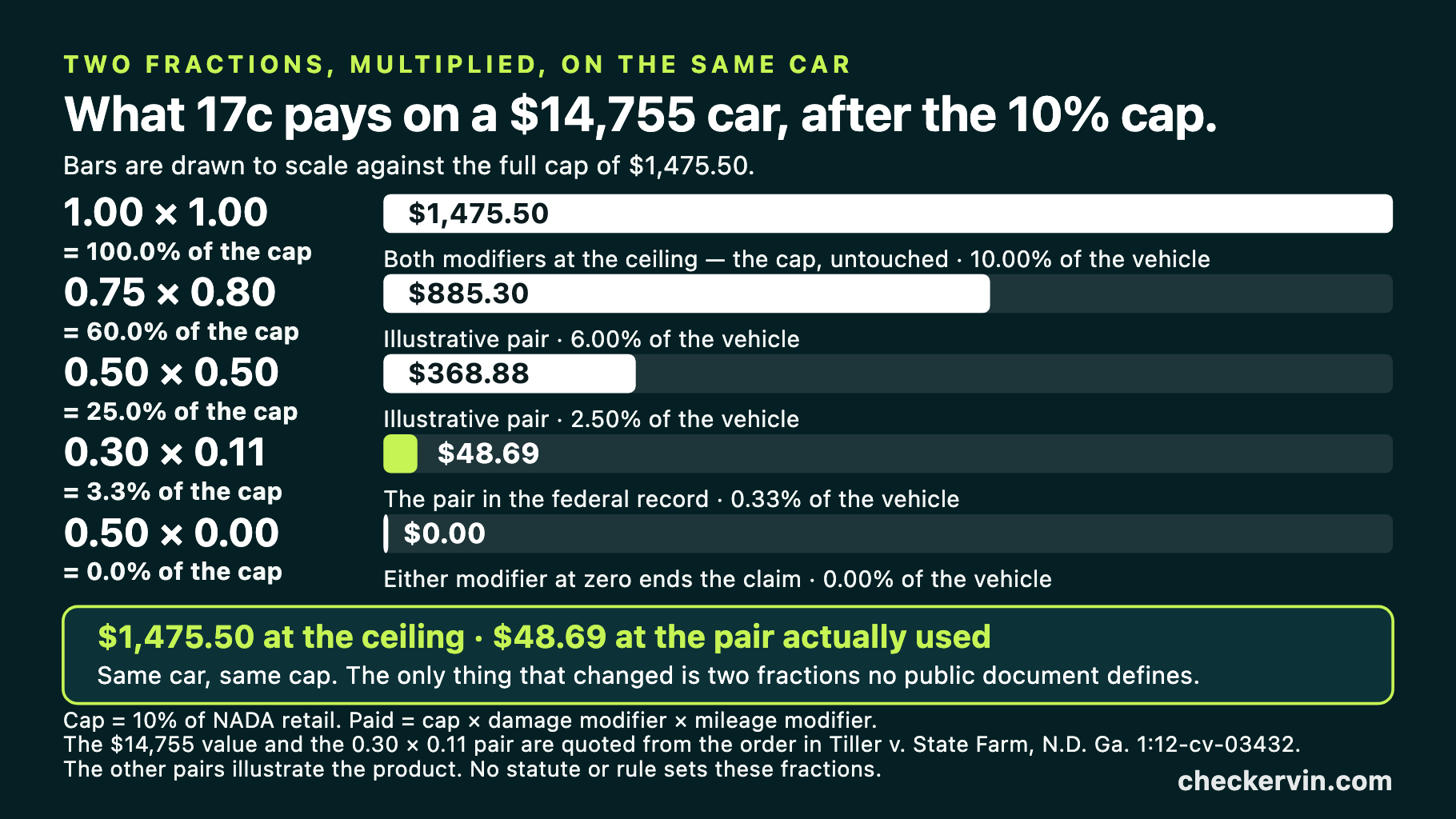
The mathematical property that does the real work here is easy to miss when the steps are listed as a procedure rather than a product. Two numbers, each no greater than one, multiplied together, give something no greater than either of them — and usually much smaller than both. Applied to a figure that has already been cut to a tenth, the effect compounds twice.
| Damage × mileage modifier | Payable on a $14,755 car |
|---|---|
| 1 × 1 | $1,475.50 — 10.00% of the vehicle |
| 0.75 × 0.8 | $885.30 — 6.00% of the vehicle |
| 0.5 × 0.5 | $368.88 — 2.50% of the vehicle |
| 0.3 × 0.11 | $48.69 — 0.33% of the vehicle |
| 0.5 × 0 | $0.00 — 0.00% of the vehicle |
The top row is the theoretical maximum: both modifiers at their ceiling, $1,475.50, which is simply the ten percent cap untouched. The bottom row is what happens when either modifier is zero. Everything interesting occurs in between, and nothing in any public document tells you how an adjuster picks the number.
What the formula actually paid, in the federal record
Arguments about formulas are cheap. There is, however, one place where the 17c method was written down with its inputs and its output attached, under oath, in a document anyone can download from a government server: an order in Tiller v. State Farm Mutual Automobile Insurance Company, docket 1:12-cv-03432-TWT, United States District Court for the Northern District of Georgia, filed 5 February 2013.
The court reproduced the insurer’s own account of the calculation. The National Automobile Dealers Association guide valued the car at $14,755. Ten percent of that was stated as $1,477.50. A damage modifier of 30% and a mileage modifier of 11% were applied. The result was a diminished value of $48.76.
| Step in the calculation | Figure as recorded |
|---|---|
| NADA retail value of the vehicle | $14,755 |
| 10% of value, as the insurer stated it | $1,477.50 — the court printed this with a [sic] |
| 10% of value, computed | $1,475.50, which is $2.00 lower |
| Damage modifier applied | 30% |
| Mileage modifier applied | 11% |
| Result, reproducing the insurer's own base | $48.76 — the $48.76 in the letter |
| Result, using the correct base | $48.69, a difference of $0.07 |
Two things are worth sitting with. The first is the size of the answer. $48.76 on a car worth $14,755 is 0.33% of the vehicle — roughly three tenths of one percent. Whatever the market actually does to a repaired car, it is not that.
The second is the arithmetic itself. Ten percent of $14,755 is $1,475.50, not $1,477.50; the court flagged the discrepancy with a bracketed sic rather than correcting it. Run the two modifiers against the correct base and you get $48.69 instead of $48.76. The gap is $0.07 and it changes nothing for anybody, which is precisely the point: when the method has already compressed the answer this far, an error in the inputs is invisible. A process that cannot be meaningfully wrong is not measuring anything.
The modifier tables nobody can source
Search for 17c and you will find the same two tables on dozens of sites: damage modifiers in quarter steps from 1.00 down to 0.00, and mileage modifiers stepping down by tenths across twenty-thousand-mile bands until they hit zero at a hundred thousand miles. They are presented as though they were the formula.
We went looking for the primary text those grids come from and could not find one. The NAIC, writing the formula out for regulators, gives only the range — zero to one — and a single worked value, that moderate damage would result in a 0.5 damage modifier. The federal record shows modifiers of 30% and 11%, and neither of those sits on either published grid. 11% is not a step in any table we found.
Only one grid value is corroborated anywhere in a primary document: a mileage modifier of zero at over 100,000 miles, which matches the allegation in the order. Everything else is repetition. So this page does not reprint the tables. If your adjuster applies a modifier, the useful question is not which row of a web table it came from — it is what evidence supports that particular fraction for your particular car, and the honest answer is often that there is none.
The criticisms regulators themselves print
This is not a fringe complaint. The NAIC’s own review sets out two structural objections in plain language.
The first is double counting. The formula multiplies by a mileage modifier, but the NADA retail value it starts from is already a mileage-adjusted number — a hundred-thousand-mile car books lower than a thirty-thousand-mile one before anybody opens a claim file. As the NAIC puts it, the formula is controversial because mileage is already factored into the NADA retail value, and the application of the mileage modifier is viewed by some as a double penalty for mileage. The car is discounted for its odometer once in the book, and again in the worksheet.
The second is that nobody looks at the car. The NAIC notes that the formula does not include an actual post-loss inspection. The damage modifier is chosen from a repair estimate rather than from an examination of the finished vehicle, which means the one thing a buyer would actually react to — how the car presents after the work — never enters the calculation at all.
For scale, the same NAIC review reports that diminished value losses are generally in the region of 10% to 20% of the direct property damage amount. Be careful with that figure: it is a share of the damage, not of the vehicle, so it cannot be compared directly with the 0.33% of vehicle value the federal record produced. The two are different denominators and anyone who lines them up beside each other without saying so is misleading you. What the NAIC range does establish is that a real diminished value loss is expected to be a substantial fraction of the repair bill, which is a different order of magnitude from a fifty-dollar check.
It is subject to proof, and that cuts both ways
Washington’s insurance regulator states the practical position more clearly than most: the insurer doesn’t automatically pay you for diminished value. It’s subject to proof that your car’s market value decreased even after repairing it. The same page tells consumers that typically you’ll file a diminished value claim against the insurer of the at-fault party and not your own insurance, and warns that some auto insurance policies don’t cover diminished value.
Read that as an allocation of work. Nobody is going to hand you a diminished value payment; you have to establish the loss. But it also means the insurer’s formula is not the standard of proof either. A worksheet is not evidence that a market moved. It is a number the payer produced.
Where an insurer is dealing with a third party rather than its own policyholder, state unfair-claims rules are in play. Washington’s, for example, makes it an unfair practice to fail to effectuate prompt, fair and equitable settlements of claims in which liability has become reasonably clear, and says that this includes an obligation to promptly pay property damage claims to innocent third parties in clear liability situations. Most states have an analogue, usually modeled on the same NAIC template. It is not a diminished value rule, and it will not tell an adjuster what to pay — but it is the frame within which a refusal to engage with your evidence has to be justified.
What evidence actually looks like
If the formula is the insurer’s opening position and proof is your obligation, the question becomes what proof consists of. Diminished value is a market claim, so the evidence is market evidence.
- An independent appraisal from someone who inspects the repaired vehicle — the step the NAIC specifically notes the formula omits
- Comparable listings: the same year, trim, mileage and region, with and without a reported accident, priced on the same day
- Written trade-in or purchase offers obtained before and after, which convert an argument about market value into two numbers from parties with money at stake
- The repair invoice in full, including what was replaced rather than repaired, and whether any structural work was performed
- The history record itself, showing exactly what a buyer running a report will see about this car
The last item is not a formality. Diminished value exists because information about the crash reaches the next buyer. If the damage was never reported to anyone, the market effect may be smaller — and if it was reported and described in detail, it may be considerably larger than any modifier grid suggests. Our page on what “damage reported” means covers how that label is generated and why its wording is so inconsistent, and VIN accident checks covers which crashes make it into a record at all.
One caution about the starting figure. The formula runs on NADA retail value, which is one book among several and not necessarily the one that describes your market. Our NADA value by VIN page explains what that guide is and who relies on it, and car value by VIN covers why no valuation can be read straight off the seventeen characters.
Why the permanent record is the whole mechanism
It is worth being clear about why a repaired car sells for less, because the reason determines what evidence is persuasive. It is not that buyers can see the damage — in a good repair they cannot. It is that buyers are told about it.
A collision generates paper. An insurance claim, a body shop invoice, sometimes a police report, sometimes an auction listing if the car changed hands in damaged condition. Those documents feed commercial history databases, and the next buyer sees a line item on a report before they see the car. The discount is a response to disclosed information, which is why the severity of the description often matters more to price than the severity of the damage.
That also explains why diminished value and structural damage are related but separate questions. A car can carry a reported accident with no structural involvement at all, and a car can have been straightened on a frame machine without any of it appearing on a report. Our frame damage check page covers why no title brand is required to record structural repair, and total loss threshold by state covers the separate question of when damage is severe enough that the car is not repaired at all.
Before you argue about a modifier, find out what the record on your car actually says. It is the thing the market is reacting to, and it is the one input in this entire subject you can check for yourself in a minute.
Check any VIN free
Decoded from official manufacturer and NHTSA records
What this page cannot tell you
Three honest gaps, stated rather than papered over.
We cannot tell you what your car’s diminished value is. No formula can, including this one — that is the argument of the whole page. The loss is whatever the market discount is for your specific vehicle in your specific area with your specific reported history, and establishing it requires looking at that market.
We cannot give you a state-by-state table of first-party rights.No government body publishes one. The charts you will find come from a private law firm’s survey, and the position in any given state turns on policy wording and case law that moves. What is printable is the NAIC’s assessment that Georgia is the only state with clear legal direction on first-party recovery, and the Texas Department’s stated position on its own market.
We cannot give you a federal figure for how much a crash costs a car. We looked. No federal agency publishes one. Every average in circulation — the ten to thirty percent figures, the single-dollar-amount averages — comes from a valuation company or a law firm rather than from a public dataset. Those may well be reasonable estimates. They are not government data, and this page will not dress them up as though they were.
Where this information comes from
- Tiller v. State Farm Mutual Automobile Insurance Company — order of 5 February 2013Docket 1:12-cv-03432-TWT. Quotes the insurer's own letter, the Section 10 reference, and the $48.76 calculation
- Texas Department of Insurance — Commissioner's Bulletin B-0027-00The Department's position on first-party versus third-party diminished value claims
- Washington State Office of the Insurance Commissioner — filing an auto claimDefines diminished value for consumers and states that it is subject to proof
- WAC 284-30-330 — unfair claims settlement practicesThe prompt, fair and equitable settlement duty, including toward third parties
- NAIC Journal of Insurance Regulation — automobile diminished value claimsWrites the 17c formula out, states the modifier range, and sets out the double-penalty and no-inspection criticisms
Keep reading
Frequently asked questions
What is the 17c diminished value formula?
Diminished value = 0.1 × NADA retail value × a damage modifier × a mileage modifier, with both modifiers running between 0 and 1. The name refers to Section 10 of the 6 March 2002 order of the Superior Court of Muscogee County on remand in State Farm Automobile Insurance Company v. Mabry, 274 Ga. 498 (2001). It is an insurer's assessment method, not a statute and not a valuation standard.
How much does 17c actually pay?
In the federal record it paid $48.76 on a car the insurer valued at $14,755 — about 0.33% of the vehicle. That is what happens when a figure already capped at ten percent of value is multiplied by two fractions, each less than one.
Does 17c pay nothing on a high-mileage car?
It can. The same order records an allegation that the insurer applied a mileage modifier of zero because the vehicle had over 100,000 miles on it. Any modifier of zero takes the whole product to zero, no matter how severe the damage was.
Can I claim diminished value from my own insurer?
It depends on your state and on your policy wording, and there is no federal answer. The Texas Department of Insurance has stated that an insurer is not obligated to pay a first-party claimant for diminished value where the car is completely repaired, because the policy does not refer to it. The NAIC describes Georgia as the only state with clear legal direction that first-party claimants may recover it. Against the at-fault driver's insurer the position is generally more favorable.
Do I have to prove diminished value?
Yes. Washington's insurance regulator puts it plainly: the insurer does not automatically pay for diminished value, and it is subject to proof that the market value decreased even after the repair. That proof is an appraisal and comparable market evidence, not a formula printed on a website.
Is there a government diminished value calculator?
No. No federal or state agency publishes a diminished value calculator, and no federal agency publishes figures on how much a crash reduces resale value. Every number circulating as an average traces back to a private valuation company or a law firm, not to a public dataset.
See the record a buyer will see
Decode any VIN free for the build, the open recalls and where to check the damage history. No account, no card.
Run a free VIN check