The short answer
- Is Carfax Used Cars legit?
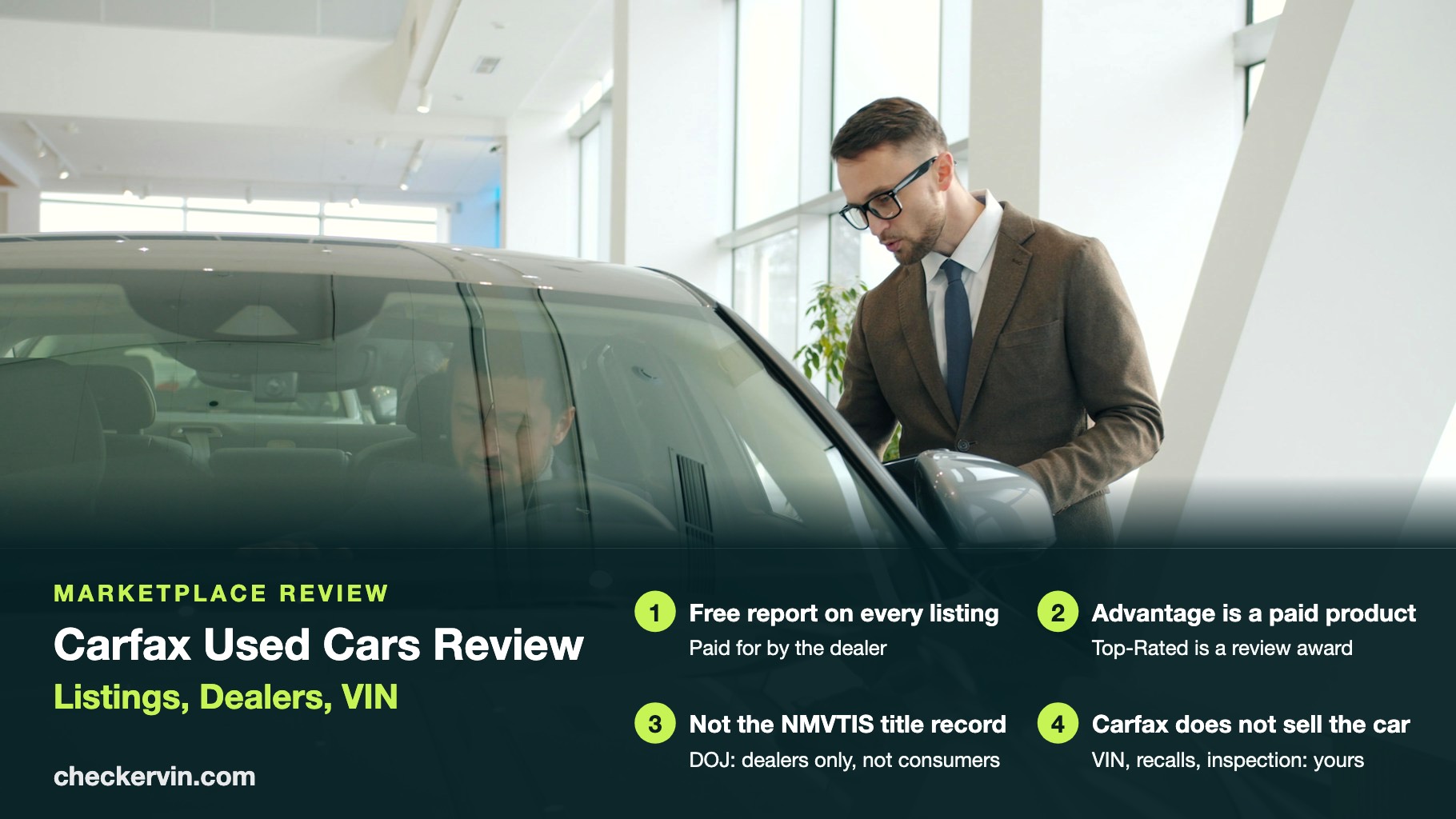
- Yes. It is a listings marketplace run by CARFAX, now owned by NYSE-listed Mobility Global. Dealers pay to list there. Carfax does not sell, inspect or warrant the cars.
- Why is the Carfax report free on a listing?
- Because the dealer's Car Listings subscription pays for it. The company's filing says every listing includes a free CARFAX report, a history-based value and verified reviews.
- Is that report a title check?
- Not the federal one. The Justice Department says consumers cannot get NMVTIS reports from Carfax. Buy the title record from a DOJ-listed provider and still book an inspection.
~23 million
Monthly unique U.S. visitors, 2025
Website and apps, per the Form 10
3
Dealer subscription products
Advantage, Car Listings, CARFAX For Life
40,000+
Dealer customers at end of 2025
Per Mobility Global's filings
Commercial only
Carfax's DOJ NMVTIS tier
Consumers cannot buy NMVTIS from it
The short answer
Carfax used car listings are a fair place to shop. Every listing comes with a Carfax report you would otherwise pay for, the company publishes its own value estimate built from that history, and dealers are reviewed by verified customers. Those are real advantages over a bare classified ad.
Three things are easy to miss, though. The report is free to you because the dealer has paid for it as part of a subscription, so you are looking at an advertisement that includes a history report, not an independent check. That report is Carfax’s commercial product, which is a different thing from the federal NMVTIS title record. And Carfax is a marketplace: it does not sell, inspect or stand behind the car. The checks that settle those questions are yours, and most of them cost little or nothing.
What Carfax Car Listings is, in the company’s own words
Carfax, which calls itself the expert in vehicle history since 1984, opened its used car listings in 2014, according to a February 2024 press release that says each listing comes with a free CARFAX Vehicle History Report. The same release announced more than a million new car listings, so the marketplace now carries new cars as well as used. Carfax’s press boilerplate called the product CARFAX Used Car Listings in 2024; by February 2026 it had become CARFAX Car Listings.
The clearest description sits in the Form 10 that Carfax’s parent filed with the SEC in May 2026. It lists three core CARFAX products, and all three are subscriptions sold to dealers:
| Dealer product | What the Form 10 says it does |
|---|---|
| Advantage | Vehicle history reports and related insights (accident, service, ownership, valuations, recalls) that dealers use to buy inventory, price it and build buyer confidence |
| Car Listings | Lets dealers post vehicles for sale on the CARFAX website and apps; every listing includes a free CARFAX report, history-based value and verified reviews |
| CARFAX For Life | Gives the dealer's customers CARFAX Car Care, with maintenance reminders tied to their VIN, to bring cars back for service |
The filing says dealers use Car Listings to generate qualified leads from approximately 23 million monthly average unique visitors to the CARFAX U.S. website and apps over 2025. It also names Premium Listings among its newer products without describing them, and we could not see how they appear because carfax.com blocked us.
The shopper side is described in the CARFAX app’s store listing:
- All used car listings include a free CARFAX Vehicle History Report
- Price-drop alerts on saved cars
- How CARFAX calculates a car's value based on its history
- The price history of a listed car
- Dealership reviews from customers
- Filtered search, sorting and side-by-side comparison
Who owns Carfax now: Mobility Global, not S&P Global
Many pages, including Carfax’s own press releases from early 2026, still describe it as part of S&P Global Mobility. That changed on July 1, 2026. An 8-K filed the next day says the separation of Mobility Global from S&P Global became effective that morning, that Mobility Global became an independent public company listed on the New York Stock Exchange under MBGL, and that S&P Global retains no ownership interest.
Mobility Global reports CARFAX as one of its two segments. Its 10-Q for the third quarter of 2026 shows CARFAX segment revenue of $313 million for the quarter, up from $291 million a year earlier. The filing says that revenue is driven mainly by the number of dealer locations enrolled in Advantage, Car Listings and CARFAX For Life and the monthly price per location, and it lists consumer pay-per-report purchases among the smaller, transactional sources of revenue.
That split is the most useful thing a shopper can take from the filings. Carfax’s main paying customer is the dealer. The free report on a listing is not a gift to you from Carfax; it is part of what the dealer buys.
Is Carfax Used Cars legit? What the public record shows
On the question of whether the business is real and accountable, yes. Its parent is a listed company that files audited reports with the SEC. The filings count over 40,000 dealer customers and more than 92,000dealers and service shops using CARFAX products at the end of 2025. Under Legal Proceedings, the Form 10 says the company is not currently a party to any material legal proceedings. We searched the FTC, the CFPB and state attorney general sites for actions naming Carfax’s listings and found none.
So “legit” is the right word for the platform. It is the wrong word to borrow for a car. A listing on a reputable marketplace tells you a dealer paid to advertise there; it does not tell you the car’s title is clean or that the repairs on the report were done well. That holds on every listings site, and our guide to used car red flags covers what to look for whichever one you use.
Who lists cars for sale on Carfax
Everything the filings describe points to dealers. Car Listings is defined as a dealer subscription product, its revenue is counted per dealer location, and the Form 10 talks about converting shoppers into leads for dealers. The app listing describes shopping “new, used and certified pre-owned cars near you,” and its reviews feature is about dealerships.
The Form 10 also mentions a product called Sell My Car among Carfax’s newer launches. It does not explain how it works, and we could not confirm on carfax.com whether a private owner can list a car for sale to other shoppers there. We do not describe that process, and you should read the seller line on any listing before you read the price.
Why it matters: under the FTC’s Used Car Rule (16 CFR Part 455), anyone who sold or offered five or more used vehicles in the previous twelve months counts as a dealer and must post a Buyers Guide on each car offered for sale; a private owner selling one car does not. Our page on getting a Carfax report free sets out where that line falls and why it decides whether a report exists at all.
Why every listing carries a free Carfax report
This is the question most people searching for “used cars for sale with Carfax” are really asking. The company answers it in the Form 10: every vehicle listing includes a free CARFAX report, a history-based value and verified reviews. Update notes for the iOS app from late 2025 say the same in plainer words: every car on the app comes with a free CARFAX Report. The free report is a feature of the dealer’s subscription, not a loss Carfax absorbs.
Carfax’s February 2026 press release adds a detail about its most committed dealers. It describes CARFAX Lifetime dealers as able to offer a free CARFAX Report for all vehicles listed on carfax.com, alongside fuller history data and CARFAX For Life service reminders. The Form 10 calls this the Dealer Lifetime Program and says it is designed to promote adoption of several products at once.
| How you get the report | Who pays for it |
|---|---|
| On a Carfax listing | The dealer, through its Car Listings subscription |
| Handed over at a dealership | The dealer, typically through Advantage |
| Bought yourself on a VIN | You: single reports or multi-report packages |
| From a private seller | Whoever bought it, if anyone did |
None of this makes the report less accurate. A paid-for report is the same document whoever paid. What changes is the setting: the report arrives inside a sales listing, chosen and published by the party that wants to sell you the car. Read it as useful disclosure from the seller, then check the parts of the car’s record the report is not built to cover.
Carfax Advantage Dealer, Lifetime and Top-Rated: what each label means
Three labels show up around Carfax dealers, and they mean very different things. Two are paid relationships with Carfax. One is an award based on customer reviews.
| Label | What it is, and what it tells you |
|---|---|
| Advantage dealer | Subscribes to Advantage, Carfax's history product for dealers. It buys Carfax reports for its stock; nothing about a given car |
| Lifetime dealer | In Carfax's Dealer Lifetime Program, which bundles several dealer products. A deeper commercial tie to Carfax |
| Top-Rated Dealer | An annual Carfax award from verified customer ratings and reviews. Past customers rated its service highly |
The Top-Rated Dealer award has a public history. Carfax’s first release about it, dated February 13, 2020, recognized Top-Rated Dealers of 2019 based on more than a million verified reviews from customers. Its February 4, 2026 release announced the seventh annual list, timed to the NADA show, citing more than 10.8 million verified ratings and reviews. It also named a 5X Top-Rated Dealer award for dealers rated highly five years running and said nearly 20% of winners have won every year since the award began. Winning dealers get showroom materials and digital badges, and the 2025 winners can show the award on the vehicle history reports they provide.
The releases we read do not say whether a dealer must buy a Carfax subscription to be eligible for the award, so we do not assume either way. The practical reading is simple. An Advantage or Lifetime label means the dealer pays Carfax. A Top-Rated badge means its customers liked how they were treated. Neither one is a statement about the car on the listing.
History-based value: Carfax’s price signal
Where other marketplaces grade a price against similar listings nearby, Carfax builds its price signal from the car’s record. Its press releases name CARFAX History-Based Value among the products it provides, the Form 10 says every listing includes a history-based value, and the app listing invites shoppers to “see how CARFAX calculates the value of a car based on its history” and to view a listed car’s price history.
We could not verify the names or thresholds of any price badges that appear on carfax.com listings, because the site blocked us and neither the filings nor the releases we read define them. So we do not print badge names here. What we can say is what a history-based value can and cannot weigh:
| A history-based value can reflect | It cannot reflect |
|---|---|
| Accidents and damage reported to Carfax | Damage that was never reported to anyone |
| Service records reported by shops | Work done at home or at shops that do not report |
| Number of owners and type of use | How carefully those owners drove |
| Mileage readings on record | Wear the record does not capture |
That makes it a better-informed number than a price compared only with other listings, and also one with a known blind spot: it inherits every gap in the history behind it. Our page on how accurate Carfax is explains where those gaps come from.
Dealer ratings and verified reviews on Carfax listings
The Form 10 lists verified reviews as part of every listing, and the app promises “dealership reviews from actual customers.” Carfax’s 2020 release made the same point about its award, calling the ratings “verified ratings from real consumers.” The releases we read do not explain how a review is verified, so we cannot say what the check involves.
Reviews are a fair way to judge a dealership’s sales process, paperwork and how it handles problems after the sale. They are a poor guide to a specific used car, because each car on a lot has its own history. Use a dealer’s rating to decide whether to deal with them, and the VIN checks below to decide whether to buy the car.
The listing’s Carfax report is not the federal title record
This is the line most shoppers never hear about. The Justice Department runs the National Motor Vehicle Title Information System, which states report titles into, and publishes the list of businesses approved to sell its reports. On that page it says, in its own capitals:
A Carfax report does show title information; the app listing says it includes whether a car has been salvaged, junked or declared a lemon. But it is Carfax’s own compilation, and the federal record is a separate product. A consumer who wants the NMVTIS report buys it from one of the 12 businesses the department listed for the public when we checked on November 25, 2026:
- Bumper.com
- Carsforsale.com
- Carvertical.com
- Checkthatvin.com
- Clearvin.com
- EpicVin.com
- GoodCar.com
- Titlecheck.us
- Vinaudit.com
- Vindata.com
- VinReport
- Vinsmart.com
The department’s consumer page describes what NMVTIS holds: information from the current title, brand history such as junk, salvage or flood, the most recent odometer reading, and any insurer determination that a car is salvage or a total loss. Our page on reading an NMVTIS reportexplains each line. The department’s consumer page gives the reason the system exists: after Hurricane Katrina, flooded cars were moved to states that do not brand flood vehicles and sold to buyers who did not know. A national record of brands is built to stop that kind of washing.
What a listings marketplace does not stand behind
Carfax is candid in its SEC filing about the limits of data. The Form 10 says CARFAX relies on more than 177,000 data sources, including car dealers, carmakers, police agencies and service shops, and that while it has controls to maintain data quality, those controls cannot ensure absolute accuracy. It names inaccurate or incomplete data as a business risk. That is an honest description of any history database: it holds what was reported to it.
On a Carfax listing, then, here is who answers for what:
| Part of the listing | Who stands behind it |
|---|---|
| The car, its price and the sale contract | The dealer selling it |
| The vehicle history report | Carfax, for what was reported to it |
| The history-based value | Carfax's estimate, built from that history |
| Dealer reviews | The customers who wrote them |
| Federal title record | You, through an NMVTIS report |
| Open recalls and mechanical condition | You, through NHTSA and a mechanic |
If a report carries a buyback guarantee, read its conditions before relying on it. Our Carfax reviewexplains why a guarantee of that kind is a promise about the report’s accuracy, not a warranty on the car.
Checks to run on any Carfax listing
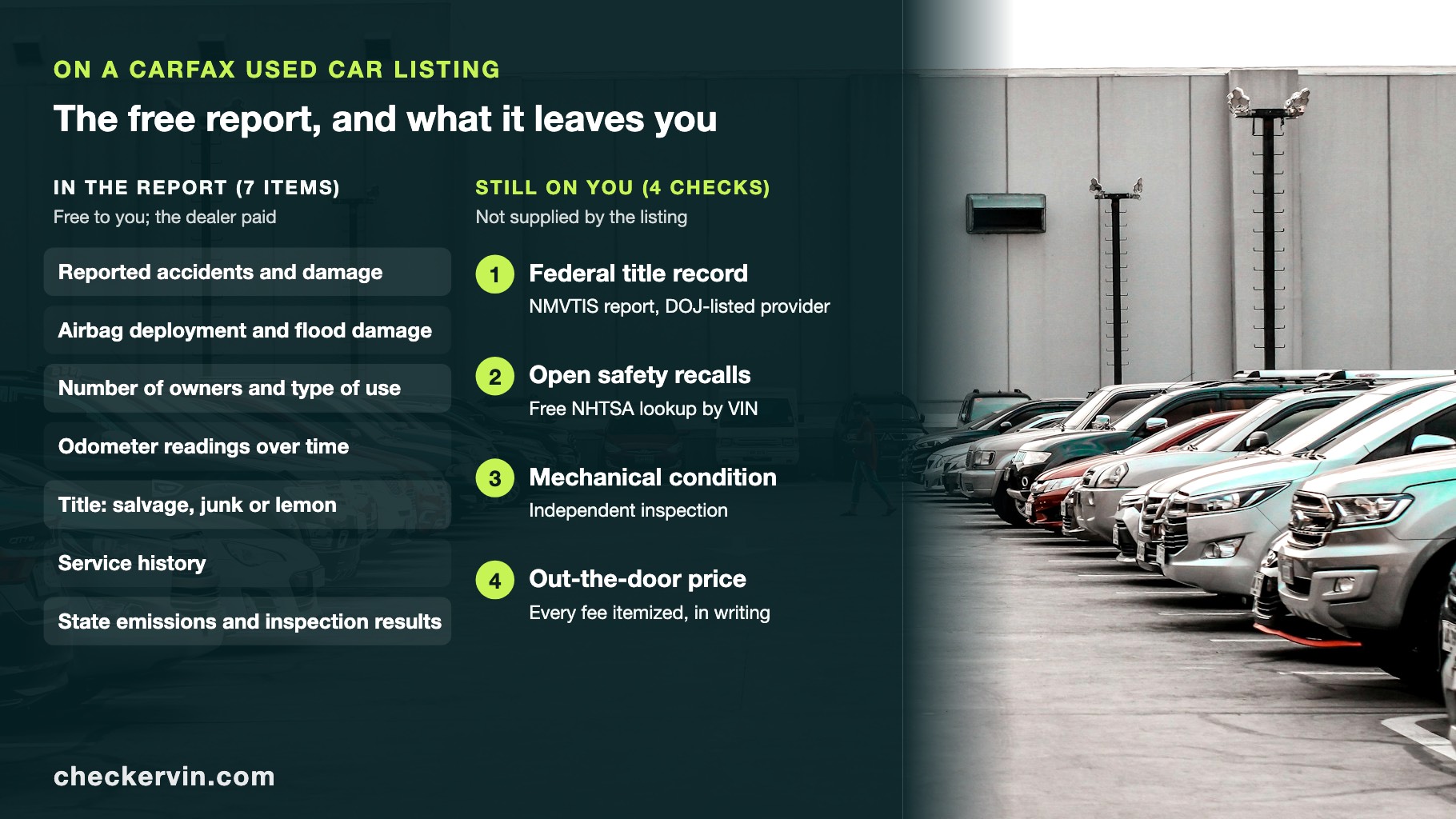
- Copy the VIN from the listing and decode it; confirm the year, trim, engine and body match the ad
- Check open safety recalls on that VIN with NHTSA's free lookup
- Read the free Carfax report for accidents, owners, use and gaps in the service record
- Buy an NMVTIS report from a DOJ-listed provider for title brands, odometer and salvage records
- Ask for the out-the-door price in writing with every fee itemized, and book an independent inspection
Here is what our free scan returns today, next to what a Carfax listing provides.
| CarCheckerVIN today | A Carfax listing |
|---|---|
| Free VIN decode: factory build and specifications | Details entered by the dealer |
| Open NHTSA safety recalls by VIN | Not described as a listing feature in what we read |
| Factory warranty terms | Certified pre-owned details where the dealer lists them |
| Market and listing prices | Carfax's history-based value and price history |
| Title, damage and odometer history: launching soon | A free Carfax report paid for by the dealer |
What our free scan returns today:
- Factory build and specifications decoded from the VIN
- Factory warranty terms
- Open NHTSA safety recalls
- Photos filed against the VIN
- Market and listing prices
Paste the VIN from a Carfax listing
Decoded from official manufacturer and NHTSA records
Carfax listings next to Cars.com and CarGurus
All three are listings marketplaces paid mainly by dealers, and none of them sells you the car. They differ in what they add to a listing. Carfax’s distinctive feature is the report: every listing carries one, and its value estimate is built from the car’s history. Our Cars.com review covers a three-badge price scale and a condition report that the dealer alone answers for. Our CarGurus review covers a five-step deal rating that runs down to Overpriced, and a 2026 New York City lawsuit over how fees interact with it.
Shopping the same car on two sites is a cheap way to test a price, and a free Carfax report on one of them is worth reading even if you buy through another. After that the checks are the same everywhere: the title record, the recall list and the mechanic are about the car, and no marketplace supplies them for you.
Where this information comes from
- Mobility Global Inc. — Form 10 information statement (SEC EDGAR)Advantage, Car Listings and CARFAX For Life; free report, history-based value and verified reviews on every listing; visitors, dealer counts, data sources, accuracy risk, legal proceedings; filed May 27, 2026
- Mobility Global Inc. — Form 8-K on completion of the separation (SEC EDGAR)Separation from S&P Global effective July 1, 2026; NYSE symbol MBGL
- Mobility Global Inc. — Form 10-Q for the quarter ended September 30, 2026 (SEC EDGAR)CARFAX segment revenue and its subscription and pay-per-report sources; filed November 12, 2026
- CARFAX — CARFAX Recognizes Top-Rated Car Dealers Nationwide (PR Newswire)Seventh annual Top-Rated Dealers, verified ratings count, 5X award, Lifetime dealers and free reports on carfax.com listings; February 4, 2026
- CARFAX — CARFAX Launches New Car Listings (via Nasdaq)Used car listings launched in 2014, each with a free report; new car listings added; February 2, 2024
- CARFAX — CARFAX Launches First-Ever Top-Rated Dealer Award (PR Newswire)The inaugural award for 2019, based on verified customer reviews; February 13, 2020
- CARFAX - New & Used Cars — Apple App Store listingApp features and the late-2025 free-report update notes; seller CARFAX, Inc.; read November 25, 2026
- CARFAX - New & Used Cars — Google Play listingThe same feature list; updated November 18, 2026
- NMVTIS — approved data providers (DOJ / BJA)The consumer notice on Carfax, its commercial-only listing and the public-tier list; retrieved November 25, 2026
- NMVTIS — information for consumers (DOJ / BJA)What NMVTIS holds, and the flood-vehicle example of brand washing
- 16 CFR Part 455 — FTC Used Motor Vehicle Trade Regulation Rule (eCFR)The five-vehicle dealer definition and the Buyers Guide duty
- NHTSA recall lookupOpen recalls by VIN, free from the regulator
- How we made this pageWritten by the CarCheckerVIN editorial team with AI assistance from Mobility Global's SEC filings, CARFAX press releases, the CARFAX app store listings, the Department of Justice's NMVTIS pages and the eCFR; facts checked November 2026. carfax.com blocked our requests and is not a source.
Keep reading
Frequently asked questions
Is Carfax Used Cars legit?
Yes, as a business. CARFAX is owned by Mobility Global Inc., which has traded on the New York Stock Exchange under MBGL since its separation from S&P Global on July 1, 2026, and files reports with the SEC. Carfax's used car listings are a paid product for dealers. Carfax does not sell the cars, so whether a particular car and seller are sound is still for you to check.
Are the Carfax reports on used car listings really free?
Free to you, yes. The company's own filing says every vehicle listing includes a free CARFAX report, along with a history-based value and verified reviews. The dealer pays for that through its Car Listings subscription. Bought on your own, outside a listing, a Carfax report is a paid product sold singly or in multi-report packages.
What is a Carfax Advantage Dealer?
A dealer that subscribes to Advantage, which the Form 10 for Carfax's parent company describes as a dealer subscription product that provides CARFAX Vehicle History Reports and related insights, such as accident, service, ownership, valuation and recall information. Dealers use it to buy inventory, price cars and show buyers the report at the point of sale. It is a paid product, not an award.
What does Carfax Top-Rated Dealer mean?
It is an annual award Carfax gives dealerships based on verified customer ratings and reviews. Carfax launched it in February 2020 for 2019 and announced the seventh annual list in February 2026, citing more than 10.8 million verified ratings and reviews. Winners can show the award on the vehicle history reports they provide. It rates the dealer's service, not any particular car.
Can private sellers list a car for sale on Carfax?
We could not confirm it. The company's filings describe Car Listings only as a dealer subscription product, and carfax.com blocked our requests, so we could not check whether private owners can list today. Treat any Carfax listing as a dealer listing unless the page clearly says otherwise, and check the seller line before anything else.
Is the free Carfax report on a listing an NMVTIS title check?
No. The Department of Justice says consumers cannot receive NMVTIS vehicle history reports from Carfax, which supplies that information only to dealerships, and lists Carfax as offering NMVTIS data to commercial customers in California only. For the federal title record, buy an NMVTIS report from one of the providers the department lists for the public.
The listing includes a report. The VIN check is yours.
Decode any VIN free for the factory build, specifications and open safety recalls. Full vehicle history reports are launching soon.
Run a free VIN check