The short answer
- Is Cars.com legit?
- Yes, as a business: it is NYSE-listed and reports to the SEC. It sells advertising and software to dealers. It does not sell, inspect or title-check the cars listed on it.
- What does a Cars.com Great Deal badge mean?
- That the posted price sits well below Cars.com's estimate for similar cars nearby. It is one of three badges, none of which says overpriced, and it grades price, not condition.
- Who stands behind the history on a listing?
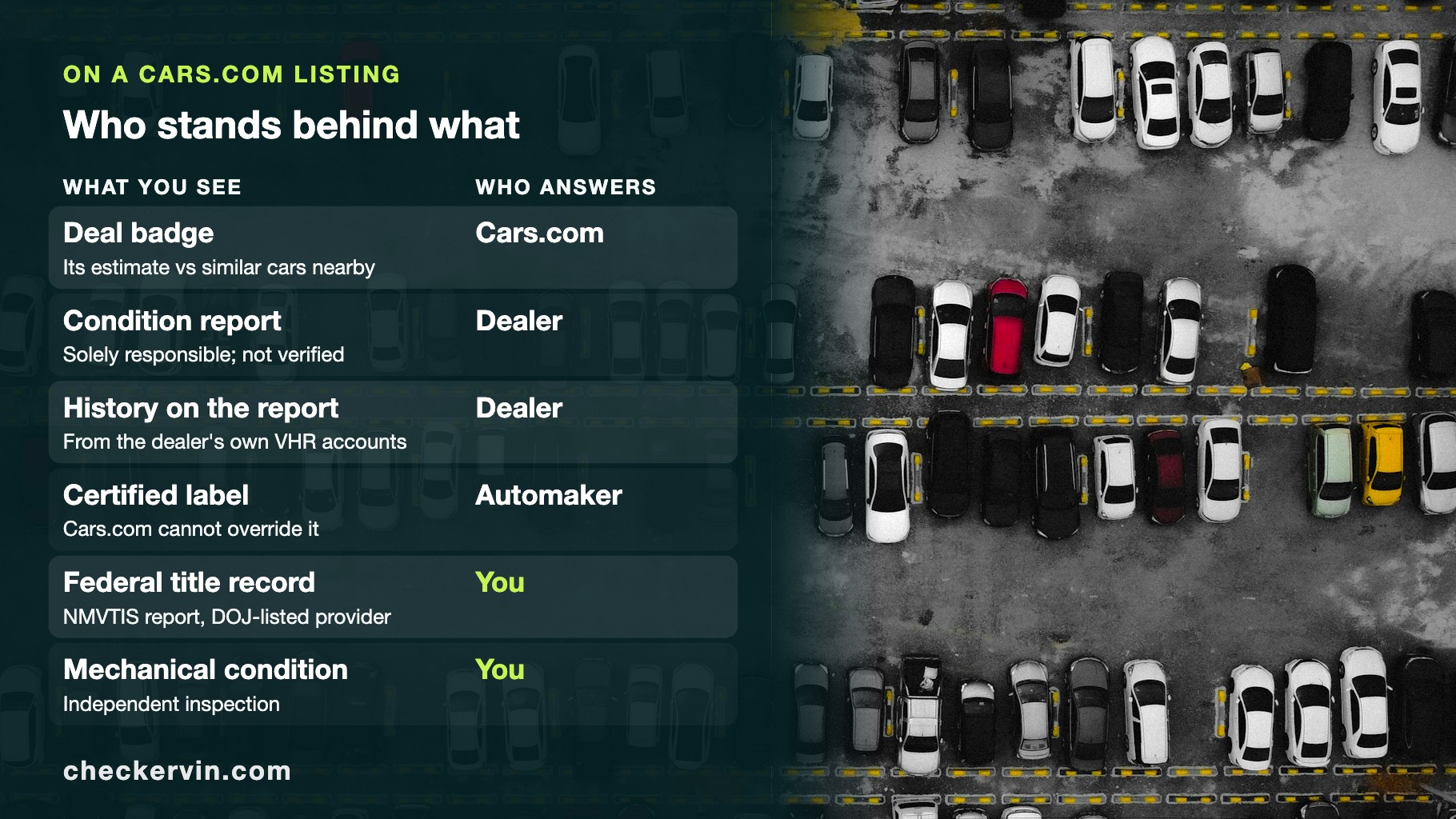
- The dealer. Cars.com says the dealer is solely responsible for its Dealer Verified Condition Report and that Cars.com does not verify the data. The federal title record is a separate check.

3
Deal badges on used listings
None of them says overpriced
89%
Share of 2025 revenue from dealers
Per its 10-K
26 million
Average monthly shoppers, 2025
Its own audience figure
Not listed
DOJ NMVTIS provider status
A marketplace, not a title-data seller
Bottom line
Cars.com is a large, established listings site, and its deal badges are a reasonable first read on whether an asking price is in line with the local market. Two things about it are easy to miss. The company sells far more to dealers than advertising space: through its other brands it can also run a dealer’s website, price the dealer’s trade-ins and handle its wholesale auctions. And the most detailed information on a Cars.com listing, the condition and history report, is published under a notice that the dealer alone answers for it.
None of that makes Cars.com untrustworthy. It does tell you where the site’s responsibility ends, which is at the listing. The car, its title and its paperwork are the seller’s, and the checks that prove them are yours.
Who Cars.com works for: the dealer is the paying customer
The company uses the name Cars Commerce on its corporate site and help center, though its legal name in SEC filings is still Cars.com Inc. Its 10-K for 2025 describes a platform built around four capabilities: the Cars.com marketplace, dealer websites (Digital Experience), advertising (Media Solutions) and trade-in tools (Trade & Appraisal). Dealer revenue made up 89% of total revenue in both 2025 and 2024, and the company says about 80% of its revenue comes from subscriptions.
The brand list in the same filing shows how far that reaches into a dealership. Under one roof sit:
- Cars.com Marketplace
- Dealer Inspire
- AccuTrade
- DealerClub
- CreditIQ
- D2C Media
- Cars Commerce Media Network
| Product line | What the 10-K says it does |
|---|---|
| Cars.com marketplace | Dealer and OEM listings shown to 26 million average monthly shoppers in 2025, sold in tiered packages |
| Dealer websites | Hosts the websites of about 7,700 dealers in the U.S. and Canada |
| AccuTrade | Prices trade-ins for dealers from demand data and diagnostic scans |
| DealerClub | A dealer-to-dealer digital wholesale auction, acquired in January 2025 |
| Media | Ads that show dealer inventory to shoppers on social media, search and streaming |
For a shopper the practical point is this: the trade-in offer, the dealer’s own site and the listing you found may all run on the same company’s software, paid for by the dealer. The 10-K says plainly that Cars.com does not sell vehicles, while noting that state regulators have on some occasions argued that dealer advertising rules apply directly to its business model. It is a dealer services company with a very large consumer website on top.
Is Cars.com legit? What the public record shows
On the question of whether the business is real and accountable, yes. Cars.com Inc. is listed on the New York Stock Exchange under the symbol CARS, files audited annual and quarterly reports with the SEC, reported revenue of $723.2 million for 2025 and had about 1,700 full-time, part-time, seasonal and temporary employees at the end of that year. It counted about 19,500 dealer customers across the U.S. and Canada at the end of 2025 and 19,251 at September 30, 2026. Its 10-K reports over 4.6 million unique VINs listed each month and over 16 million consumer reviews.
Under Legal Proceedings, the 10-K says the company does not expect any pending matter to have a material adverse effect on its finances. We searched the FTC, the CFPB and state attorney general sites for action naming Cars.com and found none. We did find a federal case in which Cars.com’s pricing tool is the example, covered below.
How Cars.com deal badges work, in its own words
The clearest explanation is in the Cars Commerce help center, in an article written for dealers and dated November 20, 2026. It says deal badges show how a used vehicle’s price compares with similar vehicles in the same local market, and that Cars.com currently shows 3 of them:
| Badge | Cars.com's definition |
|---|---|
| Great Deal | Priced significantly below the market average |
| Good Deal | Priced at or slightly below the market average |
| Fair Deal | Priced near or slightly above the market average |
The article lists 6kinds of signal behind the estimate and says Cars.com uses more than 100 variables in all to estimate a vehicle’s market value:
- Local market supply, demand and pricing trends
- Vehicle features and options
- Mileage, age and depreciation
- Vehicle history data, when available
- Certification status, such as CPO
- Dealer ratings and reviews
A few rules from the same page change how a badge should be read. Badges apply only to used vehicles. Cars.com says it does not use a car’s current list price to predict its market value; the price is compared with the estimate afterward. Badges can change overnight as supply and demand move, even when the price has not, and a price change can take up to 24 hours to show. Dealers cannot opt out. A visual Deal Gauge, shown only on badged cars, places the listing against similar vehicles nearby.
The design choice that most separates Cars.com is at the top of the scale. Its help center says the badges are “designed to provide pricing context” and that Cars.com does not label vehicles as overpriced. A car priced slightly above the market average can still carry a Fair Deal badge where features or condition justify it. So on Cars.com the worst signal is silence: a listing with no badge at all.
When a very cheap car gets no Great Deal badge
Cars.com gives 5 common reasons a used car may carry no badge:
- Too few comparable vehicles in the market
- A rare or unusual configuration that is hard to compare
- Aftermarket modifications the pricing analysis cannot weigh
- Missing listing information, such as price or mileage
- A statistical outlier Cars.com cannot rate with confidence
It adds one more that buyers should know about. In some cases, the help center says, cars priced far below the market average may not receive a Great Deal badge, and this is intentional, to protect shoppers from potential pricing errors or inaccurate listings. In other words, Cars.com treats a price that looks too good as a reason for caution rather than applause.
That is sensible, and it is also the same instinct a buyer should bring to the car. A price far under its neighbors is sometimes a typo, sometimes a dealer clearing stock, and sometimes a car with a branded title, flood history or an open recall the listing does not dwell on. The badge system will not tell you which. Our guide to used car red flags covers the signs that can, and a VIN check is the fastest way to start.
The badge from the dealer’s side of the screen
Cars.com also explains to dealers how to move a car up the scale. In the Cars.com Dealer app, a section called vehicle deal badging lists every used car within $500 of a better badge, ranks them by how close they are to the next tier, and offers a slider that shows the price at which a car would earn a Good Deal or Great Deal badge and its price rank within 60 miles. The app can export a file with the exact reduction and the target price, and Cars.com advises dealers to start with the cars closest to Great Deal.
There is nothing improper about that. It tends to push listed prices down, which helps buyers. But it shows what a badge is: a number the dealer can see coming and price toward. The general help article also tells dealers they can improve badge eligibility with complete listing details and by highlighting features in the seller’s notes. A Great Deal badge can therefore reflect a careful pricing decision about a sound car, or a sharp one about a car with a story. The badge is the same in both cases.
| A badge responds to | A badge does not see |
|---|---|
| The advertised price against Cars.com's local estimate | Dealer fees and add-ons left out of that price |
| Features and mileage the listing reports | Damage or repairs the listing does not report |
| Vehicle history data, when available | Whether that history is complete, or the title clean |
| Supply and demand nearby | Open safety recalls on this VIN |
What a federal case says about the Deal Gauge
The weak point in any price badge is the price it reads. On December 19, 2024, the Federal Trade Commission and the State of Illinois filed a complaint in the U.S. District Court for the Northern District of Illinois (case 1:24-cv-13047) against Leader Automotive Group, a group of dealerships, and its parent AutoCanada. The FTC announced a $20 million settlement with them the same day.
The complaint uses a Cars.com ad from February 2023 as an example. It says the ad appeared on Cars.com, which incorporates a Deal Gauge into many listings to tell consumers whether a car is a Great, Good or Fair Deal, and that Cars.com classified the car as a Great Deal using the dealer’s advertised price. According to the complaint, that price left out add-on charges worth more than 20% of it, which any buyer would be pushed to pay, and the pricing tool therefore rated the car better than its real cost deserved.
The lesson for a buyer is narrow and practical. A badge is computed from the number the dealer types in. If fees or add-ons sit outside that number, the badge cannot know. Ask for the out-the-door price in writing, with every charge itemized, before you treat any badge as a saving.
Cars.com’s own pricing rules, and how to report a listing
Cars Commerce publishes a notice to consumers titled “An Important Message from CARS: Pricing Transparency in Vehicle Shopping.” It says every dealership listing on the site must comply with federal and state laws against unfair or deceptive practices and with the company’s own Site Adherence Policy. In the notice’s words, the listed price must reflect the vehicle’s true selling price excluding only unavoidable government fees, material facts such as accident history must be disclosed honestly, and mandatory fees or pre-installed add-ons must be clearly disclosed and in most cases included in the advertised price.
To report a listing, the notice asks you to email siteadherence@cars.com with:
- The date you found the problem
- The Cars.com listing link and the stock number or VIN
- The dealership's name and location
- A clear description of what was unfair or deceptive
It says dealers who break the policy or the law face penalties up to and including listing suspension, points shoppers to DealerRater for dealership reviews, and names state attorneys general, the CFPB and the FTC as places to complain. Keep the listing as it appeared, ideally a dated screenshot, before you ask the dealer about a price; listings change.
The Dealer Verified Condition Report: who stands behind it
Some Cars.com listings carry a Dealer Verified Condition badge. A help article dated August 18, 2026 explains where it comes from: the dealer inspects the car in AccuTrade, the company’s appraisal tool, and that inspection data becomes a report shoppers can open from the listing. It also feeds a highlights card showing price history, vehicle demand and condition. The report can include:
- Vehicle details such as odometer, color and original owner
- Options and factory equipment
- Service status, including certified used car, extended warranty and protection package
- Vehicle history, including VHR results and frame damage disclosures
- Condition disclosures such as chipped paint, tire tread depth or mechanical issues
- OBD-II scan results and error codes, where applicable
It is a genuinely useful document when it is there, and the OBD-II scan in particular is more than most listings offer. But read the terms that come with it. Before the report opens, a pop-up tells the shopper that the dealer is solely responsible for its accuracy, and the shopper must tick a box accepting the terms. The help article states that Cars.com does not independently verify or guarantee the vehicle data, that dealers are responsible for what appears, and that shoppers are advised to inspect and verify the condition before purchase. A verification is valid for 90 days, and the dealer is told to withdraw and redo it if the mileage or disclosures change.
| Question | Answer, per the Cars Commerce help center |
|---|---|
| Who inspects the car? | The dealer, using AccuTrade |
| Who answers for accuracy? | The dealer, solely |
| Does Cars.com check it? | No; it does not independently verify or guarantee the data |
| How long is it valid? | 90 days, unless mileage or disclosures change first |
| What does Cars.com advise? | Inspect and verify the condition before you buy |
Cars.com vehicle history, and the Cars.com VIN check people search for
People search for a “Cars.com VIN check” as though the site sold one. We found no standalone VIN check or history report sold by Cars.com in its 10-K or in the help articles we read, and cars.com itself would not load for us. What we can describe is where history information on a listing comes from.
First, the deal badge uses vehicle history data “when available,” without naming a source. Second, the Dealer Verified Condition Report includes vehicle history results. A separate help article explains that dealers connect their own CARFAX and AutoCheck accounts to AccuTrade, after which history results flow into the appraisal, a red icon marks a negative history, and the disclosures appear in the condition documentation. So the history on that report is the dealer’s commercial report, presented by the dealer.
That is useful context, but it is a different product from the federal title record. The Justice Department’s NMVTIS page says consumers cannot receive NMVTIS vehicle history reports from Carfax, DMVDesk or Experian, which supply that information only to car dealerships. A consumer who wants the NMVTIS record buys it from one of the 12 businesses the department listed for the public when we checked on November 25, 2026:
- Bumper.com
- Carsforsale.com
- Carvertical.com
- Checkthatvin.com
- Clearvin.com
- EpicVin.com
- GoodCar.com
- Titlecheck.us
- Vinaudit.com
- Vindata.com
- VinReport
- Vinsmart.com
The department describes an NMVTIS report as intentionally concise: current title, state brands such as junk, salvage or flood, the latest reported odometer reading, insurer salvage and total-loss determinations, and transfers to recyclers or salvage yards. Our page on reading an NMVTIS report explains each line. A blank result means nobody reported anything, not that nothing happened, which is why the inspection still matters.
Certified labels come from the automaker, not Cars.com
A Certified label on Cars.com means the car is enrolled in an automaker’s certified pre-owned program. The help center says only franchise dealers authorized by the manufacturer can show official Certified listings; an independent dealer’s own certification program is not labeled Certified on Cars.com. Certification status comes from the automaker’s data and the dealer’s inventory feed, and Cars.com says it cannot change or override it.
That is a stronger signal than a dealer’s own “certified” wording, because the program rules and any warranty belong to the manufacturer. Certification also counts as one factor in the deal badge. It still does not clear open recalls by itself, so check the VIN for those either way, and read our page on buying a car with an open recall if one turns up.
Dealer and private listings on Cars.com
Every product the 10-K describes is sold to dealers or carmakers, and its customer counts are dealer locations. The filing does not describe a private-seller listing product, and because cars.com blocked us we could not confirm how, or whether, private owners list there today. We do not describe that process here.
What we can say is why it matters which kind of seller is on the other end. Federal and state rules ask more of a dealer than of a private seller, and our comparison of buying from a private seller or a dealer sets out what each one owes you. On any marketplace, read the seller line before the price.
Five checks for any Cars.com listing
- Copy the VIN from the listing and decode it; confirm year, trim, engine and body match the ad
- Check open recalls on that VIN with NHTSA; safety recall repairs are generally free at a franchised dealer
- Ask for the out-the-door price in writing, every fee and add-on itemized, and keep a dated screenshot of the listing
- Buy an NMVTIS report from a DOJ-listed provider for title brands, odometer and salvage records
- Book an independent inspection, even when a Dealer Verified Condition Report is attached
Here is what our free scan returns today, next to what a Cars.com listing provides.
| CarCheckerVIN today | A Cars.com listing |
|---|---|
| Free VIN decode: factory build and specifications | Details entered by the dealer |
| Open NHTSA safety recalls by VIN | Not described as a listing feature in what we read |
| Factory warranty terms | Certified program details on Certified listings |
| Market and listing prices | A deal badge against Cars.com's local estimate |
| Title, damage and odometer history: launching soon | Dealer's own history results, on listings with a condition report |
What our free scan returns today:
- Factory build and specifications decoded from the VIN
- Factory warranty terms
- Open NHTSA safety recalls
- Photos filed against the VIN
- Market and listing prices
Paste the VIN from a Cars.com listing
Decoded from official manufacturer and NHTSA records
How Cars.com sits next to CarGurus and TrueCar
Cars.com’s 10-K names CarGurus, AutoTrader and TrueCar as its direct competitors among online car marketplaces. All of them are paid mainly by dealers and none of them sells you the car. Where they differ is in how they grade a price. Cars.com’s scale has three badges and stops at Fair Deal; our CarGurus review covers a five-step scale that runs down to Overpriced, and a 2026 New York City lawsuit over how fees interact with it. Our TrueCar review explains a model built around certified dealers, a price rating and its Savings Certificate.
Shopping the same car on two sites and comparing the two price opinions is a cheap way to test a deal. The checks after that are identical everywhere, because the badge, the rating and the price report are all opinions about price. The title record, the recall list and the mechanic are facts about the car.
Where this information comes from
- Cars.com Inc. — Form 10-K for fiscal 2025 (SEC EDGAR)Business description, products, AccuTrade and DealerClub, revenue, dealer revenue share, dealer and audience counts, competitors, regulatory matters, legal proceedings, brand list; filed February 26, 2026
- Cars.com Inc. — Form 10-Q for the quarter ended September 30, 2026 (SEC EDGAR)Dealer Customers at September 30, 2026; filed November 5, 2026
- Cars Commerce Help Center — How to leverage Deal BadgesBadge tiers, signals, eligibility, the far-below-market rule, Deal Gauge; dated November 20, 2026; read November 25, 2026
- Cars Commerce Help Center — Managing deal badges in the Cars.com Dealer appThe within-$500 list, the badge slider and price rank within 60 miles
- Cars Commerce Help Center — How to use the Dealer Verified Condition ReportReport contents, the dealer-responsibility notice and 90-day validity; dated August 18, 2026
- Cars Commerce Help Center — How to connect your VHR credentialsDealers connect their own CARFAX and AutoCheck accounts to AccuTrade
- Cars Commerce Help Center — How to understand Certified listingsCertified status comes from the automaker; franchise dealers only
- Cars Commerce — An Important Message from CARS: Pricing Transparency in Vehicle ShoppingSite Adherence Policy, pricing rules for dealers and the siteadherence@cars.com reporting process
- FTC — FTC, Illinois take action against Leader Automotive GroupDecember 19, 2024; $20 million settlement with the dealer group and AutoCanada
- FTC and State of Illinois v. Leader Automotive Group — complaintN.D. Ill. case 1:24-cv-13047; the Cars.com ad and Deal Gauge example; allegations against the dealers only
- NMVTIS — approved data providers (DOJ / BJA)The public-tier list and the Carfax, DMVDesk and Experian notice; retrieved November 25, 2026
- NMVTIS — information for consumers (DOJ / BJA)What an NMVTIS report contains and the false-negative warning
- NHTSA recall lookupOpen recalls by VIN, free from the regulator
- How we made this pageWritten by the CarCheckerVIN editorial team with AI assistance from Cars.com's SEC filings, the Cars Commerce help center and consumer notice, an FTC case file and the Department of Justice's NMVTIS list; facts checked November 2026. cars.com blocked our requests and is not a source.
Keep reading
Frequently asked questions
Is Cars.com legit?
Yes, as a company. Cars.com Inc. trades on the New York Stock Exchange under CARS, files audited reports with the SEC and reported 2025 revenue of $723.2 million. It is a listings marketplace paid mainly by dealers. It does not sell the cars, and its own help pages say it does not independently verify the condition data dealers publish.
How do Cars.com deal badges work?
Cars.com shows three badges on eligible used cars: Great Deal, Good Deal and Fair Deal. Its help center says they compare a car's price with similar vehicles in the local market, using signals such as supply and demand, features, mileage, age, vehicle history data when available, certification and dealer ratings, and more than 100 variables in all. It does not label any car overpriced.
Why does a Cars.com listing have no price badge?
Cars.com lists several reasons: too few comparable cars, a rare configuration, aftermarket modifications, missing price or mileage, or a statistical outlier. It also says cars priced far below market may be denied a Great Deal badge on purpose, to protect shoppers from pricing errors or inaccurate listings. A missing badge is not a verdict on the car.
Does Cars.com have a VIN check or vehicle history report?
We found no standalone Cars.com VIN check in its SEC filings or help center. A listing can carry a Dealer Verified Condition Report, which can include the dealer's own vehicle history report results, and the dealer is responsible for its accuracy. Cars.com is not on the Justice Department's list of approved NMVTIS providers, so for the federal title record use a provider on that list.
Can a dealer game a Cars.com Great Deal badge?
The badge reads the advertised price, so it is only as honest as that price. In a 2024 federal complaint, the FTC and Illinois alleged that a dealer group left add-on charges out of a Cars.com ad, so the Deal Gauge rated the car a Great Deal. Cars.com was not a defendant. Cars.com's own policy requires dealers to include mandatory fees and add-ons in the price.
How do I report a misleading Cars.com listing?
Cars Commerce asks shoppers to email siteadherence@cars.com with the date, the listing link, the stock number or VIN, the dealership's name and location, and a description of the problem. It says dealers who break its Site Adherence Policy face penalties up to listing suspension. You can also complain to your state attorney general, the CFPB or the FTC.
The badge reads the price. Read the VIN.
Decode any VIN free for the factory build, specifications and open safety recalls. Full vehicle history reports are launching soon.
Run a free VIN check