The short answer
- Is CarGurus legit?
- Yes, as a company: it is a Nasdaq-listed marketplace that reports to the SEC. It sells advertising to dealers. It does not inspect, title-check or guarantee the cars listed on it.
- What does a deal rating mean?
- How the asking price compares with CarGurus' own estimate of local market value. It says nothing about the car's condition, and fees not in the posted price are the subject of a 2026 New York City lawsuit.
- Is Instant Max Cash Offer still running?
- No. CarGurus' 10-K says it wound down CarOffer, including Instant Max Cash Offer, by the end of 2025. Its selling product is now Sell My Car.

5
Deal Ratings on eligible used listings
Great Deal to Overpriced
$907.0 million
2025 revenue, per its 10-K
Dealers, advertisers, finance partners
26,049
US paying dealers, end of 2025
Its own key metric
Not listed
DOJ NMVTIS provider status
It is a marketplace, not a title-data seller
The short verdict
CarGurus is a useful place to find used cars and to see roughly where an asking price sits against the local market. It is not a referee. The company makes its money from the dealers who list with it, its deal ratings grade the posted price rather than the car, and its own annual report describes no inspection or title check behind any listing.
That is normal for a listings marketplace, and it is not a criticism of the business. It does mean a buyer should read a “Great Deal” badge as the start of a question, not the answer. Two facts searchers often miss: New York City’s consumer agency sued CarGurus in October 2026, alleging that fees left out of posted prices make some ratings misleading, and the Instant Max Cash Offer that many sellers still search for was shut down at the end of 2025.
What CarGurus is, according to its own filings
The clearest description of CarGurus is the one it gives investors under penalty of securities law. Its 10-K for 2025 calls it a multinational automotive platform, says it was founded in 2006and runs marketplaces in the U.S., the U.K. and Canada, and claims to be the No. 1 visited automotive shopping site in the U.S. That last claim rests on Similarweb traffic data for the fourth quarter of 2025, compared against Cars.com, Autotrader.com, TrueCar.com and CARFAX.com listings; it is the company’s claim, and we have not checked the underlying data.
The money comes from three places, in the filing’s own order: dealer subscription fees, advertising from carmakers and other brands, and partnerships with financing companies. Revenue for 2025 was $907.0 million. Dealers can list for free under what CarGurus calls Restricted Listings, which come with capped, anonymous leads; paid Listings packages buy more visibility and more leads, and are priced on the dealer’s inventory size and region. At the end of 2025 it counted 26,049 paying dealers in the U.S., and its quarterly report for the period to September 30, 2026 counted 26,402.
| Question | What the 10-K says |
|---|---|
| Who pays CarGurus? | Dealers (subscriptions), brand advertisers and finance partners |
| Can a dealer list free? | Yes, as Restricted Listings, with capped anonymous leads |
| What does a paid package buy? | Visibility, leads and dealer tools, in tiers |
| Does it sell cars itself? | No; it describes itself as a platform for dealers and shoppers |
| Does it inspect listed cars? | The filing describes no inspection program |
So when you use CarGurus as a shopper, you are the audience, and the paying customer is the dealer. That is the same arrangement as most listing sites. It is the reason the independent checks later on this page matter.
Is CarGurus legit? What the record shows
On the plain question of whether the company is real and accountable, the answer is yes. CarGurus, Inc. trades on the Nasdaq Global Select Market under the symbol CARG, files audited annual reports and quarterly reports with the SEC, and reported 1,218full-time employees at the end of 2025. New York City’s complaint gives its address as 1001 Boylston Street in Boston, the same headquarters building its 10-K names.
“Legit” is a narrower word than “safe,” though. A legitimate marketplace can still carry a listing from a dealer who prices badly, adds fees late or sells a car with a branded title. CarGurus’ filings say its vehicle pages show dealer reviews and ratings, which help with the dealer question. Nothing in them says it checks the car.
How CarGurus deal ratings work, in its own words
The 10-K describes the system in two sentences. Eligible used car listings are assigned one of 5 Deal Ratings:
- Great Deal
- Good Deal
- Fair Deal
- High Priced
- Overpriced
Those ratings are based on Instant Market Value, or IMV, which the filing calls a proprietary algorithm that assesses the market value of a used vehicle in a local market. It says IMV is calculated by analyzing tens of millions of data points, and it names 9 kinds: make, model, trim, year, features, condition, history, geographic location, mileage.
In practice a rating is a comparison: the posted asking price against the IMV for that car in that area. New York City’s complaint describes the same mechanism from the outside, saying listings priced below the IMV get a Great or Good rating, listings above it get a High or Overpriced rating, and the listing also shows the dollar gap between asking price and IMV. The word “eligible” matters too. The filing does not list which used cars qualify, so a listing without a rating is not a sign of anything on its own.
The filing does not publish the formula, the weighting of each input, or how often the estimate is refreshed. That is ordinary for a proprietary model, and it means a rating should be treated as one company’s opinion of price, made with a lot of data, rather than a market fact. If you want a second number, our page on car value by VIN explains which inputs actually move a valuation and why different guides disagree.
A deal rating grades the price, not the car
The list of IMV inputs includes “condition” and “history.” It would be easy to read that as meaning a Great Deal has passed some kind of history screen. The filing does not say that. It does not name a history source, say how a branded title or a reported accident is weighed, or say whether a car with an unknown history is rated differently. Condition, on a listings site, can only mean what the seller entered.
| A deal rating can tell you | A deal rating cannot tell you |
|---|---|
| The asking price is below or above CarGurus' local estimate | Whether the car has a salvage, flood or rebuilt brand |
| Roughly how far, in dollars, per the listing | Whether open safety recalls have been repaired |
| That CarGurus' model thinks the price is competitive | What fees the dealer will add at signing |
| Nothing about the dealer beyond the price | Whether the VIN on the car matches the listing and the title |
The pattern to watch for is the one every buyer eventually meets: a car priced well below its peers. Sometimes the dealer simply wants it gone. Sometimes the price reflects a history the listing does not dwell on. A rating built from asking prices cannot tell those apart, and our guide to used car red flags covers the signs that can.
The fee question: New York City’s lawsuit over deal ratings
We searched for official action against CarGurus at the FTC, the CFPB and state attorneys general and found none naming the company. We did find a local one. On October 5, 2026, the City of New York and the commissioner of its Department of Consumer and Worker Protection filed a verified complaint against CarGurus, Inc. in the New York State Supreme Court, New York County, under index number 454290/2026. The department announced it on October 15, 2026.
The complaint’s central allegation is that the asking price CarGurus displays can leave out hundreds or thousands of dollars in fees, down payments and trade-in requirements that are part of the dealer’s offer, and that CarGurus then labels those listings Great or Good Deals measured against an IMV the full price would exceed. It says the department corresponded with CarGurus for more than three years, that CarGurus began adding badges such as “price includes fees” and “fees not disclosed” at the end of April 2026, and that changes CarGurus announced for July 14, 2026 did not fix the problem. The department’s release says it found more than 2,000 violations of the city’s Consumer Protection Law during its investigation and seeks an injunction and civil penalties; the complaint also asks for restitution.
The federal backdrop points the same way for dealers. On September 15, 2026 the FTC published price-transparency FAQs for auto dealers, saying the advertised price must be the actual price any consumer can walk in and pay, excluding only charges the government requires the consumer to pay. The complaint also quotes CarGurus’ own pricing guidelines for dealers, which say listed prices must be full cash prices available to any shopper. Whatever the court decides, the practical step is the same: ask the dealer for the out-the-door price in writing before you treat any badge as a saving.
Dealer listings and private sellers
The 10-K describes CarGurus’ U.S. marketplace almost entirely in terms of dealers: dealer listings, dealer subscriptions, dealer reviews and leads delivered to dealers. The only place it describes a platform carrying both dealer and private seller listings is PistonHeads, its U.K. enthusiast site. We could not open cargurus.com to confirm whether or how private owners list in the U.S. today, so we do not describe that process here.
The distinction matters more than the site design suggests, because federal rules treat the two sellers differently. Under the FTC’s Used Car Rule a dealer is anyone who sold or offered five or more used vehicles in the previous twelve months, and dealers owe buyers things a private seller does not. Our page on buying from a private seller or a dealer walks through exactly what each one owes you. On CarGurus, read the seller line on every listing before you read the price.
Does CarGurus show vehicle history, and from whom?
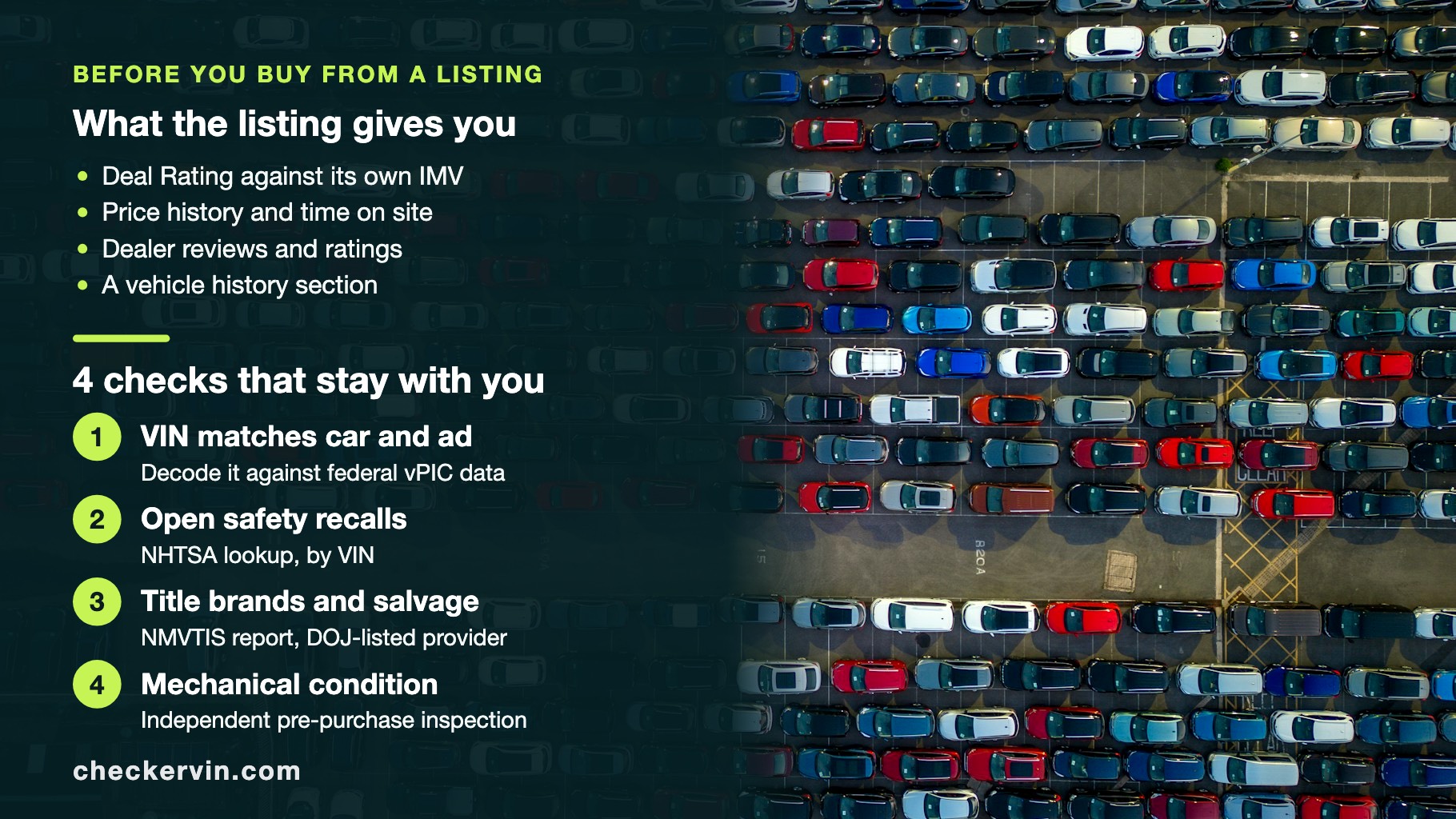
According to its 10-K, CarGurus’ vehicle detail pages include dealership information, dealer reviews and ratings, payment calculators, vehicle history, price history and time on site, as well as photos. The filing does not say where the vehicle history comes from, how complete it is, or whether it appears on every listing. Because the site blocked us, we could not open a listing to see how that section is labeled or sourced.
Two things we can say from public records. First, CarGurus is not on the Department of Justice’s list of businesses approved to sell NMVTIS vehicle history reports, so whatever history a listing shows is not CarGurus selling you the federal title record. Second, the same DOJ page states that consumers cannot receive NMVTIS reports from Carfax, DMVDesk or Experian, which supply that data to dealerships only. If a listing links a history report from one of those companies, it may be useful, but it is a different product from the federal title record.
Price history and time on site are genuinely helpful, and they are the parts a marketplace is best placed to know. A car whose price has been cut several times, or that has sat for months, gives you room to negotiate and a reason to ask why. None of it replaces the title check below.
CarGurus Instant Max Cash Offer: what happened to it
Many sellers still search for the CarGurus Instant Max Cash Offer, so it is worth being precise. In its 10-K, CarGurus says that through 2025 it reported a Digital Wholesale segment, which primarily earned revenue from Dealer-to-Dealer and Instant Max Cash Offer services sold on its CarOffer platform. On August 6, 2025, its board decided to wind down CarOffer, including both of those products, after concluding the model had proven less effective in a volatile pricing environment.
The filing says the wind-down was completed and the business was treated as abandoned for accounting purposes as of December 31, 2025, at a total cost of $13.3 million. Any article that still describes how to get an Instant Max Cash Offer from CarGurus is describing a product the company says no longer exists.
What remains is Sell My Car, formerly called Sell My Car – Top Dealer Offers. The 10-K describes it as letting consumers sell their cars while dealers make tailored trade-in offers on them; dealers control their own bidding, receive the seller’s contact details as a lead, and pay CarGurus mainly through monthly subscriptions. Its mobile app, the filing says, lets consumers receive instant offers through Sell My Car.
- An offer comes from a dealer, not from CarGurus; the dealer decides whether it stands after seeing the car
- Have your title, lien payoff details and the VIN ready, because the buyer will check all three
- Compare the offer with a private sale and a trade-in quote before you accept
- Check your own car's open recalls by VIN, so nothing in the inspection surprises you
CarGurus vs Autotrader: a fair, short comparison
People comparing CarGurus vs Autotrader usually want to know which one to shop on. We wanted to answer that from Autotrader’s own pages, and could not: autotrader.com returned a “site is currently unavailable” block page to every request we made on November 25, 2026. Rather than repeat third-party summaries, here is what we could verify.
| Point | What we could verify |
|---|---|
| Owner | CarGurus is independent and public; Cox Automotive lists Autotrader and Kelley Blue Book among its brands |
| Business model | CarGurus' 10-K names AutoTrader.com among the major U.S. online automotive marketplaces it competes with |
| Price grading | CarGurus: five Deal Ratings from its IMV. Autotrader: not verified from its own pages |
| Traffic claim | CarGurus claims No. 1 visits in the U.S., citing Similarweb; Autotrader's own claims not read |
| Stands behind the car? | Neither, as a listing site; the seller does, to the extent the law and the contract say |
For a buyer the useful difference is less about the site and more about the valuation each one leans on. CarGurus grades with its own model. Autotrader sits in the same group as Kelley Blue Book. Shopping both and comparing the same car’s price against two different market estimates is a cheap way to see whether a deal holds up. The checks after that are identical.
What a marketplace does not stand behind
This is the point the badges can obscure. CarGurus connects you with a seller and gives you pricing context. The car, its title and its repair record belong to the seller. New York City’s complaint describes CarGurus as presenting itself as a neutral third party; whatever the merits of that case, neutral is not the same as responsible for the vehicle.
Three records are free or close to free, and none of them depends on trusting the listing:
| Check | Where it comes from |
|---|---|
| The VIN matches the car and the ad | The 17-character VIN decoded against the federal vPIC database |
| Open safety recalls | NHTSA's recall lookup, by VIN |
| Title brands, odometer, salvage and total-loss records | An NMVTIS report from a DOJ-approved provider |
| Mechanical condition | An independent pre-purchase inspection |
Only businesses the Department of Justice approves may sell that federal title record to the public. When we checked on November 25, 2026, the department named 12 of them in its consumer tier:
- Bumper.com
- Carsforsale.com
- Carvertical.com
- Checkthatvin.com
- Clearvin.com
- EpicVin.com
- GoodCar.com
- Titlecheck.us
- Vinaudit.com
- Vindata.com
- VinReport
- Vinsmart.com
The department describes an NMVTIS report as intentionally concise, covering five key indicators tied to fraud and theft. It also says 87 percent of the U.S. vehicle population is in NMVTIS and warns that a search can return a false negative such as “no junk or salvage history.” A blank line in the report means no one filed anything, not that nothing happened, which is why the mechanic still gets the last word.
Checks to run on any CarGurus listing
- Get the VIN from the listing or the seller and decode it; confirm year, trim, engine and body match the ad
- Check open recalls by VIN; safety recall repairs are generally free at a franchised dealer
- Ask the seller for the out-the-door price in writing, with every fee itemized
- Pull an NMVTIS report from a DOJ-listed provider for title brands and salvage records
- Read the price history and days on site, and ask why if either looks unusual
- Match the VIN on the car's dash and door label to the listing and the title before paying
- Book an independent inspection; no rating or database replaces one
Here is what our free scan returns today, side by side with what CarGurus provides.
| CarCheckerVIN today | CarGurus |
|---|---|
| Free VIN decode: factory build and specifications | Listing details entered by the seller |
| Open NHTSA safety recalls by VIN | Not described as a listing feature in its filings |
| Factory warranty terms | Not described in its filings |
| Market and listing prices | Deal Rating against its own IMV, plus price history |
| Title, damage and odometer history: launching soon | Vehicle history on listings; source not named in its filings |
What our free scan returns today:
- Factory build and specifications decoded from the VIN
- Factory warranty terms
- Open NHTSA safety recalls
- Photos filed against the VIN
- Market and listing prices
Paste the VIN from a CarGurus listing
Decoded from official manufacturer and NHTSA records
Who CarGurus suits
CarGurus suits a shopper who wants a wide selection of dealer inventory and a quick sense of where each asking price sits, and who is willing to do the checks a marketplace does not. It suits less well anyone who reads a Great Deal badge as a recommendation of the car, or who expects the site to stand between them and a dealer’s fees. For the whole sequence from shortlist to signature, see how to buy a used car, and if a listing shows an open recall, read what the law says about buying it.
Where this information comes from
- CarGurus, Inc. — Form 10-K for fiscal 2025 (SEC EDGAR)Deal Ratings and IMV, vehicle page contents, revenue, paying dealers, Restricted Listings, Sell My Car, the CarOffer and Instant Max Cash Offer wind-down; filed February 19, 2026
- CarGurus, Inc. — Form 10-Q for the quarter ended September 30, 2026 (SEC EDGAR)Paying dealers at September 30, 2026 and the legal-proceedings statement; filed November 5, 2026
- NYC DCWP — press release on its lawsuit against CarGurusOctober 15, 2026; violation count and relief sought; read November 25, 2026
- NYC DCWP — summons and verified complaint, City of New York v. CarGurus, Inc.NY Supreme Court, New York County, index 454290/2026, filed October 5, 2026; allegations only
- FTC — price transparency FAQs for auto dealersSeptember 15, 2026; the advertised price must be the price any consumer can pay
- NMVTIS — approved data providers (DOJ / BJA)The public-tier list, VinGurus.com under EpicVin, and the Carfax, DMVDesk and Experian notice; retrieved November 25, 2026
- NMVTIS — information for consumers (DOJ / BJA)Five indicators, the 87 percent coverage figure and the false-negative warning
- 16 CFR 455.1 — Used Car Rule definitions (eCFR)The five-vehicle dealer definition
- Cox Automotive — brandsLists Autotrader and Kelley Blue Book among its brands
- NHTSA recall lookupOpen recalls by VIN, free from the regulator
- How we made this pageWritten by the CarCheckerVIN editorial team with AI assistance from NHTSA vPIC and other public records, chiefly CarGurus' SEC filings, New York City court and agency documents and the Department of Justice's NMVTIS pages; facts checked November 2026. cargurus.com and autotrader.com blocked our requests and are not sources.
Keep reading
Frequently asked questions
Is CarGurus legit?
As a business, yes. CarGurus, Inc. is a public company that files annual and quarterly reports with the SEC, trades on Nasdaq under CARG and says it was founded in 2006. It is a listings marketplace: dealers pay it to advertise. That makes the company real, but it does not vouch for any car or dealer, and New York City's consumer agency sued it in October 2026 over how prices and deal ratings are shown, which CarGurus has not been found liable for.
How do CarGurus deal ratings work?
By CarGurus' own description in its annual report, eligible used-car listings get one of five ratings, from Great Deal to Overpriced, based on its Instant Market Value. IMV is its algorithm's estimate of a used vehicle's market value in a local market, built from data points such as make, model, trim, year, features, condition, history, location and mileage. The rating compares the asking price with that estimate.
Is a CarGurus Great Deal really a good deal?
It means the posted asking price sits below CarGurus' estimate of market value. It does not mean the car is sound, the title is clean or the out-the-door price is low. New York City's complaint alleges that some listings rated Good or Great carried mandatory fees that pushed the real cost above market value. Ask for the out-the-door price in writing and check the VIN yourself.
Does CarGurus still offer Instant Max Cash Offer?
Not according to its 10-K. CarGurus says its board decided on August 6, 2025 to wind down CarOffer, including the Dealer-to-Dealer and Instant Max Cash Offer products, and that the wind-down was complete as of December 31, 2025. Selling now runs through Sell My Car, where dealers make offers on cars consumers list.
CarGurus vs Autotrader: which is better?
They are both listings marketplaces where the car is sold by someone else, so neither replaces your own checks. CarGurus grades price against its own market estimate. Autotrader belongs to Cox Automotive, which also owns Kelley Blue Book. Autotrader's site blocked our requests, so we could not verify its current features and do not rank one over the other.
Does CarGurus check a car's title or condition?
Nothing in its SEC filings says it inspects cars or checks titles. Its listings show information including vehicle history and price history, but CarGurus is not on the Department of Justice list of approved NMVTIS title-data providers. For the federal title record, use a provider on that list; for condition, use an independent mechanic.
Check the car, not just the badge
Decode any VIN free for the factory build, specifications and open safety recalls. Full vehicle history reports are launching soon.
Run a free VIN check