The short answer
- Does Carfax work for motorcycles?
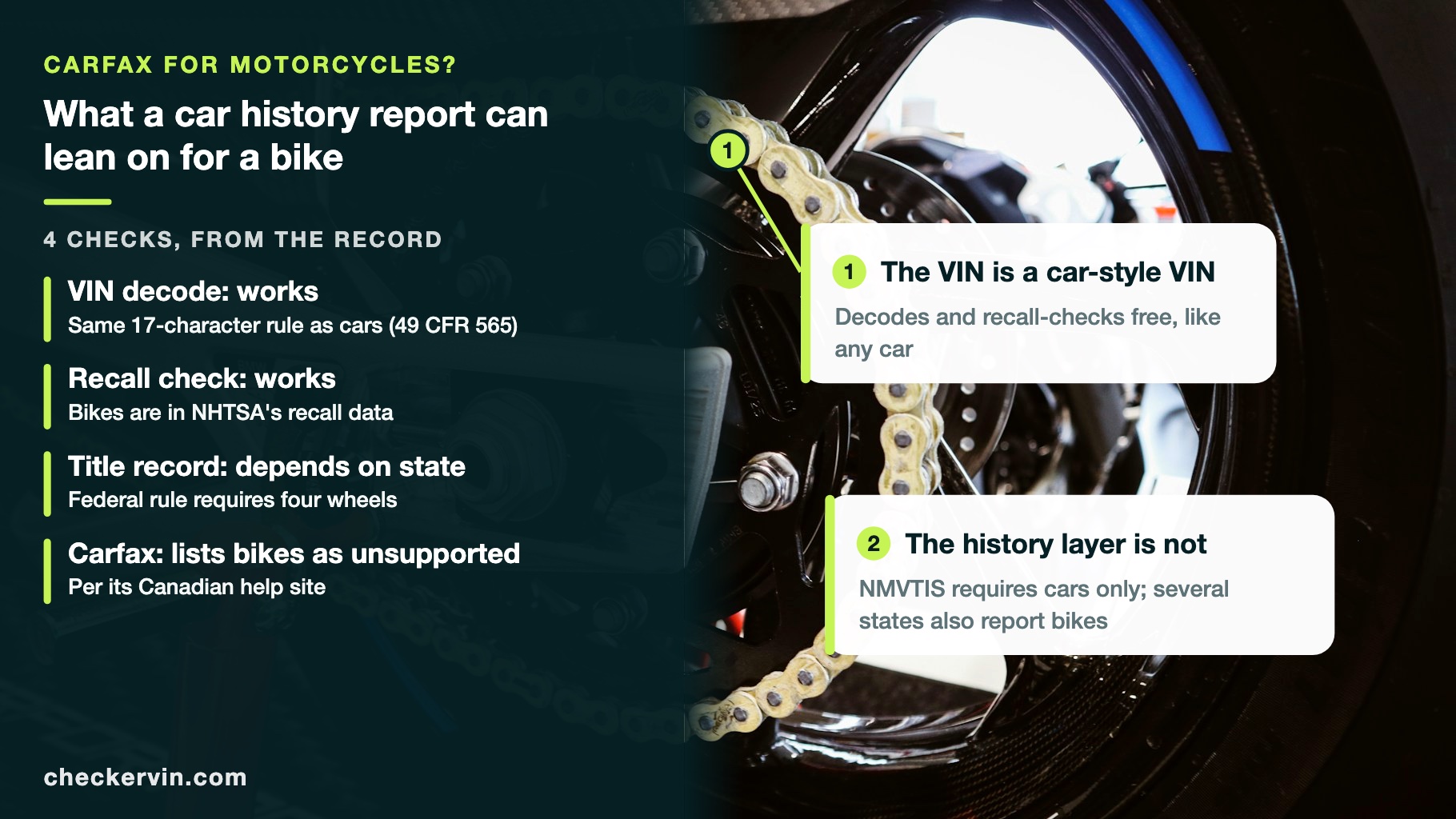
- Carfax's Canadian help site lists motorcycles, RVs, boats and trailers as vehicle types it cannot report on. We could not read a U.S. statement because carfax.com blocked our requests.
- Why don't car reports cover them well?
- The federal title rule behind car reports requires reporting on four-wheeled automobiles under 10,000 pounds. Bikes, trailers, many motorhomes and every boat fall outside that definition.
- What works instead?
- A free VIN decode and recall check for bikes and RV chassis, the state title record, and for boats the 12-character HIN, state agencies and Coast Guard documentation.
17
Characters in a motorcycle VIN
49 CFR Part 565, same rule as cars
12
Characters in a boat HIN
33 CFR 181.25, not a VIN
4 wheels
What NMVTIS reporting requires
28 CFR 25.52 via 49 U.S.C. 32901
Dealers
Who Carfax sells NMVTIS data to
Commercial customers, California only (DOJ)
The short answer
If you are asking whether Carfax works for motorcycles, RVs or boats, the most direct statement Carfax publishes that we could read says no for all three. Its Canadian help site lists motorcycles, motorhomes and RVs, boats and trailers among the vehicle types it cannot produce a report for. That is not a quirk of one company. The data a car history report stands on was organized around cars, and the federal title rule under it defines its scope by four wheels.
The useful answer is what to run instead, and it differs by vehicle. Motorcycles and motorhome chassis carry standard 17-character VINs, so free federal decodes and recall lookups work on them. Their title records depend on the state. Boats are a different system altogether, keyed to a 12-character hull number. The rest of this page takes each in turn.
Does Carfax work for motorcycles? What its own pages say
We tried to answer this from Carfax’s U.S. pages first. In November 2026, carfax.com and its U.S. support site answered our requests with an access-denied error, and we did not try to get round it. We also searched Carfax’s press releases on PR Newswire for anything on motorcycles, RVs or boats and found none.
The Carfax page that did load is a help article on Carfax’s Canadian support site, titled “What does the ‘We couldn’t verify your VIN’ message mean?” It says the message appears when a VIN is not recognized as a passenger car or light truck built after 1980 for sale in Canada or the U.S., or belongs to a vehicle type it does not support. Its list, which it says is not exhaustive, includes:
- Motorcycles
- Campers, motorhomes and RVs
- Boats and personal watercraft
- Trailers
- All-terrain vehicles and snowmobiles
- Heavy equipment
- Classic vehicles built before 1981
- Vehicles made for markets outside Canada and the U.S.
Two cautions on reading that. It is the Canadian site, last modified in May 2023, and the U.S. product could differ; we could not check. And it describes what the report can decode, not whether a stray record about a bike exists somewhere in a database. For a buyer the practical upshot is the same: do not plan on a Carfax report as your motorcycle history report, RV history report or boat history report.
Why car history systems stop at four wheels
Every low-cost title report in the U.S. resells NMVTIS, the federal title system. Its rules sit in 28 CFR Part 25, and the reporting duties there are written about an “automobile.” Section 25.52 gives that word the meaning in 49 U.S.C. 32901(a): a four-wheeled vehicle propelled by fuel, built mainly for public roads and rated at less than 10,000 pounds gross vehicle weight. The statute then carves out work trucks and vehicles built in stages by small manufacturers.
States must send title data for all automobiles; insurers must report automobiles they take as total losses from the current model year and the four before it; junk and salvage yards must report the automobiles they acquire. Read against the definition, that leaves several things outside the mandatory net:
| Vehicle | An “automobile” under 28 CFR 25.52? |
|---|---|
| Car, SUV, light pickup | Yes: four wheels, under 10,000 pounds |
| Motorcycle | No: two wheels (three-wheelers fail the same test) |
| Motorhome over 10,000 pounds | No: over the weight line |
| Motorhome finished in stages by a small builder | No: the statute excludes small multi-stage builders |
| Travel trailer, fifth wheel | No: not self-propelled |
| Boat | No: not a road vehicle, and it carries a HIN rather than a VIN |
“Not required” is not the same as “never there.” The Justice Department’s consumer page says several states may report all motor vehicles, including motorcycles and heavy equipment, even though the requirement covers common automobiles only. It also says about 87 percent of the U.S. vehicle population is in NMVTIS and that a search can return a false negative. On a bike or a motorhome, a clean result is weaker evidence than it is on a sedan.
Motorcycle history report: the routes that work
The good news for bike buyers is identification. 49 CFR Part 565 applies to motorcycles exactly as it does to cars: 17 characters, a check digit in position nine, a manufacturer code filed with NHTSA. So a motorcycle VIN decodes on any federal lookup, and NHTSA’s recall data covers bikes; a 2022 model-year search for Harley-Davidson returns models with recall records, for instance.
History is where it gets uneven. Because the federal rule does not require motorcycle titles, whether a provider holds them depends on what each state sends. Before paying for any motorcycle history report, ask the seller two questions: does it hold motorcycle title data, and from which states? Then compare the answer with the states on the bike’s title. Where the bike’s VIN is stamped, how frame and engine numbers relate, and theft checks are covered in our motorcycle VIN lookup guide; pricing a bike once its identity checks out is in motorcycle value by VIN.
How many motorcycle makers NHTSA's decoder knows
One reason motorcycle reports are patchier than car reports shows up in NHTSA’s own database. We asked vPIC, the public decoder, how many makes it holds for each vehicle type on November 25, 2026:
| vPIC vehicle type | Makes listed, and what sits there |
|---|---|
| Motorcycle | 1,704 makes: Road bikes, scooters with a VIN, many small importers |
| Passenger car | 195 makes: The type every car history product is built around |
| Incomplete vehicle | 125 makes: Includes the stripped chassis a motorhome is built on |
| Trailer | 9,631 makes: Travel trailers and fifth wheels sit in this type |
| Low speed vehicle | 531 makes: Golf-cart-class road vehicles |
That is 1,704 motorcycle makes against 195passenger-car makes. The counts are registrations in NHTSA’s database rather than distinct companies (it lists both “HARLEY-DAVIDSON” and “HARLEY” as motorcycle makes, for example), but the shape is clear: a long tail of small makers and importers, each filing its own VIN structure. A private records network built on dealer service visits has far less to work with on a bike from a brand with a handful of U.S. dealers. The decode, which only needs the filed VIN structure, does not have that problem.
Carfax for RVs: two vehicles under one roof
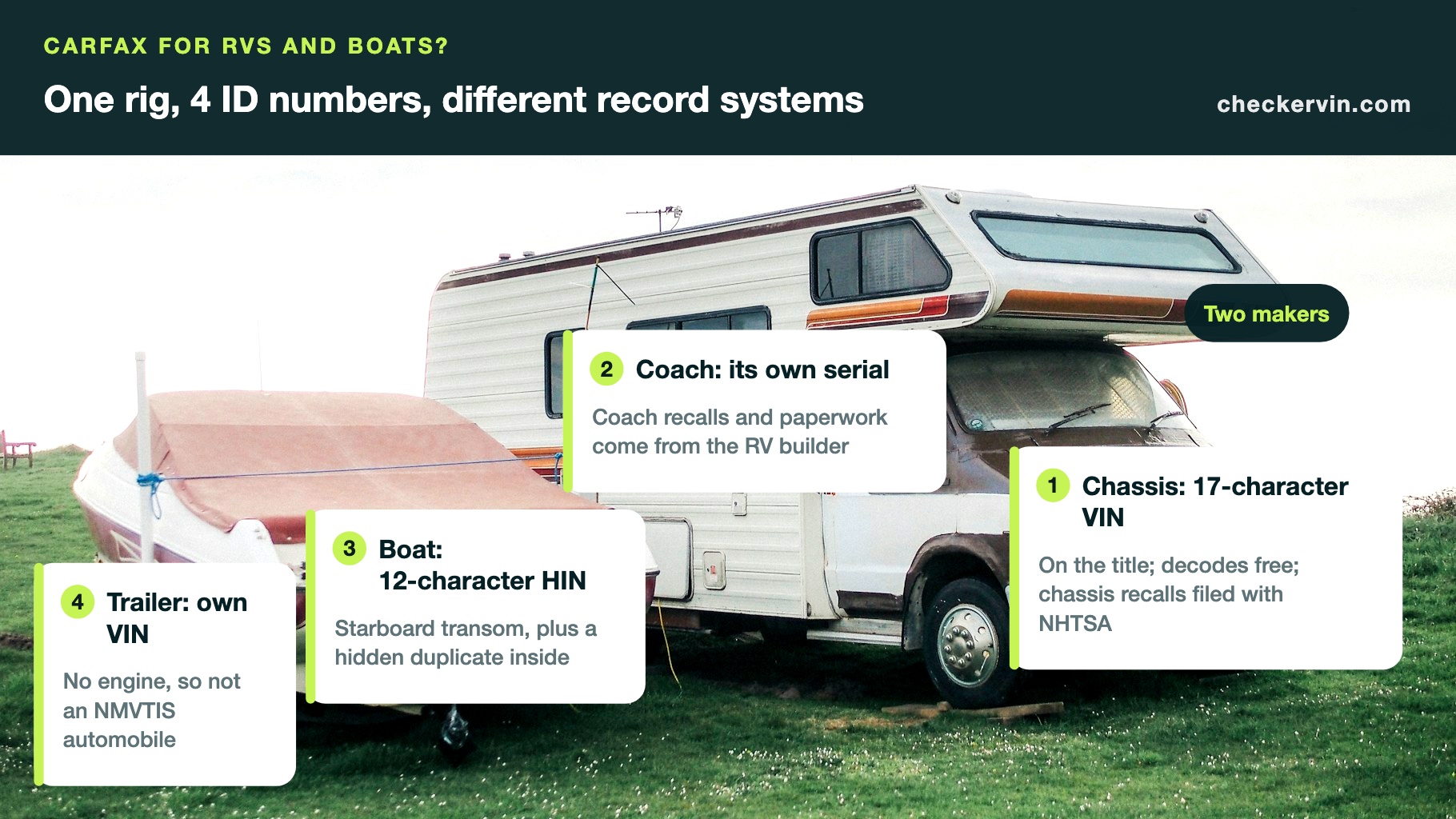
A motorhome is a chassis from one manufacturer with a coach from another built on top. The chassis VIN is the vehicle’s legal identity: it is on the title, and it is what a VIN decode returns, which is why a motorhome often decodes as a truck maker. The coach has its own serial number and data plate. Our RV VIN lookup guide covers where both numbers sit and how to read them.
For an RV history report, that split decides where each answer lives. Chassis recalls are filed against the chassis VIN. NHTSA campaign 21V202000, for example, covered certain 2020–2021 Ford F-53 motorhome stripped chassis for too little rear axle lubricant, which Ford said could damage the rear wheel bearings. A recall on the coach’s plumbing, propane or slide-outs is the coach builder’s, so ask that manufacturer about the coach serial as well.
On the title side, the weight line and the multi-stage carve-out in the statute mean many motorhomes fall outside mandatory NMVTIS reporting. Some states report them anyway; ask any provider before buying, exactly as with a bike.
Travel trailers and fifth wheels
Towable RVs are simpler to identify and harder to research. They carry a 17-character VIN, since Part 565 applies to trailers, so the number decodes, and NHTSA’s recall data includes towable makers (a 2022 search for Keystone returns models with recall records). But a trailer has no engine, so it is not an “automobile” under the federal title rule at all. NHTSA’s database also shows how crowded the field is: 9,631 trailer makes on November 25, 2026, more than any other type.
Titling rules for trailers are set by each state, and they differ, so the state title record (and the title itself) carries most of the weight. Match the VIN on the trailer frame to the title, and treat a seller who has only a bill of sale with care. Our trailer VIN lookup covers where trailer VINs are stamped.
Carfax for boats: a HIN is not a VIN
A boat cannot run through a car history report because it does not carry the number those reports look up. Coast Guard rules in 33 CFR 181 Subpart C require two identical hull identification numbers on each boat, each 12 characters long:
| Characters | What they record, per 33 CFR 181.25 |
|---|---|
| 1–3 | Manufacturer identification code assigned by the Coast Guard |
| 4–8 | Serial number, with no I, O or Q |
| 9–10 | Month (a letter, A for January) and last digit of the year of certification or build |
| 11–12 | Model year, last two digits |
The primary HIN goes on the starboard outboard side of the transom, within two inches of the top; the duplicate goes in an unexposed spot inside the hull or under a fitting, and both must be fixed so that alteration would be obvious (33 CFR 181.29). The full walk-through, including what to do when a HIN is missing, is in our boat HIN lookup.
Boat history report: where boat records actually live
Since NMVTIS is a road-vehicle system, there is no federal title database for boats of the kind car reports resell. Boat records come from three places, and a commercial boat history report is only as good as how many of them it reaches:
| Record | Who holds it |
|---|---|
| Title or registration | The state agency for the boat's state of principal use; rules vary by state |
| Coast Guard documentation | The National Vessel Documentation Center, for documented vessels: under 46 CFR 67.5, any vessel of at least five net tons wholly owned by U.S. citizens may be documented, recreational boats included |
| Theft, insurance and survey records | Insurers, marine surveyors and law enforcement; no single public index |
The step that comes before any boat history report is verifying the HIN itself: read both copies, confirm they match each other and the paperwork, and check the date characters against the model year being advertised. A report on the wrong hull is worse than no report. The motor and the trailer carry their own numbers too, so a boat purchase is often three checks rather than one.
Which check answers which question, by vehicle
| Question | Motorcycle · Motorhome · Towable RV · Boat |
|---|---|
| Identity number | Motorcycle: 17-character VIN · Motorhome: 17-character chassis VIN plus coach serial · Towable RV: 17-character VIN · Boat: 12-character HIN |
| Free decode | Motorcycle: Yes, any VIN decoder · Motorhome: Chassis only · Towable RV: Yes · Boat: Not with a VIN decoder |
| Recalls | Motorcycle: NHTSA by VIN · Motorhome: NHTSA for the chassis; coach builder for the coach · Towable RV: NHTSA by VIN · Boat: Ask the builder; NHTSA's VIN lookup does not apply |
| Federal title record | Motorcycle: Only where the state reports bikes · Motorhome: Depends on weight, build and state · Towable RV: Not required · Boat: None; state or Coast Guard |
| Carfax (per its Canadian help site) | Motorcycle: Not supported · Motorhome: Not supported · Towable RV: Not supported · Boat: Not supported |
Read across any row and the pattern holds: the identity and recall checks are free and federal, and the history layer is the part that has to be asked about vehicle by vehicle.
What CheckerVIN checks for free, for bikes and RV chassis
Our free scan takes any 17-character VIN, so it works on a motorcycle, a travel trailer or a motorhome chassis the same way it works on a car. The decode comes from NHTSA’s vPIC and the recall check from NHTSA’s recall data, both of which cover these vehicles. It will not decode a boat’s HIN; use the HIN guide for that. What the free scan returns today:
- Factory build and specifications decoded from the VIN
- Factory warranty terms
- Open NHTSA safety recalls
- Photos filed against the VIN
- Market and listing prices
How much the warranty, photo and price sections return depends on the vehicle; they are fullest for mainstream cars and light trucks.
Decode a motorcycle or RV chassis VIN free
Decoded from official manufacturer and NHTSA records
A buying order for a bike, an RV or a boat
- Find the identity number on the vehicle itself, not the listing: the frame VIN on a bike, the chassis VIN and coach plate on a motorhome, both HINs on a boat
- Match it to the title or registration, character for character
- Decode it free and confirm the year, maker and type match the ad
- Check open recalls free: NHTSA by VIN, plus the coach builder for an RV
- Ask any paid history provider whether it covers this vehicle type in these states, then decide whether to buy
- Pay for an inspection by someone who works on that kind of vehicle: a bike mechanic, an RV technician, a marine surveyor
The first two steps cost nothing and catch the problems a history report cannot fix, such as a restamped number or a title for a different machine.
Where this information comes from
- Carfax Canada help: “What does the ‘We couldn’t verify your VIN’ message mean?”Unsupported vehicle types; marked modified May 19, 2023; read November 2026. carfax.com and support.carfax.com blocked our requests
- NMVTIS approved data providers (DOJ / BJA)Carfax listed for commercial customers in California only; public-tier list; read November 25, 2026
- NMVTIS information for consumers (DOJ / BJA)87 percent coverage, states that report motorcycles, false negatives
- 28 CFR Part 25, Subpart B (eCFR)NMVTIS definitions (25.52) and the state, insurer and yard reporting duties (25.54 to 25.56)
- 49 U.S.C. 32901 (Cornell LII)The four-wheel, 10,000-pound definition of automobile, with its exceptions
- 49 CFR Part 565, VIN requirements (eCFR)17 characters; applies to motorcycles, trailers and incomplete vehicles
- 33 CFR Part 181, Subpart C, Identification of boats (eCFR)12-character HIN format and where both copies must be fixed
- 46 CFR 67.5, vessels eligible for documentation (eCFR)Five net tons, U.S.-citizen owned, recreational vessels included
- NHTSA vPIC: makes by vehicle typeMake counts for motorcycle, passenger car, incomplete vehicle, trailer and low speed vehicle; pulled November 25, 2026
- NHTSA recalls API: 2021 Ford F-53Campaign 21V202000, motorhome stripped chassis
- NHTSA recalls API: models with recalls, 2022 Harley-Davidson and KeystoneShows motorcycle and towable-RV makers in NHTSA's recall data (swap the make for Keystone)
- How we made this pageWritten by the CarCheckerVIN editorial team with AI assistance from Carfax's Canadian help site, the Justice Department's NMVTIS pages, the eCFR, NHTSA vPIC and recall data, and other public records; facts checked November 2026.
Keep reading
Frequently asked questions
Does Carfax work for motorcycles?
Carfax's Canadian help site lists motorcycles among the vehicle types it cannot generate a report for, and says it decodes passenger cars and light trucks built after 1980. Carfax's U.S. site blocked our requests in November 2026, so we could not read a U.S. statement. Before paying for any report on a bike, enter the VIN and see whether the seller recognizes it as a motorcycle at all.
Is there a Carfax for RVs?
Not one we could verify. Carfax Canada lists campers, motorhomes and RVs as unsupported. A motorhome's chassis carries a normal 17-character VIN, so chassis decodes and chassis recalls work on any federal lookup, but the coach built on top is a separate product with its own manufacturer, recalls and paperwork.
Is there a Carfax for boats?
No. A boat carries a 12-character hull identification number, not a 17-character VIN, so car history systems cannot match it. Carfax Canada lists boats and personal watercraft as unsupported. Boat records sit with state titling or registration agencies and, for documented vessels, the Coast Guard.
How do I get a motorcycle history report?
Decode the VIN and check recalls free, then buy a title report only from a provider that confirms it holds motorcycle title data for the states the bike was registered in. The federal rule requires title reporting for four-wheeled automobiles; the Justice Department says several states also report motorcycles, which means coverage depends on the state.
How do I get an RV history report?
Split it in two. Run the chassis VIN through a free decode and NHTSA's recall lookup, and buy a title report on that VIN if the provider covers the vehicle's weight class and states. Then ask the coach manufacturer for recalls and service bulletins on the coach serial number, which no VIN-based report covers.
Does a boat history report use the HIN?
Yes. Any boat record is keyed to the 12-character HIN that 33 CFR 181 requires on the starboard side of the transom, with a duplicate hidden inside the hull. Check that the two match and agree with the title or registration before you pay for any report on it.
Start with the free decode
Decode any motorcycle, trailer or RV chassis VIN free for the build and open safety recalls. Full vehicle history reports are launching soon.
Run a free VIN check