The short answer
- What sets a motorcycle's value?
- Condition, maintenance evidence and originality, ahead of mileage. Bikes accumulate miles slowly and are stored for months at a time, so the odometer says far less about a motorcycle's state than it does about a car's.
- Why can low mileage be bad?
- Because it usually means the bike stood. Standing degrades fuel systems, perishes tires, dries seals, ages brake fluid and kills batteries — and none of that shows on the odometer.
- What does the VIN contribute?
- It settles exactly which variant you have, which matters more on bikes than cars because closely related models with similar names can be worth very different amounts.
Condition
The dominant factor
Ahead of the odometer
Standing
What low mileage often means
Not careful ownership
Original
What buyers pay more for
Modifications usually subtract
J.D. Power
The book covering bikes
Formerly NADA
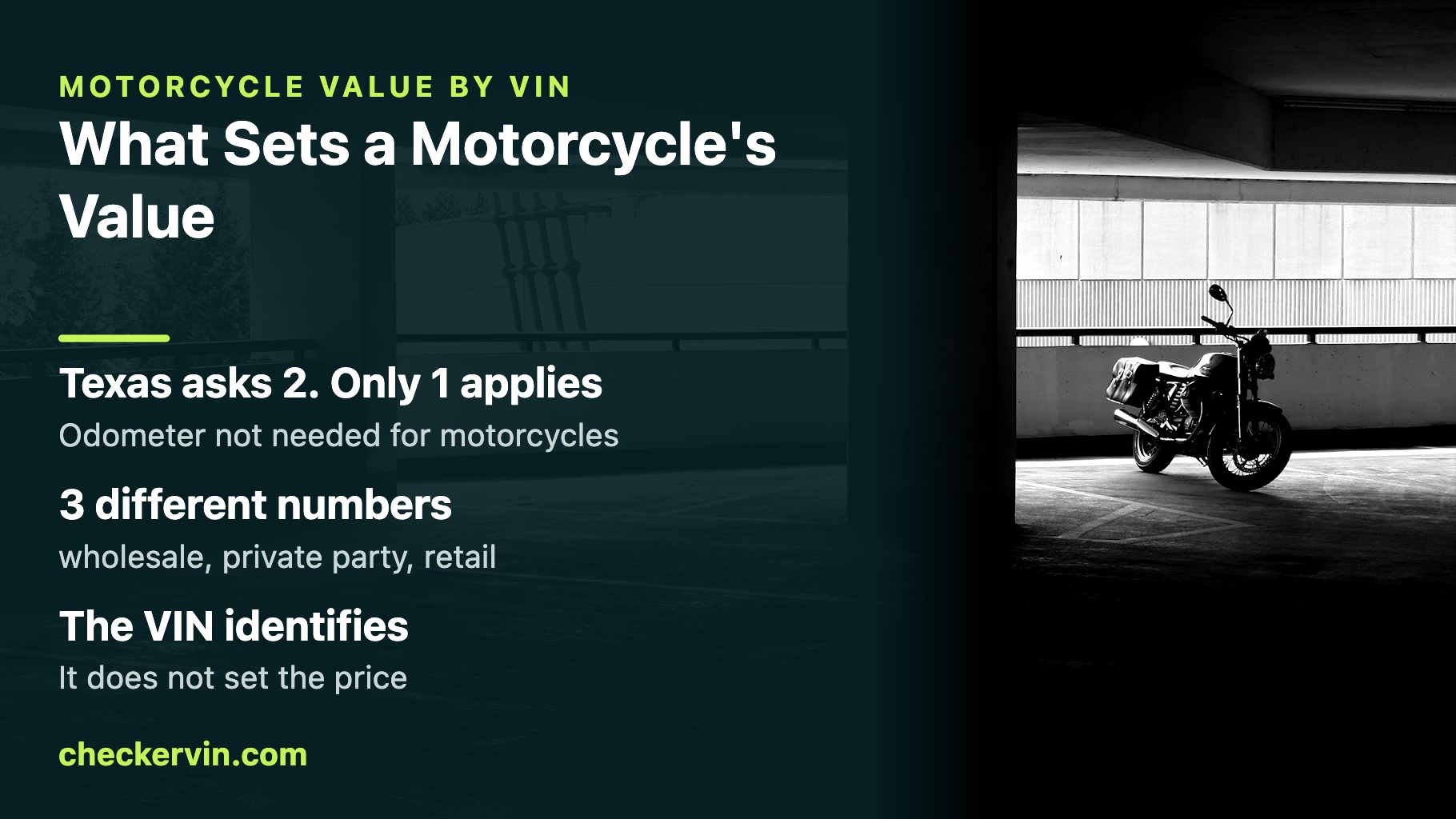
Bikes do not value the way cars do
A used car is priced largely as a wearing asset — miles consumed against a design life, with condition adjusting the result. Motorcycles break that model in several directions at once.
They cover far fewer miles a year. They are stored for whole seasons in most of the country. They are modified as a matter of course rather than as an exception. And their desirability is far more sensitive to model and variant than to the ordinary trim differences that separate cars.
Why mileage weighs less here
On a car, mileage is the best single proxy for remaining life because cars are driven more or less continuously. A motorcycle’s odometer measures something much narrower: the hours it spent running, in a life mostly spent parked.
Two bikes of the same year with identical readings can be in entirely different condition depending on whether those miles were accumulated steadily over a decade or in two seasons before the machine was put away.
A state tax office already treats bikes this way
It would be fair to read the section above as opinion. It is not, and the cleanest proof is not from a price guide or a dealer — it is from a tax authority that has to put a defensible number on a vehicle before it can collect on the sale.
Texas assesses motor vehicle sales tax against a Standard Presumptive Value: what the state reckons a vehicle is worth from actual sales in the region, rather than whatever figure appears on the bill of sale. The Legislature created it in 2009, Black Book supplies the values from Texas sales data, and the figures are updated weekly. To preview one, the state asks you for two things — and only one of them applies to a motorcycle. In its own words, you enter “the vehicle identification number (VIN) and odometer reading (not needed for motorcycles)”.
| What Texas asks for | Car versus motorcycle |
|---|---|
| Vehicle identification number | Required for both |
| Odometer reading | Required on a car — not needed on a motorcycle |
Read what that concedes. A system built to survive a dispute over money, valuing millions of vehicles a year, has decided that mileage adds enough to a car’s number to be worth collecting and does not add enough to a motorcycle’s to be worth asking. That is the same conclusion this page reaches from the other direction, arrived at by an organization with no interest in the argument.
Wholesale, retail, and the gap sellers do not expect
One line in the Texas material is worth pulling out on its own, because it explains an argument that happens in every private motorcycle sale. The state does not use a retail figure. Its presumptive values come from Black Book’s average wholesaleused vehicle value, drawn from regional sales.
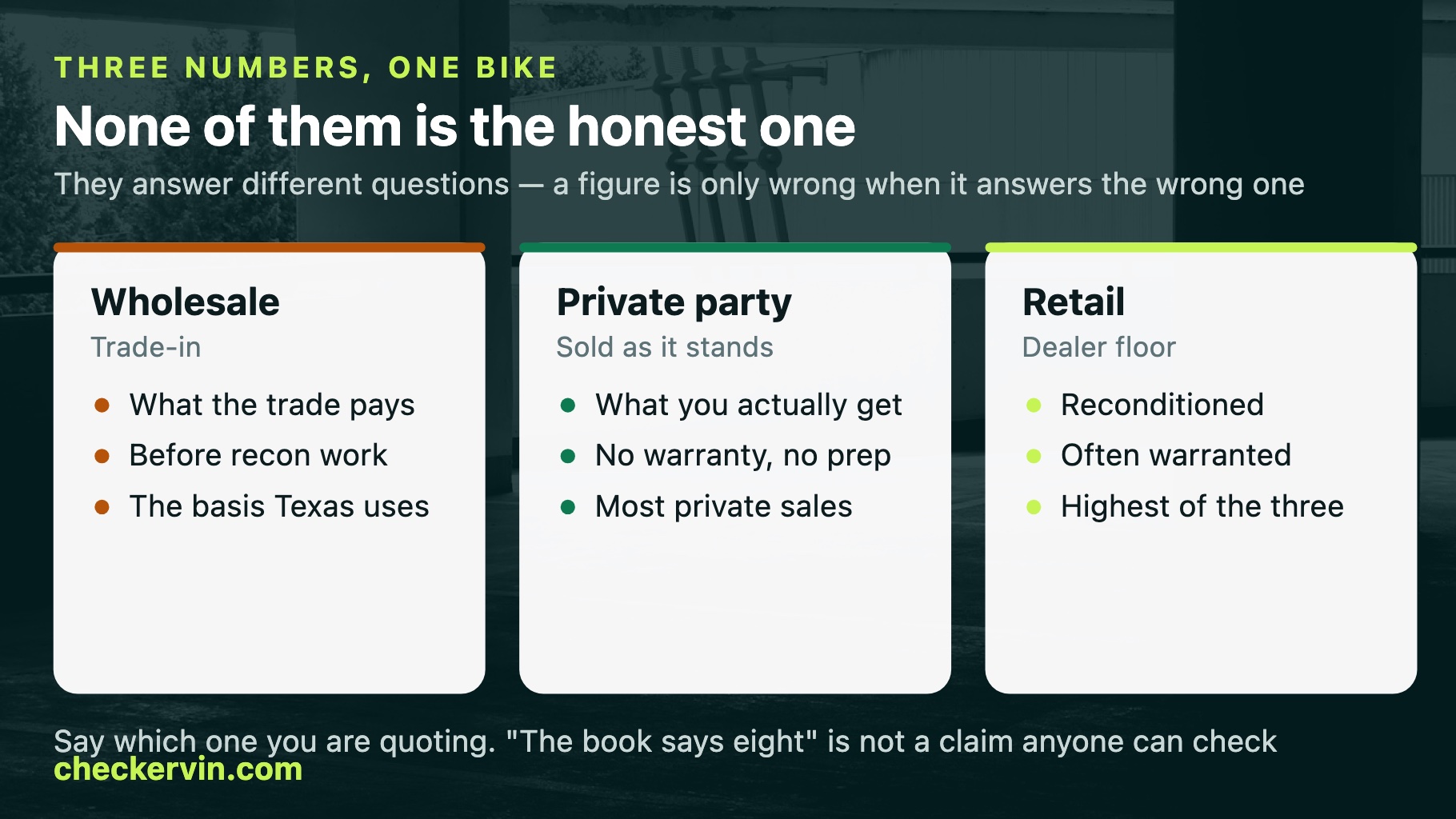
Wholesale is what the trade pays to acquire a machine it intends to recondition, warrant and resell at a margin. Retail is what the same machine carries on a dealer floor afterwards. Both are real numbers describing the same bike on the same day, and the distance between them is not small. A seller who has read a retail figure and a buyer who has read a wholesale one are not disagreeing about the motorcycle; they are quoting two different questions and assuming they asked the same one.
| Which number you are looking at | What it describes |
|---|---|
| Wholesale / trade-in | What the trade pays to take it on, before reconditioning |
| Private party | What a private seller realistically achieves, sold as it stands |
| Retail / dealer | What it carries on a floor, reconditioned and often warranted |
On a motorcycle the spread is wider than the equivalent on a car, and the reasons are the ones this page has already given. Seasonality moves the retail number hard while the wholesale number moves less. Reconditioning a bike that has sat is expensive relative to its value, so the trade discounts harder for exactly the condition that is most common in private sales. And the variant ambiguity cuts both ways — a trade buyer prices the risk of the version being the lesser one, while a private seller assumes it is the better one.
None of the three is the honest number and the other two dishonest ones. They answer different questions, and a figure is only wrong when it is quoted as an answer to a question it was not asked. The practical instruction is to know which of the three you are quoting before you quote it, and to say so. “The book says eight” is not a claim anyone can check. “Private party, good condition, for this variant, in this month” is, and it is the version that survives the conversation.
Sat versus ridden, and why sitting costs more
This is the reversal worth internalizing before you price anything.
| What sitting does | What it costs to put right |
|---|---|
| Fuel degrades and varnishes | Carburetor strip or injector and pump work |
| Tires perish and flat-spot | A pair of tires regardless of tread depth |
| Seals and gaskets dry out | Fork seals, and sometimes engine cases weeping |
| Brake fluid absorbs moisture | Full fluid change, and corroded caliper pistons |
| Batteries discharge and sulfate | A battery, and sometimes a charging diagnosis |
| Chains and cables stiffen | Chain and sprockets as a set |
None of that is visible in a valuation tool. All of it is visible on the machine, and a bike advertised as a low-mileage garage find frequently needs every line in that table.
Modifications almost always subtract
Owners find this the hardest part to accept, because the parts were expensive and fitted with care. The market rarely returns the money.
A modified bike appeals to the subset of buyers who wanted those exact changes. Everyone else is calculating what it costs to undo them, or discounting for the possibility that a machine modified enthusiastically was also ridden enthusiastically.
Which books actually cover motorcycles
Valuation coverage for bikes is thinner than for cars, and that shapes who you end up negotiating against.
J.D. Power, the guide that carried the NADA name, covers motorcycles and recreational vehicles alongside cars and trucks. Because lenders use that service for underwriting, it is frequently the reference in the room when a bike is being financed, insured or settled after a loss.
For enthusiast and older machines, completed auction and marketplace results are often more informative than any book, because desirability on specific models moves faster than a guide can track.
Season and geography move the number
Motorcycles are seasonal in a way cars are not. The same bike attracts different money in March than in November across most of the country, and a seller who lists in midwinter in a cold state is competing for a much smaller pool of buyers.
Geography compounds it. Year-round riding regions sustain steadier demand, while a bike in a state with a short season has spent most of its life in storage — which loops back to everything in the sitting-versus-ridden section above.
Why a title brand hits a bike harder
A motorcycle has very little structure between an impact and the parts that matter. Where a car absorbs a knock in crumple zones and body panels, a bike of similar damage value may well have taken the hit through the forks or the frame.
That is why a salvage or rebuilt brand tends to discount a motorcycle more sharply, and why frame straightness deserves specific attention on any bike whose history is unclear. Frame damage is also harder for a non-specialist to detect than a repaired quarter panel.
What the VIN does settle, and why it matters more here
The number will not price the bike. It will tell you precisely which bike it is, and on motorcycles that is worth more than it sounds.
Model lines run closely related variants with similar names and materially different values — differences in engine, suspension, brakes and intended market that a listing may describe loosely and an optimistic seller may describe generously. Decoding removes that ambiguity before any number is discussed.
What a value-by-VIN tool actually does with the number
“Value by VIN” is how the search gets typed, and it implies a mechanism that mostly does not exist. Worth being precise about what happens when you paste seventeen characters into one of these tools, because it changes how much weight the output deserves.
The VIN is used to identify, not to price. It resolves the year, make, model and often the variant, and those resolved attributes are then looked up against a pricing table built from sales data. The number itself contributes nothing to the figure. You can watch this happen on the tools themselves: several of the best-known motorcycle valuation sites skip the VIN entirely and simply ask you to pick year, make and model from dropdowns, which produces the same answer because it is the same lookup with a manual first step.
| Step | Where the number comes from |
|---|---|
| Identify the machine | The VIN — this part it genuinely does |
| Resolve model and variant | The VIN, on manufacturers who encode it |
| Attach a value | A pricing table built from sales, not from your VIN |
| Adjust for condition | You, or an inspector — no tool can see the bike |
Two consequences follow, and both matter more on a bike than a car. Where a manufacturer encodes the variant thinly, the tool resolves your machine to a broader model and prices the family rather than the version you own — which on motorcycles can span a wide range. And because the value never came from your specific machine, two identical VINs return one number regardless of whether one was stored indoors and serviced and the other sat outside for four winters.
What to establish before you price anything
The sequence below costs nothing and settles most of what a valuation tool cannot see.
- 1Decode the VINConfirm the exact model and year rather than trusting the advertisement, since variant differences drive real money on bikes.
- 2Ask how it was stored, not just how far it wentIndoors, on a tender, with fuel treated and tires off the ground is a materially different machine from one left outside under a cover.
- 3Look for evidence, not assurancesReceipts for tires, chain, fluids and any fork work tell you what the odometer cannot.
- 4Check the frame and the records togetherStraightness and paperwork are the two things that matter most, and neither appears in a book value.
Where a valuation stops
Every book value for a motorcycle is an average of transactions involving other machines, and bikes vary more than cars do around any average.
A guide cannot see the corrosion on the fasteners, the fork seal beginning to weep, or the fact that the bike has not turned a wheel in three years. On a motorcycle those are not details around the edge of the value — frequently they are the value.
There is a second limit worth naming, because it is the one that turns a good valuation into a bad decision. Every figure discussed on this page prices a motorcycle that is what it claims to be. None of them prices the risk that it is not. A stolen machine, a bike carrying a brand from another state, or one whose frame number does not match its paperwork will return a perfectly ordinary book value, because the book was never asked that question.
That is why the sequence matters more than the number. Establish the identity first, then the condition, then the price — because a valuation applied to a machine you have not identified is a confident figure attached to an unknown object, and the confidence is the dangerous part.
Our own free check returns the factory build, the specifications and open recalls, and produces no valuation. What it does is make certain the machine you are pricing is the machine you think it is. Accident, title and odometer history are a separate layer we do not hold today — for a bike, the free federal theft check at NICB and the seller’s own title document are where that part of the question gets answered.
Where this information comes from
- Texas DMV — Standard Presumptive Value calculatorA state valuation system that asks for the VIN and odometer — and states in its own text that the odometer is not needed for motorcycles
- NHTSA vPIC — public VIN decoderConfirms the exact motorcycle a VIN describes before any number is discussed
- Texas DMV — Standard Presumptive Value calculatorA state valuation system that asks for the VIN and odometer — and states in its own text that the odometer is not needed for motorcycles
- NHTSA recall lookupOpen safety campaigns on the machine, free and by VIN
- Texas DMV — Standard Presumptive Value calculatorA state valuation system that asks for the VIN and odometer — and states in its own text that the odometer is not needed for motorcycles
- NHTSA — odometer fraudWhy a mileage claim on any vehicle deserves corroboration
Keep reading
Frequently asked questions
Can I get a motorcycle's value from the VIN?
The VIN fixes exactly which machine it is — year, model, engine and often the market it was built for — and that matters more on bikes than cars because variants differ sharply in value. The valuation itself still needs mileage, condition and modification history, none of which the number encodes.
Is low mileage always good on a motorcycle?
No, and this is the biggest difference from cars. A bike with very low mileage for its age has usually been standing rather than being ridden, and standing is hard on fuel systems, tires, seals, brake fluid and batteries. A well-maintained bike with moderate mileage is frequently the better machine. Texas makes the same judgment in a system that has to defend its numbers: its Standard Presumptive Value calculator asks for the VIN and the odometer reading on a car, and states in its own text that the odometer is not needed for motorcycles. A tax authority valuing millions of vehicles decided mileage was not worth collecting on a bike.
Do modifications increase a motorcycle's value?
Usually not, however much they cost. Exhausts, bars, seats and paint narrow the buyer pool to people who share the previous owner's taste, and reversible modifications are worth most when the original parts come with the bike.
Which valuation books cover motorcycles?
J.D. Power, formerly NADA, covers motorcycles alongside cars, trucks and recreational vehicles, which is why lenders financing a bike tend to work from it. Consumer-facing coverage of motorcycles is generally thinner than for cars.
Does a salvage brand matter more on a bike?
It tends to, because a motorcycle has far less structure to absorb an impact. Damage severe enough to brand the title is more likely to have reached the frame, and frame damage on a bike is both harder to verify and more consequential than comparable damage to a car's body panel.
Decode the bike before you price it
Enter the VIN for the factory build, the specifications and any open safety recall on that exact machine. Free, and no account needed.
Run a free VIN check