The short answer
- Why does an RV VIN decode return a chassis manufacturer?
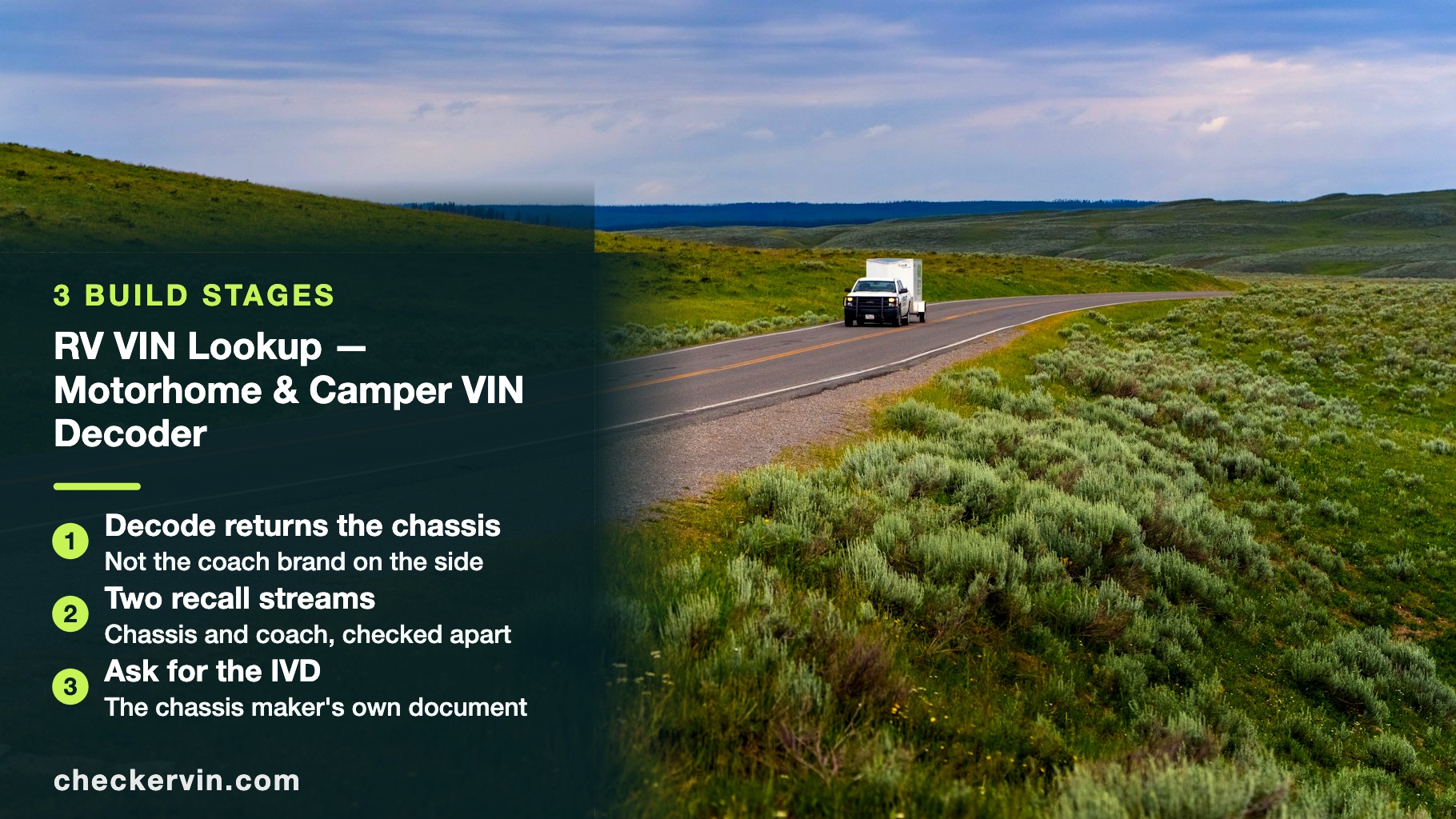
- Because on a motorhome the VIN identifies the chassis, which a commercial vehicle manufacturer built. The RV company bought that chassis and constructed the living quarters onto it. The decode is describing the part of the vehicle the VIN belongs to.
- How do I identify the coach itself?
- Through the RV manufacturer's own data plate, which carries a separate serial number and usually sits near the entry door, inside a cabinet, or in an exterior storage bay. That number, not the VIN, identifies the coach.
- What about a travel trailer?
- Towables are simpler. There is no chassis manufacturer, so the RV builder issues the VIN directly and one number covers the whole unit. Look on the A-frame or the left-side frame rail near the front.
Two
Numbers on a motorhome
Chassis VIN and coach serial
Two
Recall streams to check
Chassis maker and coach builder
One
Number on a towable
Issued by the RV builder
Front
Where towable VINs live
A-frame or left frame rail
The chassis-versus-coach split
A motorhome is manufactured in two stages by two different companies. A commercial vehicle manufacturer builds a chassis — frame, engine, drivetrain, steering, brakes and often a cab. That chassis is sold as an incomplete vehicle to an RV company, which builds the living quarters onto it and sells the finished product.
The VIN is assigned by the chassis manufacturer at the first stage. It therefore describes the mechanical vehicle, not the coach. Everything about the interior, the appliances, the floor plan and the brand is outside its scope.
| Identifier | What it covers |
|---|---|
| Chassis VIN | Frame, engine, drivetrain, brakes, gross vehicle weight rating. Issued by the chassis manufacturer. This is the number on the title and registration. |
| Coach serial number | The living quarters: floor plan, appliances, slide-outs, holding tanks. Issued by the RV builder on its own data plate. |
That split is also why a VIN cannot price the vehicle — camper value by VIN explains why RV guides are indexed on the coach and floorplan instead.
The RV classes, and how identification differs
| Class | How it is built and identified |
|---|---|
| Class A | Bus-style, built on a purpose-made motorhome chassis. Chassis VIN from the chassis maker, coach serial from the builder. |
| Class B | A van conversion. The VIN belongs to the van manufacturer, and the converter may add its own plate. The most likely class to decode as an ordinary commercial van. |
| Class C | Built on a cutaway chassis with the original cab retained. Chassis VIN from the chassis maker — this is the class where the decode surprises people most. |
| Travel trailer | Towable. One VIN, issued by the RV manufacturer. No chassis maker involved. |
| Fifth wheel | Towable, coupling into a truck bed. One VIN from the RV manufacturer. |
| Truck camper | A slide-in unit carried in a pickup bed. Often not a titled vehicle at all in many states — check locally. |
| Popup / folding | Towable with collapsible sides. One VIN from the manufacturer. |
Where to find the numbers
- 1Motorhome chassis VIN — windshield and door jambExactly as on a truck. Base of the windshield on the driver's side, readable from outside, and on the sticker inside the driver's door frame.
- 2Coach data plate — near the entry doorCommonly just inside the entry door, inside a cabinet or wardrobe, or in an exterior storage bay. It carries the builder's serial number, the build date and the coach weight ratings.
- 3Towable VIN — the A-frame or left railThe front structure where the coupler attaches, or the left-side frame rail near the front corner.
- 4Certification label — left side, toward the frontCarries the VIN, the build date and the weight ratings that govern what you can legally load.
- 5The paperworkTitle, registration and insurance. On a motorhome these are issued against the chassis VIN, not the coach serial.
What an RV VIN decode actually returns
On a motorhome, expect chassis information and nothing about the coach. That is still genuinely useful — it is the mechanical half of what you are buying, and the half that strands you at the roadside.
- Chassis manufacturer and model year
- Engine displacement, cylinder count and fuel type
- Gross vehicle weight rating class
- Brake system type
- Drivetrain configuration
- Assembly plant and country of manufacture
- Open safety recalls against the chassis
Towable RVs: one number, simpler life
Travel trailers, fifth wheels and popups have no separate chassis manufacturer. The RV builder constructs the frame and the coach together and issues a single VIN covering the whole unit.
That makes identification straightforward, but it also means the RV manufacturer is your only recourse for both structural and appliance issues — and RV builders come and go more often than truck manufacturers do. On an older towable from a discontinued brand, parts support is a real consideration.
Two recall streams, and most owners check only one
This is the most consequential practical point on the page. An RV can have open recalls from two independent sources, and they are searched separately.
| Source | What it covers and how to check |
|---|---|
| Chassis manufacturer | Engine, brakes, steering, fuel system, drivetrain. Searchable by chassis VIN through NHTSA's free lookup. |
| Coach builder | Slide-outs, LP gas systems, appliances, wiring, steps, awnings. Issued against the builder's own serial and often not returned by a VIN search. |
The split has a legal name, and a document to go with it
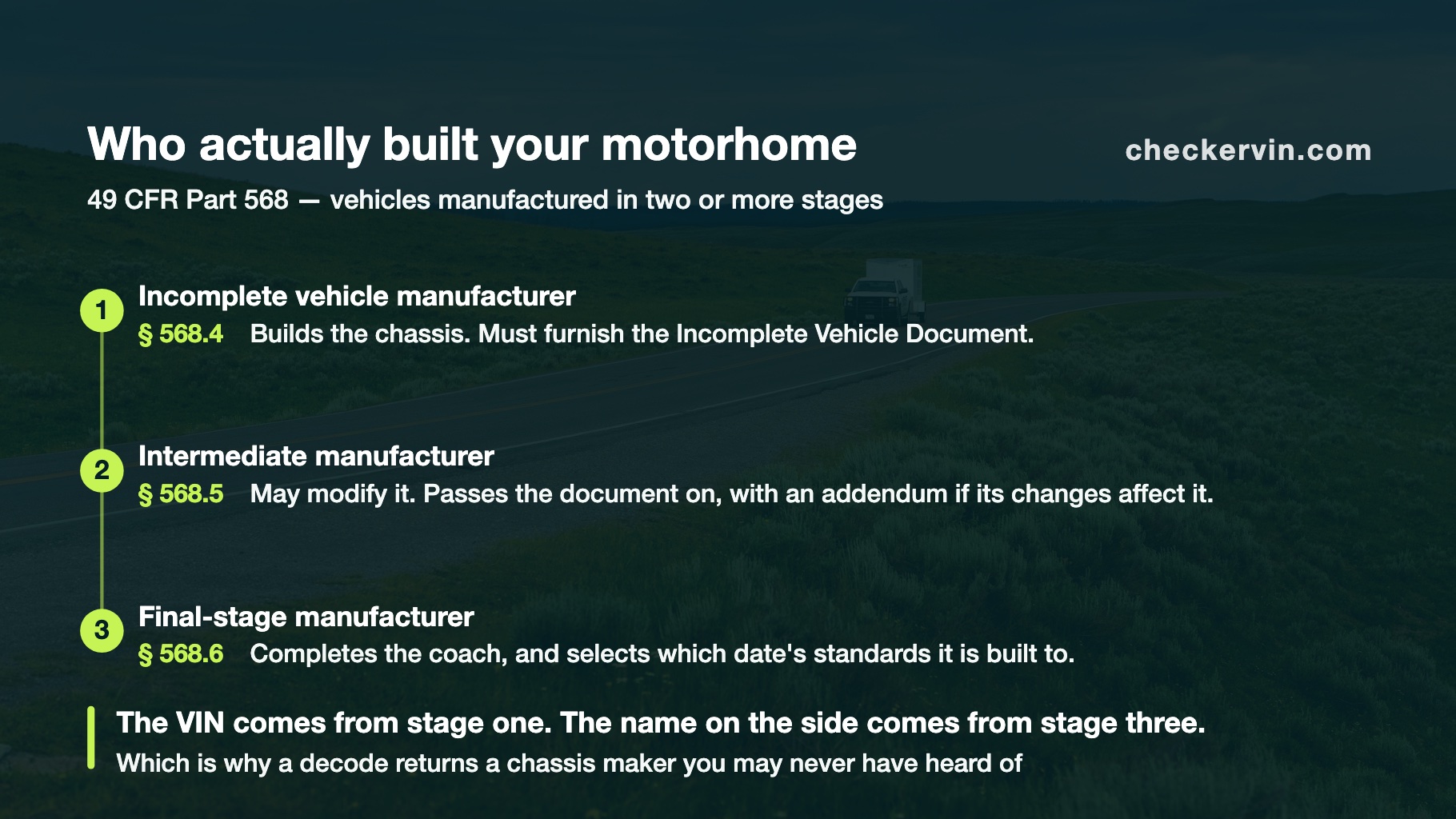
Everything above describes the chassis-and-coach division as a fact of how RVs get built. It is more than that. Federal rule treats it as a defined process with named roles and required paperwork: 49 CFR Part 568, vehicles manufactured in two or more stages. Your motorhome is the textbook case the part was written for.
There are up to three roles. The incomplete vehicle manufacturer builds the chassis. An intermediate manufacturer may modify it. The final-stage manufacturer completes it into the vehicle you bought. Each one has obligations, and the first of them produces a document most RV owners have never heard of.
Under § 568.4, the chassis maker must furnish an Incomplete Vehicle Document for each incomplete vehicle, at or before the time of delivery. The rule specifies what it carries:
- The name and mailing address of the incomplete vehicle manufacturer
- The month and year in which it performed its last manufacturing operation on the chassis
- Identification by VIN, or by groups of VINs, of the incomplete vehicles the document covers
- The gross vehicle weight rating of the completed vehicle the chassis is intended for
- The gross axle weight rating for each axle, listed in order from front to rear
Read the third item again, because the reason for it is unusually explicit. The identification must let a person “ascertain positively that a document applies to a particular incomplete vehicle after the document has been removed from the vehicle.” The rule anticipates the paperwork being separated from the RV and requires it to remain matchable anyway. If an intermediate manufacturer changed anything that affects those statements, § 568.5 requires the document to travel onward with an addendum saying so.
Which model year an RV was built to is a choice, not a date
One more consequence of building in stages, and it explains VIN decodes that look wrong. Under § 568.6 the final-stage manufacturer must complete the vehicle so it conforms to the standards in effect on a date it selects— the date the incomplete vehicle was manufactured, the date of final completion, or any date between the two.
So the safety standards an RV was built to are not fixed by its model year. A coach finished in one year can lawfully be completed to the standards in force when its chassis was built months earlier, and a chassis can sit for a long time before a coach goes on it. None of that is irregular and none of it is a warning sign. It is the rule working as written.
What it means in practice is that an RV carries two ages, and only one of them is on the title. The chassis has the date in the incomplete vehicle document; the coach has whatever year it was sold as. When a decode returns a year that disagrees with the paperwork, this is usually why — and it is also why the two recall streams above have to be checked separately rather than assumed to move together.
Weight ratings on an RV
RVs are routinely overloaded, because owners fill the storage the coach provides without checking whether the chassis can carry it. The ratings are on the labels and they are legal limits, not suggestions.
- GVWR — the maximum the loaded RV may weigh
- GAWR — per-axle maximums, front and rear
- Cargo carrying capacity — GVWR minus the actual wet weight of the coach
- Water weighs a great deal, and full fresh, gray and black tanks consume capacity fast
- On a towable, tongue or pin weight must suit the tow vehicle's hitch rating
- The tow vehicle's own rating is a separate limit, and the lower figure governs
Water damage: the defect that decides RV value
If you take one inspection point from this page, take this one. Water intrusion is to RVs what rust is to cars — the failure that quietly destroys the structure and is expensive beyond the point of economic repair.
RVs have many roof and sidewall penetrations: vents, antennas, air conditioners, skylights, marker lights, slide-out seals. Every one is sealed with a material that degrades in sunlight and needs periodic maintenance most owners never perform.
- Soft or spongy spots in the floor, especially near slide-outs and the entry door
- Staining or discoloration on ceiling panels and in upper cabinets
- A musty smell, or an air freshener working to cover one
- Delamination — sidewall panels bubbling or separating from the substrate
- Cracked, shrunken or missing sealant around every roof penetration
- Soft window frames and corners, where water tracks down inside the wall
- Slide-out seals that are hardened, torn or no longer contacting
RV titles and brands
Motorhomes are titled as motor vehicles and can carry the same brands as cars — salvage, rebuilt, flood. Those brands attach to the chassis VIN and follow it through the national title system.
Towable RVs are titled under each state's trailer rules, which vary considerably. Some states title every towable, others only above a weight threshold. Check what applies where you will register it, rather than where it is being sold.
Theft checks on an RV
Run the free theft lookup against the chassis VIN on a motorhome, or the trailer VIN on a towable, before money changes hands. Towables in particular are stolen the same way trailers are — hitched and driven away.
- Confirm the VIN on the vehicle matches the title exactly
- Confirm the seller's name matches the paperwork
- On a motorhome, check both the windshield plate and the door jamb
- Inspect around the VIN plate for tampering, grinding or fresh paint
- Ask for the coach data plate as well — a seller who cannot find it may not know the unit
Model year matters for where you can stay
Some RV parks and resorts apply age restrictions, commonly declining units over a certain number of years old. The policies are inconsistently enforced and often waived for a well-presented RV, but they exist.
The model year in the VIN is what a park will go by. If you intend to stay at destination resorts rather than public campgrounds, it is worth knowing the year before you buy rather than discovering the restriction at a gate.
Buying a used RV: the identification checklist
- 1Decode the chassis VIN before you travelEstablish the chassis manufacturer, engine, model year and weight rating. This is the mechanical half of the purchase.
- 2Find and photograph the coach data plateYou need the builder's serial to check coach recalls and to order parts. A seller who cannot locate it is a signal in itself.
- 3Run both recall checksChassis VIN through NHTSA, coach serial with the RV builder. LP gas and electrical recalls live on the coach side.
- 4Run the free theft checkAgainst the chassis or trailer VIN, before money moves.
- 5Inspect exhaustively for waterFloor, ceiling, cabinets, sidewalls, every roof penetration and every slide-out seal. This decides whether the RV is worth buying at all.
- 6Read every weight labelConfirm the cargo capacity suits how you intend to travel, and that your tow vehicle suits a towable.
- 7Pay for a professional RV inspectionA dedicated RV inspector checks systems a car mechanic will not touch — LP gas, 12-volt and shore power, tanks, appliances and the roof.
What an RV VIN decode will not tell you
- Anything about the coach: floor plan, appliances, slide-outs or holding tanks
- Water damage, delamination or roof condition
- Accident history and structural repairs
- Title brands, which need a separate title record check
- How the RV was stored — covered, indoors or in full sun for a decade
- Coach-side recalls issued by the RV builder
Where this information comes from
Keep reading
Frequently asked questions
Why does my RV VIN decode show Ford instead of my RV brand?
Because on a Class A or Class C motorhome the VIN belongs to the chassis, and the chassis was built by a commercial vehicle manufacturer. The coach builder assembled the living quarters onto that chassis afterward. A decode returning the chassis maker is correct, not an error.
Where is the VIN on a motorhome?
On a motorhome the chassis VIN is at the base of the windshield on the driver's side and on the driver's door jamb, exactly as on a truck. The coach builder adds its own data plate separately, usually near the entry door or in a storage compartment.
Do travel trailers and fifth wheels have VINs?
Yes. Towable RVs carry their own 17-character VIN issued by the RV manufacturer, since there is no separate chassis maker involved. Look on the A-frame at the front, the left-side frame rail, or the certification label near the front left corner.
How many recall checks does an RV need?
Two. Chassis recalls are issued by the chassis manufacturer against the chassis VIN, and coach recalls are issued by the RV builder against its own serial number. Checking only the VIN misses everything the coach builder has recalled.
Can I check if an RV is stolen by VIN?
Run the free NICB theft lookup against the chassis VIN on a motorhome, or the trailer VIN on a towable. It covers vehicles reported stolen by participating insurers, and is worth running on any private-sale RV before money changes hands.
Decode an RV chassis in seconds
Enter the chassis VIN for the manufacturer, engine, weight rating and open safety recalls. Free, no account.
Run a free VIN check