The short answer
- How do you look up a motorcycle by VIN?
- Find the 17-character VIN stamped on the steering head at the front of the frame, then decode it. A free decode returns the manufacturer, model year, engine displacement, body class and plant, plus any open safety recall against that specific bike.
- Where exactly is the number on a bike?
- The steering head is the primary location on most motorcycles — the frame tube the forks pass through, usually stamped on the right side. Some manufacturers use the frame downtube instead, and most bikes also carry a printed certification label.
- What is the difference between the VIN and the engine number?
- The VIN identifies the frame and is the bike's legal identity. The engine number is a separate serial stamped on the engine cases. On most motorcycles they are unrelated numbers, and an engine number will not decode as a VIN.
17
Characters since 1981
Same standard as cars
Frame
The VIN belongs to the frame
Not the engine
Free
Decode and recall check
NHTSA covers motorcycles
Two
Numbers on every bike
Frame VIN and engine serial
What a motorcycle VIN lookup returns
A decode describes the machine as it left the factory. On a bike that matters particularly, because motorcycles are modified more heavily and more often than cars — and what a bike is now can be some distance from what it was built as.
- Manufacturer and country of manufacture
- Model year, which sets the generation and parts compatibility
- Engine displacement and configuration as built
- Body class — cruiser, sport, touring, dual-sport, scooter
- Manufacturing plant
- Open safety recalls issued against that exact machine
For what the number cannot settle, see motorcycle value by VIN — on a bike, low mileage is frequently a warning rather than a selling point.

Where the VIN is stamped on a motorcycle
- 1The steering headThe frame tube the front forks pass through, at the front of the bike below the handlebars. Turn the bars to full lock and look at the right side of the neck. This is the primary location on the great majority of motorcycles.
- 2The frame downtubeSome manufacturers stamp lower on the frame instead, along the main tubes near the engine mounts. Worth checking when the steering head shows nothing.
- 3The certification labelA printed label carrying the VIN, usually on the frame near the steering head or under the seat. Easier to read than a stamping, and it also gives the build date.
- 4Under the seat or the tankA few manufacturers place the label in less obvious positions. Lifting the seat is worth doing anyway, since it is where you will find the tool kit and often the battery.
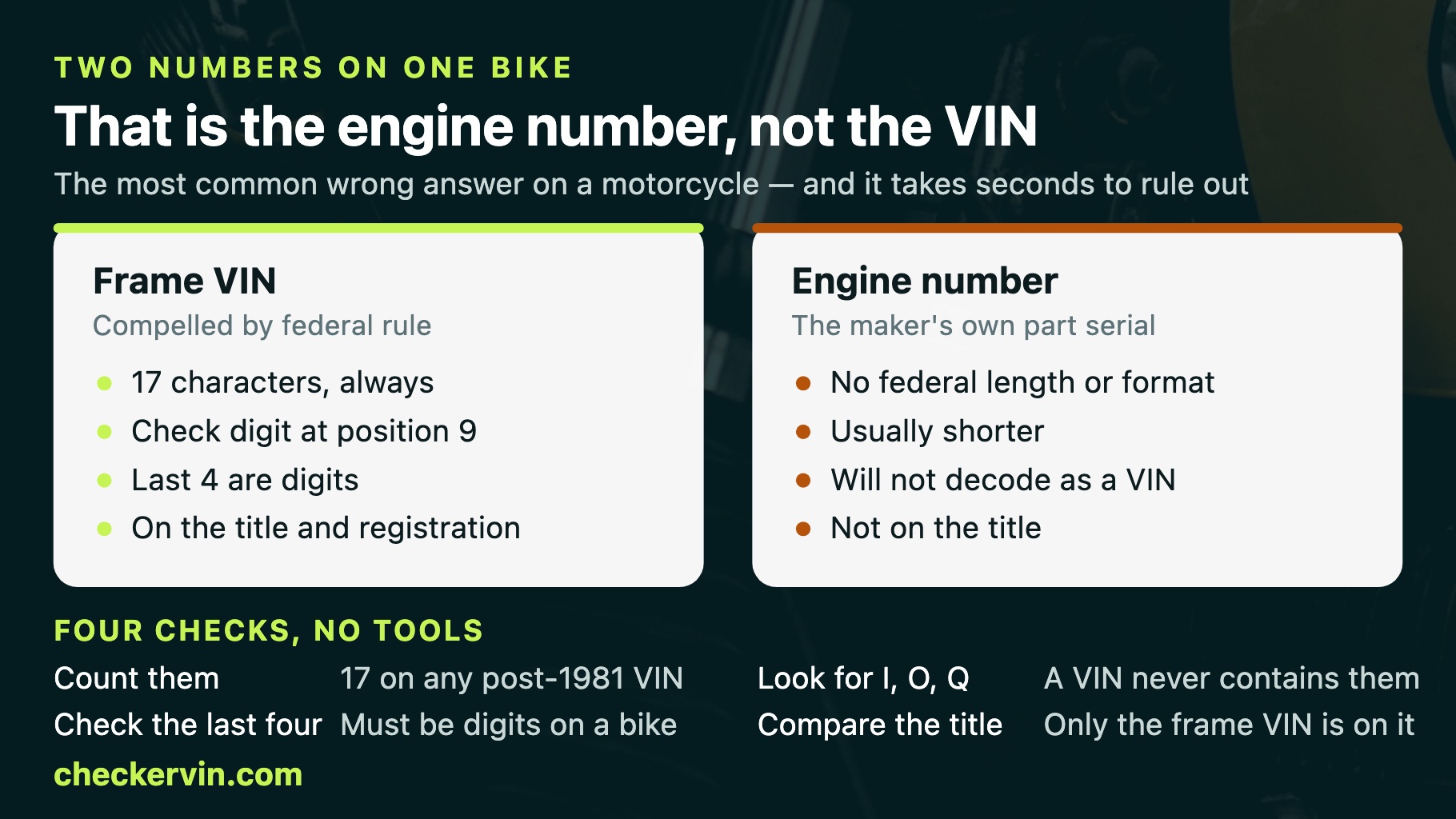
Frame VIN versus engine number
This distinction causes more confusion than anything else about motorcycle identification, and understanding it takes thirty seconds.
| Number | What it is |
|---|---|
| Frame VIN | The 17-character vehicle identification number stamped on the frame. This is the bike's legal identity — it appears on the title, the registration and the insurance policy. |
| Engine number | A separate serial stamped on the engine cases, identifying that engine as a component. Usually a different format and a different length. It will not decode as a VIN. |
On a car, engine and frame effectively stay together for life. On a motorcycle they frequently do not — engines are removed, rebuilt, swapped between frames and sold separately as routine practice in the used and custom market.
There is a structural reason the two numbers look nothing alike, and knowing it settles the question faster than counting characters. The VIN exists because federal rule compels it: seventeen characters, a fixed alphabet that excludes I, O and Q, a check digit computed from the other sixteen, and a required list of attributes it must make decipherable. The engine number is a manufacturer’s own part serial. No federal rule sets its length, its format, its alphabet or its position, which is exactly why it varies between makes and why it is usually shorter.
| Test you can apply in the parking lot | What it tells you |
|---|---|
| Count the characters | Seventeen on any post-1981 VIN. Fewer, and you are reading an engine or part number |
| Look for I, O or Q | A VIN never contains them. A number with an O in it is not a VIN |
| Check the last four | On a motorcycle they must be digits. Letters there mean it is not the VIN |
| Compare against the title | The frame VIN appears there. An engine number does not |
That last row is the one worth doing first when a seller hands you a number. The document and the frame should agree exactly; the engine is a separate question and a separate conversation.
What a motorcycle VIN is required to encode
A motorcycle VIN is seventeen characters like a car’s, and it is read in the same blocks. What differs is the middle, and the difference is not a manufacturer’s preference — it is written into federal rule with its own row.
49 CFR § 565.15(b) requires positions four through eight to make a specific list of attributes decipherable, and prints that list as a table by vehicle type. Set the motorcycle row beside the passenger-car row and the difference is immediate.
| Vehicle type | What positions 4–8 must make decipherable |
|---|---|
| Passenger car | Make, line, series, body type, engine type, and all restraint devices and their location |
| Motorcycle | Make, type of motorcycle, line, engine type, and net brake horsepower |
Two things fall out of that. A car’s descriptor is required to carry restraint devices, which a motorcycle does not have, and a body type, which does not apply either. What a motorcycle must carry instead is type of motorcycle— street, off-road, dual-purpose and so on — and net brake horsepower. It is the only vehicle type in the table whose row demands a power figure at all. Not trucks, not buses, not trailers. Motorcycles alone.
And that requirement carries something found nowhere else in the rule: an accuracy tolerance. The note beneath the table states that encoded horsepower “shall differ by no more than 10 percent from the actual net brake horsepower”, with a separate floor for very small machines — a motorcycle of 2 hp or less must not encode more than 2, and one above 2 hp must encode more than 2.
The answer to “are motorcycle VINs seventeen digits” is therefore yes for anything built to the standard, with one caveat worth stating plainly: the characters are not all digits. The VIN alphabet excludes I, O and Q throughout, and on a motorcycle the final fourcharacters must be numeric — where a passenger car takes five — because the rule sets five only for cars and for light trucks and multipurpose vehicles, and four for everything else.
The seventeen characters on a motorcycle
| Position | What it encodes |
|---|---|
| 1 | Country of manufacture — 1 or 5 United States, J Japan, W Germany, Z Italy |
| 2–3 | Manufacturer and vehicle type |
| 4–8 | The manufacturer's descriptor: model, engine, body style and equipment |
| 9 | Check digit, calculated from the other sixteen characters |
| 10 | Model year |
| 11 | Assembly plant |
| 12–17 | Sequential production number for that machine |
The framework is identical to a car's. What differs is the descriptor block, where each motorcycle manufacturer defines its own scheme — which is why a decode against the manufacturer's filed structure returns a correct answer where a generic chart does not.
Motorcycle manufacturer codes
The first three characters identify the maker and the country, and on motorcycles they are distinctive enough to recognize on sight once you have seen a few.
| Starts with | Manufacturer |
|---|---|
| 1HD | Harley-Davidson, United States |
| JH2 | Honda motorcycles, Japan |
| JYA | Yamaha, Japan |
| JS1 | Suzuki, Japan |
| JKA | Kawasaki, Japan |
| ZDM | Ducati, Italy |
| WB1 | BMW Motorrad, Germany |
Reading the model year
The tenth character carries the model year on the same thirty-year cycle cars use, omitting I, O, Q, U and Z. F is 2015, K is 2019, L is 2020, M is 2021, N is 2022, P is 2023, R is 2024, S is 2025 and T is 2026. The digits 1 through 9 covered 2001 to 2009.
Model year matters more on bikes than the calendar year suggests, because motorcycles often sit unsold or barely used for long periods. A low-mileage bike several model years old is common, and it raises different questions — fuel system deposits, perished rubber, battery condition — than an equivalent car would.
Why the theft check matters more on a motorcycle
A motorcycle can be lifted into a van by two people in under a minute. It has no steering wheel lock in the automotive sense, it is easy to move once immobilized, and it breaks down into saleable parts quickly. Theft is a materially larger share of the risk than it is with cars.
The used market compounds it. Bikes change hands privately far more often than cars do, frequently in cash, frequently without a dealer in the transaction to run checks on either party's behalf. That check is yours to run.
- Run the free theft lookup before you travel to see the bike
- Check that the frame VIN matches the title exactly, character for character
- Confirm the seller's name matches the name on the title
- Be wary of a bike sold without a title, whatever the explanation offered
- Look for grinding, filing or restamping around the steering head
- Treat a price well under market with suspicion rather than excitement
Motorcycle recalls by VIN
Motorcycles are covered by the same recall regime as cars. When a manufacturer determines a safety defect exists, it must remedy it at no charge to the owner, regardless of how many owners the machine has had.
Recalls are scoped to VIN ranges rather than to models, so searching a model name shows campaigns that may not apply to your bike. Check the VIN itself through NHTSA's free lookup, and treat an unrepaired open recall as a reason to visit a dealer rather than a reason to panic.
Salvage and rebuilt motorcycles
Bikes are totaled easily. There is no crumple zone, no bodywork to absorb an impact, and fairings alone can exceed the value of an older machine. A drop that would barely mark a car can produce a repair estimate above the bike's value.
That has two consequences. Salvage-branded motorcycles are relatively common and often suffered modest damage — but frame damage on a motorcycle is far more consequential than panel damage on a car, because the frame is the structure, the suspension mounting and the steering geometry all at once.
Engine swaps, replacement frames and mismatched numbers
Motorcycle culture is a modification culture, and swapped engines are ordinary rather than sinister. Bikes get rebuilt, engines get replaced with larger ones, and frames occasionally get replaced after damage.
What matters is disclosure and paperwork. An engine swap performed openly, with receipts, is a maintenance record. An engine number the seller cannot explain, on a bike whose title and frame do not obviously agree, is a different situation.
- Ask directly whether the engine is the one the bike was built with
- Ask for receipts covering any engine or frame replacement
- Confirm the frame VIN matches the title — that is the number that must agree
- Check whether the state requires notification of a replacement engine
- Establish that the displacement in the decode matches what is fitted, since insurance and registration may depend on it
Motorcycles built before 1981
The 17-character standard became mandatory for the 1981 model year. Earlier motorcycles use manufacturer-specific formats — usually shorter, often a model prefix followed by a serial number, with no check digit and no standardized year character.
NHTSA's database does not cover them, and no modern decoder will read them correctly. Identifying a vintage bike means going to marque-specific references, factory parts books and owner club registries, which for popular models are often more detailed than anything a decoder could offer.
The used motorcycle VIN checklist
- 1Get the VIN before you travelAsk the seller to photograph the steering head stamping. A seller unwilling to send it has answered a question you had not asked yet.
- 2Decode it and compare against the advertModel year, displacement and model should match. Discrepancies are worth resolving before you spend a Saturday on the road.
- 3Run the free theft checkBefore money moves, always. Motorcycle theft rates make this the highest-value free check available to you.
- 4Run the recall checkFree, immediate, and the repair costs nothing. An open recall is a dealer appointment, not a deal-breaker.
- 5Read the frame stamping in personCompare it to the title, character by character, and look at the metal around it for grinding, filing or restamping.
- 6Check the engine number against what you were toldEstablish whether the engine is original, and whether the seller's account of it holds up.
- 7Have it inspected if it is branded or high-valueFrame alignment, fork straightness and evidence of a previous crash are worth a professional opinion.
What a motorcycle VIN will not tell you
- Crash history, including drops that never generated an insurance claim
- Title brands such as salvage, rebuilt or flood
- Actual mileage, or whether the odometer has been replaced
- How many owners the bike has had
- Service history, valve adjustments and chain or belt condition
- Modifications, aftermarket parts and whether they were fitted competently
On a motorcycle that last point carries unusual weight. A great deal of what determines whether a used bike is a good buy comes down to maintenance and modification quality, and neither is encoded anywhere in the VIN.
Where this information comes from
Keep reading
Frequently asked questions
How do I look up a motorcycle VIN for free?
Enter the 17-character VIN into a decoder. Motorcycles sold in the United States from the 1981 model year use the same federal VIN standard as cars, and manufacturers file their structure with NHTSA's public vPIC database, so the decode and the recall check are both free.
Where is the VIN on a motorcycle?
Most commonly stamped on the steering head — the frame tube the front forks pass through, at the front of the bike below the handlebars. Turn the bars and look at the right side of the neck. Many bikes also carry a certification label with the VIN printed on it.
Is the engine number the same as the VIN?
No. The engine carries its own serial number stamped on the cases, and on most motorcycles it is a different number entirely. The VIN belongs to the frame. Confusing the two is the most common mistake people make when a number does not decode.
Can I check if a motorcycle is stolen by VIN?
Yes, and you should. NICB VINCheck is free and covers vehicles reported stolen and not recovered by participating insurers. It is worth running on any private-sale bike before money changes hands, though it only sees records member insurers submitted.
Do motorcycles get safety recalls?
They do, and the same rules apply: the manufacturer must perform the remedy at no cost to the owner. NHTSA's free lookup covers motorcycles alongside cars, scoped to specific VIN ranges rather than to a model in general.
Check a bike before you ride it home
Decode any motorcycle VIN for the factory build, specifications and open safety recalls. Free, no account.
Run a free VIN check