The short answer
- Where is the VIN on a trailer?
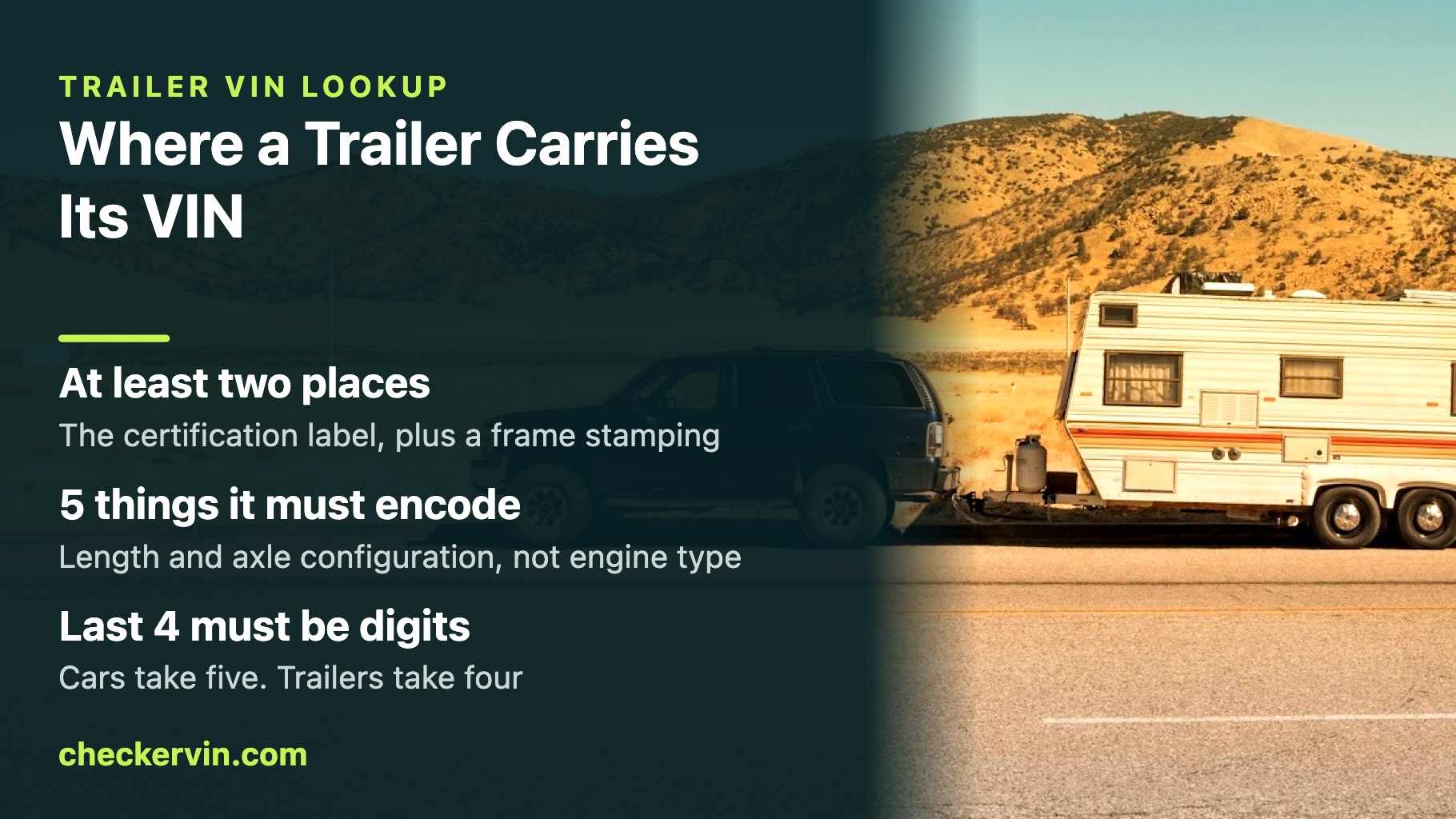
- Check the tongue or A-frame at the front first, then the left-side frame rail near the front corner. Most manufactured trailers also carry a certification label with the VIN printed on it, along with the build date and weight ratings.
- What does a trailer VIN tell you?
- The manufacturer, model year, and often the trailer type, length and axle configuration as built. It also lets you run a theft check, and it is the number the title and registration are issued against.
- What if the trailer has no VIN at all?
- That usually means it was homemade or the plate has been lost. Your state motor vehicle agency can issue a state-assigned identification number after an inspection, which is what makes the trailer titleable and legal to register.
Front
Where to look first
Tongue, A-frame or left rail
17
Characters on manufactured trailers
1981 model year onward
State
Assigned numbers for homemade
Inspection then issue
HIN
A boat's number is different
Not the trailer's VIN
What a trailer VIN lookup gives you
A trailer decode is narrower than a car decode, because trailers are simpler and manufacturers file less detail. What you get is still the information that matters for buying, titling and insuring one.
- Manufacturer and country of manufacture
- Model year as built
- Trailer type and, on many manufacturers, body style
- Axle configuration where the manufacturer files it
- The number your title, registration and insurance are issued against
- A basis for running the free theft check
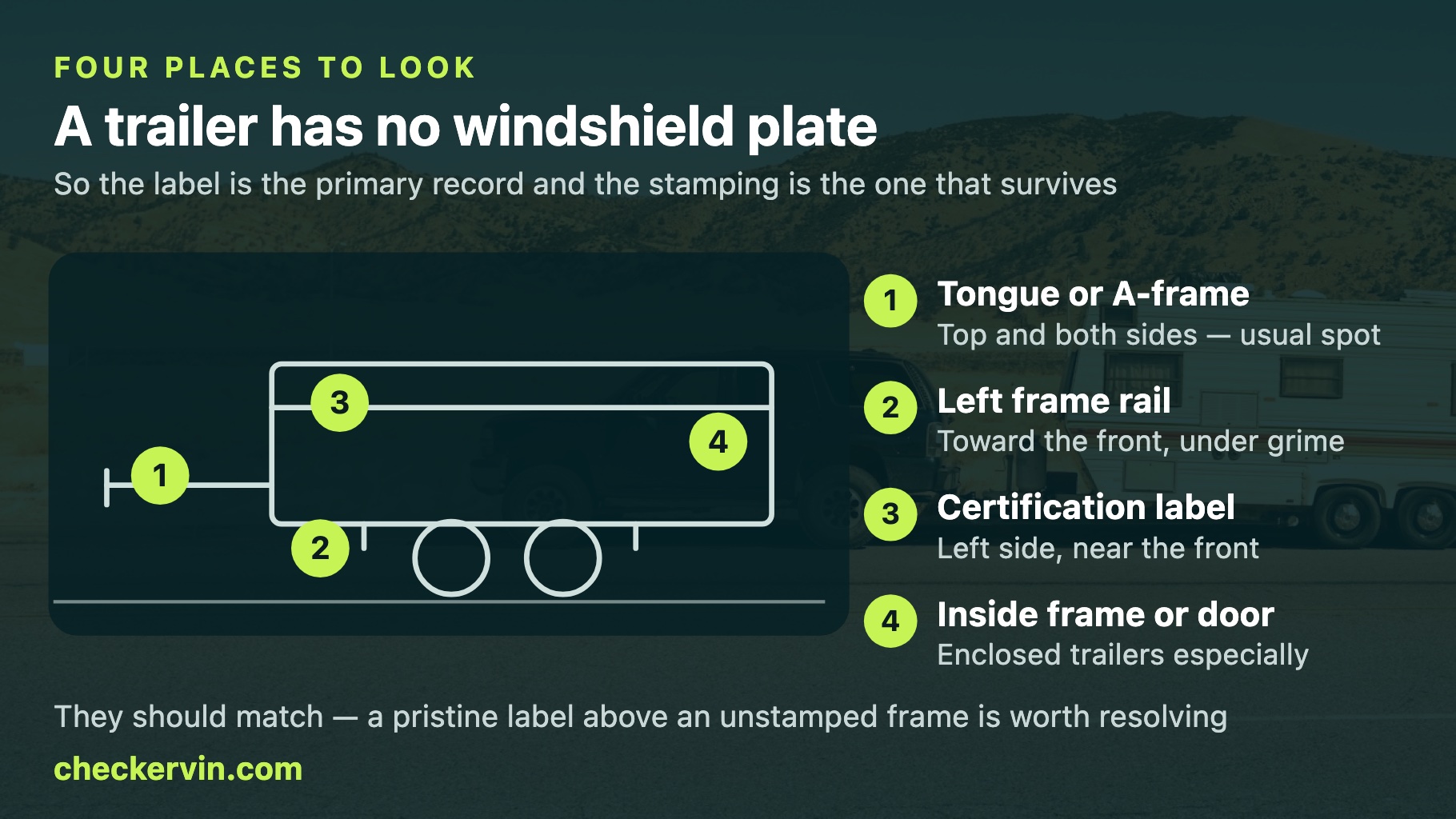
Where the VIN is on a trailer
- 1The tongue or A-frameThe front structure where the coupler attaches to the tow vehicle. Look on the top and both sides. This is the most common location across trailer types.
- 2The left frame rail, toward the frontFederal labeling convention places identification on the left side. Run your hand along the rail near the front corner — road grime hides stampings.
- 3The certification labelA metal or foil plate, usually on the left side near the front, carrying the VIN, the build date and the weight ratings. Easier to read than a stamping.
- 4Inside the frame or under the deckSome builders stamp less accessible locations. On an enclosed trailer, check inside the door frame as well.
How many VINs a trailer carries, and the one people call hidden
Two questions get asked about this constantly and are almost never answered together: how many places the number appears, and where the “hidden” one is. They are the same question, and the answer is structural rather than mysterious.
A trailer inverts a car. On a car the primary location is the windshield plate, visible from outside without opening anything, and everything else is a cross-check. A trailer has no windshield, so the roles swap: the federally required certification label becomes the primary, and the number stamped or riveted into the frame becomes the durable backup.
| Where it appears | What kind of record it is |
|---|---|
| Certification label | Federally required, carries the VIN alongside the weight ratings |
| Stamped into the tongue or A-frame | The manufacturer's own mark, and the one that survives |
| Riveted VIN plate on a frame rail | Common on larger and commercial trailers |
| State-assigned plate | Only where a state issued a number — homemade or replacement |
So the expected answer to “how many” is at least two, and the useful part is that they should agree. The label is a sticker or foil plate and it is the easy one to peel, replace or lose to weather. The stamping is not. When the two disagree, or when a trailer offered as a recent build carries a pristine label above a frame with no stamping anywhere on it, that is the discrepancy worth resolving before money moves — not because a missing stamping proves anything on its own, but because a legitimate seller can usually explain it and a dishonest one cannot.
The “hidden” VIN is simply that frame stamping. It is not concealed by design; it is unpainted steel that has spent years behind a wheel, and it is normally under rust, road film or a later coat of paint. That is a cleaning problem, not a searching problem, which is why the wire brush matters more than knowing a secret location.
The seventeen characters on a trailer
| Position | What it encodes |
|---|---|
| 1 | Country of manufacture |
| 2–3 | Manufacturer |
| 4–8 | The manufacturer's descriptor: trailer type, body style, length and axle configuration |
| 9 | Check digit, calculated from the other sixteen characters |
| 10 | Model year |
| 11 | Assembly plant |
| 12–17 | Sequential production number |
The framework is identical to a car's. What differs is what the middle five characters are legally required to convey, and that is not a matter of convention. 49 CFR § 565.15(b) prints a table of what the descriptor section must make decipherable, and it gives each vehicle type its own row. Trailers get their own.
| Vehicle type | What positions 4–8 must make decipherable |
|---|---|
| Passenger car | Make, line, series, body type, engine type, and all restraint devices |
| Trailer, including trailer kits | Make, type of trailer, body type, length and axle configuration |
Put those two rows beside each other and the difference is the whole point. A car's descriptor is required to carry an engine type and restraint devices, neither of which a trailer has. A trailer's is required to carry length and axle configuration, which no car VIN encodes. That is why a generic VIN chart produces nonsense on a trailer: it is reading for engine and restraints in five characters that were filled with deck length and axle count.
One more difference sits at the far end of the number, and it is the kind of detail that decides whether a VIN you are copying is plausible. The regulation requires the last fivecharacters to be numeric on passenger cars and on multipurpose vehicles and trucks rated at 10,000 pounds or less. For everything else — trailers included — it requires the last four. A trailer VIN whose final four characters are not all digits is worth a second look before you write it onto a bill of sale.
Confirming the builder from the first three characters
The fastest sanity check on a trailer number costs nothing and takes seconds. The first three characters identify the manufacturer, and NHTSA publishes that register openly. Read those three back and you learn two things: whether the builder is who the seller says, and whether the federal register agrees the thing is a trailer at all.
| First three characters | What NHTSA's register returns |
|---|---|
| 5KT | Karavan Trailers Inc. — vehicle type: Trailer |
| 1UY | Utility Trailer Manufacturing — Trailer |
| 4YM | Carry-On Trailer, Inc. — Trailer |
| 4P5 | PJ Trailers Manufacturing — Trailer |
| 1PT | Trailmobile (Pullman Incorporated) — Trailer |
Every row there was read back from the federal register rather than copied from a chart, and one of them is worth calling out. Karavan’s own support page tells owners their VIN begins with 5KT; the register agrees, and returns Karavan Trailers Inc. against that code. When a manufacturer’s own documentation and NHTSA’s register say the same thing, you can stop looking.
The certification label, and why it matters more than the VIN
On a trailer, the certification label is arguably the more useful document. It carries the VIN, but it also carries the numbers that determine what you can legally do with the trailer.
| On the label | Why it matters |
|---|---|
| VIN | The identity used for titling, registration and insurance |
| Date of manufacture | Month and year, which sets the model year and dates the tires |
| GVWR | Gross vehicle weight rating — the maximum the loaded trailer may weigh |
| GAWR | Gross axle weight rating — the maximum each axle may carry |
| Tire size and cold inflation pressure | The specification the ratings assume |
| Manufacturer name | Which matters when sourcing parts for an older trailer |
GVWR: the number that decides what you can tow legally
Trailer weight ratings are where casual owners get into trouble, because the limits are legal as well as mechanical. Exceeding GVWR is a violation in most jurisdictions and can affect an insurance claim after an incident.
- GVWR is the loaded trailer's maximum — trailer weight plus everything on it
- Subtract the empty weight to get your actual usable payload
- The tow vehicle's own towing capacity is a separate limit, and the lower of the two governs
- Tongue weight matters as much as total weight for stability
- Weight ratings assume the tires on the label — undersized tires reduce the real limit
- Some states require registration classes or brakes above a weight threshold
Trailer types and what changes between them
| Type | What to know |
|---|---|
| Utility / open | Open deck with rails. The most common and the most often homemade. |
| Cargo / enclosed | Box trailers. Check the door frame as well as the tongue for the VIN. |
| Boat trailer | Carries its own VIN. The boat has a separate Hull Identification Number. |
| Travel trailer | A towable RV. Titled and registered like other trailers in most states. |
| Fifth wheel | Couples to a hitch in a truck bed rather than a ball. Higher weight ratings. |
| Equipment / flatbed | Heavier ratings, often with ramps and brakes. Weight class rules more likely to apply. |
| Livestock / horse | Enclosed with ventilation. Floor condition is the critical inspection point. |
Boat trailers: two numbers, two documents
This confuses more people than any other trailer question, and getting it wrong on a purchase means discovering later that you own one of the two items you thought you bought.
| Item | Its number |
|---|---|
| The trailer | A 17-character VIN, on the tongue or frame. Titled and registered as a trailer under state vehicle rules. |
| The boat | A Hull Identification Number — a different format, molded or affixed to the transom, usually on the starboard side. Registered under state boating rules. |
Homemade and shop-built trailers
A large share of the utility trailers on the road were welded up in a shop or a driveway rather than built on a production line. They never received a manufacturer VIN, because there was no manufacturer in the regulatory sense.
That is a solvable situation, not a dead end. States issue their own identification numbers for exactly this case, and a homemade trailer with a state-assigned number is fully legal to title, register and sell.
- 1Gather proof of the materialsReceipts for the axle, the coupler, the frame steel and the lighting. States want evidence the components were lawfully acquired rather than removed from a stolen trailer.
- 2Apply to your state motor vehicle agencyAsk specifically for the homemade or shop-built trailer process. Requirements vary considerably between states.
- 3Pass the inspectionTypically a physical inspection confirming the trailer is roadworthy, that lighting works, and that no component carries an altered identification number.
- 4Receive and attach the assigned numberThe state issues a number with a plate or decal. Attach it where instructed and keep the paperwork permanently.
- 5Title and registerOnce the number exists, the trailer titles and registers like any other.
If a trailer you are buying has no VIN
Treat this as a question that must be answered before money moves, not a detail to sort out afterwards. There are innocent explanations and there is one bad one.
- It was homemade and never assigned a number — solvable, but the work falls to you
- The certification label corroded or fell off — check for a stamping elsewhere on the frame
- The plate was painted over during a refurbishment — worth scraping carefully
- The number was deliberately removed, which is the explanation you must rule out
If you buy an unnumbered trailer knowingly, price in the state process and confirm your state will assign a number to a trailer you did not build yourself — some require a bill of sale chain that a casual private purchase may not produce.
Trailers and titles: the rules vary
Trailer titling is one of the least uniform areas of vehicle law. Some states title every trailer. Others title only above a weight threshold and register lighter ones with a plate alone. Some issue a permanent registration.
The practical consequence for a buyer is that “this trailer does not have a title” may be entirely normal in one state and a serious problem in another — and what matters is the rule in yourstate, where you will register it, not the seller's.
Trailer theft, and why the check is worth running
Trailers are among the easiest things to steal. They require no keys, no ignition and no skill — just a hitch and thirty seconds. They are then easy to repaint, easy to resell privately, and rarely reported with enough detail to trace.
- Run the free theft lookup against the VIN before money changes hands
- Confirm the VIN on the trailer matches the title or registration exactly
- Confirm the seller's name matches the paperwork
- Inspect the frame around the VIN for grinding, filing or fresh paint
- Be cautious about a trailer sold with no paperwork at a low price
- Photograph the VIN and the loaded trailer for your own records after purchase
Do trailers get recalls?
They do. Trailer manufacturers are subject to the same safety regime as vehicle manufacturers, and recalls have covered axles, couplers, brake systems, lighting and suspension components.
Check the VIN through NHTSA's free lookup. Where a recall applies, the manufacturer must remedy it at no cost to the owner — although on trailers the practical difficulty is that small builders sometimes cease trading, which is worth knowing before you rely on it.
Buying a used trailer: the checklist
- 1Find and photograph the VIN before you agree a priceIf nobody can find one, you are buying a titling project as well as a trailer.
- 2Read the certification labelGVWR, axle ratings and the build date determine whether the trailer suits what you intend to tow and whether your vehicle can legally pull it loaded.
- 3Run the free theft checkBefore money moves. Trailer theft is common enough that this is the highest-value minute you will spend.
- 4Check the tire date codesMolded into the sidewall. Age matters more than tread depth on a trailer.
- 5Inspect the frame, coupler and safety chainsRust at the welds, a worn coupler and damaged chains are the failures that matter at highway speed.
- 6Test every light with the tow vehicle connectedRunning lights, brakes and both indicators. Wiring faults are the most common defect on a used trailer.
- 7Confirm what your state requires to register itTitle rules, weight classes and brake requirements vary. Check before you buy, not after.
Where this information comes from
- eCFR — 49 CFR § 565.15, VIN content requirementsTable I gives trailers their own required list — make, type of trailer, body type, length and axle configuration — and sets the last four characters numeric for anything that is not a car or light truck
- NHTSA vPIC — manufacturer identifier registerThe register every builder code on this page was read back from, returning make, manufacturer name and vehicle type
- NHTSA vPIC — public VIN decoderCovers trailers alongside cars, trucks and motorcycles
- NHTSA recall lookupFree open-recall check by VIN, including trailer components
- NICB VINCheckFree theft lookup from participating insurers
Keep reading
Frequently asked questions
Where is the VIN number on a trailer?
Most commonly stamped or labeled on the tongue or A-frame at the front, or on the left-side frame rail near the front corner. Manufacturers also fit a certification label carrying the VIN, the build date and the weight ratings, usually on the left side toward the front.
Do trailers have 17-digit VINs?
Trailers manufactured for road use from the 1981 model year carry 17-character VINs under the same federal standard as cars. Older trailers, homemade units and some very light trailers may carry shorter numbers, a state-assigned identifier, or none at all.
How do I get a VIN for a homemade trailer?
Apply to your state motor vehicle agency for a state-assigned identification number. The process typically involves an inspection, proof of the materials used or a bill of sale for the components, and a fee. The state then issues a number and a plate or decal to attach.
Is a boat trailer's VIN the same as the boat's number?
No, and this catches people out constantly. The trailer carries a VIN. The boat carries a Hull Identification Number, which is a different format in a different place. They are separate items, frequently titled separately, and both need checking on a boat-and-trailer purchase.
Can I check if a trailer is stolen by VIN?
You can run the free NICB theft lookup against the trailer VIN, and it is worth doing. Trailers are stolen often because they are easy to hitch and drive away, and a private-sale trailer with no paperwork deserves scrutiny before money changes hands.
Check a trailer before you hitch it
Decode any trailer VIN for the manufacturer, model year and build data, plus open safety recalls. Free, no account.
Run a free VIN check