The short answer
- Which Tacomas have a timing belt?
- Only the 1995–2004 trucks with the 3.4L V6. Every 2005–2022 Tacoma engine uses a timing chain.
- What does the job cost?
- No reliable Tacoma-specific figure exists. KBB repeats a generic $409–$919 line even on Tacoma years that have no belt.
- Got a belt quote on a 2005+ truck?
- It is for another belt or part. Toyota bulletins cover a drive-belt chirp (0.2 hours) and a vacuum-pump knock (1.8 hours).
What the timing belt prices online are actually pricing
Search for this job and Kelley Blue Book ranks near the top with a page per Tacoma model year and cab style, each titled timing belt replacement. We opened three of them in November 2026: the 2004 Tacoma Double Cab, which can have the 3.4-liter belt engine, and the 2005 Access Cab and 2016 Double Cab, which cannot. All three said that a fair repair range for this repair was not yet available, all three showed a placeholder location rather than a ZIP code, and all three carried the same FAQ sentence: expect to pay $409 to $919, parts and labor included.
A figure that appears unchanged on a belt truck and on two trucks without a belt is not a Tacoma estimate. It is a template line, and the same pages say elsewhere that a vehicle has either a belt or a chain depending on the engine, without saying which this one has. So treat $409 to $919 as KBB’s generic answer for belt jobs on all cars, not as a price for your truck.
The other pages on the first results screen are owner forums for first-generation trucks and a repair site’s tensioner page. They are honest about who they are for: the 1995–2004 Tacoma. We sell VIN checks, not repairs, and publish no price of our own, so the useful thing this page can do is establish whether your truck has a belt to replace, and if it does not, work out what a quote with the word “belt” or “timing” in it is really for.
Which Tacomas have a timing belt
The engine list comes from fueleconomy.gov, which records every Tacoma configuration certified for each model year. We pulled it for every year from 2004 to 2022. The 2004 truck was offered with a 2.4-liter four, a 2.7-liter four and the 3.4-liter V6. From 2005 the V6 was a 4.0-liter, and from 2016 a 3.5-liter with both direct and port injection, while a 2.7-liter four ran alongside the V6 the whole way. The redesigned 2024 truck sits outside both our data and this post.
| Tacoma engine and years | Timing drive |
|---|---|
| 1995–2004 3.4L V6 (5VZ-FE) | Belt: the engine behind nearly every belt search |
| 1995–2004 2.4L and 2.7L fours | Generally documented as chain; confirm the engine by VIN |
| 2005–2015 2.7L four (2TR-FE) | Chain |
| 2005–2015 4.0L V6 (1GR-FE) | Chain |
| 2016–2022 2.7L four | Chain |
| 2016–2022 3.5L V6 (2GR-FKS) | Chain |
One caveat on sourcing, because this table is the whole argument. We could not open a Toyota document that names the timing drive on the newer engines; Toyota’s parts and maintenance sites refuse automated requests. What we can say is that every source we found agrees on chains for these engines, and not one of the 1,243 Toyota bulletins, tech tips and dealer notices NHTSA lists for the 2005–2022 Tacoma has a summary that mentions a timing belt, while two mention the accessory drive belt. Our timing belt or chain lookup by VIN is the quickest way to confirm it for one truck.
Settle it with the VIN, not the listing
A used-truck listing that says “V6” does not tell you whether the engine is the belt-driven 3.4 or a later chain engine. The VIN does, in two places. The tenth character is the model year: 4 means 2004, 5 means 2005, and that one step decides whether a belt is possible. On newer trucks the engine code is encoded directly.
We checked that against Toyota’s own paperwork. Bulletin T-SB-0098-20 lists the 2016–2020 Tacoma VIN patterns it applies to, all for the 2GR engine, and each carries Z as the fifth character. We built three full VINs from the bulletin’s production-change table and ran them through NHTSA’s vehicle decoder, which returned Tacoma, engine model 2GR-FKS, 3.5 liters, six cylinders for each. Our engine size check by VIN and Toyota VIN decoder run the same kind of decode for free, so you can do this before a shop opens the hood.
The model year is the line that matters, not the date the truck was bought. The redesigned 2005 Tacoma went on sale in the fall of 2004, so a truck first sold in calendar 2004 can be either a last-of-the-line belt truck or a first-year chain truck. A seller who says “it’s an ’04 or ’05” is describing two different engines, and only the tenth character settles which one is in the driveway. On a first-generation V6, a look at the front of the engine for the plastic timing belt covers is a sensible second check before anyone quotes the job.
The 1995–2004 belt job, for trucks that have one
If the VIN says a first-generation truck with the 3.4-liter V6, the belt is real and it is scheduled maintenance. Toyota prints the interval in the maintenance guide for that model year. Owners on the forums commonly cite 90,000 miles for 2001–2004 trucks and a shorter figure for earlier ones, but we could not open Toyota’s guide to confirm either number, so we do not put it in Toyota’s mouth. KBB’s own general advice is to start thinking about a belt once you pass 90,000 miles and to check the owner’s manual.
The labor is in reaching the belt, which runs across the front of the engine behind the accessory drive and covers. Because the water pump, belt tensioner and idler pulleys come into reach during the same teardown, many shops quote them as a package. That is a reasonable bundle on an engine this old, but it is a choice, and the written quote should list each part so you can see what the price covers.
Our complaint corpus starts with the 2008 model year, so it says nothing about first-generation trucks, and we will not stretch it to answer whether a 2002 is a good year. The most useful paperwork on a truck that old is a receipt for the last belt change. If there is none, assume the job is due.
What the engine complaint record shows, and what it can't
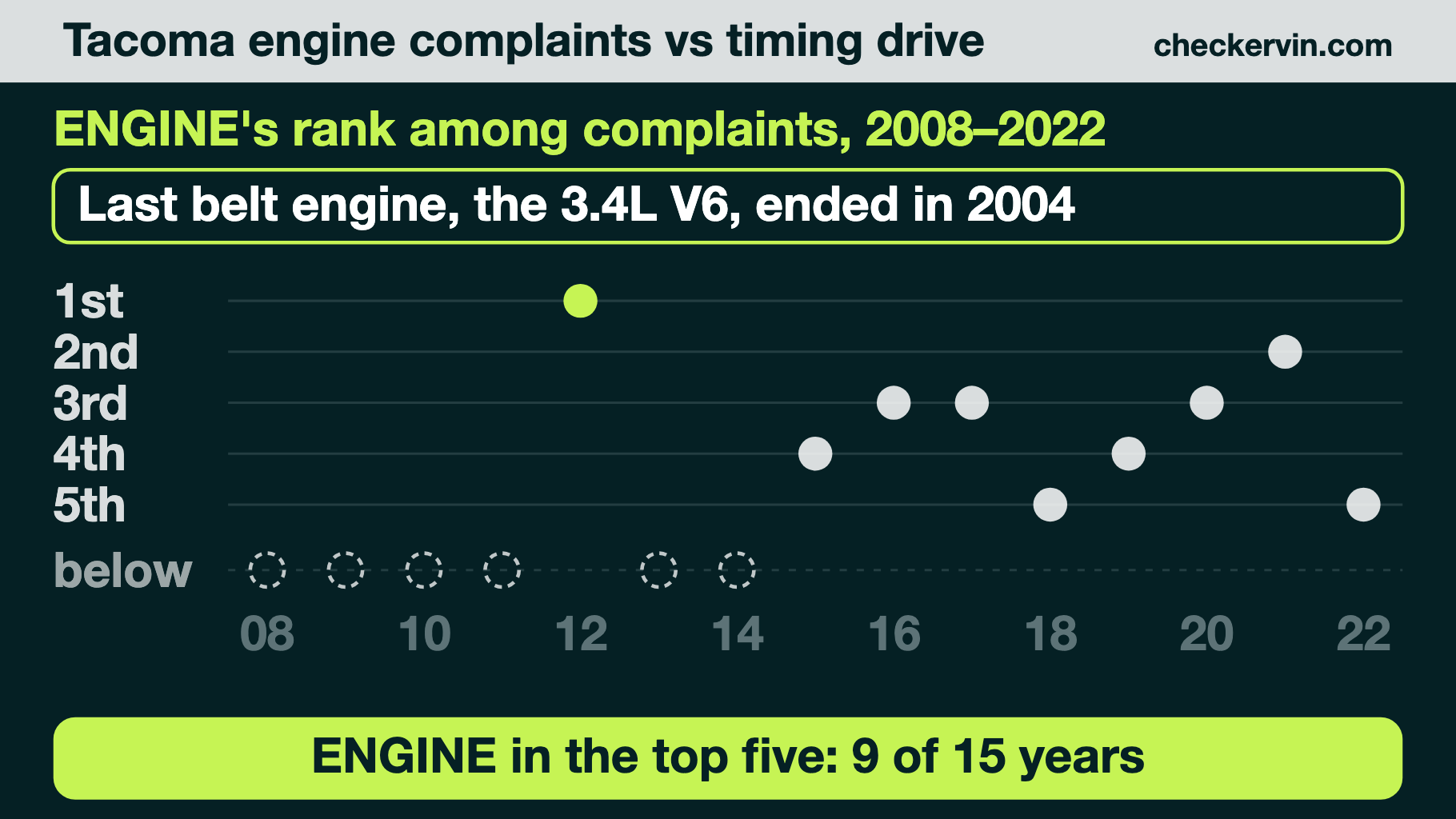
For the years we hold, 2008 to 2022, the federal record has 3,287owner complaints against the Tacoma. ENGINE makes the model year’s five most-reported components in 9 of those 15 years and ranks first only in 2012. Across the years where it makes the top five it accounts for at least 305 reports.
In 2008, 2009, 2010, 2011, 2013 and 2014it falls below fifth place, which means fewer reports than that year’s fifth component and never more than 54. That is not zero, and the chart below draws those years as hollow rings in a separate row for that reason. The split is by generation: ENGINE reaches the top five in 2 of 8 years before 2016 and in 7 of 7 from 2016 on.
None of that is a belt count, or even a timing count. ENGINE holds every engine fault an owner files, from a check-engine light to a stall, so the figure is context and an upper bound. What it does establish is that every one of these complaints concerns a truck built after the belt engine was gone. The Tacoma years-to-avoid breakdown has the full record by year, and the Tacoma timing chain cost post explains the 2012 spike and the timing cover leaks owners describe.
The belt a 2016–2022 Tacoma does have
A newer Tacoma has one belt you can see: the ribbed accessory drive belt that turns the alternator, air-conditioning compressor and other pulleys at the front of the engine. Some shops and parts counters still call it a serpentine or fan belt, and a quote that says “belt replacement” on a 2016 or later truck is almost always this part.
Toyota has a bulletin for it. T-SB-0098-20, revised in March 2021, covers 2016–2020 Tacomas with the 2GR-FKS V6 that chirp from the main accessory drive belt. The fix is a new belt, part 90916-A2025 superseded by 90916-A2037, and Toyota books 0.2 hours of labor for it. The bulletin applies only to trucks built before a set of production-change VINs it lists, and it falls under the 36-month, 36,000-mile basic warranty, so on most trucks that coverage has expired.
The bulletin is also useful for what it tells technicians not to do. It says a slight wobble in any idler or tensioner pulley is normal and that those parts should not be replaced for that alone. If a chirp quote includes a tensioner and two idlers on the strength of a wobble, that line is worth questioning.
Water pump: leaking, or just weeping
On belt engines the water pump is the classic add-on to a timing job. On a newer Tacoma it is a separate repair, and Toyota’s own guidance on when to do it is unusually concrete. Bulletin T-SB-0103-20, revised in June 2024, covers 2008–2024 Tacomas among many other Toyotas and separates two conditions.
| What you see at the pump | What Toyota's bulletin says |
|---|---|
| Dry, crusty coolant residue | Temporary leak: do not replace the pump |
| Wet residue or drips, coolant below low mark | Active leak: replace the pump |
| Pulley with excess play or rough rotation | Replace the pump |
| A dry paper towel pressed on the deposits | Stays dry: temporary; comes away wet: active |
The bulletin explains why the residue happens: the pump’s mechanical seal lets a small amount of coolant out to cool and lubricate itself, and that coolant evaporates, while debris caught in the seal can cause a short-lived drip that clears on its own. A crusty trace near the pump is therefore not proof that it is failing, and a shop proposing a pump with your belt should be able to show you a wet towel.
Noises that get called timing problems
The other route to a timing quote is a noise. A tick or knock near the front of the engine sounds serious, and “timing” is the word people reach for. Toyota has documented three such noises on the 3.5-liter V6, none of them in the timing drive.
- Ticking at idle, loudest with the windows down, next to a wall or in a drive-thru: Toyota tech tip T-TT-0364-15 says this is the 2016 Tacoma's direct injection system cleaning itself, normal operation, and needs no repair
- Knocking at idle from the bank 1 head cover near the high-pressure fuel pump: bulletin T-SB-0115-22 traces it to the vacuum pump on 2016–2023 Tacomas without crawl control, with 1.8 hours booked to replace the pump
- Chirping from the high-pressure fuel pump on 2016–2017 trucks: bulletin T-SB-0016-18, listed by NHTSA, which we saw in summary only
The second-generation 4.0-liter has one of its own. According to the summary NHTSA lists for T-SB-0044-14, some 2012–2014 Tacomas with the 1GR-FE could spark knock under light acceleration or uphill in hot weather, and Toyota changed the engine computer logic to reduce it. A knock that only appears climbing a hill in August is a fuel and timing-advance question, not a mechanical one.
The vacuum pump bulletin sets a good standard for any noise diagnosis: confirm the sound against a recording, find it with a stethoscope, then measure before replacing anything. Ask your shop for the same sequence on a noise it attributes to the timing chain.
The big-labor jobs that sit near the camshafts
Some genuinely expensive work on the newer V6 happens close enough to the cams that an owner might hear it described as a timing job. Toyota bulletin T-SB-0073-18 covers oil leaking from the camshaft sensor bolt holes on 2016–2018 Tacomas whose engines were built before a production change. The repair replaces the camshaft housing using the cylinder head gasket procedure, and Toyota books 15.8 hours for one side on the Tacoma, plus 1.7 if the other side also leaks.
That bulletin falls under Toyota’s 60-month, 60,000-mile powertrain warranty, so on these model years the coverage window has closed for most trucks. It still matters to a buyer, because a seep at the cam sensors on a 2016–2018 V6 is a known, documented leak with a known labor figure, which is a far better basis for negotiating than a vague “timing” quote. The timing cover reseal owners describe on the same engine is a different leak; the chain post covers it.
What recalls cover, and what they don't
We queried NHTSA’s recall database for every Tacoma model year from 1995 through 2022. For 2008–2022 the per-year campaign counts, 87in all, match our corpus exactly, which is how we know the query worked. No campaign in the entire span names a timing belt, timing chain, drive belt, water pump or pulley, including on the first-generation belt trucks. The engine recalls in our span, 13V557 for 2013–2014 valve springs and 17V356 for a 2016–2017 crank position sensor, are unrelated to any belt.
A recall is free at any Toyota dealer no matter how old the truck is; a technical service bulletin pays nothing once the warranty it cites has run out. The Toyota recall lookup by VIN shows which campaigns are still open on a given truck, and the TSB versus recall guide explains the difference in more detail.
Before you pay for anything with “belt” in it
- Read the tenth VIN character: 4 or earlier can be a belt truck, 5 or later cannot
- On a 1995–2004 truck, confirm it is the 3.4L V6 and ask for the last belt receipt
- On a 2005–2022 truck, ask the shop to name the belt or part; a timing belt is not an answer
- For a water pump, ask whether the leak is active, as Toyota's paper towel test defines it
- For a noise, ask which bulletin or measurement points to the part being replaced
Most of the confusion is vocabulary, not dishonesty. Belt, timing and chain get used loosely at service counters, and the practical fix is to have the part names written on the estimate. A drive belt at 0.2 hours of book time and a camshaft housing at 15.8 are both real Toyota jobs on the same engine; you should know which one you are buying.
Where this information comes from
- fueleconomy.gov (DOE/EPA) — Tacoma engines by yearSource of the engine lineup: 3.4L V6 last offered in 2004, 4.0L V6 for 2005–2015, 3.5L V6 from 2016, with a 2.7L four throughout.
- Toyota T-SB-0098-20 Rev1 (NHTSA copy)2016–2020 Tacoma accessory drive belt chirp: 0.2 hours, new belt part number, normal idler wobble.
- Toyota T-SB-0103-20 Rev1 (NHTSA copy)Water pump leak inspection for 2008–2024 Tacomas and other Toyotas: temporary versus active leaks.
- Toyota T-SB-0115-22 (NHTSA copy)Vacuum pump knock at idle, 2016–2023 Tacoma without crawl control, 1.8 hours.
- Toyota Tech Tip T-TT-0364-15 (NHTSA copy)2016 Tacoma ticking at idle is direct injection self-cleaning; no repair needed.
- Toyota T-SB-0073-18 (NHTSA copy)2016–2018 Tacoma cam sensor bolt-hole oil leak: camshaft housing replacement at 15.8 hours.
- NHTSA — recalls by VINOur year-by-year query, 1995–2022, found no Tacoma recall naming a timing belt, chain, drive belt or water pump.
- NHTSA vPIC VIN decoderDecoded VINs from Toyota's bulletin tables as Tacoma, engine model 2GR-FKS.
- Kelley Blue Book — 2005 Tacoma timing belt pageNo fair repair range; the same generic $409–$919 line as its 2004 and 2016 Tacoma pages, retrieved November 2026.
Keep reading
Frequently asked questions
How much does a Toyota Tacoma timing belt replacement cost?
The 3.4-liter V6 sold in 1995 to 2004 Tacomas is the known timing-belt engine; the Toyota documents we could reach do not name the timing drive on later engines, so confirm yours by VIN. We found no Tacoma-specific estimate we could stand behind. Kelley Blue Book's Tacoma timing belt pages show no fair repair range and repeat the same generic line, $409 to $919 including parts and labor, on the 2004, 2005 and 2016 pages alike, even though the 2005 and 2016 trucks have no belt (retrieved November 2026). Get a written quote that names the parts, and confirm the engine by VIN first.
How much does it cost to replace a timing chain on a Toyota Tacoma?
That is a different job on a different engine, and we cover it in our Tacoma timing chain cost post. In short, chain replacement is not scheduled maintenance on any 2005 to 2022 Tacoma, published estimator prices for a full chain job are scarce, and the large owner-reported bills in the federal complaint record are for resealing the timing chain cover on 2016 and later V6 trucks rather than for new chains.
When should you change the timing belt on a Toyota Tacoma?
Only the 1995 to 2004 3.4-liter V6 needs it, and the interval is printed in the maintenance guide for that truck. Owners commonly cite 90,000 miles for later first-generation trucks, and Kelley Blue Book's general advice is to start thinking about a belt after 90,000 miles, but we could not open Toyota's own guide to confirm a figure, so check the booklet or ask a Toyota dealer with the VIN. A 2005 to 2022 Tacoma has no timing belt interval at all.
Can a timing belt last 200,000 miles?
On a Tacoma it depends entirely on which engine. A 2005 to 2022 truck has no timing belt to wear out, so the question does not arise. On a 1995 to 2004 3.4-liter V6, running a belt far past the interval in its maintenance guide is a gamble with age as well as mileage, since rubber hardens over time. If a first-generation truck has no record of a belt change, budget for one rather than assume the original is fine.
Is replacing a timing belt a big job on a Tacoma?
On the 3.4-liter V6 it is a front-of-engine job that shops commonly pair with the water pump and tensioner because the same parts come off. On newer Tacomas the jobs that get confused with it vary widely in size: Toyota books 0.2 hours to replace the accessory drive belt under bulletin T-SB-0098-20, 1.8 hours for the vacuum pump under T-SB-0115-22, and 15.8 hours to replace a camshaft housing for a cam sensor oil leak under T-SB-0073-18. Ask which one your quote is for.
Find out whether that Tacoma has a belt at all
A free CheckerVIN report shows the model year, engine, specifications and open recalls for any Tacoma VIN, so you know which maintenance applies before you pay for it.
Run a free VIN check