The short answer
- Does a VIN decode say belt or chain?
- No. There is no timing drive field. The decode identifies the engine, and the engine is what the answer attaches to.
- Which question actually matters?
- Both, and they are independent. Belt or chain sets whether a replacement is scheduled. Interference geometry sets what a failure costs.
- Is a chain the safe option?
- Safer on maintenance, not on consequence. Guides and tensioners wear, and a jumped chain meets the same pistons a snapped belt would.
- Where is the real answer?
- In the manufacturer's maintenance schedule for that specific engine, reached using the engine identification the VIN returns.
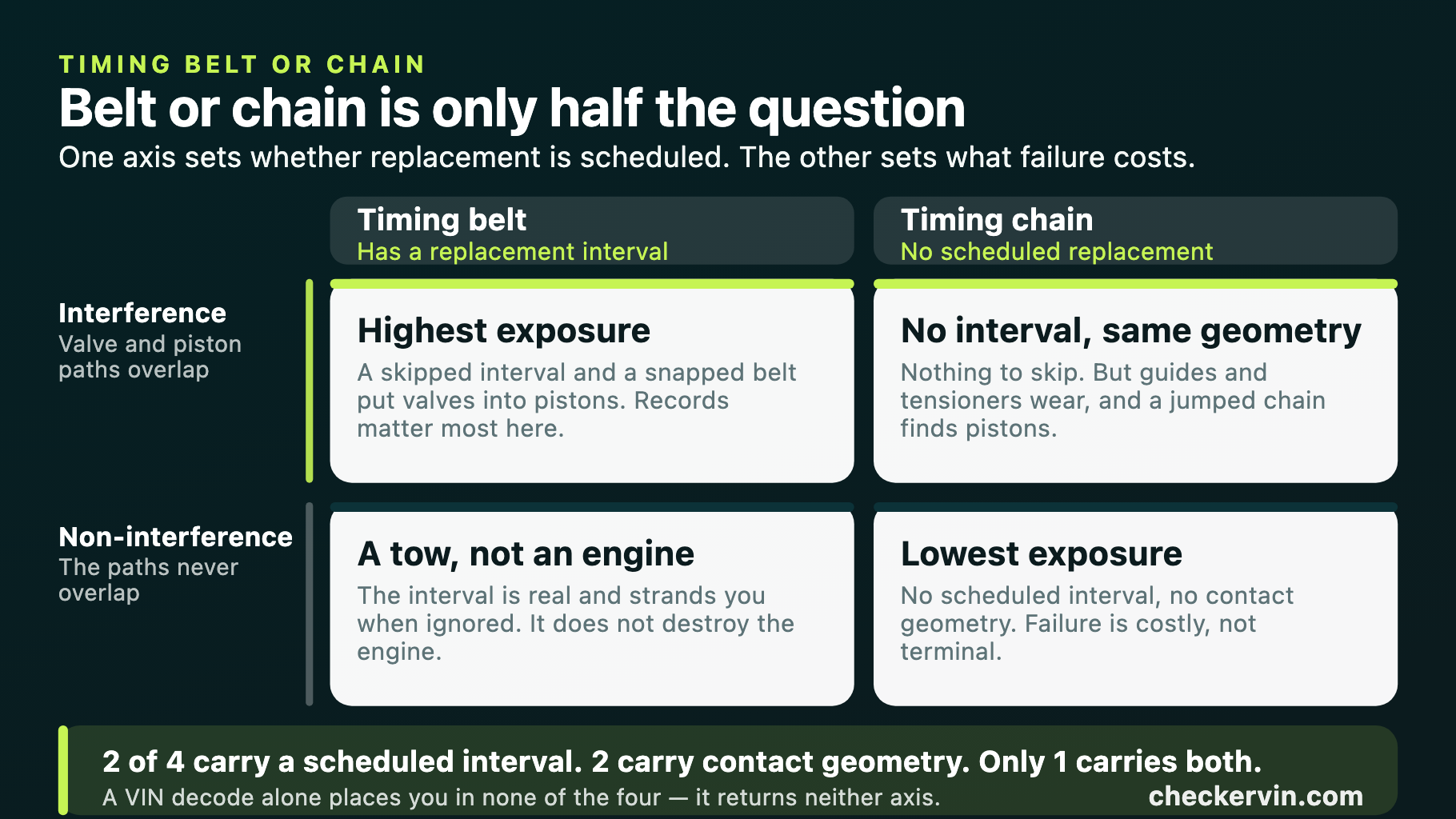
Belt or chain is half the question
The shorthand most buyers carry into a used car lot is that a belt is a liability and a chain is a relief. There is something real underneath it. A belt is a consumable with a service interval attached, and an interval is a thing a previous owner can quietly skip. A chain has no equivalent appointment. If that were the whole picture, the shorthand would be sound.
It is not the whole picture, because it collapses two separate facts into one. Belt against chain answers a question about maintenance: is there a scheduled replacement, and can it have been missed? It does not answer the question about consequence: when the drive between the crankshaft and the camshaft fails, what does the engine do next? That second answer comes from the geometry inside the cylinder, and the two have no reliable relationship to each other.
Cross them and you get four situations rather than two, and they are not ranked the way the shorthand implies. A belt on an engine whose valves and pistons never share space is an inconvenience with a schedule. A chain on an engine where they do share space has no schedule to skip and the full consequence still waiting behind a worn tensioner. Someone reasoning from belt-bad-chain-good lands in the wrong quadrant roughly half the time.
Two axes that do not predict each other
It is worth being precise about what each axis governs, because the entire argument of this page rests on their independence.
| The axis | What it decides |
|---|---|
| Belt or chain | Whether a replacement is on the maintenance schedule, and therefore whether a previous owner had an opportunity to skip it. |
| Interference or not | Whether valve travel and piston travel overlap, and therefore whether a timing failure damages the engine or merely stops it. |
| What the badge tells you | Neither. Trim level and model name are marketing designations, and the same nameplate is routinely sold with more than one engine. |
| What the VIN tells you | The engine. Both answers are properties of that engine, so the VIN is the correct starting point even though it is not the answer. |
Because the axes are independent, knowing one tells you very little about the other. Belt-driven engines are built both ways. Chain-driven engines are built both ways. The correlation people believe they have observed is largely an artifact of which engines happen to be common in a given market at a given time, and it will not survive contact with a specific car in front of you.
What interference actually means
The word describes a physical relationship, not a quality grade. In an interference engine, the arc a valve sweeps when it opens reaches into the space the piston passes through at the top of its travel. Under normal operation nothing collides, because the belt or chain keeps the camshaft and the crankshaft in a fixed relationship — the valve is always closed and out of the way by the time the piston arrives.
Break that relationship and the choreography stops. The crankshaft carries on turning under the engine's own momentum while the camshaft stops where it is, leaving valves standing open in a space the pistons are still sweeping through. The contact that follows is not a single event. It repeats for as long as the engine keeps rotating, which is why the damage is usually described in terms of bent valves and marked pistons rather than a single broken part.
A non-interference engine is laid out so that the two paths never cross, whatever the camshaft happens to be doing. The same failure produces an engine that stops running and a car that needs recovery, and the repair is the timing job that should have been done plus the labor to set the timing again. The distinction is entirely about internal clearance, which is why it cannot be inferred from the outside of the engine, from its displacement, or from the manufacturer's reputation.
Per engine
Where the answer is decided
Not per model, and not per manufacturer
Repeated
How the contact happens
For as long as the engine keeps turning
Internal
Why you cannot see it
Clearance inside the cylinder, not an external feature
Independent
Relationship to belt or chain
Both drive types appear in both geometries
What a VIN decode actually returns
It is reasonable to expect the VIN to settle this. It identifies the vehicle precisely, and the answer is a property of the vehicle. The problem is not precision — it is that the timing drive was never one of the things the decode was built to report.
We checked rather than assumed. Decoding a real VIN against the National Highway Traffic Safety Administration's public decoder while writing this page, the service defines 140 variables and returned 33 of them populated for that vehicle. Searching all 140 for anything touching the subject produces three matches, and none of them is a timing drive field. Two are unrelated to the engine entirely. The third is the interesting one, and it is discussed in the next section.
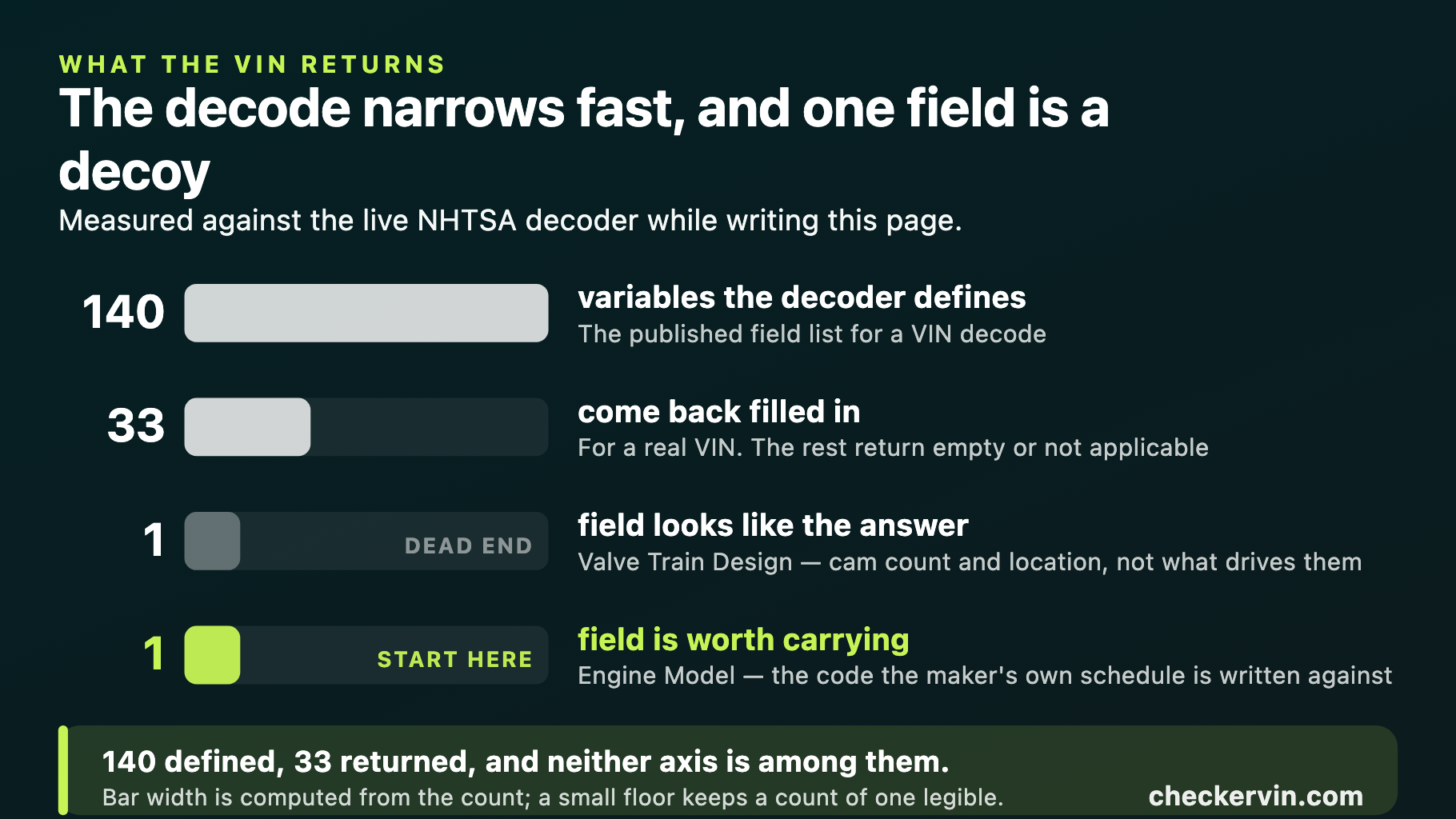
This is not a defect in the decoder. A VIN decode reports how the vehicle was configured and built, and it is genuinely authoritative on that. Belt against chain is a design fact about the engine, and interference is a geometry fact about the engine. Both are answerable — just not from this source, and pretending otherwise would send readers to a field that cannot carry the weight.
Valve train design is not timing drive
The one field in the decode that looks like it might answer the question is valve train design, and for our test VIN it returned a single overhead cam designation. It is easy to see why a reader stops there. It is the only entry with the word valve in it, it sounds mechanical and specific, and it arrives in a list where most other fields are obviously about something else.
It is still the wrong field. Valve train design tells you how many camshafts an engine has and where they sit — over the valves, in the block, one shared across a cylinder head or one per bank. That is a description of the arrangement being driven. It contains no statement about what does the driving, and no statement at all about clearance inside the cylinder. Single and dual overhead cam engines are built with belts and with chains, and in interference and non-interference geometries, in every combination.
The one field worth carrying
The field that does earn its place looks far less promising. Our test decode returned an engine model entry containing a short alphanumeric code — the manufacturer's own internal designation for that engine family and variant. On its face it is meaningless. In practice it is the key, because the manufacturer's maintenance schedule is written against exactly that designation rather than against the model name on the tailgate.
That distinction matters more than it sounds. A model name covers every engine sold under it across a production run. An engine code covers one engine. When a manufacturer publishes a timing belt interval, or declines to publish one because the engine uses a chain, the statement is attached to the engine. Carrying the code rather than the model name is what turns a general question into one with a single correct answer.
So the useful sequence is not decode-and-read. It is decode, take the engine identification the decode returns, and go to the manufacturer for that engine. The VIN is the first step of three rather than the whole journey — which is a less satisfying answer than a field that says "chain," and it is the one that is actually true.
A chain is not nothing to do
Chains are frequently described as lasting the life of the engine, and the claim is defensible as far as it goes — a chain is a steel component designed without a replacement appointment, and many reach very high mileage untouched. The trouble is what the phrase invites readers to conclude, which is that a chain-driven engine has no timing exposure at all.
A chain does not run alone. It runs against plastic guides that hold its path and through a tensioner that keeps it taut, and both are wear items operating in hot oil for the life of the engine. Tensioners on many designs depend on oil pressure to do their job, which quietly ties the health of the timing drive to how well the engine has been serviced — a car with a neglected oil history has a timing exposure that a maintenance schedule never mentions.
When those components fail, the chain develops slack. Slack lets it skip teeth on a sprocket, and a chain that has jumped timing puts the camshaft and crankshaft out of the relationship that keeps valves clear of pistons. On an interference engine, that is the same outcome a snapped belt produces — arrived at down a different road. And because a chain job usually means going deeper into the engine than a belt job does, it is frequently the more expensive repair of the two when it does become necessary.
- A chain has no scheduled replacement, which removes the skipped-interval risk entirely
- Its guides and tensioner are wear items with no appointment of their own
- Many tensioners rely on oil pressure, tying timing health to service history
- A rattle on a cold start is the symptom owners most often report and ignore
- A jumped chain reaches the same pistons a snapped belt would
- Chain work is commonly the more expensive job when it is finally needed
Where the interval comes from
For belt-driven engines there is a number, and the only version of it that counts is the manufacturer's for that engine. Published intervals vary considerably between makers, and they are commonly expressed as a distance and a time together — whichever arrives first — because the rubber and reinforcement in a belt age whether or not the car is driven. A low-mileage car that has spent years parked can be past its belt interval on the calendar alone.
We are deliberately not printing a single figure here. Any number general enough to apply to every car would be wrong for most of them, and a reader who took it as authoritative could be badly misled in either direction — replacing early at real cost, or driving past a shorter interval believing they had room. The interval is whatever that vehicle's own schedule says, and the engine code is how you find that schedule.
One practical detail is worth knowing before getting a quote. On many belt-driven engines the belt also drives the water pump, and the pump sits behind the same covers the belt does. Because the labor to reach one is the labor to reach the other, pump and tensioner are commonly replaced at the same time. A quote that covers the belt alone and a quote that covers the full set are answering different questions, and the difference is worth asking about rather than assuming.
Nobody has to tell you it was done
Here is the gap this page exists to name. Title brands are reported. Odometer readings are recorded at transfer. Open safety recalls are published by the manufacturer and searchable by VIN. Routine maintenance is none of those things. A belt replacement is a private transaction between an owner and a shop, and no rule requires anyone to create a record of it, retain one, or disclose it at sale.
That means there is no lookup that answers "was the belt done." Not here, and not anywhere — the record does not exist to be looked up. We would rather say that plainly than let anyone expect otherwise from a VIN check, ours included. What exists instead is whatever paper the work generated, which is why the practical move is to ask for the invoice rather than for the assurance.
What the federal form covers
Buying from a dealer, you get one federally mandated disclosure: the Buyers Guide required by the Federal Trade Commission's Used Car Rule at 16 CFR Part 455. It is genuinely useful, and it is worth understanding exactly what it is for — because it is not a service history, and reading it as one leads people to conclusions it does not support.
The form is about warranty status. It states whether the vehicle is sold with a warranty or without one, and if there is a warranty, what it covers. The Rule is notably strict about that last part: where systems are covered, the dealer must identify which ones, and shorthand such as "drive train" or "power train" is expressly not permitted in place of naming them. Duration and the share of repair cost the dealer pays must be stated too.
Two further provisions give the form real weight. Under § 455.3, the information on the final window form is incorporated into the contract of sale, and the regulation states that information on the window form overrides any contrary provisions in the contract of sale. Under § 455.4, a dealer may not make statements, oral or written, that alter or contradict those disclosures. So what the form says is not merely informational — it wins against paperwork that says otherwise.
| What the Buyers Guide does | What it does not do |
|---|---|
| States whether the vehicle is sold with a warranty or without one. | Says nothing about what maintenance has or has not been performed. |
| Names the specific systems covered, with shorthand prohibited. | Does not certify the condition of any system it names. |
| Is incorporated into the contract and overrides contrary terms in it. | Creates no obligation to disclose a belt that is overdue. |
| Must be displayed so that both sides are readily readable. | Is not a vehicle history report and does not draw on one. |
None of which touches the timing belt. A dealer selling a car whose belt is ten thousand miles past its interval, with no warranty offered, can comply with the Rule completely. The form will tell you that you are on your own for repairs. It will not tell you that a repair is already due.
As is is not available everywhere
The phrase most people associate with the Buyers Guide is "As Is — No Dealer Warranty," and it is widely assumed to be a nationwide default. The Rule itself says otherwise. Where state law limits or prohibits as-is sales, that state law overrides the federal part, and the Rule does not give a dealer the right to sell as is. In those states the as-is heading is removed from the form and replaced with an "Implied Warranties Only" disclosure, which tells the buyer that the dealer makes no promises to fix things, but that implied warranties under state law may still give rights over serious problems that were not apparent at purchase.
Whether an engine with an overdue timing belt amounts to such a problem is a question for a lawyer in your state, and we are not going to pretend otherwise. What matters for a buyer is narrower and more useful: the box checked on that form is not decorative, the version of the form you are looking at depends on where you are standing, and the difference between the two headings is the difference between having no recourse and having a question worth asking.
What an inspection reaches
A pre-purchase inspection is the right move on any used car, and on this question it has a specific and limited reach that is worth understanding before you pay for one.
What an inspection can establish well: which engine is actually fitted, confirming the decode against the physical hardware; whether the engine has been serviced in a way consistent with the seller's account; whether a chain-driven engine makes the noises a worn tensioner makes, particularly on a cold start; and whether there are signs of previous work in the area the timing covers occupy.
What it generally cannot establish: the remaining life of a timing belt. The belt sits behind covers, inspecting it properly is most of the labor of replacing it, and a belt that looks acceptable can still be past its interval — condition and age are not the same measure, and the interval is written against age and distance rather than appearance. An inspector who reports that a belt looks fine has told you something narrower than it sounds.
Which brings the question back to documents. On this one issue, an invoice from the shop that did the work is worth more than an inspection, because it answers the question the inspection cannot reach. The inspection is still worth having for everything else it finds.
The check sequence
- 1Decode the VIN and read the engine, not the modelThe decode gives you the engine identification the manufacturer's own documentation is written against. That code, not the name on the tailgate, is what the rest of the sequence runs on.
- 2Ignore valve train designIt will be there, it will look relevant, and it answers a different question. Cam count and location tell you nothing about what drives the cams or about clearance inside the cylinder.
- 3Establish belt or chain for that engineFrom the manufacturer's maintenance schedule. If a timing belt interval is published for the engine, it has a belt. If no belt interval exists, that is the strong signal it uses a chain.
- 4Establish interference or not for that engineFrom the manufacturer or a belt manufacturer's application guide, checked against the engine identification rather than the model name. This is the axis that sets the size of the risk.
- 5Ask for the invoice, not the assuranceIf it is belt-driven, ask for paperwork from the shop that did the work, naming the vehicle and the parts. There is no record to look this up in, so the document is the whole evidence base.
- 6Price an undocumented belt as outstandingGet a quote for the job on that engine, and ask whether it includes the water pump and tensioner. Treat an unevidenced belt as a bill you are about to inherit, because that is the assumption that is wrong cheaply.
- 7Read the Buyers Guide for what it isIt tells you your warranty position, and it overrides contrary terms in the contract. It says nothing about maintenance, so it cannot close this question either way.
Where this information comes from
- 16 CFR Part 455 — Used Motor Vehicle Trade Regulation RuleThe Buyers Guide requirement, the prohibition on shorthand for covered systems, the override of contrary contract terms in §455.3, and the state-law override on as-is sales.
- NHTSA Product Information Catalog and Vehicle Listing (vPIC)The public VIN decoder. The variable list and the populated-field counts cited on this page were measured against the live service.
- NHTSA recalls by VINWhat is reportable and searchable by VIN, in contrast to routine maintenance, which is neither.
Keep reading
Frequently asked questions
Can I tell whether a car has a timing belt or a chain from the VIN?
Not from the decode itself. No public VIN decoder returns a timing drive field, and NHTSA's decoder does not carry one among the variables it defines. What the VIN does give you is the exact engine, which is the thing the answer actually attaches to — timing drive is a property of the engine, not of the badge on the tailgate. Take the engine identification the decode returns to the manufacturer's own maintenance schedule and the question resolves there.
Does SOHC or DOHC tell me whether it is a belt or a chain?
No, and this is the single most common wrong turn. Valve train design describes how many camshafts there are and where they sit. It says nothing about what drives them. Single and dual overhead cam engines are built both ways, and the field sits in the decode looking like an answer because it is the only entry with the word valve in it. It is not the answer.
Is a timing chain maintenance free?
No. A chain has no scheduled replacement in the way a belt does, which is a real advantage, but the guides and the tensioner that keep it under control are wear items. When they let go the chain can jump timing, and on an engine with overlapping valve and piston travel the consequence is the same one a snapped belt produces. Chain work is also frequently the more expensive of the two jobs when it does become necessary.
How do I find out whether an engine is an interference design?
From the manufacturer or from a belt manufacturer's application guide, not from the VIN and not from the general shape of the engine. Interference is a geometry question about whether valve travel and piston travel overlap, and it is decided per engine. Two engines of the same displacement from the same maker can differ. Any list you find should be checked against the engine identification rather than against the model name.
The seller says the belt was done. Is that on any record I can check?
Usually not. Routine maintenance is not a reportable event in the way a title brand or a recall is, so there is no federal record of a belt change and no requirement that anyone create one. What exists is whatever paper the work generated — an invoice from the shop that did it, naming the vehicle and the parts. Ask for that document rather than for the claim. A belt job on an interference engine is expensive enough that the receipt is usually kept, and its absence is itself informative.
Start with the VIN
Decode any VIN free for the factory build, specifications and open safety recalls. No account, no card.
Run a free VIN check