The short answer
- What does it cost?
- YourMechanic averages $182; KBB's fair-repair ranges run roughly $278-$422 depending on model year, cab style and ZIP code.
- Does the Tacoma have a transmission problem?
- Power train tops 20% of that year's complaints in exactly two model years, 2016 and 2017, peaking at 42%.
- What fluid does it take?
- Toyota Genuine ATF WS for the AC60 6-speed — the transmission introduced on the third-generation Tacoma.
What the service actually costs
YourMechanic averages a Tacoma transmission fluid service at about $182, split roughly $87 for parts and $95 for labor. Kelley Blue Book instead publishes a fair-repair range by model year, cab style and ZIP code — sampled figures run from about $278 to $421 for a 2014 Double Cab and $318 to $422 for a 2023 Double Cab. Owners on enthusiast forums have separately reported dealer quotes near $400 for a straight drain-and-fill and $500 for a dealer-recommended flush. None of these numbers is ours — we sell VIN checks, not repairs, and price nothing here ourselves — so treat every figure in this post as attributed to whoever published it, not as our quote.
A flat estimator price also does not tell you whether the truck you’re pricing sits on the quiet side of this nameplate’s complaint record or the loud side. As the next section shows, that is not spread evenly — it concentrates almost entirely on two specific model years.
What 3,287 complaints say about the Tacoma's transmission
Our corpus of federal NHTSA complaints holds 3,287 reports against the 2008–2022 Toyota Tacoma. POWER TRAIN names 486 of them — 14.8% of the entire record — and unlike some nameplates in this series, it is not simply absent before a given year and present after. Power train actually appears among the model year’s own top-5 complaint categories in most years across the span, and even ranks first in five separate years.
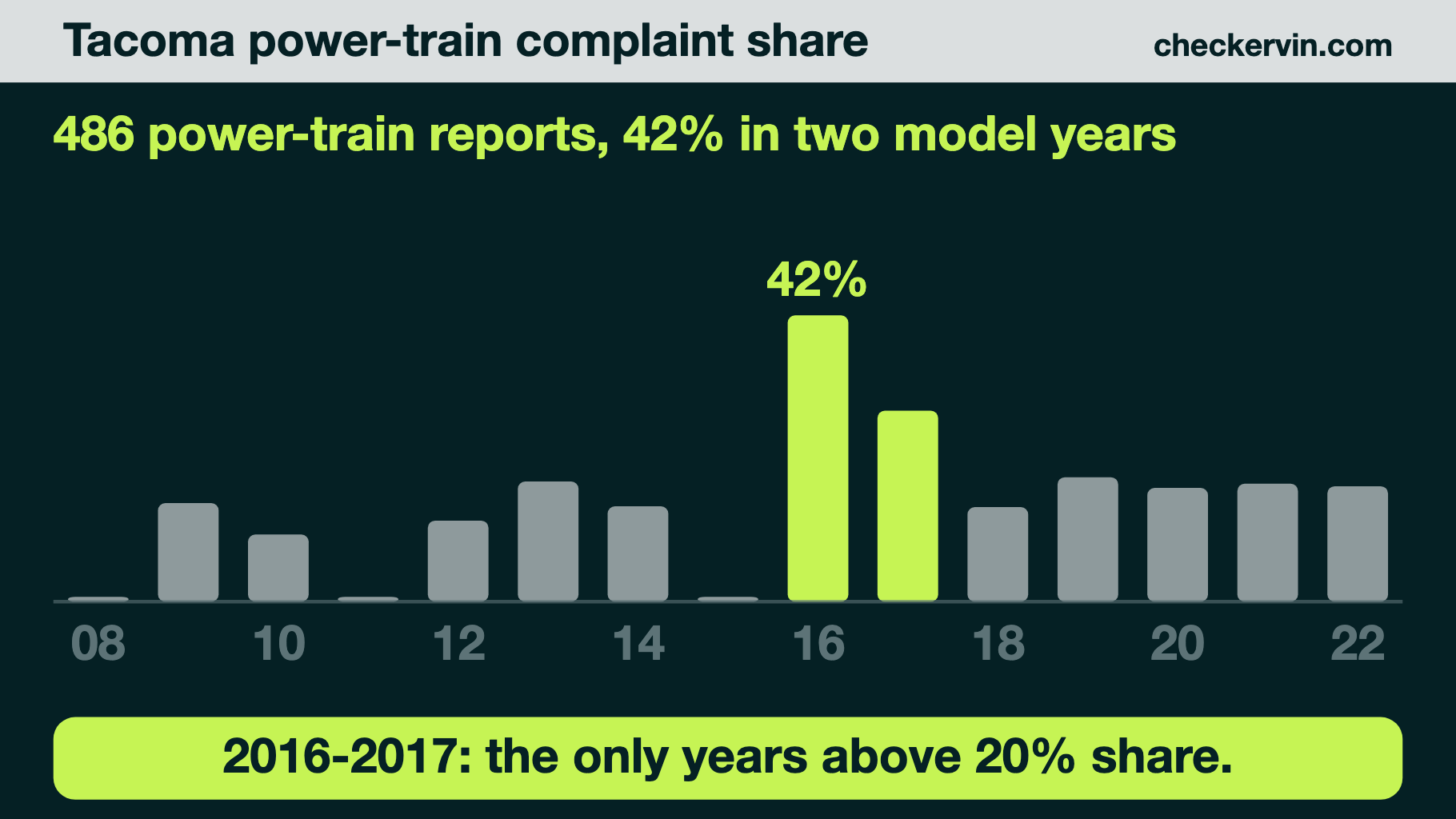
What is not spread evenly is the magnitude. Only two model years — 2016 and 2017— ever push power train above 20% of that year’s own complaints. Every other year in the corpus, including the other three years where power train still ranks first, tops out at 18.3% — under half of 2016’s share and well below 2017’s.
The two years that spike: 2016 and 2017
In 2016, power train names 136 of 324 total complaints — 42% of the entire model year, the single highest share and the single highest raw count of any year in the corpus. 2017 follows at 28%. Together, those two consecutive model years hold 42% of every power-train complaint this corpus has ever recorded against the Tacoma — concentrated in just 2 of the 15 model years on file.
| Model year | Power-train share of that year's complaints |
|---|---|
| 2016 | 42% (136 of 324) |
| 2017 | 28% (68 of 243) |
That is a narrower, sharper concentration than a gradual rise would produce. Something specific to those two model years — not a slow drift across the whole generation — is the more honest read of this pattern.
What changed in 2016
2016is the first model year of the Tacoma’s third-generation redesign. Reporting on the launch describes a new platform, a new 3.5-liter V6 replacing the outgoing 4.0-liter, and — most relevant here — an all-new six-speed automatic, internally designated AC60, replacing the four- and five-speed automatics used on the outgoing second-generation truck.
A new transmission design in its first model years on the road, paired with a real documented shift-feel bulletin covering exactly this window, is a specific, falsifiable explanation for why the pattern starts precisely where it does — not evidence by itself, but the clearest candidate this record offers.
What a real Toyota bulletin says
A documented Toyota technical service bulletin corroborates this window independently of our own complaint corpus. T-SB-0077-16 Rev1, dated July 14, 2016 and titled “ECM Calibration: Shift Feeling Enhancements,” is scoped explicitly to 2016–2017Tacomas equipped with the 2GR V6 engine and the AC60 six-speed automatic. It describes shift-feel concerns including delayed engagement when shifting from Park or Reverse into Drive, and harsh first-to-second upshifts — symptoms consistent with the gear-hunting and delayed-engagement complaints owners describe on enthusiast forums for this exact window.
A separate carcomplaints.com aggregation lists 25 individual owner complaints specifically about the 2017 Tacoma “not shifting properly,” at an average of roughly 7,350 miles — low mileage for a transmission complaint, consistent with a design or calibration issue rather than ordinary wear. Forum reports are mixed on whether the bulletin’s software recalibration fully resolves the symptoms for every truck it was applied to.
Two real recalls, neither one this
Two genuine NHTSA safety recalls also cover 2016–2017Tacomas, and it is worth naming both plainly rather than folding them into the transmission story above — they are not the same issue. Campaign 17V285000 covers a potential rear differential fluid leak (power train, but the differential, not the transmission), affecting roughly 227,700 vehicles. Campaign 17V356000 is an engine recall for a crank position sensor that could stall the engine, affecting roughly 31,800 vehicles. Neither campaign is the shift-feel bulletin above, and neither is a transmission-fluid issue.
A VIN-specific recall lookup is the only way to know whether a given truck was ever subject to either campaign, or whether the remedy was already performed — a complaint-record pattern and an open recall are two separate questions.
ATF-WS, and a disputed interval
The AC60 automatic calls for Toyota Genuine ATF WS, per multiple independent service and parts sources covering the third-generation Tacoma. Owner forums report WS-rated aftermarket fluids, such as Valvoline MaxLife, in routine use as well, though the conservative recommendation — especially for a truck still under warranty — is Toyota’s own genuine fluid.
| Fluid | Where it stands |
|---|---|
| Toyota Genuine ATF WS | The specification multiple sources confirm for the AC60 |
| WS-rated aftermarket (e.g. Valvoline MaxLife) | Reported as commonly used by owners; not Toyota's own fluid |
| Older T-IV / generic Dexron | Not the AC60's specification in any source checked for this post |
How often it should actually be changed is where sources disagree outright. One forum account describes Toyota’s stated interval for these trucks shifting over the AC60’s production run — variously “lifetime,” 100,000, 80,000 or 60,000 miles for severe service, which Toyota defines to include short trips, towing and heavy city driving. Independent shop and owner advice more commonly suggests an initial drain-and-fill around 30,000 miles, then every 25,000 to 30,000 miles after that.
The Tacoma's worst year wasn't this
It would be easy to read the 2016–2017spike as proof those are simply the Tacoma’s worst model years, period. The record does not support that either. The nameplate’s single heaviest complaint year across the entire 15-year span is actually 2009, with 519total complaints — more than either spike year. 2009’s leading category is suspension, at 119 complaints, not the transmission at all.
The point of naming this plainly: this page is about the transmission-fluid question specifically, and the record shows a real, dated, two-year concentration starting in 2016— not a claim that the Tacoma’s overall complaint volume only ever rises, or that every problem traces back to the transmission.
What an actual transmission problem looks like, if it shows up
- Delayed or hesitant engagement when shifting from Park or Reverse into Drive
- A harsh or clunky 1-2 upshift, or gear hunting between 4th, 5th and 6th on the highway
- A shudder, flare or slip between gears, especially on a slight grade
- Dark or burnt-smelling fluid rather than the bright red or pink of healthy fluid
None of these symptoms are unique to the Tacoma — they are the general signs any automatic transmission gives before a repair gets expensive. The order that matters is cheap first: confirm the exact model year by VIN, then get a fluid condition check, before anyone prices a repair beyond a routine service.
Before you authorize the service
- Confirm the exact model year by VIN — the complaint spike above is specific to 2016-2017
- Confirm the shop is using Toyota Genuine ATF WS or a confirmed WS-rated equivalent
- Ask whether your dealer has applied T-SB-0077-16 if your symptoms match its description
- Pull the VIN's open recalls before paying for anything else
- Get the quote itemized — fluid brand, quantity and labor — not a single flat-rate line
If you're buying the Tacoma, not maintaining it
The same record reads as a specific, dated caution rather than a blanket one. A Toyota VIN decodeconfirms the exact model year — worth knowing before you assume a used Tacoma falls on either side of the 2016–2017 window, since the complaint record on either side of it looks nothing alike. A Tacoma from outside that window carries a far lower power-train complaint share in our corpus; one from 2016 or 2017 carries a documented, bulletin-corroborated pattern worth asking a seller or a pre-purchase inspector about directly.
That is one category, not the whole truck. Run the recall lookupon any candidate VIN before you negotiate — recalls run on their own schedule, independent of the complaint pattern above — and see which Tacoma model years the full record flags across every component, not just the transmission. More generally, the VIN, not the badge, decides which transmission fluid a truck actually takes, exactly as this post found on the Tacoma specifically.
Where this information comes from
- NHTSA — Tacoma complaint databaseThe federal complaint record this page's figures are computed from, browsable by model year.
- NHTSA — recalls by VINThe official lookup to confirm either real recall named above, or any other, on a specific Tacoma VIN.
- Toyota technical service bulletin T-SB-0077-16 Rev1 — AC60 shift feelingScoped to 2016-2017 Tacomas with the 2GR engine and AC60 six-speed, hosted on NHTSA's own TSB archive.
- YourMechanic — Tacoma transmission fluid service estimateThe $182 average figure quoted above, retrieved via search November 2026.
Keep reading
Frequently asked questions
How much does it cost to change the transmission fluid in a Toyota Tacoma?
YourMechanic puts the average at about $182, split roughly $87 for parts and $95 for labor. Kelley Blue Book's fair-repair ranges vary by model year, cab style and ZIP code — roughly $278-$421 for a 2014 Double Cab and $318-$422 for a 2023 Double Cab. Owners have separately reported dealer quotes near $400 for a drain-and-fill and $500 for a dealer-recommended flush. None of these figures is ours — we sell VIN checks, not repairs — so treat them as attributed estimates, not a quote.
What transmission fluid does a Toyota Tacoma's AC60 automatic take?
Toyota Genuine ATF WS, according to multiple parts and service sources covering the AC60 6-speed that debuted on the third-generation Tacoma. Owner forums report WS-rated aftermarket fluids, such as Valvoline MaxLife, in common use as well, though conservative advice — especially under warranty — is to stick with Toyota's own WS fluid. Confirm the exact spec for your model year against your owner's manual.
Which Toyota Tacoma model years show the most power-train complaints?
Computed from src/data/models/toyota-tacoma.json: across the 2008-2022 span, power train exceeds 20% of that model year's own complaints in exactly two years, 2016 (42%) and 2017 (28%) — every other year in the corpus, including other years where power train still ranks first, stays at 18.3% or below. Those two years alone hold 42% of every power-train complaint this corpus has recorded for the nameplate.
Does the Toyota Tacoma have transmission problems?
Its own federal complaint record shows a sharp, dated concentration: 2016 and 2017 are the only two model years where power train tops 20% of that year's complaints, which a real Toyota technical service bulletin (T-SB-0077-16 Rev1) independently corroborates for those exact two model years. The Tacoma's single heaviest complaint year overall is actually 2009 (519 complaints), led by suspension, not the transmission — a separate, older story. Complaints are unverified owner reports, not a measured failure rate, so this describes a documented pattern worth asking about, not a guaranteed defect in any individual truck.
How often should a Tacoma's transmission fluid actually be changed?
Sources disagree, and Toyota's own stated interval has reportedly shifted over the AC60's production run — described in different places as a lifetime fill, or a 100,000-, 80,000- or 60,000-mile severe-service interval (short trips, towing, heavy city driving count as severe). More conservative owner and independent-shop advice suggests an initial change around 30,000 miles and roughly every 25,000-30,000 miles after that. We did not confirm either position against a document opened directly in this session, so this page states both rather than picking a side.
Confirm the generation before you price the service
A free CheckerVIN report shows the factory build, specifications and open recalls for any VIN — confirm what you're actually pricing.
Run a free VIN check