The short answer
- What does it cost?
- YourMechanic averages $1,025 for a Pilot belt job; KBB shows $1,163–$1,714 for a 2017 in one ZIP. Honda books 3.2 hours for the belt alone.
- Belt or chain?
- Belt, on every 2008–2022 Pilot. All of them use a 3.5-liter V6, and the belt also drives the water pump.
- What if it snaps?
- Honda's recall paperwork budgets a new engine block and cylinder heads, at 12.4 to 12.7 hours of labor before parts.
The numbers, and whose numbers they are
Three estimators publish a Pilot timing belt figure, and none of them is ours. YourMechanic’s Honda Pilot page gives an average of $1,025, made up of $409 in parts and $616 in labor. Kelley Blue Book’s 2017 Pilot page, set to ZIP code 23704, shows a Fair Repair Range of $1,163 to $1,714 with parts at $620 to $685. RepairPal’s page for the 2024 Pilot, a newer generation than this post covers, lists $1,126 to $1,362, splitting it into $500 to $734 of labor and $626 to $628 of parts, on a page marked as last updated October 16, 2025. All three were retrieved in November 2026.
One more number circulates and should be ignored for this vehicle. KBB’s 2010 and 2016 Pilot pages say a Fair Repair Range “is not yet available” and fall back on a generic $409 to $919 that is not tied to any engine. A transverse V6 with two camshaft pulleys, a hydraulic tensioner and an engine mount in the way is not a generic job. We sell VIN checks, not repairs, so the rest of this post is about the part of the bill that does not depend on anyone’s survey.
Honda's own labor clock: 3.2 hours, or 12.7
When Honda recalled certain 2018 and 2019 Pilots for defective timing belts in 2019, it had to tell dealers how long the work takes, because Honda was paying for it. Service Bulletin 19-045, the remedy procedure filed with NHTSA, sets warranty times for every outcome. We read version 3, dated June 19, 2020, in full.
| Honda operation (SB 19-045, Pilot) | Warranty flat-rate time |
|---|---|
| Inspect the timing belt lot code only | 0.5 hours |
| Inspect, replace the belt, leak-down test, verify valve timing | 3.2 hours |
| Belt failed: replace the engine block and one cylinder head | 12.4 hours |
| Belt failed: replace the engine block and both cylinder heads | 12.7 hours |
The 3.2-hour line is the closest thing to an objective floor for a third-generation Pilot belt job, and it covers the belt only. A full Maintenance Minder code 4 service adds spark plugs and a valve-clearance inspection, and most shops quote the tensioner, idler and water pump at the same time, so expect a shop’s hours to run above Honda’s. Multiply the hours on the quote by the rate the shop posts and the parts list becomes the only thing left to argue about.
The bottom two lines are the reason the job is worth doing on time. Honda’s parts list for a damaged engine is a cylinder block and both cylinder heads, and the labor alone is roughly four times the belt job.
A belt in every Pilot from 2008 to 2022
The EPA’s fuel economy database lists one engine for every Pilot from 2008 through 2022, in every drivetrain and trim it records: a 3.5-liter six-cylinder. From 2016 the entries add direct injection. Honda’s own owner’s-manual maintenance pages for the 2008, 2012, 2016, 2018 and 2021 Pilot all carry the same line under Maintenance Minder sub-item 4: “Replace timing belt and inspect water pump.”
That makes the Pilot different from most of the Honda lineup people compare it with. The four-cylinder Civic, CR-V and Accord time their valves with chains, which is why the CR-V timing chain post is about failure rather than schedule. On a Pilot the belt is a consumable with a due date. If you want the drive type confirmed against a specific vehicle rather than a model, the timing belt or chain lookup by VIN starts from the engine the VIN decodes to.
When the Maintenance Minder calls for it
Search results will tell you the Pilot’s belt is due at 105,000 miles or seven years. None of the Pilot owner’s manuals we read for this span prints that number. The 2008 and 2012 manuals say the belt should be replaced according to the Maintenance Minder, and the later ones simply list it under code 4. The Minder calculates when that code appears from how the engine has been used, so two Pilots with the same odometer reading can be told different things.
The fixed number Honda does print is for hard use. Every manual we read says to replace the belt every 60,000 miles if you regularly drive in temperatures above 110°F or in very low temperatures. The 2008 through 2018 versions add regular trailer towing to that list; the 2021 version drops it. For a Pilot that has spent its life towing a camper through Arizona summers, 60,000 miles is the interval Honda wrote down, whatever the dash says.
What a snapped belt does to this engine
Mechanics describe an engine like this as an interference design: the valves and pistons use the same space at different moments, and only the belt keeps them apart. Honda’s documents describe the consequence in their own terms. Its April 24, 2019 statement on the belt recall warned that teeth breaking off the belt lead “to slippage of the belt and incorrect engine timing,” with a stall and potential engine damage. The remedy bulletin tells technicians that out-of-time camshafts set codes P0341 and P0369 and make the engine run rough, and its parts list for a damaged engine is a new block and heads.
The complaint narratives filed with NHTSA show what this looks like from the driver’s seat. Owners describe a sudden loud noise, every warning light at once, a stall in traffic and an engine that would not restart, followed by a shop telling them the belt had let go and the engine was finished. At least two describe belts that failed before 80,000 miles. Those are individual reports, not a failure rate, but they are the reason a belt job is cheap insurance.
The water pump question
The belt-routing diagram in Honda Service Bulletin 16-054 shows the water pump pulley sitting on the timing belt path, between the two camshaft pulleys. Honda’s schedule says to inspect the pump at code 4, not to replace it. Shops usually recommend replacing it anyway, and the logic is labor: the pump is reached through the same teardown, so replacing it later means paying for most of the belt job twice.
The same argument applies to the hydraulic auto-tensioner and the idler pulley, which are the parts that move. We found no Honda recall or bulletin covering the Pilot’s tensioner or water pump in this span. That means the choice is yours, and a good quote lists each part as a separate line so you can make it.
What 2,165 engine complaints say, and what they cannot
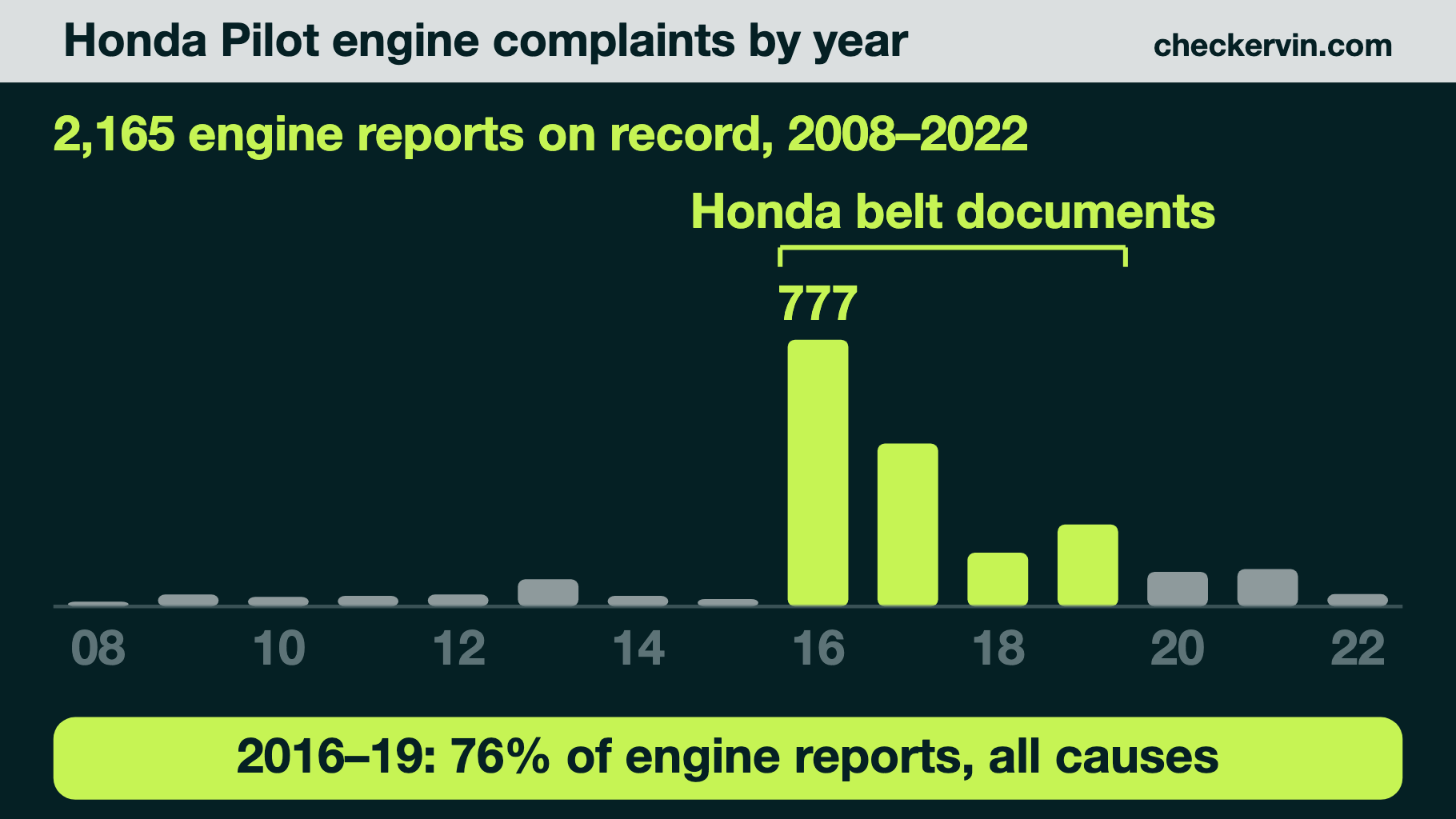
Our corpus of federal NHTSA complaints holds 6,459 reports against the 2008–2022 Pilot, and 2,165 of them, about 34%, land in the ENGINE category. ENGINE is among the five most-reported components in every model year. It ranks first in 2009, 2012–2018. The reports bunch hard into the four years Honda’s belt documents name: 2016–2019 hold 1,648 engine complaints, 76% of the total. A year inside that window averages about 412 engine reports; a year outside it averages about 47. The 2016 Pilot alone carries 777.
That is where the honesty has to come in. ENGINE counts every engine fault an owner reported, and NHTSA has no timing-belt category, so these numbers are an upper bound and a map, never a belt count. Read the narratives behind the 2016–2019 reports and timing-belt mentions are a small minority. Far more describe the idle-stop system failing to restart the engine, misfires, and knocking from the bottom end that turned out to be connecting rod bearings. The two recall years, 2018 and 2019, carry 396 engine reports between them, and most of those are not about belts either.
Recall 19V-298: the belts that were never hardened
In May 2018 Honda’s belt supplier, Gates Unitta Asia, added molds to increase capacity. One of them, according to Honda’s Part 573 report to NHTSA, did not let the belts vulcanize and harden properly, and the teeth on those belts could separate. Honda received its first engine-stall claim between August and October 2018 and filed the recall on April 11, 2019. By April 4 it counted 15 warranty claims, 15 field reports and no crashes or injuries.
| Recall 19V-298, Pilot portion | From Honda's Part 573 report |
|---|---|
| 2018 Pilot | 6,236 vehicles, built June 27 – July 16, 2018 |
| 2019 Pilot | 34,583 vehicles, built July 10 – September 25, 2018 |
| Whole recall (seven Honda and Acura models) | 93,946 vehicles |
| Remedy | Dealer reads the belt's lot code; replaces it if suspect, and repairs any engine damage free |
The recall worked through quickly. Honda’s sixth quarterly report, for the third quarter of 2020, counts 87,916 of the 93,946 vehicles remedied, a figure that includes vehicles inspected and found not to need a belt. The rest is the part that matters to a shopper: a 2018 or 2019 Pilot built in those summer weeks that has never been to a dealer could still carry a suspect belt. The Honda recall check shows whether 19V-298 is still open on a given VIN. Honda did not offer reimbursement for repairs made before the recall, because the new vehicle warranty already covered them.
Chirps, knocks, and paying for the wrong repair
Two noises get misdiagnosed as a dying belt on third-generation Pilots, and both have Honda paperwork. The first is a chirp. Service Bulletin 16-054, revised to version 3 on October 22, 2020, covers every 2016–2018 Pilot and early-production 2019s whose timing belt chirps once the engine is fully warm because the belt rubs the back edge of the crankshaft pulley. The fix is a tapered shim behind the idler pulley, booked at 2.6 hours, and the bulletin says plainly that “the normal warranty applies.” A chirp on these years is a reason to ask for the bulletin, not a reason to buy a belt.
The second is a knock, and it is the expensive mistake. Recall 23V-751 covers 2016 and 2018–2019 Pilots whose connecting rod bearings may wear and seize. Among NHTSA complaint narratives are owners who paid for a timing belt job to cure a knock, then learned the noise was the rod bearings. A belt that fails tends to announce itself with a stall, not a rhythmic knock from the bottom of the engine, so check that recall first.
The difference between those documents is worth understanding, and the TSB versus recall explainer covers it: the recall pays outright, while the bulletin pays only inside warranty.
Which Pilot years carry extra engine paperwork
The belt is due on every Pilot, but some years come with other engine history a buyer should know before pricing the job. Each line below is from a Honda document filed with NHTSA.
| Model years | Honda engine document, and its status today |
|---|---|
| 2009–2013 | Soto settlement: misfire from piston rings, coverage 8 years from purchase, now expired |
| 2013 | Recall 13V-382: pistons not properly heat-treated; short block replaced free |
| 2013–2015 | SB 25-060: piston-ring misfire coverage, ended January 31, 2026 |
| 2016–2019 | Fuel injector warranty extension: 10 years or 150,000 miles from purchase |
| 2016, 2018–2019 | Recall 23V-751: connecting rod bearings; inspect, repair or replace engine free |
| 2018–2019 | Recall 19V-298: suspect timing belt lots, free replacement |
The injector extension is the one still live on many vehicles, and it runs from each Pilot’s original purchase date, so the Honda warranty check by VIN is the way to see what is left on a particular one. For the full complaint picture beyond the engine, the Honda Pilot years-to-avoid page breaks the record down by year.
Before you authorize the job
- Run the VIN for open recalls first — 19V-298 replaces suspect belts free, and 23V-751 covers rod-bearing knocks
- Ask whether the quote is the belt alone or a full code 4 service with spark plugs and valve-clearance check
- Get the water pump, tensioner and idler pulley as separate lines, each with a part price
- Compare the quoted hours with Honda's 3.2 hours for the belt alone, then add time for the extras you approved
- On a 2016–2019 with a warm-engine chirp, ask about Service Bulletin 16-054 before buying a belt
- Keep the invoice; it is the only proof of the job a future buyer will accept
If you are buying a Pilot, not repairing one
Treat the belt as a line item in the price. A Pilot past roughly 100,000 miles, or one that has towed, either comes with an invoice for the code 4 service or comes with that bill attached. No federal database records a belt change, and the vehicle maintenance report guide explains why service history is so patchy, so the seller’s paperwork is what you have to go on.
A Honda VIN decode confirms the model year and build details, which matters for the recall, since only Pilots built between late June and late September 2018 were in its population. If the transmission is the other big-ticket item on your list, the Pilot transmission fluid post covers the six-speed and nine-speed split in the same generation.
Where this information comes from
- Honda Service Bulletin 19-045 v3 (NHTSA copy) — 3.5L V6 timing belt recall remedyThe warranty labor times quoted above: 3.2 hours for the belt, 12.4–12.7 hours for a block and heads, plus the damaged-engine parts list.
- NHTSA Part 573 Safety Recall Report 19V-298Pilot vehicle counts and build dates, the supplier, the hardening defect and the claim chronology.
- American Honda statement on the timing belt recall, April 24, 2019 (NHTSA copy)Honda's own description of belt slippage, incorrect engine timing and potential engine damage.
- NHTSA Recall Quarterly Report #6, 19V-29887,916 of 93,946 vehicles remedied by the third quarter of 2020.
- Honda Service Bulletin 16-054 v3 (NHTSA copy) — Timing Belt Chirps2016–2019 Pilot chirp fix, 2.6 hours, normal warranty; its routing diagram shows the water pump on the belt.
- Honda — 2018 Pilot Maintenance Minder service codesCode 4 contents and the 60,000-mile severe-use footnote, towing included.
- Honda — 2021 Pilot Maintenance Minder service codesSame code 4 belt line; the severe-use footnote no longer mentions towing.
- EPA fueleconomy.gov — Honda Pilot 2008–2022One engine listed for every year and drivetrain: a 3.5-liter six-cylinder.
- NHTSA — recalls by VINThe official lookup for 19V-298, 23V-751 and 13V-382 on a specific Pilot.
- YourMechanic — Honda Pilot timing belt estimateThe $1,025 average quoted above, retrieved November 2026.
- Kelley Blue Book — 2017 Pilot timing belt replacement$1,163–$1,714 for ZIP 23704, retrieved November 2026; ranges change by ZIP.
- RepairPal — 2024 Pilot timing belt estimate$1,126–$1,362, updated October 16, 2025; a newer Pilot than this post covers.
Keep reading
Frequently asked questions
How much does it cost to change a timing belt on a 2010 Honda Pilot?
We could not verify a published price specific to the 2010 model year, so we will not invent one. The figures we could attribute are model-wide: YourMechanic gives an average of $1,025 for a Pilot timing belt ($409 parts, $616 labor), and Kelley Blue Book's 2017 Pilot page shows $1,163 to $1,714 for ZIP code 23704, both retrieved November 2026. A 2010 has the same kind of 3.5-liter belt-driven V6, so ask any shop for a written quote that separates the belt, tensioner, idler, water pump and spark plugs, because Honda's Maintenance Minder code 4 bundles the belt with plugs and a valve-clearance check.
How often should you change the timing belt on a 2016 Honda Pilot?
When the Maintenance Minder shows sub-item 4. Honda's 2016 Pilot maintenance pages print no fixed mileage for normal driving; they list 'Replace timing belt and inspect water pump' under code 4 and let the Minder schedule it from how the engine is used. The one fixed number is the severe-use rule: replace every 60,000 miles if you regularly drive in temperatures over 110°F, in very low temperatures, or while towing a trailer.
Does a 2020 Honda Pilot have a timing belt or a chain?
A belt. Every 2008 to 2022 Pilot uses a 3.5-liter V6, per the EPA's fuel economy listings, and Honda's 2018 and 2021 Pilot maintenance pages both list timing belt replacement under Maintenance Minder code 4. The 2020 sits between those two years on the same engine. Honda's 2018-2019 timing belt recall, 19V-298, is further confirmation that this generation runs a belt.
How long do timing belts last on a Honda Pilot?
Honda does not publish a lifespan, only a replacement trigger: the Maintenance Minder's code 4 under normal use, or every 60,000 miles in extreme heat, extreme cold or (on most years) regular towing. Age matters as well as miles, since rubber belts harden over time, so a low-mileage older Pilot whose Minder has been reset without the work being done is the riskier case. Ask for the invoice rather than relying on the dash.
What year to stay away from Honda Pilot?
In the federal complaint record, 2016 stands out: 777 engine complaints, the most of any Pilot year, and Honda has since recalled 2016 and 2018-2019 Pilots for connecting rod bearings (23V-751) and extended fuel injector coverage on 2016-2019 models. The 2009-2013 and 2013-2015 piston-ring warranty extensions have both expired. None of that makes a particular Pilot good or bad; run its VIN for open recalls and look for proof of the code 4 service before you buy.
Check the recalls before you pay for the belt
A free CheckerVIN report shows the factory build, engine, specifications and open recalls for any VIN, so you know whether Honda already owes that Pilot a belt or an engine inspection.
Run a free VIN check