The short answer
- What does it cost?
- No estimator publishes a full Tacoma chain job. RepairPal lists $574–$642 for a 2007 Tacoma tensioner; owners report $4,500–$6,666 for timing cover leaks.
- Chain or belt?
- Chain, on every 2005–2023 Tacoma engine. Only the 1995–2004 3.4L V6 has a belt.
- Is chain failure common?
- No. Engine complaints are about 9% of the Tacoma's record, and the biggest spike (2012) is air-injection pumps, not chains.
The numbers, and whose numbers they are
Start with what is missing. We looked for a published estimator price for replacing the timing chain on a Tacoma and did not find one. RepairPal, which publishes chain estimates for plenty of other trucks, lists a related job on its 2007 Tacoma page: a timing chain tensioner replacement at $574 to $642. That figure comes from RepairPal’s own listing, read in October 2026 through a live search because the site refuses direct requests from our tools. It prices the tensioner, the spring-loaded part that keeps the chain tight, and not the chain, guides and front-cover teardown that a full job involves.
Kelley Blue Book goes the other way. Its Tacoma repair pages are titled timing belt replacement, for trucks that have no belt, and when we loaded its 2021 Tacoma Double Cab page directly it said the fair repair range for this repair was not yet available. The same KBB page notes that chains can last the life of a car, which is the more useful sentence on it.
The most specific dollar figures come from owners. Federal complaints filed against 2016 and 2020 Tacomas describe $4,500 and roughly $5,700 paid, and a $6,666 dealer quote, to stop oil leaking from the timing chain cover. Those are three people’s bills, not a survey, and they price a reseal, not a new chain. We sell VIN checks rather than repairs and publish no price of our own, so every figure here belongs to whoever published it.
Chain or belt, engine by engine
Half the traffic on this question is really asking whether the truck has a belt at all. For anything built in the last twenty years it does not. The search confusion has a source: the first-generation Tacoma’s 3.4-liter V6, sold from 1995 through 2004, is belt-driven, and a lot of the Tacoma repair advice still online was written for those trucks.
| Tacoma engine | Timing drive |
|---|---|
| 1995–2004 3.4L V6 (5VZ-FE) | Belt, the source of most timing-belt questions |
| 2005–2015 2.7L four-cylinder (2TR-FE) | Chain |
| 2005–2015 4.0L V6 (1GR-FE) | Chain |
| 2016–2023 2.7L four-cylinder | Chain |
| 2016–2023 3.5L V6 (2GR-FKS) | Chain |
The 4.0-liter V6 belongs to Toyota’s GR family, whose engines drive their camshafts with a chain, and the 3.5-liter V6 Toyota launched in the 2016 truck is a later member of the same family. The 2024 redesign moved to a turbocharged engine that sits outside our data and outside this post. If the truck in front of you could be either side of the 2004 line, the timing belt or chain lookup by VIN answers it in one step, and an engine size check by VIN tells you which of the two current engines you are pricing.
What 3,245 complaints say about the engine
Our corpus of federal NHTSA complaints holds 3,245 reports against the 2008–2022 Tacoma. The ENGINE category accounts for at least 301 of them, about 9%, and ranks fourthamong the truck’s components, behind power train (484), suspension (412) and unknown or other (324). That is a small engine record for a truck sold in these numbers, and it is the first thing worth knowing before anyone quotes a timing job.
A comparison makes the scale clearer. Counted the same way, ENGINE is about 18% of the Ford F-150’s complaints across the same years, a truck whose own manufacturer published bulletins for chain wear and cam phasers. The Tacoma’s share is roughly half of that. A low share does not mean no Tacoma ever needs a chain; it means the federal record gives no sign of a pattern, and a shop recommending one should be able to point to evidence on your particular engine.
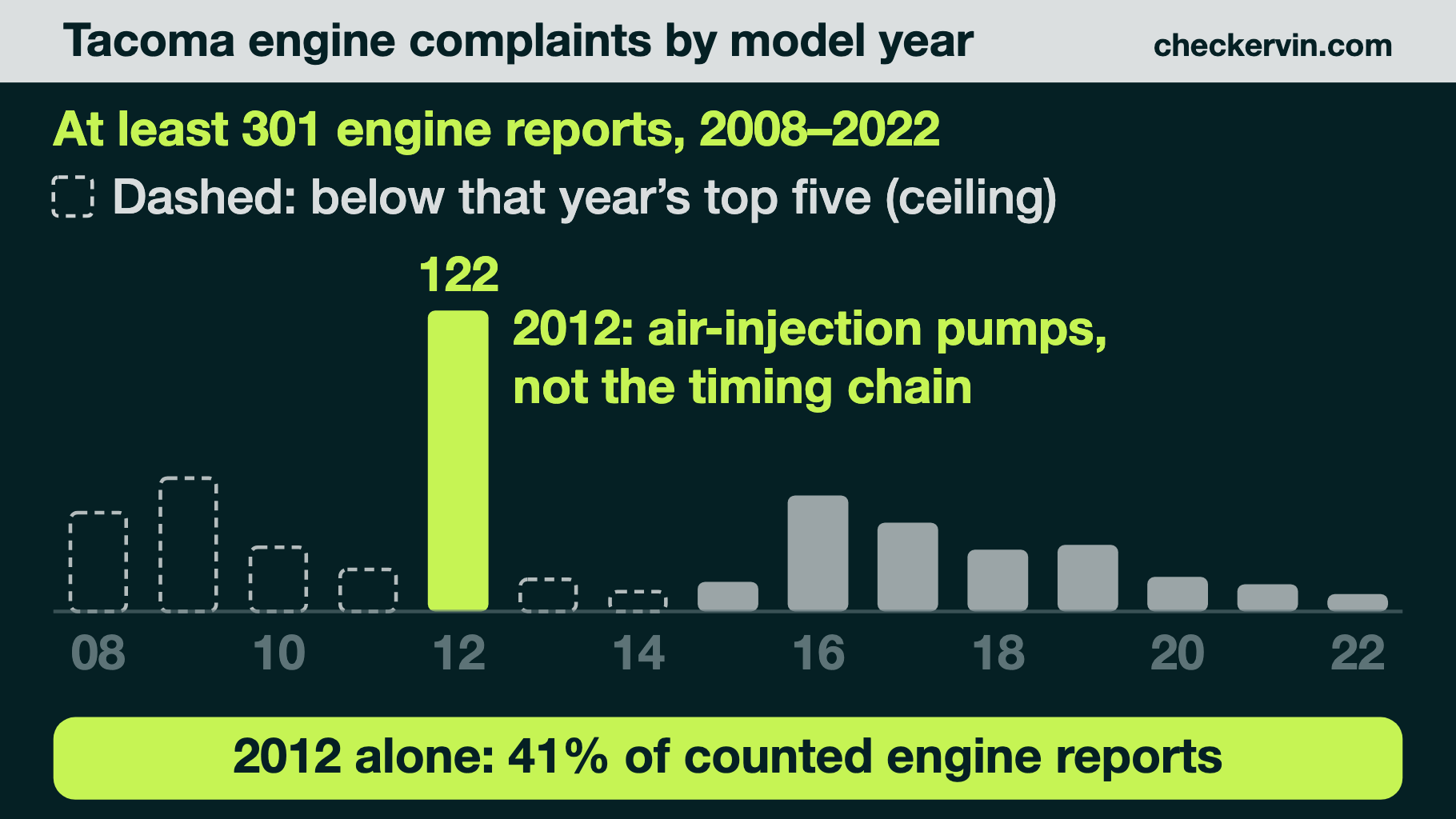
The “at least” matters. Our data keeps the five most-reported components for each model year, and in 6 of the 15years ENGINE is not among them, so its count there sits somewhere below that year’s fifth-place figure, never higher than 54. The chart draws those years as dashed outlines at that ceiling rather than as zeros. And ENGINE is a broad bucket: it holds every engine fault an owner reports, from a check-engine light to a stall, so even the counted figure is an upper bound on timing-chain trouble, not a count of it.
2012: the spike that isn't a chain
One bar towers over the rest. The 2012 Tacoma carries 122 engine complaints, 41% of every engine report we can count across fifteen model years, and about 41% of all complaints against that model year. Anyone scanning a complaints site for “Tacoma engine problems” will land on it, and it would be easy to assume a timing problem.
Reading the narratives says otherwise. Most of the 2012 engine complaints describe the same sequence: a check-engine light and a TRAC OFF light together, codes P2440 or P2442, and the truck dropping into a reduced-power mode. Those codes belong to the secondary air-injection system, a pump and a pair of valves that push fresh air into the exhaust during a cold start so the catalytic converter warms up faster. None of it touches the timing drive.
Toyota acknowledged the problem twice. Customer Support Program ZHA, first published January 11, 2018, covers air injection pumps and air switching valves on about 87,000 certain 2012 Tacomas when moisture has caused the check-engine light. A July 2018 update changed the secondary coverage from 10 years or 150,000 miles to 10 years from first use regardless of mileage. Then, on May 28, 2020, Special Service Campaign 20TC01 covered about 78,900 trucks built from late August 2011 to early August 2012, with a free inspection, an improved filter or new pump as needed, and new switching valves.
2008–2015: a quiet engine record
Take 2012 out and the second-generation truck barely registers. ENGINE is missing from the top five in 2008, 2009, 2010, 2011, 2013 and 2014, and outside the 2012 spike it reaches the top five only in 2015, with 12 report. These are the years of the 4.0-liter 1GR-FE V6 and the 2.7-liter four-cylinder, the same pair the 2010-and-later 4Runner uses, and their reputation for long chain life is consistent with what owners have, and have not, filed.
Two engine items from this era deserve a mention, and neither is the chain. NHTSA campaign 13V557 recalled certain 2013 and 2014 Tacomas built between July 1 and October 11, 2013, whose valve springs could break and stall the engine; dealers replace the springs free. And trade press, Engine Builder magazine among it, has reported a Toyota bulletin for a small oil seep where the timing cover, cylinder head and block meet on early 1GR-FE engines, fixed by resealing the cover. We could not read that bulletin in primary form, and the summaries disagree on which model years it covers, so we cite no number for it. It is a reseal, not a chain.
2016–2022: the cover, not the chain
The redesigned 2016 truck changes the pattern. ENGINE places in the top five in every third-generation model year we hold, peaking at 47 reports on the 2016 truck and falling to 7 on the 2022. Together these years hold 55% of the counted engine complaints. The 2016 and 2017 narratives include stalling reports of the kind Toyota’s crank position sensor recall addressed, alongside the usual spread of check-engine complaints.
The timing story here is a leak. Owners of 2016, 2019, 2020, 2021 and 2022 trucks describe oil seeping from the timing chain cover on the 3.5-liter V6, often found at a routine oil change, sometimes at as little as 37,000 miles. Several say the dealer had to pull the engine to reseal it, and one 2016 owner describes the dealer fixing it twice before it leaked again. That is why the bills quoted in these complaints run into the thousands for what is, in parts, a tube of sealant and some gaskets. None of these owners report a chain that stretched or jumped.
A Mitchell 1 summary published by VehicleServicePros also describes a Toyota bulletin for oil leaking from the cam sensor bolt holes on 2GR-FKS engines, including 2016–2018 Tacomas, with a later engine-number production change. We could not open the bulletin itself, so we note it only because a cam housing seep near the front of the engine is one more thing a shop should rule out before calling it the timing cover.
The practical point for anyone holding a quote: on a 2016 or later V6, a big number attached to the word “timing” is far more likely to be a cover reseal than a chain replacement, and the cost is in access, not parts. Ask the shop to write down which it is, whether the engine has to come out, and whether the chain set is included or only inspected. Owners in the complaint record who paid for a reseal were not told their chain was worn, and if yours is, the shop should be able to say what it measured.
What recalls cover, and what they don't
We queried NHTSA’s recall database for every Tacoma model year from 2008 through 2022, and the per-year campaign counts matched our corpus exactly. No campaign names the timing chain, its tensioner or the timing cover. The two engine recalls are 13V557, the 2013–2014 valve springs, and 17V356, which covers 2016–2017 V6 trucks whose crank position sensor could fail and stall the engine, fixed with an improved sensor.
| Program type | What it pays for |
|---|---|
| Safety recall | Free fix at any Toyota dealer, with no expiry on the remedy |
| Special service campaign | Free fix for a named condition, such as 20TC01 on 2012 air pumps |
| Customer support program | Coverage for its stated term — ZHA runs 10 years from first use |
| Technical service bulletin | Repair instructions only; pays nothing outside warranty |
The difference between those rows is explained in our TSB versus recall guide. For the truck you actually own or are buying, the Toyota recall lookup by VIN shows which campaigns are still unrepaired on it.
When a chain job is actually warranted
A Tacoma chain is not a maintenance item. Toyota does not schedule its replacement, and nothing in the federal record suggests owners of these trucks should replace one on mileage alone. The job becomes reasonable when the engine gives you evidence:
- A rattle or slap from the front of the engine at cold start that lasts longer than a second or two, or that returns warm
- Camshaft-to-crankshaft correlation codes such as P0016, P0017, P0018 or P0019, confirmed after the sensors check out
- Plastic guide fragments or metallic debris found in the oil pan or filter
- A long history of missed or stretched oil changes on a high-mileage engine
One of those alone is a reason to diagnose, not to replace. A correlation code can come from a sensor or wiring fault, and a front-of-engine noise can be an accessory pulley. If the front cover is coming off anyway to stop a leak, ask what the chain, guides and tensioner look like while it is open; replacing them then costs parts, not a second teardown.
Oil is the variable owners control. A chain runs in engine oil and its tensioner is pressurized by it, so the engines that do wear chains early tend to be the ones run low or run long between changes. On a used truck with no service records, that history is a better predictor than the model year, and it is the one thing no complaint database can tell you about a specific engine.
Before you authorize the work
- Confirm the engine by VIN — a 2.7L and a 3.5L are different jobs at different prices
- Ask whether the quote is a chain replacement or a timing cover reseal; the two are often blurred
- For a leak, ask for a dye test so the source is proven, as one dealer in the complaint record did
- On a 2012 truck with a check-engine light, rule out ZHA and 20TC01 first
- Get the labor hours in writing and compare them with a second shop
The second item causes most of the confusion. A shop quoting “timing chain work” on a third-generation Tacoma may mean resealing the cover, which is mostly labor, or replacing the chain set, which adds parts. Both can be fair; you should know which one you are buying.
If you are buying the truck, not repairing it
The record reads as a short checklist. On a third-generation truck, look under the front of the engine for oil on the timing cover seam and ask for any reseal paperwork. On a 2012, ask whether the air-injection work was done. A Toyota VIN decode confirms the engine and build, and a Toyota warranty check by VIN tells you whether any factory powertrain coverage remains on a newer truck. The Tacoma years-to-avoid breakdown covers the rest of the complaint record, where power train and suspension, not the engine, carry the most reports, and the 2016 Tacoma record shows a single year in detail.
For comparison, the F-150 timing chain cost post shows what a truck with documented chain and phaser bulletins looks like in the same data, and the 4Runner transmission fluid post covers the SUV that shares the second-generation Tacoma’s engines.
Where this information comes from
- Toyota Customer Support Program ZHA (NHTSA copy)Air injection pumps and switching valves on about 87,000 certain 2012 Tacomas; the July 2018 update to 10 years from first use, regardless of mileage.
- Toyota Warranty Policy Bulletin POL18-01 (NHTSA copy)The dealer-side version of ZHA, with the original 10-year or 150,000-mile secondary coverage.
- Toyota Special Service Campaign 20TC01 (NHTSA copy)May 2020 remedy for about 78,900 2012 Tacomas built late August 2011 to early August 2012.
- NHTSA — recalls by VINThe official lookup; our year-by-year query found no Tacoma recall naming the timing chain or cover, and two engine recalls, 13V557 and 17V356.
- NHTSA — vehicle safety complaintsThe owner-complaint database behind our corpus and the narratives quoted above, including the timing cover leak costs.
- Toyota — 2016 Tacoma launch releaseToyota's own description of the third-generation 2.7-liter four-cylinder and 3.5-liter V6.
- RepairPal — 2007 Toyota Tacoma repair costsThe $574–$642 timing chain tensioner figure, retrieved October 2026.
- Kelley Blue Book — 2021 Tacoma timing belt pageTitled for a belt the truck does not have; showed no repair range when retrieved October 2026.
Keep reading
Frequently asked questions
How much does it cost to replace the timing chain on a Toyota Tacoma?
We found no published estimator figure for a full Tacoma timing chain replacement. The closest is RepairPal's 2007 Tacoma page, which lists a timing chain tensioner replacement at $574 to $642 (retrieved October 2026). Kelley Blue Book's Tacoma pages are titled timing belt replacement, and its live 2021 Tacoma page shows no range at all. Owners filing federal complaints about third-generation trucks report $4,500 to about $5,700 paid, and one $6,666 dealer quote, for timing chain cover leaks rather than chain replacement. Treat those as individual accounts, not a market price.
Does the Toyota Tacoma have a timing belt or a timing chain?
Every Tacoma engine from 2005 through 2023 uses a timing chain: the 2.7-liter four-cylinder, the 4.0-liter V6 sold through 2015 and the 3.5-liter V6 sold from 2016. The belt questions come from the first-generation trucks, whose 3.4-liter V6 (1995-2004) is belt-driven. If you are not sure which engine a truck has, a VIN decode settles it.
Do Tacoma timing chains fail?
Rarely, on the evidence we can see. ENGINE ranks fourth among the Tacoma's complaint categories, at about 9% of reports, and in the narratives we read across 2008-2022, chain or tensioner failure barely appears. The largest engine spike, the 2012 truck, is secondary air-injection pump trouble that Toyota covered under its own programs. What third-generation owners do describe, repeatedly, is oil leaking from the timing chain cover.
Why is a Tacoma timing cover leak so expensive?
Owners who filed federal complaints about 2016 and later trucks describe dealers pulling the engine, or the engine and transmission, to reseal the timing chain cover on the 3.5-liter V6, which turns a gasket into a teardown. Their reported bills run from $4,500 to $6,666. Toyota has issued no recall for it, and we found no Toyota warranty extension covering it. Confirm the leak source with dye before agreeing to the work, because a valve cover or cam sensor seep can look similar from underneath.
Is the 2012 Tacoma check engine light problem covered by Toyota?
Possibly, if the light comes from the air-injection system. Toyota's Customer Support Program ZHA covered air injection pumps and air switching valves on certain 2012 Tacomas for 10 years from first use, regardless of mileage, after a July 2018 update removed the original 150,000-mile cap; for most trucks that term has now run out. Special Service Campaign 20TC01, issued in May 2020, added a free inspection, an improved filter and new switching valves for trucks built from late August 2011 to early August 2012, and its dealer notice states no end date we could find. A Toyota dealer can check whether 20TC01 is still open on a given VIN.
Confirm the engine before you price the repair
A free CheckerVIN report shows the factory build, engine, specifications and open recalls for any Tacoma VIN, so you know which timing drive and which programs apply.
Run a free VIN check