The short answer
- What does it cost?
- Aftermarket packs list at $1,599–$2,999 before installation; RepairPal estimates $6,006–$6,205 installed for the 2025–2026 Camry.
- Am I still covered?
- A 2020-or-newer Camry Hybrid carries 10 years/150,000 miles on the pack. Most 2019-and-earlier cars have aged out of their 8-year term.
- Is there a free fix?
- No recall replaces the Camry Hybrid pack in NHTSA's records for 2007–2022, checked October 2026 against a query that does find Prius hybrid recalls.
10 yr / 150k
Toyota pack coverage from MY2020
8 yr / 100k on 2019 and earlier
3.5%
Electrical share of Camry top-five reports
2008–2022, gas and hybrid pooled
10.6%
Same share on the all-hybrid Prius
Same years, same complaint file
0
Hybrid-propulsion recalls, Camry Hybrid
MY2007–2022, NHTSA API, Oct 2026
Three tiers of price, and whose numbers they are
We sell VIN checks, not batteries, so every dollar figure here belongs to someone else and carries the date we read it. All were retrieved on October 25, 2026.
| Source and tier | What it lists |
|---|---|
| Greentec Auto — remanufactured | $1,599 for 2007–2011 and 2012–2016 packs; 24- and 18-month warranties respectively |
| Greentec Auto — new cells | $2,199 for 2007–2011 and 2012–2016; $2,999 for 2018–2021 (36 to 48 months) |
| Best Hybrid Batteries | $1,849 (2007–2011), $1,949 (2012–2017), $2,149 (2018+, NiMH or lithium); 3-year unlimited-mileage warranty |
| J.D. Power guide | $3,000 to $5,000 as its summary range for a replacement |
| RepairPal estimator | $6,006 to $6,205 installed for the 2025–2026 Camry; labor $427 to $627, parts about $5,579 |
The aftermarket figures are parts prices. Best Hybrid Batteries does not price installation on its Camry page, and Greentec says most installs take about an hour without putting a number on it. The RepairPal figure is the opposite case: a full installed estimate, but for the newest Camry, where the part alone accounts for more than nine tenths of the bill. Read the low end as “a rebuilt pack for an older car, plus a shop’s hour” and the high end as “a new Toyota pack in a current car.” Both are real; they describe different purchases.
The J.D. Power page also states that federal law requires an 8-year/100,000-mile hybrid battery warranty. That is not how the regulation reads for a conventional hybrid, and our hybrid battery replacement costguide walks through the actual text. For a Camry the coverage that matters is Toyota’s own, covered below.
Which pack your Camry has decides the part
Toyota has sold the Camry Hybrid across four body generations in the US, and the pack changed with them. The 2007–2011 car and the 2012–2017 car both used nickel-metal hydride packs, and aftermarket sellers stock one part for each span. The 2018 redesign moved the pack under the rear seat and, per Green Car Reports’ launch coverage, split it by trim: the LE got a lighter lithium-ion pack and the SE and XLE kept nickel-metal hydride. From the 2025 model year every Camry sold in the US is a hybrid.
That split is the most practical fact on this page for anyone ordering a 2018-or-later replacement. Best Hybrid Batteries lists separate NiMH and lithium-ion packs for those years at the same price, and its page tells buyers to confirm the battery type, ideally with the VIN and the original battery’s identification, before ordering. A trim badge on the trunk lid is weak evidence; badges get swapped and trims get misdescribed in listings. A Toyota VIN decode confirms the model year, trim and drivetrain from the factory record before you spend a dollar.
The warranty clock, generation by generation
Toyota’s October 2019 announcement raised hybrid battery coverage for 2020 model year hybrids from 8 years or 100,000 miles to 10 years or 150,000 miles, and the change transfers to later owners. The release kept the battery control module, the hybrid control module and the inverter with converter on the 8-year/100,000-mile hybrid system warranty, so a 2020 Camry Hybrid can be inside one clock and outside another on the same day.
Read against 2026, the generations land in very different places. These are model-year approximations; the real clock starts on the first owner’s in-service date and ends at the age or mileage limit, whichever arrives first.
| Camry Hybrid years | Where the pack coverage stands in 2026 |
|---|---|
| 2007–2011 | Even the newest is about 15 years old, beyond every term Toyota or a state has offered. Any replacement is yours to pay. |
| 2012–2017 | The 8-year term ended years ago. A late-delivered 2017 in a CARB state could sit near the end of a 10-year battery term into 2027; anything older is out. |
| 2018–2019 | 8 years / 100,000 miles nationally. A 2018 has mostly aged out; a 2019 delivered in 2019 can stay covered into 2027 if the odometer allows. |
| 2020 and newer | 10 years / 150,000 miles on the pack, so a 2020 car is covered toward 2030. The inverter and battery ECU stay on 8 / 100,000. |
The practical consequence: a 2019 and a 2020 Camry Hybrid with the same miles can carry very different battery risk for a buyer in 2026, even though they are the same body and powertrain. Our Toyota warranty check by VIN page explains how to get the in-service date for a specific car.
The CARB-state wrinkle on older cars
California’s Air Resources Board publishes a fact sheet on warranty periods that lists 10 years or 150,000 miles for the battery or other energy storage device on vehicles certified as partial zero-emission (PZEV, 2001–2017) or transitional zero-emission (TZEV, 2018–2025). States that adopt California’s vehicle rules carry the same terms. Press coverage of the first Camry Hybrid in 2006 reported exactly this: 10 years or 150,000 miles on the battery in California and several northeastern states, against 8 years or 100,000 elsewhere.
What we could not verify is which later Camry Hybrid model years were certified to that standard, and in which configurations. The warranty and maintenance guide for the specific model year is the document that settles it, and a Toyota dealer can print the coverage that applies to a VIN. Until you have one of those in hand, treat any older Camry Hybrid as out of coverage. By 2026, the 10-year CARB term has run out on nearly every car built before 2017 anyway, so the wrinkle matters mainly for 2016–2019 cars registered in those states.
What the Camry complaint file can and cannot say
Our corpus holds 7,521 NHTSA complaints against the 2008–2022 Camry. The hybrid is in there, but it is not separable: complaints for gas and hybrid cars sit under the same nameplate, and the gas car has been most of what Toyota sold under the Camry name across these years. So the file is a record of the Camry, not of its pack.
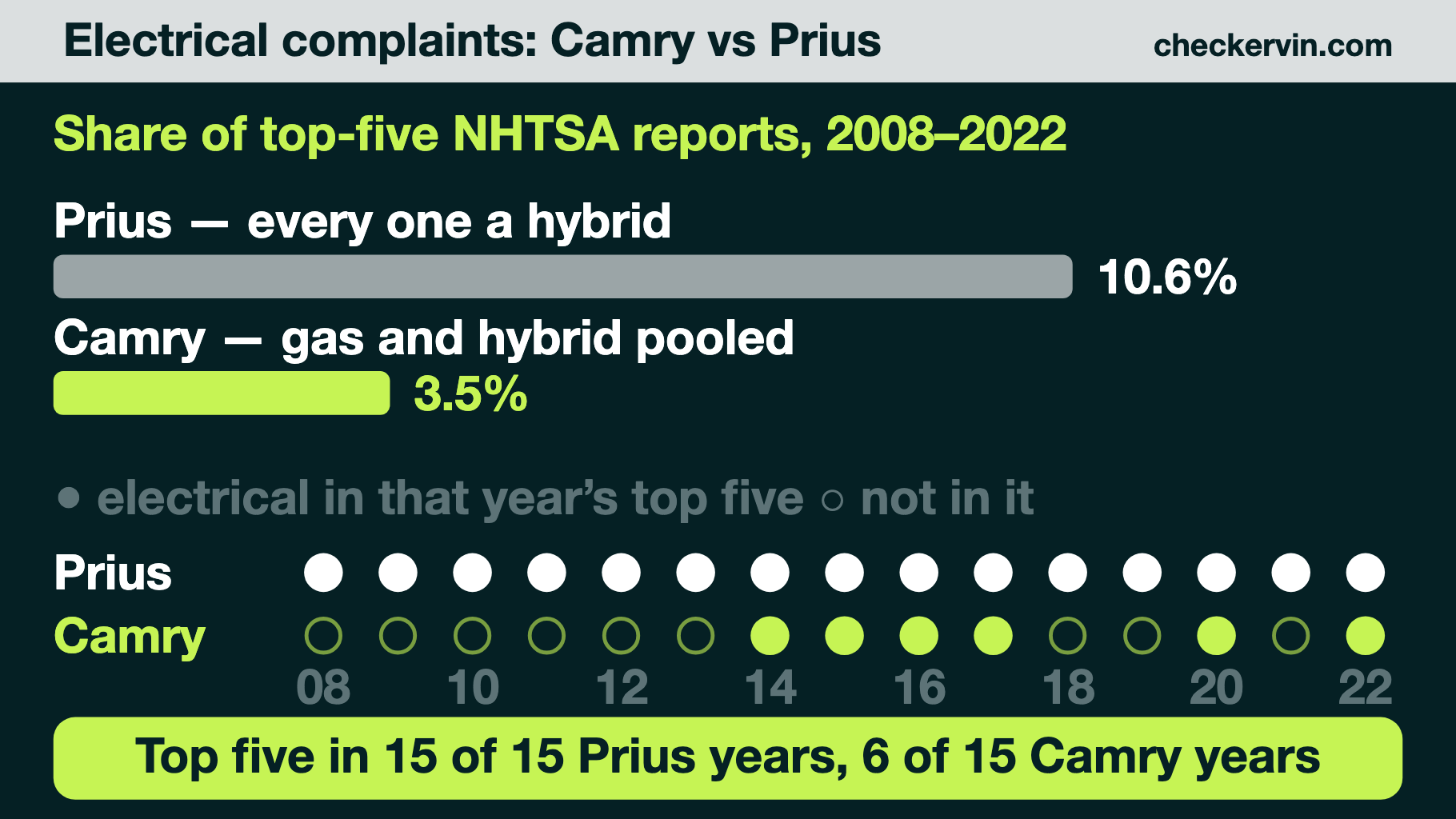
Aggregate the five most-reported components in each model year and the electrical system, the category a battery fault would most likely be filed under, comes to 206 of 5,855 reports: 3.5%, ranked 9 of 13 categories. It is the most-reported component in 1 of 15 model years (2020). The category at the top is vehicle speed control with 998 reports, and power train leads more model years (5) than any other category.
Even the category that sounds closest to a hybrid problem does not hold up. Fuel and propulsion reaches the Camry’s top five only in 2019 and 2020, and those years overlap Toyota’s low-pressure fuel pump recalls covering 2018–2020 Camrys (campaigns 20V012 and 20V682). We cannot prove those reports are fuel pump complaints, but we cannot claim them as hybrid ones either. Read the 2020 electrical peak of 65 reports the same way: a pooled count that a pack failure could sit inside, not a pack count.
The Prius as a control group
The way to see what pooling does is to put the Camry next to a nameplate where every car is a hybrid. The Prius has the same span in our corpus. Its electrical-system category makes up 10.6% of top-five reports, about 3times the Camry’s share, and it appears in the top five in 15 of 15 Prius model years. On the Camry it appears in 6 of 15: 2014, 2015, 2016, 2017, 2020, 2022.
A Prius pack is not the same part as a Camry pack, and the Prius has its own reasons for electrical complaints, so this is not a measure of Camry pack durability. It is a measure of how much hybrid signal a pooled nameplate can carry, and the answer is “not much.” Anyone telling you the federal complaint data proves Camry Hybrid packs are bulletproof, or fragile, is reading something the file does not contain. Our Toyota Camry years-to-avoid breakdown scores each model year on the whole record, which is the right use of it.
No recall pays for this pack, checked against a known positive
A recall is the one route where a pack replacement costs nothing regardless of age or mileage, so it deserved a real check rather than an assumption. On October 25, 2026 we queried NHTSA’s recall API for the “Camry Hybrid” model in every year from 2007 through 2022 and for the plain “Camry” model from 2012 through 2022, where some hybrid campaigns are filed. None of the returned campaigns is filed against the hybrid propulsion system.
An empty result only means something if the query could have found a hit, so we ran the same query on the 2012 Prius first. It returns two campaigns under hybrid propulsion, 14V053000 and 18V684000, both concerning the inverter’s power module. The query sees hybrid-system recalls when they exist; for the Camry Hybrid, through 2022, there are none.
Camry Hybrid recalls that do exist touch other parts: a 2016 front drive shaft that may separate (17V462000, shared with the Avalon Hybrid) and a 2019 fuel filler pipe that may not have been reconnected after an inspection (19V097000). Neither involves the pack, and both should be closed on any car you buy. Campaigns get added, so run your own VIN rather than trusting our snapshot; if one turns up open, read buying a car with an open recall before you negotiate.
Rule out the cheap battery first
Every Camry Hybrid also carries an ordinary 12-volt battery that powers up the computers and closes the high-voltage relays. When it is weak, the car will not enter ready mode, and to an owner that looks exactly like a dead hybrid system. Some estimator pages titled for the Camry Hybrid’s “battery replacement” quote a few hundred dollars, and their breakdowns appear to be pricing this 12-volt unit, not the pack.
Before any pack conversation, have the 12-volt tested. If it needs replacing, our battery size by VIN page helps you match the right group size for the car, a purchase measured in hundreds rather than thousands.
Reading a dealer quote and a rebuilt quote side by side
The spread between $1,599 and $6,000 is mostly the pack, not the labor, so the useful comparison is between what each quote is actually buying. Five questions separate them.
- Is the pack new Toyota, new aftermarket cells, or remanufactured from used modules?
- Does the chemistry match the car — NiMH or lithium-ion on a 2018-or-newer Camry?
- How long is the pack warranty, and is it time only or time and mileage?
- Is installation included, and is there a core charge or core-return requirement?
- Was the inverter or battery ECU tested? On a 2020+ car those sit on a shorter warranty than the pack.
The warranty question is where the cheaper options vary most. In Greentec’s own listing, a remanufactured 2012–2016 pack carries 18 months while a new-cell 2007–2011 pack carries 48. Best Hybrid Batteries lists three years with unlimited mileage and an optional six-year plan. A dealer-installed Toyota pack comes with Toyota’s parts warranty, which the dealer can state for your car. Divide each price by its warranty months and the ranking often changes.
If you are shopping a used Camry Hybrid
The model year matters more here than on most used cars. A 2020 or newer Camry Hybrid bought in 2026 can still have years of pack coverage that the asking price rarely reflects, while a 2019 with similar miles may be at the end of its term. Ask for the in-service date, and get the seller to show the warranty booklet if the car is older and was sold in a CARB state.
On anything outside coverage, budget the pack as a known possible cost rather than a surprise: the aftermarket price for that generation from the table above, plus an hour or two of shop time. Then check the rest of the car on its own terms with a free decode for the build and open recalls. A CheckerVIN report does not include accident, title or odometer history; for those, a pre-purchase inspection and the free federal and insurance databases are the honest routes.
Where this information comes from
- NHTSA — recalls API, Camry Hybrid by model yearQueried for 2007–2022 on October 25, 2026; no campaign filed under hybrid propulsion. Shown here for 2016, the drive shaft campaign.
- NHTSA — recalls API, 2012 Prius (known positive)Returns two hybrid propulsion campaigns, proving the query can find them when they exist.
- NHTSA — recall lookup by VINRun your own car; campaigns are added after our snapshot date. Also the source of the complaint records computed above.
- California Air Resources Board — vehicle and emissions warranty periodsLists 10 years/150,000 miles for the battery on PZEV- and TZEV-certified vehicles.
- Toyota — battery warranty extension for model year 2020The 10-year/150,000-mile pack term from MY2020, and the components left at 8 years/100,000.
- Green Car Reports — 2018 Camry Hybrid's two battery packsLaunch coverage of the LE lithium-ion and SE/XLE nickel-metal hydride split.
- Best Hybrid Batteries — Camry Hybrid packsPer-generation parts prices and warranty quoted above, retrieved October 25, 2026.
- Greentec Auto — Camry Hybrid replacement pricesRemanufactured and new-cell prices and warranty months quoted above, retrieved October 25, 2026.
- RepairPal — Camry Hybrid HV battery estimateThe $6,006–$6,205 installed range for the 2025–2026 Camry, as listed October 25, 2026.
- J.D. Power — Camry Hybrid battery replacement costThe $3,000–$5,000 summary range quoted above, as listed October 25, 2026.
Keep reading
Frequently asked questions
How much does a Toyota Camry Hybrid battery replacement cost?
It depends mostly on which pack you buy. Aftermarket sellers list Camry Hybrid packs from $1,599 remanufactured to $2,999 with new cells (Greentec Auto, retrieved October 2026), before installation. RepairPal's estimator puts a replacement on the 2025-2026 Camry at $6,006 to $6,205 including labor of $427 to $627. J.D. Power's guide summarizes the range as $3,000 to $5,000. Those are their figures, not ours; the gap between them is the choice between a new Toyota pack and a rebuilt one.
Is the Camry Hybrid battery still under warranty?
For a 2020 or newer Camry Hybrid, probably: Toyota raised hybrid battery coverage to 10 years or 150,000 miles starting with the 2020 model year. Camry Hybrids from 2019 and earlier carried 8 years or 100,000 miles nationally, so by 2026 most of them have aged out. Cars certified to California's partial-zero-emission standards and sold in states that follow California rules can carry 10 years or 150,000 miles on the battery. The clock runs from the first owner's in-service date, not the model year.
Does the 2018 and newer Camry Hybrid use a lithium-ion battery?
Some do. At the 2018 launch, the LE trim got a lithium-ion pack and the SE and XLE got nickel-metal hydride, according to Green Car Reports' launch coverage. Aftermarket sellers list separate NiMH and lithium-ion packs for 2018-and-later Camrys and ask for the VIN and original battery identification before shipping. Confirm which one your car has before ordering anything, because the two packs do not interchange.
Is there a recall that replaces the Camry Hybrid battery?
Not that we could find. Querying NHTSA's recall API on October 25, 2026 for every Camry Hybrid model year from 2007 through 2022 returned no campaign filed against the hybrid propulsion system. The same query does return hybrid-system recalls for the 2012 Prius, so it can see such campaigns when they exist. Hybrid-specific Camry recalls do exist, for a 2016 drive shaft and a 2019 fuel filler pipe, but neither touches the pack. Check your own VIN anyway, since campaigns are added over time.
Do Camry Hybrid batteries fail often?
The public record cannot answer that for the Camry specifically. NHTSA's complaint file in our corpus puts gas and hybrid Camrys under one nameplate, and the electrical-system category makes up 3.5% of the Camry's top-five complaint reports against 10.6% for the all-hybrid Prius. That gap says the Camry file mostly describes gas cars. It does not say Camry Hybrid packs are more or less durable than anyone else's.
Know the car before you price the pack
A free CheckerVIN report shows the factory build, specifications and open recalls for any VIN, so the part you order matches the Camry you own.
Run a free VIN check