The short answer
- Is the trace really unavoidable?
- Yes. Clearing codes also clears the readiness monitors, and they only return to ready by being driven — not by being reset again.
- How do I read it?
- Any inexpensive scanner on the diagnostic port. You are looking for monitors reporting incomplete or not ready.
- What does it prove?
- That the computer's memory was cleared recently. A battery change does the same thing, so treat it as a question to ask, not a verdict.
2 min
To read the monitor status
Any basic scan tool
2–3 days
Of driving to return to ready
Ohio EPA guidance
Not ready
What a fresh clear reports
Or 'incomplete'
Rejected
What an inspection does with it
40 CFR 51.357(a)(5)
The oldest trick in used-car preparation, and the trace it leaves
A fault code is stored, the light comes on, and the seller books a viewing. Ten minutes before you arrive the codes are cleared — with a scan tool, or simply by disconnecting the battery — and the light goes out. You arrive to a clean dashboard and an engine that is already warm, and nothing about the car contradicts the listing.
The step that defeats this is not looking harder at the dashboard. It is that clearing the codes does something else at the same time, something the seller cannot undo, and something that stays visible for days.
What a readiness monitor is
Modern vehicles continuously self-test their emissions-related systems. Ohio EPA describes an OBD monitor as a computer test, or series of computer tests, used to determine whether an emission control device or system is operational — and these diagnostic checks are performed while the vehicle is driven, with certain driving conditions needing to be met before the computer can conclude anything.
Each check reports to a readiness monitor. When all of them have run, the computer reports systems as ready. The monitors cover the systems a fault code would typically come from — engine, transmission, fuel systems and other emissions controls.
What 'not ready' means, in the state's own words
The sentence that makes this page possible is one Ohio EPA wrote for people preparing for an emissions test: if diagnostic data has been erased during vehicle repairs or through battery disconnection, the computer reports systems as incomplete or not ready. Vehicles are rejected from testing when these checks are not completed. That last consequence is not a state policy choice — it is the federal inspection rule, quoted in full below.
So the act of clearing the light writes its own record. The light is off, and the computer is simultaneously reporting that it has not yet finished checking anything — which is a state no ordinary, well-maintained, regularly driven car is in.
The rejection rule is federal, not one state’s policy
Ohio documents this well, which is why it is quoted above — but the rule itself is not Ohio’s. It is federal, it is written into the requirements every state inspection and maintenance program is built against, and it is unusually blunt for a regulation.
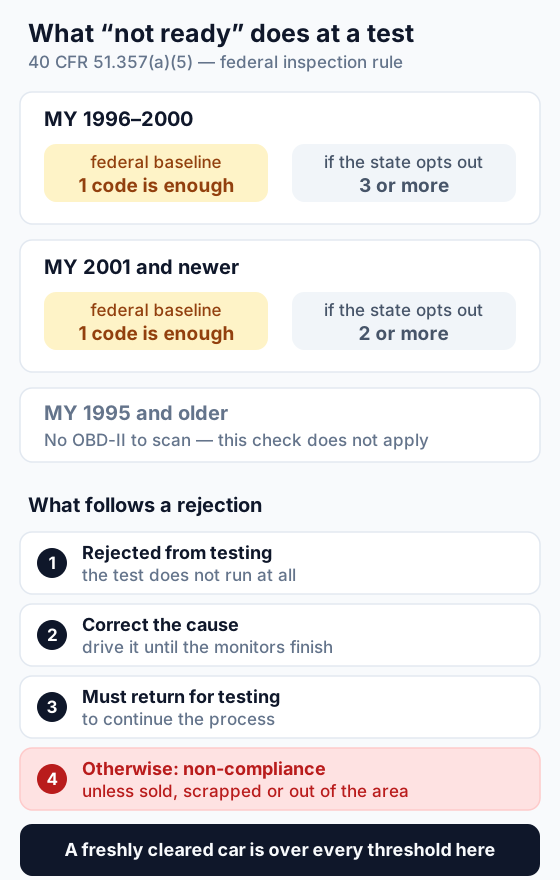
40 CFR 51.357(a)(5) says that model year 1996 and newer vehicles shall be rejected from testing if a scan of the OBD system reveals a “not ready” code for any component of the OBD system. Any component. One unfinished self-test is the federal baseline for turning a car away.
The same paragraph then gives states a documented way to be more forgiving. At a state’s option it may instead reject 1996–2000 vehicles only when three or more“not ready” codes are present, and 2001 and later vehicles only when two or more are present.
| Model year | When the car is turned away |
|---|---|
| 1996–2000 | Baseline: any one “not ready” code. Where the state takes the option: three or more |
| 2001 and newer | Baseline: any one “not ready” code. Where the state takes the option: two or more |
| 1995 and older | No OBD-II system to scan — this check does not apply, and the bulb test below matters more |
Read that as a buyer rather than as a motorist and it says something useful. A car cleared on the morning of a viewing does not report one unfinished monitor — it reports most of them unfinished, which is above every threshold in the table. The lenient option exists to protect people with a recently replaced battery, not to cover a car that was reset an hour ago.
Which cars this applies to
The 1996 line in the regulation is not arbitrary. It is the model year OBD-II became standard equipment, which is what gives an inspector — and you — a port to scan and a set of monitors to read. On a 1995 or older vehicle there is nothing to interrogate, the readiness concept does not exist, and the only version of this check available to you is the bulb test described further down.
The split between the two OBD-II bands matters more than it looks. The same scan result — say two monitors reporting not ready — is a rejection for a 2003 car under either the baseline or the state option, but on a 1998 car in a state that took the option it is within tolerance. So the age of the car changes what the identical reading would mean at an official test, which is worth knowing before you use the phrase “this would not pass” in a negotiation.
Whether your state runs a testing program at all is a separate question, and one our smog check history guide covers along with what the test record itself preserves. This page stays on the scan you can run yourself in a driveway.
Rejected is not the same as failed — and it does not end there
The distinction is easy to miss and it works in the seller’s favor. A rejected vehicle has not failed an emissions test; it has been turned away before the test happened. Nothing is recorded about its emissions because nothing was measured. 40 CFR 51.357(a)(3) makes the same point from the other direction: an official test, once started, must be carried out in its entirety regardless of intermediate outcomes — except, among a short list, in the case of unset readiness codes. Unset monitors are one of the few things that stop an inspection in progress.
What follows is the part with a price attached. The regulation continues that once the cause for rejection has been corrected the vehicle must return for testing to continue the process, and that failure to return for testing in a timely manner after rejection shall be considered non-compliance with the program — unless the motorist can show the vehicle was sold, scrapped, or is otherwise no longer operating in the program area.
There is a second-order clue in that. Because a rejected vehicle is turned away before anything is measured, it leaves no test result behind — so a car that has been rejected and never brought back shows up as a gap in its inspection history rather than as a failure. Where a state publishes that history, an unexplained hole in it around the time the car changed hands is worth as much as any code you could read.
How long the trace lasts
Long enough to be useful, and not so long that every car fails. Ohio EPA’s guidance is that everyday driving should allow a vehicle’s OBD monitors to become ready in two to three days, and that if it is taking longer the owner should consult a dealer or technician. Older vehicles may take more time, and a generic drive cycle may need repeating between two and five times depending on the make, model and age of the vehicle.
That window is well matched to how used cars are actually sold. A car cleared on the morning of the viewing will still be reporting not ready. A car whose codes were cleared during a genuine repair three weeks ago will not be.
Reading it yourself, in two minutes
- 1Find the diagnostic portIt is a 16-pin connector, almost always within reach of the driver's seat — under the dash, near the steering column, sometimes behind a small cover. If a car has no such port at all, it is old enough that none of this applies.
- 2Plug in a basic scan toolThe cheapest handheld readers and the small wireless adapters that pair with a phone both report monitor status. This is not a professional diagnostic exercise — you are reading one screen.
- 3Read the readiness or I/M status screenYou want the list of monitors and whether each is complete or incomplete. A car in normal use shows most or all complete. A recently cleared car shows several incomplete or not ready.
- 4Check for stored and pending codes while you are therePending codes are faults the computer has seen once but not yet confirmed. A cleared car with a pending code already reappearing is telling you the fault is still there and is on its way back.
- 5If your tool supports it, read distance since codes clearedSome scanners report the miles or ignition cycles since the last clear. Where it is available it turns an inference into a number, which is a better conversation to have with a seller than a suspicion.
The innocent explanations, stated first
This check is only useful if you do not over-read it, and the false positives are genuinely common. The same state guidance that describes the reading also names the ordinary causes: data is erased during vehicle repairs or through battery disconnection.
| What you see | What it might honestly mean |
|---|---|
| Monitors not ready, seller had a new battery fitted | Disconnecting the battery clears the same data — check the battery date |
| Monitors not ready, recent repair invoice | A genuine repair often ends with codes cleared; the invoice is the corroboration |
| Monitors not ready, car has been standing | A vehicle that has barely been driven has not completed its drive cycles |
| Monitors not ready, no explanation offered | The one that matters — a question with no answer, ten minutes before you pay |
| Monitors ready, light off | The reassuring result, and the one most sellers cannot manufacture on the day |
The distinction to hold on to is that the reading tells you the memory was cleared recently. It does not tell you who cleared it or why. What makes it valuable is that a seller who has an honest answer can give it immediately, and a seller who does not usually cannot invent one on the spot.
The cruder version: the bulb itself
There is a blunter variant of the same deception, and it is worth ruling out in the same minute. If the warning lamp has been removed or disabled, no code will ever illuminate it — and the dashboard will look permanently healthy.
The check is free. Turn the ignition to the on position without starting the engine. The instrument cluster runs a lamp test and the malfunction indicator should illuminate along with the others, then go out once the engine is running. A car whose check engine light never comes on at all during that test has a problem that is not the absence of faults.
What a cleared code was most likely about
Codes get cleared for all sorts of reasons, but the population of faults they come from is not random. Across the 73 model years in our NHTSA extract, the two largest component groups by owner reports are engine and electrical system — with 14,378 and 11,926 component reports respectively.
Those are also the two areas most likely to be behind a stored fault code and least likely to be cheap. It does not mean a not-ready reading indicates an expensive problem — but it does mean the category of thing being hidden, when something is being hidden, tends not to be trivial.
What to do with the answer
- Ask directly when the battery was last disconnected and what work has recently been done — and expect dates and documents rather than a general reassurance.
- Offer to come back in three days. A seller with nothing to hide loses nothing by agreeing; the car will have driven itself back to ready.
- Make the purchase conditional on an independent inspection at a shop you choose, and tell the shop the monitors were not ready.
- Take a not-ready reading into the price conversation as an unknown rather than as an accusation — you are pricing a risk, not proving a fraud.
- Run the free recall lookup on the VIN as well, because an open campaign is a different unknown and it costs nothing to remove.
One more practical note. In states that run emissions testing, a vehicle with incomplete monitors is rejected from testing under 40 CFR 51.357(a)(5) — so a car in this condition may also be a car you cannot immediately get through inspection, quite apart from what the cleared code was about. The consequences of that rejection are worth pricing into the offer rather than discovering after it.
Where this information comes from
- Ohio EPA — OBDII readiness and communication failuresWhat a monitor is, that erased data reports as incomplete or not ready, the two-to-three-day return to ready, and rejection from testing
- 40 CFR 51.357 — inspection and maintenance test proceduresThe federal rejection rule for “not ready” codes, the state option thresholds, and what happens after a rejection
- NHTSA — datasets and APIsThe complaint records behind the component ranking
- NHTSA recall lookupThe other free unknown to remove before buying
Keep reading
Frequently asked questions
Can you tell if a check engine light was recently cleared?
Yes, and it takes about two minutes. Clearing the codes also resets the car's readiness monitors, and until the vehicle has been driven enough for each self-test to run again they report as "incomplete" or "not ready." That status is readable through the diagnostic port by any inexpensive scanner, and the seller cannot switch it off.
What is a readiness monitor?
Ohio EPA describes an OBD monitor as a computer test or series of computer tests used to determine whether an emission control device or system is operational, performed while the vehicle is driven. When all the checks have run, the computer reports systems as "ready." When the data has been erased, it reports them as incomplete.
How long do monitors take to reset?
Ohio EPA's guidance is that everyday driving should return a vehicle's monitors to ready in two to three days, and that if it takes longer than that a technician should be consulted. Older vehicles may take more time, and a generic drive cycle may need repeating several times depending on the make, model and age.
Does 'not ready' prove the seller was hiding something?
No, and treating it that way will cost you good cars. The same state guidance notes that data is erased during repairs or through battery disconnection — so a new battery, a recent legitimate repair, or a car that has been jump-started can all produce the identical reading. It tells you the computer's memory was cleared recently. It does not tell you why.
What should I do if the monitors are not ready?
Ask when the battery was last disconnected and what work was recently done, and expect a specific answer. Then either come back after the car has been driven a few days, or make the sale conditional on an independent inspection. What you should not do is accept a warm engine, an unlit dashboard and a shrug as a clean bill of health.
Two free checks before you go
Decode any VIN free for the factory build, specifications and open safety recalls. No account, no card. Full vehicle history reports are launching soon.
Run a free VIN check