The short answer
- What does it cost?
- No honest single figure exists. It moves with pack, model year, module-versus-pack repair and labor — so price the specific car.
- Is it under warranty?
- Ask that first. The clock runs from the in-service date, not from your purchase, and the answer is free.
- Is 8 years federal law?
- Not for a used conventional hybrid. The federal paragraph names EVs and plug-ins, and is optional before 2027.
8 yr / 80,000
Federal floor where it applies
Against 24 months / 24,000 otherwise
MY2027
When the battery paragraph stops being optional
Light-duty, at or below 6,000 lb GVWR
0
Battery categories in NHTSA's complaint taxonomy
Across 31 categories in our corpus
Why there is no dollar figure on this page
You searched for a price and this page is not going to print one. That is a deliberate choice rather than an omission, and the reasoning is short enough to check.
A replacement figure depends on the make, the model year, the size of the pack, whether the fault can be answered with a single module or needs the whole assembly, whether a remanufactured unit exists for that generation, whether a core charge applies, and what labor costs where you live. None of those come from a source anybody can cite and re-check. The averages that circulate are built from dealer quotes collected at unknown times in unknown markets, and once a number like that is repeated three times it stops carrying its own uncertainty around with it.
The question that comes before the price
A traction battery is not an ordinary wear part in the eyes of federal regulation. It sits inside the emission control system, because the whole point of a hybrid drivetrain is to reduce what comes out of the tailpipe. That places it under the Clean Air Act warranty machinery rather than under ordinary consumer-goods rules, and that machinery has terms you can look up.
So the sequence for a used hybrid is: establish the in-service date, establish which warranty regime applies to that model year, establish whether age or mileage has run out first, and only then start asking about parts prices. Reversing the order is how people talk themselves out of a car that was still covered, or into one that was not.
What federal regulation actually names
The emission defect warranty runs for 24 months or 24,000 miles on light-duty vehicles and trucks. Against that default, 40 CFR § 85.2103(d)(1) carves out a short list of components that carry 8 years or 80,000 miles instead. There are 5 of them:
- Catalytic converters and SCR catalysts, and related components
- Particulate filters and particulate traps
- Components related to exhaust gas recirculation with compression-ignition engines
- Emission control module
- Batteries serving as a Renewable Energy Storage System for electric and plug-in hybrid vehicles
The last entry is the one this page is about, and it is worth reading in the regulation’s own words rather than in summary, because the summary is where the detail goes missing.
Note how far the sentence reaches when it does apply. It is not only the pack. It covers the components needed to charge the system, to store the energy and to transmit power to move the vehicle — which pulls in hardware that a repair estimate would list separately from the battery.
The word that changes everything, and nobody quotes it
The same paragraph continues, and the continuation is the reason the popular version of this fact is wrong for almost every car on the used market today.
Optional means a manufacturer may adopt the 8-year term for the battery and many do — but before model year 2027they are not compelled to. Every used hybrid and plug-in hybrid you can buy today is older than that threshold. So the familiar sentence — that federal law guarantees you eight years on the battery — describes a rule that has not yet taken effect for the cars people are asking about.
This is not a reason to worry. Manufacturers publish their own battery terms, frequently longer than the federal floor, and several states impose their own on vehicles sold there. It is a reason to read the warranty booklet for the specific car instead of trusting a number you read in an article, because the number in the article is not currently backed by the authority it is being attributed to.
A hybrid is not a plug-in hybrid, and the rule says so
There is a second qualification hiding in that same sentence, and it is the one most likely to affect the car you are looking at. The paragraph names electric vehicles and plug-in hybrid electric vehicles. A conventional hybrid — one that never plugs in and charges its pack from the engine and from braking — is neither of those things.
| Type of vehicle | Named in § 85.2103(d)(1)(v)? |
|---|---|
| Battery electric vehicle | Yes |
| Plug-in hybrid electric vehicle | Yes |
| Conventional hybrid, no plug | Not named |
| Mild hybrid with a small assist pack | Not named |
That matters because the model tail on this question is almost entirely conventional hybrids. If the car you are pricing charges only from its own engine and its own braking, the federal paragraph everybody cites was not written about it, and the coverage that exists comes from the manufacturer or from the state.
When the clock started, and why it is not your purchase date
For a second owner this is the decisive detail, and it is stated plainly in § 85.2103(b). The warranty period runs on the vehicle’s age in years and on its odometer reading, and it expires on whichever arrives first. The start is the date the vehicle was delivered to its ultimate purchaser — or, where the car began life as a demonstrator or a company car, the date it was first placed in service.
Nothing about that restarts when the car changes hands. A hybrid first delivered in March of one year is running the same clock in the hands of its fourth owner. And the demonstrator provision has a bite people miss: a car that spent nine months on a dealer fleet before its first retail sale started its warranty at the beginning of those nine months, not at the end.
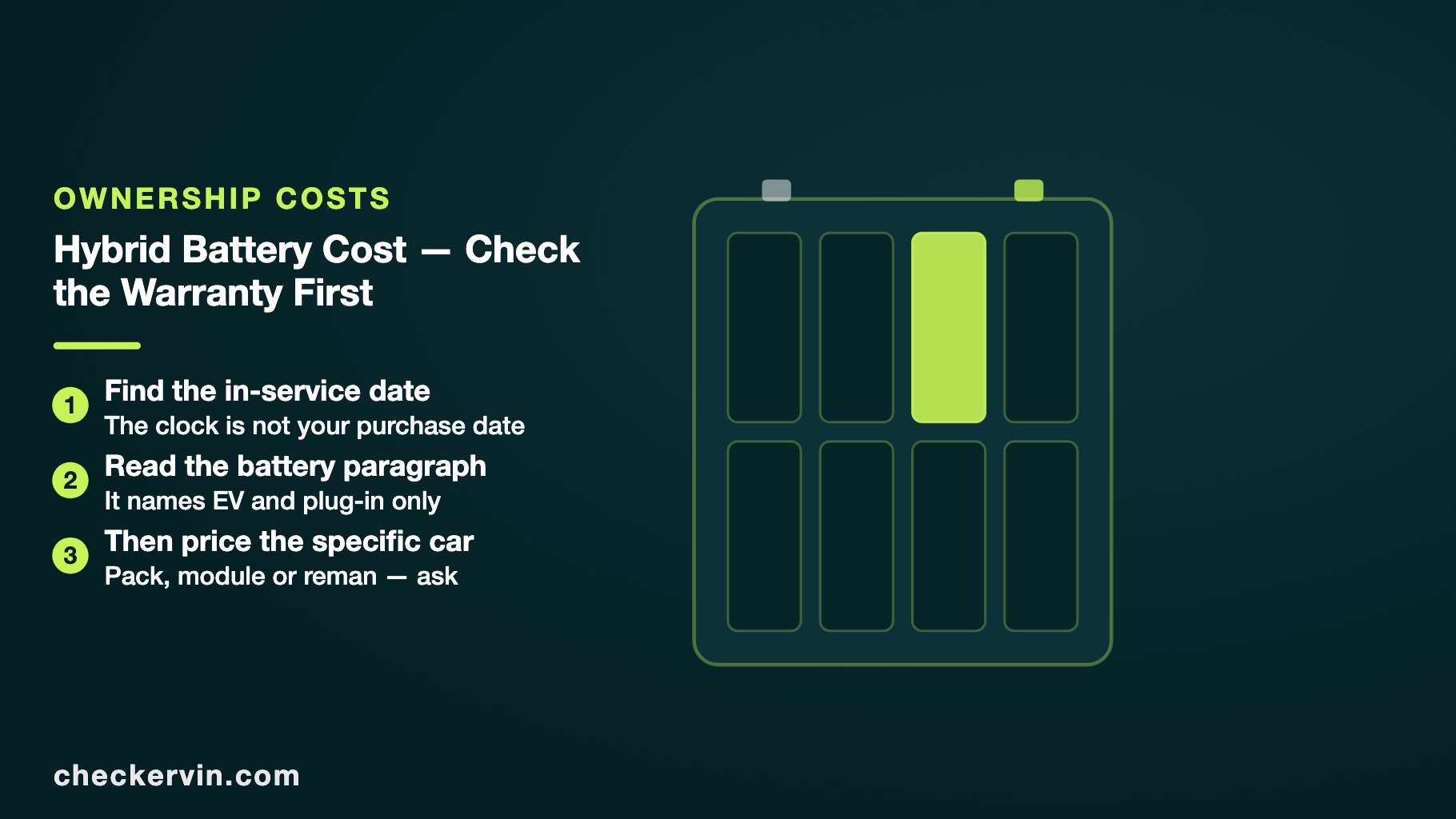
- 1Find the in-service dateA franchised dealer for that make can read it from the VIN. It is also on the original warranty paperwork, if the car still has it.
- 2Compare it to today, and to the odometerTwo independent limits, and the warranty ends at the first one reached. A low-mileage older car and a high-mileage newer one fail on different tests.
- 3Read the manufacturer's own battery termThe federal floor is a floor. The published term for that model year may be longer, and in some states it is required to be.
Check any VIN free
Decoded from official manufacturer and NHTSA records
Two warranties, not one
People speak about “the emission warranty” as a single thing. The regulation creates two, they cover different situations, and knowing which one you are invoking changes what you have to show.
| Which warranty | What it answers |
|---|---|
| Emission defect warranty, § 85.2103(d) | A covered component is defective. 24 months or 24,000 miles by default, 8 years or 80,000 for the listed components |
| Emission performance warranty, § 85.2103(c) | The vehicle fails an approved emission test during its useful life and you face a penalty or a denial of the right to use it — the manufacturer must remedy at no cost |
The performance warranty is the one that is easy to overlook and the one most likely to matter in a state with testing. Its trigger is not a broken part you can point to. It is the vehicle failing to conform to the applicable standards, as determined by an approved test, where the failure exposes you to a sanction — including being told you may not use the car. Where the cause is one of the specified major components, the same 8-year or 80,000-mile term applies.
If your state runs emission testing, a failed test on a hybrid is worth reading against this provision before paying for a diagnosis. Our page on smog check history covers what the testing record itself shows.
How a battery claim actually gets denied
A warranty is only as good as the grounds for refusing it, and here the regulation is more protective than most people expect. Under § 85.2104, a claim may be denied on the basis of the owner not complying with the written instructions for proper maintenance and use. But the manufacturer’s ability to demand proof is fenced in on two sides at once.
It may require evidence only for those maintenance instructions where it has an objective reason to believe both that the work was not performed and that skipping it could have caused this vehicle to exceed the applicable standards. Not any missed service. A missed service the manufacturer has a reason to believe caused this failure.
The improper-use paragraph, and its limit
There is a provision written specifically for battery vehicles, and it cuts both ways in a way worth knowing before you need it.
Written instructions for the proper use of battery electric and plug-in hybrid vehicles may identify certain behavior or operating modes expected to unreasonably or artificially shorten battery durability. The regulation gives an example: exceeding the vehicle’s towing capacity might be considered improper use.
For a used buyer the practical reading is about towing and about charging habits. If the hybrid you are considering has spent its life pulling a trailer at the edge of its rating, that is a fact worth establishing, and what the vehicle was rated to tow is checkable. It is one of the few histories that has an explicit regulatory hook into battery coverage.
What counts as evidence you maintained it
Because a denial turns on maintenance, the regulation sets out what proof looks like. It gives three routes, and the third exists specifically for people who do their own work.
| Route | What it requires |
|---|---|
| A validated log book | Maintenance recorded at approximately the specified intervals, validated by someone who regularly services cars for a living |
| Evidence of scheduled servicing | A showing that the vehicle was submitted at approximately those intervals to someone in the business of performing that maintenance |
| The owner's own statement | That you performed it at approximately the interval, with a showing that you bought and used proper parts — and, on request, that you are able to perform it properly |
Two things follow for a buyer rather than an owner. Service records that come with a used hybrid are not sentimental clutter; they are the evidence the regulation contemplates, and they belong in the sale. And the intervals are described as approximate throughout, which means a service performed slightly late is not automatically a forfeit.
What owners actually report on the archetypal hybrid
The query behind this page assumes the battery is the thing that will bite you. The public complaint record does not obviously agree, and it is worth looking at rather than asserting either way.
Below is every model year of the Toyota Prius in this site’s data — 15 model years from 2008 to 2022— with the five most-reported components in each year aggregated. It is 8,466 reports in total, filed with NHTSA.
| Component | Reports across the span |
|---|---|
| Service brakes | 3,868 |
| Hydraulic | 1,111 |
| Electrical system | 901 |
| Exterior lighting | 788 |
| Vehicle speed control | 583 |
| Electric | 502 |
Service brakes is 45.7% of that total on its own, and it is the single most-reported component in 9 of the 15 model years. Nothing resembling a battery appears anywhere in the list.
Why that absence proves less than it looks like
It would be easy to present the table above as evidence that hybrid packs are reliable. It is not evidence of that, and the reason is a fact about the instrument rather than about the cars.
NHTSA files complaints against a fixed vocabulary of components. Across the sixty-model corpus behind this site that vocabulary has thirty-one categories, and not one of them is a battery. The nearest is a fuel and propulsion system category, which reaches a Toyota Prius top-five list in a single model year. A category that does not exist cannot record anything, so its silence is not a finding.
What the table does support is a milder and more useful claim. If you are budgeting for a used hybrid on the assumption that the pack is the only risk worth pricing, the reported experience of the model with the longest history points somewhere else entirely.
The version of this repair that costs nothing
There is one circumstance in which a high-voltage battery is replaced at no charge to you regardless of warranty terms, age or mileage, and it is worth checking before anything else on this page: an open safety recall.
A recall remedy is performed free. Some of the largest campaigns of recent years have involved high-voltage battery systems, with remedies ranging from a software limit on charge level through to a full pack replacement. An open campaign on a car you are considering is not a reason to walk away — it is unfinished free work attached to the vehicle.
Checking takes a VIN and nothing else, and it is one of the things our free decode returns alongside the factory build. If a campaign is open, ask the seller why it has not been done, then read buying a car with an open recall before you agree a price around it.
Getting a real number for the car in front of you
Once the warranty question is settled and a replacement is genuinely on your side of the ledger, there is a short sequence that produces an actual figure rather than an average.
- 1Ask a franchised dealer for the pack part number and price for that model yearParts departments quote from a catalog rather than an opinion. Give them the VIN, not the model name — packs change mid-generation.
- 2Ask whether module-level repair is supportedOn many hybrids a single failed module can be replaced rather than the assembly, and the difference between the two answers is usually larger than any other variable.
- 3Ask what a remanufactured pack costs, and whether a core charge appliesWhere a remanufactured option exists it is a different order of price, and the core charge changes the net figure.
- 4Ask what the labor time is for that specific carAccess varies enormously between models. Labor hours multiplied by a local rate is the half of the estimate that no article can carry.
Four questions, one phone call, and the answer belongs to the car you are actually considering. If you are still deciding whether the car is worth the exercise, the red flags worth walking away from and the pre-purchase inspection are the two cheaper checks that come first.

Where this information comes from
- 40 CFR § 85.2103 — Emission warrantyThe two warranties, the terms, and the specified major emission control components
- 40 CFR § 85.2104 — Owners' compliance with instructions for proper maintenance and useGrounds for denial, acceptable evidence, and the improper-use paragraph
- 40 CFR § 85.2102 — DefinitionsDefines owner as the original purchaser or any subsequent purchaser
- NHTSA complaint and recall recordsSource of the model-year complaint figures computed above
- NHTSA vPIC — VIN decoding APIThe free decode behind the checks recommended here
Frequently asked questions
How much does a hybrid battery cost to replace?
We are not going to print a figure, because there is no source for one we could cite and re-check. The price moves with the make, the model year, the pack size, whether the remedy is a single module or the whole pack, whether a remanufactured unit exists for that car, and the local labor rate. A confident average would be a guess wearing a citation. What is worth your time first is finding out whether the pack is still covered, because the answer to that question is often free and always changes the arithmetic.
Is a hybrid battery covered by an 8-year federal warranty?
Not in the way the sentence is usually repeated. Federal regulation does make a traction battery a specified major emission control component carrying an eight-year or 80,000-mile emission defect warranty — but the paragraph names electric vehicles and plug-in hybrid electric vehicles, and it is optional for light-duty vehicles before model year 2027. So for a used conventional hybrid on the road today, the coverage that matters comes from the manufacturer's own warranty and, in some states, from state rules — not from a federal mandate.
Does the battery warranty transfer to me as the second owner?
The federal emission warranty is written around the vehicle rather than the person, and the regulation defines an owner as the original purchaser or any subsequent purchaser. The clock, though, does not restart. It runs from the date the vehicle was delivered to its first retail buyer, or from the date it was first placed in service if it began life as a demonstrator, and it ends on age or mileage, whichever comes first. Check the in-service date, not the date on your bill of sale.
Can a manufacturer refuse a battery warranty claim?
Yes, and the regulation sets out the grounds. A claim may be denied where the owner did not comply with the written instructions for proper maintenance and use — but the manufacturer may only demand evidence for instructions it has an objective reason to believe were skipped and that could have caused the failure. There is also a paragraph on improper use, which allows a manufacturer to identify behavior expected to unreasonably shorten battery durability, with exceeding the vehicle's towing capacity given as the example.
How do I prove the car was maintained?
The rule lists three acceptable forms: a maintenance log book validated at roughly the specified intervals by someone in the business of servicing cars, a showing that the vehicle was submitted for scheduled servicing at roughly those intervals, or the owner's own statement that they did the work, together with a showing that proper parts were purchased and used. That last route exists specifically for people who service their own cars, and it is why receipts matter more than memory.
Do hybrid batteries fail as often as people think?
The public record does not answer that question as cleanly as either camp claims. In the NHTSA complaint data behind this site, the component taxonomy has no battery category at all, and across fifteen model years of the archetypal hybrid the most-reported component is brakes by a wide margin. That is a fact about how complaints are filed, not proof that packs are reliable — an absent category cannot record anything, so it is evidence of nothing on its own.
Should I avoid a used hybrid because of the battery?
The battery is one line in a longer arithmetic, and treating it as the whole question tends to produce the wrong decision in both directions. What sharpens it is knowing the in-service date, whether any coverage is still running, whether module-level repair is supported for that generation, and whether an open recall touches the high-voltage system — that last one being the case where the remedy is performed at no charge to you.
Keep reading
Check the recalls before you price the battery
Free, instant, and an open high-voltage campaign is remedied at no charge to you.
Run a free VIN check