The short answer
- What does it cost?
- Estimator averages run $211 (YourMechanic) to $231 (AutoNation). Kelley Blue Book's ZIP-based ranges run higher, from about $278 to $538 in the two we read.
- When is it due?
- Every 75,000 miles on the non-turbo 2.0 and 2.5, per Mazda's 2016–2022 manuals. Every 40,000 miles on the 2.5 turbo (2019–2022). The 2019 diesel has none.
- Misfire code?
- Test before buying plugs. Mazda bulletins trace CX-5 misfires to ignition coils, software, frozen exhaust, rocker arms and worn turbo valve seats.
$211–$231
Estimator averages, CX-5 spark plugs
YourMechanic, AutoNation; Nov. 2026
40,000 mi
Plug interval, SKYACTIV-G 2.5T
Mazda owner’s manuals, 2019–2022 CX-5
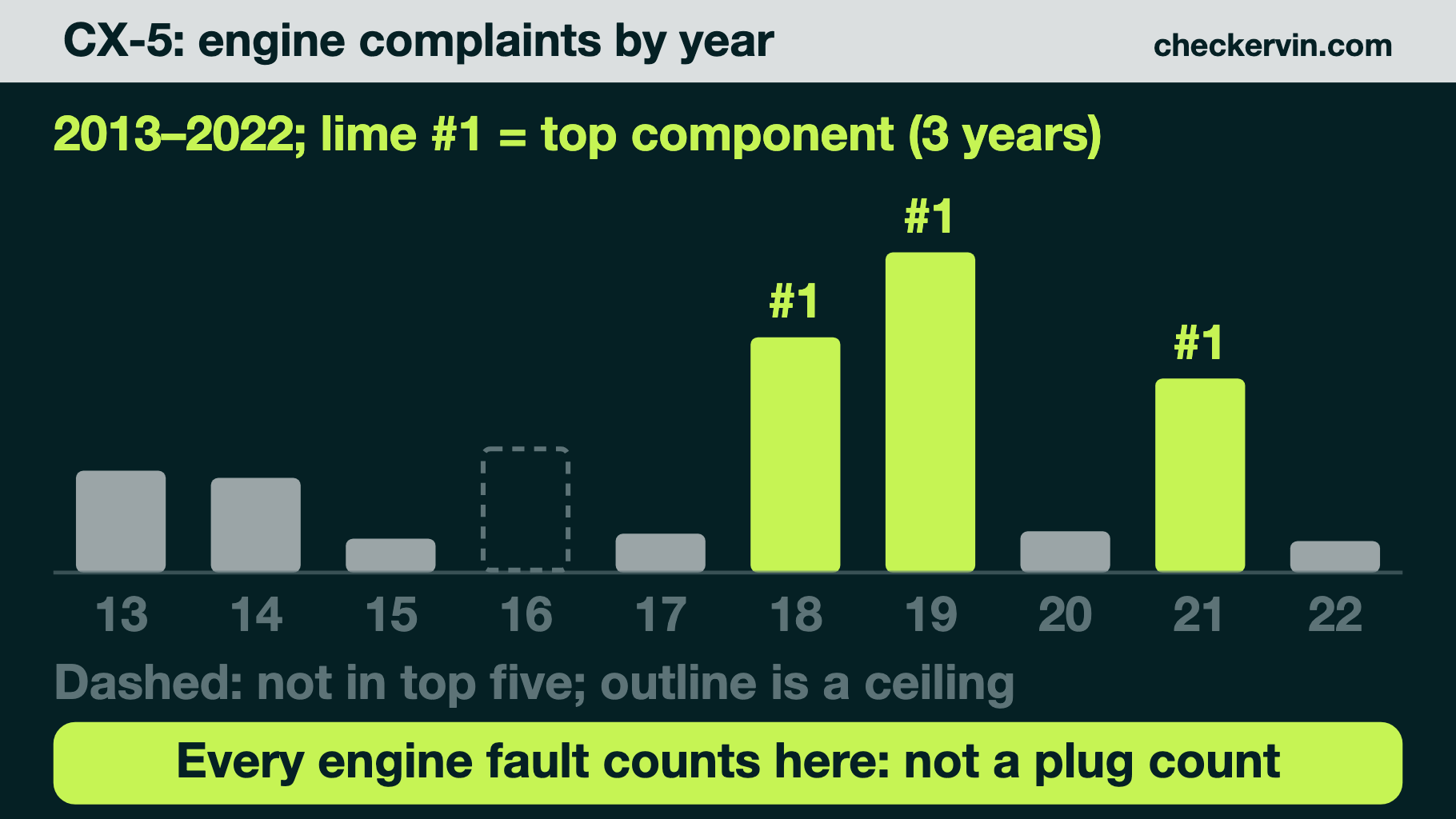
3 of 10
Years the engine leads the CX-5 record
2018, 2019 and 2021; NHTSA complaints
0
CX-5 ignition recalls, 2013–2022
NHTSA recall query, every model year
The numbers, and whose numbers they are
CheckerVIN decodes VINs and lists open recalls. We do not service cars, so every price here belongs to someone else, with the date we read it. On November 22, 2026, YourMechanic’s CX-5 spark plug estimate showed an average of $211, split into about $71 for parts and $140 for labor. AutoNation Mobile Service showed an average of $231. Both sites block our research tools, so we read the figures from their search listings, and two separate searches returned the same numbers for each.
Kelley Blue Book prices the job by model year and ZIP code, so its numbers describe one place, not the country. For a 2014 CX-5 at ZIP 53086, in Wisconsin, KBB showed a fair repair range of $278 to $365. For a 2013 at ZIP 91352, in the Los Angeles area, it showed $434 to $538. Treat those as examples of how far location moves the price, not as a CX-5 figure for your town.
On a four-cylinder with coil-on-plug ignition this is short work, and the spread mostly reflects labor rates and whose plugs go in. The question that moves real money on a CX-5 is when the job is due, because one engine needs it almost twice as often as the others.
Which engine, which interval
We read the scheduled maintenance tables in Mazda’s US owner’s manuals for the 2016 through 2022 CX-5. The 2016, 2017 and 2018 manuals give one line: replace the spark plugs every 75,000 miles. From 2019 the tables split by engine. The SKYACTIV-G 2.5T, the turbocharged 2.5, is listed at every 40,000 miles; every other gas engine stays at 75,000. The 2019 severe-conditions schedule repeats the same two figures, so short trips and towing do not change them. We could not reach the 2013–2015 manual pages, so owners of those years should check the printed book.
| CX-5 engine | Mazda plug interval |
|---|---|
| SKYACTIV-G 2.0 | 75,000 miles (2016–2020 manuals) |
| SKYACTIV-G 2.5, including cylinder deactivation from 2018 | 75,000 miles (2016–2022 manuals) |
| SKYACTIV-G 2.5T turbo (2019–2022) | 40,000 miles, normal and severe schedules |
| SKYACTIV-D 2.2 diesel (2019) | None: a diesel has no spark plugs |
The practical effect: a turbo CX-5 at 80,000 miles is on its second set, while a non-turbo car at the same mileage has just finished its first. A used-car seller who says the plugs are “not due” on a turbo with 45,000 miles is reading the wrong line. Mazda’s own scheduled-maintenance bulletin points technicians back to these owner’s manual tables rather than printing intervals itself. A VIN engine lookup settles which row applies.
What the CX-5 engine record shows
Our corpus holds 2,077 NHTSA complaints against the 2013–2022 CX-5. NHTSA has no spark plug category. The ENGINE category takes in every engine fault, from oil leaks to stalls to valvetrain damage, so it is an outer limit on plug trouble, never a count of it.
We keep the top five components for each model year. The engine makes that list in 9 of the 10 years. In 2016 it falls below the fifth-place count of 51, so that year is uncounted, not zero. The counted years add up to at least 450 engine complaints, and 69% of them come from three model years: 2018, 2019 and 2021, the only years the engine ranks first. In 2018 it accounts for 81% of all complaints; in 2019, 49%; in 2021, 54%. The tallest bar is 2019, at 132 reports. No other year tops 42.
We read the narratives behind those three bars. Spark plugs barely appear: across all ten years and every component, only a handful of complaints mention them at all. What the 2018–2019 owners describe is smoke and a burning-oil smell from the engine bay. What the 2021 owners describe is oil that disappears between changes. Neither is a plug failure, and both are worth knowing about before you pay for a tune-up on one of these cars.
2018–2019: oil smoke that is not a plug problem
The 2018 and 2019 engine complaints read like one story told many times. Often past 60,000 miles in the reports we read, the owner smells burning oil, sees smoke from under the hood or through the vents, and finds oil on the ground. Many say no warning light came on. Shops and dealers in these reports most often blame a cracked cylinder head leaking oil onto the exhaust manifold, and most of the owners who name their engine have the non-turbo 2.5 with cylinder deactivation, which Mazda introduced on the CX-5 for 2018.
Mazda’s paper trail is indirect. Service alert SA-058/20 established a new cylinder head assembly for the 2018–2020 CX-5’s 2.5 with cylinder deactivation; for a time heads were out of stock and Mazda authorized whole-engine replacement under warranty instead. The current version, SA-073/24a, covers 2018–2023 CX-5s and lists search terms including engine oil leak, oil smell, misfire and low compression. It also tells technicians to clean oil off the exhaust manifold and its heat shields. No CX-5 bulletin we found names a crack as the cause, so we report the crack as what owners and shops say, not what Mazda says.
The spark plug connection is a practical one. A head repair on this engine means removing the coils and the head, so if you are paying for one, ask whether new plugs are included before you buy them separately. And if the car smokes, a plug change is not the fix. The only engine recall on these two years, 19V-497, fixes engine computer software that may stall the engine; it has nothing to do with oil leaks or plugs.
2018–2019: a cylinder 4 misfire can be the valvetrain
Cylinder deactivation shuts off two of the four cylinders at light load, and Mazda’s service alert SA-022/19 (which replaced SA-041/18) covers what can go wrong in that hardware on 2018–2019 CX-5s. The symptoms are lack of power, a rough idle and engine noise, with codes that include P0304, a misfire on cylinder 4. The inspection is not a plug check. The technician removes the cylinder head cover and looks for a fallen or broken rocker arm, especially on cylinders 1 and 4, the two that deactivate. Mazda asks for oil change records, and the repair path is engine replacement through its technical hotline.
A related alert, SA-047/21, covers 2018–2021 CX-5s that set code P3400, a cylinder deactivation fault. Mazda found the oil control valve could be plugged by plastic from the oil filter wrapper, pushed in when a technician punched through the wrapper to drain the filter, and says warranty does not apply to damage from outside influence. On a 2018–2019 2.5 that misfires on cylinder 4 and sounds wrong, new plugs are the cheap guess. The rocker arms are the expensive one, and the one Mazda checks.
2019–2020 turbo: a misfire from worn valve seats
The 2.5T is the engine with the 40,000-mile plug interval, and it has its own misfire bulletin. Mazda TSB 01-001/23a covers 2019–2020 CX-5 turbos built before July 8, 2020 (VINs below JM3KF******843332). Owners report poor acceleration and a rough idle, with misfire codes P0301 through P0304 stored most of the time but not always. Mazda says plainly that only turbo engines apply.
The cause is a variable valve in the exhaust manifold that seizes. The exhaust port runs hot, the exhaust valve seats wear unevenly, and the cylinder leaks compression. The test is a compression leakage check, and the repair is a new cylinder head and a redesigned exhaust manifold. If there is no leakage, Mazda sends the technician back to normal misfire diagnosis, which is where plugs and coils come in.
The same engine has a warranty extension. Under Customer Service Program CSP11, Mazda extended powertrain coverage to 10 years or 120,000 miles for coolant leaks at the cylinder head around the exhaust manifold on 2019–2020 CX-5s with the 2.5T. On a turbo CX-5 that misfires or loses coolant, ask the dealer to check both before anyone sells you a plug job as the answer.
2021: oil consumption, and why it fouls plugs
The 2021engine complaints are mostly about oil: low-oil warnings a few hundred miles after a change, owners adding a quart between services, and talk of valve stem seals. Most narratives do not say which engine the car has. Mazda’s documented fix is narrow. Through Special Service Program SSPD5, tied to a class action settlement, Mazda extended powertrain coverage for excessive oil consumption and reimburses some oil costs on turbo engines with the affected valve stem seals. Its bulletin 01-004/26 limits the CX-5 scope to 2021 US and Canada turbos with the 10.25-inch display, built from October 6, 2020 to September 13, 2021. The repair replaces the exhaust-side valve seals, and Mazda tells dealers not to simply top off the oil without replacing them.
Oil that gets past the valve seals burns in the cylinder and coats the plugs. A mechanic who pulls oily plugs from a 2021 turbo is seeing a symptom. New plugs will run cleanly for a while; the seals are what stop the loss, and on eligible cars SSPD5’s extended warranty covers that repair. For any CX-5, Mazda’s own oil consumption check (M-Tip MT-005/20) is simple: fill to the full mark, drive 1,200 miles, and see whether the level is still above the low mark. Our oil type by VIN page lists the grade to use for the top-off.
Misfires Mazda traced to something else, mostly on early cars
Most of these misfire bulletins date from the first-generation CX-5, and none of them blames the spark plugs:
| CX-5 and bulletin | What Mazda found |
|---|---|
| 2013–2016 built before Apr. 7, 2016; TSB 01-014/16 | Ignition coils from one of two suppliers can fail internally with large temperature swings; coil replaced, 0.3 hr |
| 2013–2015 2.0L built before Nov. 2014; TSB 01-005/15 | In deep cold with repeated short trips, excess fuel collects in the oil; misfire codes and a rising oil level; oil change and software update |
| 2013–2016 2.0L built before Apr. 8, 2015; TSB 01-011/15 | Engine computer may detect a false misfire under hard acceleration in the cold and cut power; software update |
| 2013–2019; TSB 01-007/19 | Rough idle and misfire codes on the first cold start, caused by frozen water in the main muffler restricting exhaust |
| 2013–2023; M-Tip MT-004/22 | Lean code P0171 with possible misfires; check the air box, airflow sensor and oxygen sensor before replacing injectors |
The coil bulletin matters most for a plug quote, because a failing coil and a worn plug set the same code. Mazda says only coils from the supplier it names are affected and tells technicians to tell them apart by the lot number printed on the coil. The bulletin covered the repair under the new-vehicle warranty, which these cars have outlived, but the coil itself is the part to price, not a full set of plugs.
Mazda’s coil swap test, and where the plugs come in
The coil bulletin also spells out the cheapest diagnosis on any CX-5 with a single-cylinder misfire. Swap the coil from the misfiring cylinder with one from a healthy cylinder and see whether the code follows. If it moves, the coil is bad. If it stays put, Mazda says a different cause, such as the wiring harness or a spark plug, is possible. That is the moment a plug becomes the suspect, not before.
The same bulletin hints at access. Mazda books 0.3 hours to replace coils on these engines, which tells you the coils sit on top and come off quickly; the plugs are directly beneath them. We could not get Mazda’s flat-rate time for the plug job itself, which sits in paid service information. YourMechanic’s labor figure of about $140 is consistent with a short job at independent rates. If a quote carries far more labor than that on a non-turbo CX-5, ask what else is being removed.
Before you authorize CX-5 spark plugs
- Confirm the engine: the 2.5 turbo is due every 40,000 miles, the others every 75,000
- For a misfire, ask for the code and whether the coil swap moved it
- On a 2013–2016, ask whether the coils are from the supplier in TSB 01-014/16
- On a 2018–2019 2.5 with a cylinder 4 misfire, ask about SA-022/19
- On a 2019–2020 turbo that misfires, ask for the compression leakage check in TSB 01-001/23a
- On a 2021 turbo using oil, ask whether SSPD5 applies before paying for plugs
- Check open recalls by VIN, including 19V-497 on a 2018–2019 that stalls
The Mazda recall check shows open campaigns in a minute. Our guide to bulletins versus recalls explains why a recall remedy is free while a bulletin repair is free only under warranty or a program like CSP11 or SSPD5. If a misfire light came on and then went out, our page on telling whether the check engine light was clearedexplains what the computer still remembers. For the CX-5’s charging system, the CX-5 alternator cost post works through that record the same way.
If you are buying the CX-5, not servicing it
Ask for the plug receipt, and check it against the right interval. A turbo past 40,000 miles with no record of plugs is due now. On a 2018–2019 non-turbo, open the hood after the test drive and look and smell for oil around the exhaust side of the engine; ask whether the cylinder head has been replaced. On a 2021 turbo, ask how often the owner adds oil and whether a dealer has done the valve seal work. The Mazda CX-5 years-to-avoid page lays out every year’s complaint record, and the warranty check by VIN estimates what factory coverage remains.
A free CheckerVIN report returns the factory build, engine, specifications and open safety recalls for any VIN. It does not include accident, title, odometer or service history, so it cannot tell you when the plugs were last changed or whether a head was replaced. Only the seller’s receipts can.
Where this information comes from
- Mazda: 2019 CX-5 owner’s manual, scheduled maintenance2.5T plugs every 40,000 miles; other gas engines every 75,000. Same split in the 2020–2022 manuals.
- Mazda: 2016 CX-5 owner’s manual, scheduled maintenanceSpark plugs every 75,000 miles, before the turbo joined the lineup.
- Mazda TSB 01-014/16: check engine light with misfire codes (NHTSA copy)2013–2016 CX-5: ignition coil failure; the coil swap test; 0.3 hr.
- Mazda SA-022/19: engine runs rough with P0304 and cylinder deactivation codes (NHTSA copy)2018–2019 CX-5 with cylinder deactivation: inspect for a fallen or broken rocker arm.
- Mazda SA-073/24a: new cylinder head assembly, 2.5 with cylinder deactivation (NHTSA copy)2018–2023 CX-5; lists oil leak, oil smell and misfire among its search terms.
- Mazda TSB 01-001/23a: turbo misfire from exhaust valve seat wear (NHTSA copy)2019–2020 CX-5 2.5T built before July 8, 2020; cylinder head and exhaust manifold replaced.
- Mazda TSB 01-004/26: low engine oil level, SSPD5 valve stem seals (NHTSA copy)Scope for the CX-5: 2021 turbos built Oct. 6, 2020 to Sept. 13, 2021.
- Mazda CSP11: coolant leaks at cylinder head warranty extension (NHTSA copy)2019–2020 CX-5 2.5T: 10 years or 120,000 miles for this repair.
- Mazda TSB 01-007/19: rough idle with misfire codes in cold temperature (NHTSA copy)2013–2019 CX-5: frozen water in the main muffler, not the plugs.
- NHTSA: recalls by VINOur query of every 2013–2022 CX-5 found no ignition recall; 19V-497 is the only engine campaign.
Keep reading
Frequently asked questions
How much does it cost to replace the spark plugs on a Mazda CX-5?
Two online estimators we checked on November 22, 2026 put it at an average of $211 (YourMechanic: about $71 in parts and $140 in labor) and $231 (AutoNation Mobile Service). Kelley Blue Book's ranges depend on ZIP code: $278 to $365 for a 2014 CX-5 at one Wisconsin ZIP and $434 to $538 for a 2013 at one Southern California ZIP. A dealer using Mazda plugs will usually sit at the top of that spread.
When should I change the spark plugs on my Mazda CX-5?
It depends on the engine. Mazda's owner's manuals for the 2016–2022 CX-5 list 75,000 miles for the non-turbo 2.0- and 2.5-liter engines. For the 2.5-liter turbo, which the 2019–2022 manuals cover, the interval is 40,000 miles, on both the normal and the severe schedule. The 2019 diesel has no spark plugs. Check the manual for your model year, and decode the VIN if you are not sure which engine you have.
What kills spark plugs quickly?
Anything that puts oil or excess fuel into the cylinders, plus heat and overdue service. Mazda has documented oil consumption on 2021 CX-5 turbos with affected valve stem seals, and fuel diluting the oil on early 2.0-liter CX-5s driven on short trips in deep cold. A plug pulled from an oil-burning engine can look fouled, but new plugs will not stop the oil loss. Find the cause first.
What are the best spark plugs for a Mazda CX-5?
The ones Mazda specifies for your engine, gapped as supplied. The turbo and non-turbo engines have different service intervals, so do not assume one plug fits every CX-5. We did not confirm Mazda part numbers for this page. A parts counter needs your VIN or your exact engine to look them up, and a free VIN decode gives you the engine.
What is the most common engine problem on the Mazda CX-5?
It depends on the year. In our NHTSA data the engine is the most-reported component on the 2018, 2019 and 2021 CX-5. Reading those complaints, the 2018–2019 reports center on oil leaks and smoke that owners and shops trace to cracked cylinder heads, and the 2021 reports on oil consumption. Spark plugs rarely come up. The 2016 is led by exterior lighting complaints instead. Our CX-5 years-to-avoid page covers every year.
Check the VIN before you price the plugs
A free CheckerVIN report shows the factory build, engine, specifications and open recalls for any VIN: enough to know whether your CX-5 is on the 40,000- or 75,000-mile plug schedule and which bulletins to ask about.
Run a free VIN check