The short answer
- What does it cost?
- Estimator averages run $496 (YourMechanic) to $650 (AutoNation). A new Mazda alternator lists at $385.25 as a part, before labor.
- Is it really the alternator?
- Test first. On a 2013–2014 CX-5, Mazda bulletin 05-003/19 covers a worn shifter switch that leaves the ignition on and drains the battery. It is a 0.3-hour repair.
- Newer CX-5?
- Mazda has drain bulletins for 2017–2022 models: a seat ventilation unit, a telematics unit and cup-holder spills. Ask for a parasitic draw test.
$496–$650
Estimator averages, CX-5 alternator
YourMechanic, AutoNation; Nov. 2026
0.3 hr
Mazda labor for the 2013–2014 shifter switch
TSB 05-003/19, part KDY0-46-040
4 of 10
Years electrical leads the CX-5 record
2013, 2014, 2017 and 2020; NHTSA complaints
0
CX-5 alternator recalls, 2013–2022
NHTSA recall query, every model year
The numbers, and whose numbers they are
CheckerVIN decodes VINs and lists open recalls. We do not fix cars, so the prices on this page belong to other companies, each with the date we read it. On November 22, 2026, YourMechanic’s CX-5 alternator estimate showed an average of $496, made up of about $342 in parts and $154 in labor. AutoNation Mobile Service showed an average of $650. Both sites block our research tools, so we read the figures from their search listings; two separate searches returned the same numbers for each.
Those are mobile-mechanic averages built on aftermarket or remanufactured parts. A new Mazda unit is its own line. Cox Mazda Parts listed alternator PE01-18-300, which it ties to the CX-5’s 2.0- and 2.5-liter engines, at an MSRP of $385.25 and a sale price of $265.77. Add labor, tax and any core charge, and a dealer job with a new Mazda part sits above both estimator averages. That gap is worth knowing, but on a CX-5 the bigger saving is usually upstream of the price: making sure the alternator is the part that failed.
What the CX-5 complaint record shows
Our corpus holds 2,077 NHTSA complaints against the 2013–2022 CX-5. NHTSA has no alternator category. The closest one, ELECTRICAL SYSTEM, also takes in the 12-volt battery, wiring, the ignition and shifter switches, screens and control modules. It is an outer limit on charging trouble, never a count of failed alternators.
We keep the top five components for each model year. Electrical makes that list in 8 of the 10 years; in 2015 and 2018 it falls outside the top five, so those years are uncounted, not zero. The counted years add up to at least 399 electrical complaints. Electrical ranks first in 2013, 2014, 2017 and 2020, and the tallest bar is 2014, at 132 reports. In 2013 and 2014 it makes up 33% of all complaints; across the later counted years it is 17%.
Reading the electrical narratives changes what those bars mean. In the 2013 and 2014 reports, dead and drained batteries are the most common theme, and the story told most often is specific: the engine shuts off, but the radio, dashboard and accessories stay on, and the battery is flat by morning. In 2017, 2019 and 2020 the reports are mostly about the touchscreen. The alternator is named in only a handful of electrical complaints across all ten years.
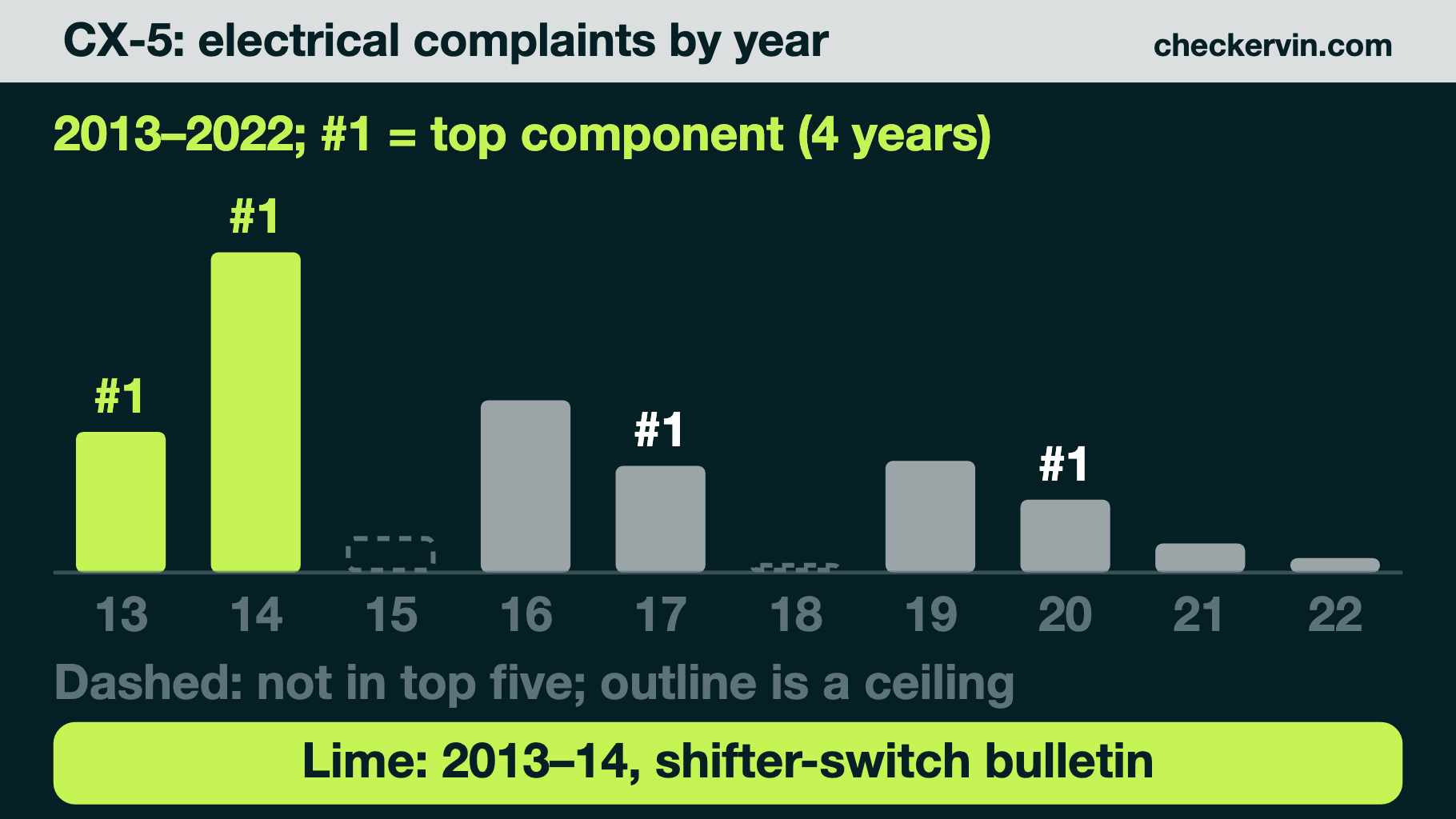
2013–2014: the CX-5 that will not fully turn off
Mazda first wrote this up in December 2015, in Technical Service Bulletin 05-007/15, for early 2013 CX-5s. It widened the bulletin in April 2016 (05-004/16) and reissued it in May 2019 (05-003/19). The current version covers 2013–2014 CX-5s with VINs below JM3KE******430747, which Mazda says means cars built before December 27, 2013, along with some 2014 Mazda6s. The description matches the complaints closely. With the shifter in Park and the engine off, the ignition may stay on in accessory mode, and Mazda notes that owners may describe this as the radio staying on.
The cause is a worn switch unit inside the gate-type automatic shifter, the switch that tells the car it is in Park. Mazda changed the switch material for better wear resistance and released the new switch, part KDY0-46-040, as a service part. The repair removes the CX-5’s rear console, takes out two screws and swaps the switch. Mazda books it at 0.3 hours. The bulletin covered it under the new-vehicle warranty, which these cars have long outlived, so today it is generally a paid repair. Even so, it is a small part and a short job next to an alternator.
Why does it matter for an alternator quote? Because the end state is the same: a CX-5 with a dead battery and, after a few rounds of this, a battery that no longer holds a charge. A shop that tests the battery, finds it weak and replaces it, then sees the car dead again a week later, can reasonably start suspecting the charging system. Owners in the complaints describe exactly that loop, including replaced batteries that did not stop it.
2014–2018: a shift knob that sticks in the cold
A separate bulletin, 05-001/19 from February 2019, describes a similar symptom with a different cause. On 2014–2016 CX-5s and 2017–2018 models built before April 2, 2018, the lock release button on the shift knob can stick in the pressed position in very cold weather. Mazda traced it to a production process that let an internal part swell with moisture. The result, again, is an ignition that stays in accessory mode after the engine shuts off. The fix is a new shift knob, and the bulletin applies only to knobs with the part numbers it lists. If your CX-5 drains its battery only on frigid nights, this is the document to bring up.
Mazda’s own order of tests puts the alternator third
Mazda calls the alternator the generator, and its battery maintenance bulletin, 01-006/22, covers every 2013–2022 CX-5. Its list of reasons a battery runs flat is useful to read before approving a repair. It names generator problems, including a loose drive belt, internal failure and damage, and faults in the wiring that lets the engine computer control the generator. It also names long idling with heavy electrical load, accessories left on, a car that sits unused, and excess draw from aftermarket equipment.
The troubleshooting order matters more. Mazda has the technician measure parasitic draw first, then check the harness between the engine computer and the generator’s field coil, then measure generator voltage, and only then inspect the generator itself. The bulletin also warns against replacing a battery on the strength of its built-in indicator eye, which shows charge, not condition. A Mazda tip sheet, MT-008/18, adds a softer cause for 2013–2018 CX-5s that will not start: a key fob sitting next to a phone, an aftermarket charger, or a GPS tracker wired into the car.
2017–2022: battery drains with a paper trail
The second-generation CX-5 arrived for 2017, and its electrical bars are shorter. Mazda has still documented several ways it can flatten its battery without any help from the alternator:
| CX-5 | What Mazda documents |
|---|---|
| 2017–2022 | SA-023/23: a spill at the front cup holder corrodes connector C-16; battery discharge, ignition will not turn off, screen stays on. Mazda says it is not a warranty repair |
| 2019–2022 (built Sept. 2018 to Aug. 2022) | TSB 09-035/24: the seat ventilation stays on after shutdown and can discharge the battery completely; new seat control unit |
| 2021 | Special service program SSPC7: the telematics unit may not go to sleep and can drain the battery; the unit is reprogrammed |
| 2018–2019 | Recall 19V-497: engine computer software may stall the engine. A stall is not a charging fault |
The seat ventilation bulletin is the one with the sharpest edge. Mazda says that in some cases the battery ends up so deeply discharged that it cannot be recharged. That leaves a dead battery and a car that will not start, which is exactly how a failing alternator shows up in a driveway. A new battery alone will not fix it. On a 2019–2022 with ventilated seats that keeps killing batteries, ask whether a parasitic draw test pointed at the seat unit.
2017–2020: the top electrical complaint is the screen
Electrical ranks first in 2017 and 2020, but the counts are modest, 44 and 30, and when we read them the main subject was the infotainment touchscreen, not charging. Owners describe ghost touch: the screen changing stations, raising the volume and placing calls on its own. Mazda’s bulletin SA-041/22 covers this on 2017–2020 CX-5s with certain center displays, along with peeling and cracked screen surfaces, and supplies a screen-only repair kit instead of a new display.
We mention it because it inflates the electrical bars on those years. A 2020 with 30 electrical complaints is not a 2020 with 30 charging failures. The chart shows where to look, and the narratives tell you that, on these years, most of what is there has nothing to do with the alternator.
The belt tensioner bulletin sits on the same belt
The alternator is driven by the accessory belt, and the belt’s automatic tensioner has its own bulletin. Mazda’s 01-008/26, issued in April 2026 and superseding versions from 2019 and 2023, covers 2013–2020 CX-5s built before July 20, 2020. Some may develop rattling from the engine compartment and oil leaking from the tensioner’s damper under heat and high load. Mazda changed the damper shape and released tensioner PE03-15-980C.
Two details are worth carrying into a shop. First, Mazda’s inspection guide tells technicians to tell a genuinely wet tensioner apart from normal dirt and from oil on the surrounding area, and it names the alternator as part of that area. Second, the labor is short: Mazda books 0.4 hours on a 2013–2016 CX-5, 0.3 on 2017–2020 2.0- and 2.5-liter cars and 0.5 on the 2.5-liter turbo. A rattle near the front of the engine on one of these cars deserves a look at the tensioner before the alternator gets the blame for the noise.
Which alternator your CX-5 takes
The CX-5 has used several SKYACTIV engines in this span: 2.0- and 2.5-liter fours, a 2.5-liter turbo (Mazda’s coolant-leak warranty extension names 2019–2020 turbo CX-5s), and a 2.2-liter diesel that Mazda’s maintenance program ties to the 2019 model. Mazda’s own bulletins split repair times by engine, and the alternator follows the engine too.
We could confirm one new Mazda part and its price: PE01-18-300, at $385.25 MSRP and $265.77 on sale at Cox Mazda Parts, listed for the 2.0- and 2.5-liter engines. We could not confirm which model years it covers, or the part numbers for the turbo or diesel. A Mazda VIN decodegives the engine, which is the fact a parts counter needs. We also found no Mazda document in the CX-5’s NHTSA file that describes an i-ELOOP capacitor system or a special stop-start battery on a US CX-5, so we do not price one here.
Labor and access: what we could and could not confirm
We could not get Mazda’s flat-rate time for removing the alternator on any CX-5 engine, or the removal steps; both sit in Mazda’s paid service information. YourMechanic’s labor figure of about $154 implies a job of an hour or two at independent rates, but no estimator we read breaks it out by engine, so we will not guess which CX-5 is harder to reach.
The Mazda times we do have belong to the cheaper jobs around it: 0.3 hours for the 2013–2014 shifter switch and 0.3 to 0.5 hours for the belt tensioner. That is the case for diagnosis before parts. Ask the shop to write down the battery test, the charging voltage with the engine running, the parasitic draw, the labor hours and the exact alternator it plans to fit.
Before you authorize a CX-5 alternator
- Ask for the battery test, the running charging voltage and a parasitic draw reading
- On a 2013–2014, check whether the ignition stays on after shutdown (TSB 05-003/19)
- On a 2014–2018 that drains only in the cold, ask about the shift knob bulletin 05-001/19
- On a 2019–2022 with ventilated seats, ask whether TSB 09-035/24 applies
- On a 2021, ask a Mazda dealer whether the telematics program SSPC7 was done
- Check open recalls by VIN, including 19V-497 on a 2018–2019 that stalls
- Ask whether the alternator is new Mazda, remanufactured or aftermarket, and about the core charge
The Mazda recall check shows open campaigns in a minute. Our guide to bulletins versus recalls explains why the shifter switch and tensioner fixes cost money once the warranty has run out, while a recall remedy stays free. For the CX-5’s other routine jobs, our CX-5 brake cost post works through that record the same way.
If you are buying the CX-5, not repairing it
Charging and drain problems rarely show up on a test drive, so ask. Has the battery been replaced, and how often? Has the car needed a jump? On a 2013–2014, shut it off in Park and watch the dash: if the screen and lights stay on, you have found the shifter switch. On a later car, ask whether the infotainment screen ever acts on its own. The Mazda CX-5 years-to-avoid page lays out the full complaint record by year, and the warranty check by VIN estimates whether factory coverage remains.
A free CheckerVIN report returns the factory build, engine, specifications and open safety recalls for any VIN. It does not include accident, title, odometer or repair history, so it cannot tell you whether the alternator, battery or shifter switch was ever replaced. Only the seller’s receipts can.
Where this information comes from
- Mazda TSB 05-003/19: Ignition does not turn off when pressing START/STOP button (NHTSA copy)2013–2014 CX-5 built before Dec. 27, 2013; worn shifter switch unit KDY0-46-040; 0.3 hr.
- Mazda TSB 05-004/16, April 2016 (NHTSA copy)The earlier version that widened the shifter-switch fix from early 2013 builds to 2014.
- Mazda TSB 05-001/19: ignition stays on in very cold weather (NHTSA copy)2014–2018 CX-5: shift knob lock release button can stick; knob replaced.
- Mazda TSB 01-006/22: battery maintenance (NHTSA copy)Lists generator, belt and wiring causes; measures parasitic draw before testing the generator.
- Mazda SA-023/23: battery discharge from a cup-holder spill (NHTSA copy)2017–2022 CX-5: corrosion at connector C-16; not covered by warranty.
- Mazda TSB 09-035/24: seat ventilation stays on after shutdown (NHTSA copy)2019–2022 CX-5: battery can be completely discharged; seat control unit replaced.
- Mazda TSB 01-008/26: drive belt auto tensioner rattle and oil leak (NHTSA copy)2013–2020 CX-5 built before July 20, 2020; tensioner PE03-15-980C; 0.3–0.5 hr.
- Mazda SA-041/22: infotainment ghost touch, peeling and cracks (NHTSA copy)2017–2020 CX-5 with listed center displays; the main subject of those years' electrical complaints.
- NHTSA: recalls by VINOur query of every 2013–2022 CX-5 found nine campaigns and none naming the alternator.
Keep reading
Frequently asked questions
How much does it cost to replace a Mazda CX-5 alternator?
Two online estimators we checked on November 22, 2026 put it at an average of $496 (YourMechanic: about $342 in parts and $154 in labor) and $650 (AutoNation Mobile Service). A dealer using a new Mazda part will usually land higher. Ask for a written quote that names the part, whether it is new or remanufactured, and the test result that points to the alternator.
How much is a Mazda alternator as a part?
Cox Mazda Parts listed new Mazda alternator PE01-18-300, which it describes for CX-5 2.0- and 2.5-liter engines, at an MSRP of $385.25 with a sale price of $265.77 when we checked on November 22, 2026. Remanufactured and used units cost less. Confirm the part number against your VIN before you buy, because the turbocharged and later engines may take a different unit.
Why does my Mazda CX-5 battery keep dying?
Mazda has documented several causes that are not the alternator. On 2013–2014 CX-5s, a worn switch in the shifter can leave the ignition in accessory mode after you shut the engine off. Later models have bulletins for a seat ventilation unit that stays on (2019–2022), a telematics unit that does not sleep (2021), and cup-holder spills corroding a connector (2017–2022). Mazda's own procedure checks parasitic draw before it tests the alternator.
What are the signs of a bad alternator on a CX-5?
A battery warning light, dimming lights, slow cranking, and a car that loses power while driving. A battery that is dead every morning but starts fine after a jump points more often to a drain than to a failing alternator. Mazda's bulletin lists a loose drive belt and charging-circuit wiring faults alongside internal alternator failure, so ask for the charging voltage and a parasitic draw reading.
What is the most common problem with the Mazda CX-5?
It depends on the year. In our NHTSA data the electrical system is the most-reported component in 4 of the 10 CX-5 model years from 2013 to 2022 (2013, 2014, 2017 and 2020), but those complaints are mostly drained batteries and infotainment screens. The 2019 is led by engine complaints and the 2016 by exterior lighting. Our CX-5 years-to-avoid page covers every year.
Check the VIN before you price the alternator
A free CheckerVIN report shows the factory build, engine, specifications and open recalls for any VIN: enough to know which CX-5 alternator fits and which bulletins to ask about first.
Run a free VIN check