The short answer
- What does it cost?
- YourMechanic averages about $220 for a Wrangler alternator and quotes $809 for a 2018 JK 3.6. Dealers run higher.
- Was it ever recalled?
- No. NHTSA's records show no Wrangler alternator or charging recall from 2007 to 2023, so the owner pays unless the Jeep is under warranty.
- Which part charges the battery?
- An alternator on most Wranglers. On eTorque Jeeps a 48-volt motor generator does it; on the 4xe, a converter fed by the high-voltage battery.
$220
YourMechanic Wrangler alternator average
Retrieved Nov. 2026
$809
YourMechanic estimate, 2018 JK 3.6L
Shop/dealer $965.56–$1,424.69
0
Wrangler alternator recalls, 2007–2023
NHTSA recall records
43%
Of 2022 complaints were electrical
Highest share in our record
The prices, and whose prices they are
CheckerVIN sells no repairs and sets no prices, so the dollar figures here are someone else’s, with the date we read them. YourMechanic’s Jeep Wrangler alternator page gives an average of about $220, with parts from $73 to $299. Its worked example, a 2008 Wrangler with the 3.8-liter V6, comes to $226.58 from a mobile mechanic against a shop or dealer range of $280.31 to $408.69. The site refuses direct requests from our tools, so we read these figures through search listings in November 2026; three separate searches returned the same numbers.
The same company’s Wrangler JK page runs higher. It averages $486, about $304 in parts and $182 in labor, and quotes $809 for a 2018 JK with the 3.6-liter Pentastar, with a shop or dealer range of $965.56 to $1,424.69. The spread between the two pages is mostly the part: an aftermarket or remanufactured unit for an older 3.8 against a new one for the Pentastar, bought at dealer prices.
We could not find a RepairPal estimator for the Wrangler alternator, only its general alternator page, so nothing from RepairPal is quoted. Kelley Blue Book surfaced no Wrangler alternator range, and we could not open AutoNation’s or Go-Parts’ pages. None of these figures covers an eTorque motor generator or anything on the 4xe, which are different parts with different bills.
What 2,008 counted electrical complaints say
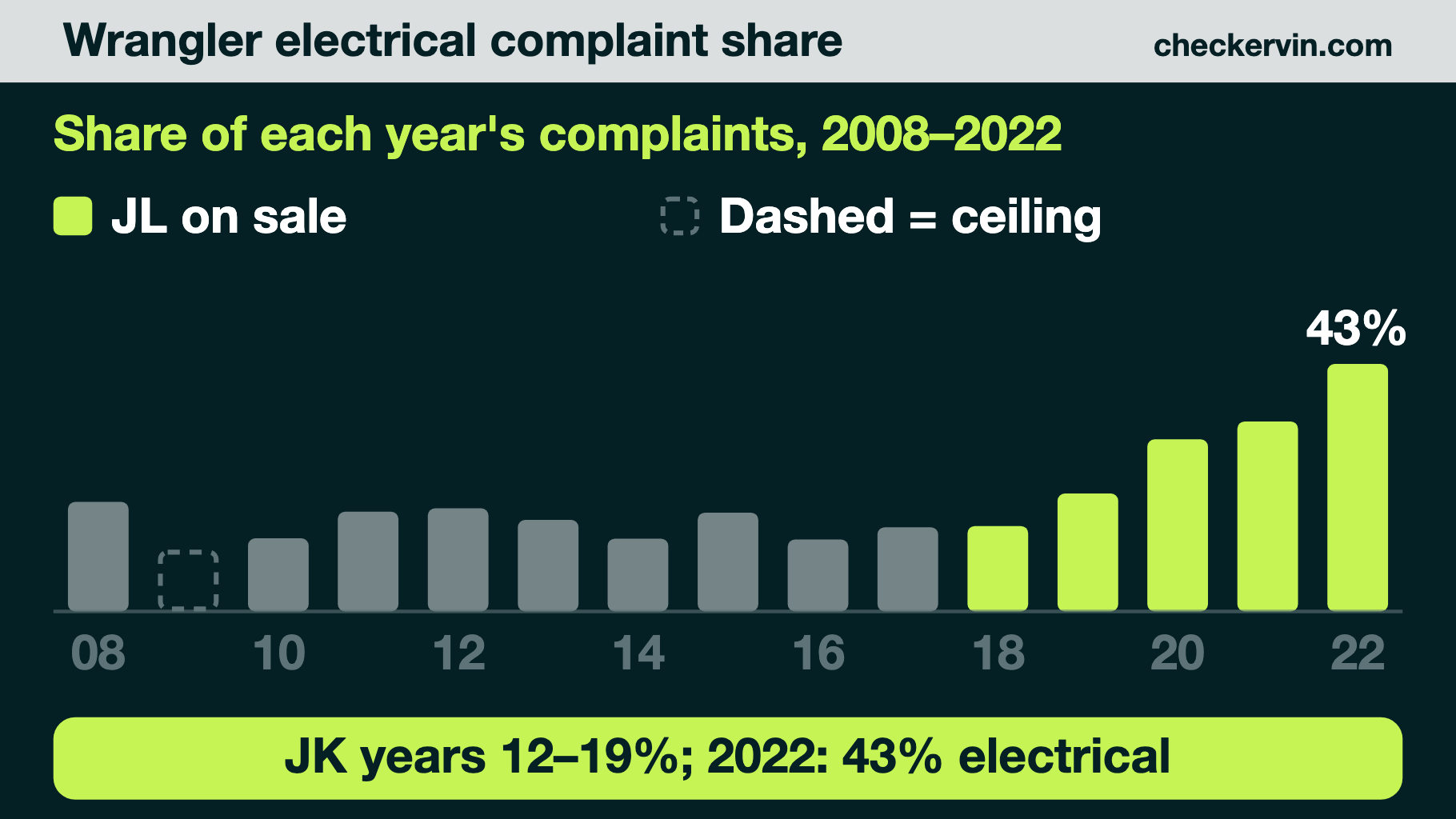
Our corpus of federal NHTSA complaints holds 11,029 reports against the 2008–2022Wrangler. NHTSA has no alternator category. The nearest is ELECTRICAL SYSTEM, which takes in both batteries, wiring, lighting, the fuse and body modules and, on the 4xe, the high-voltage system. It ranks among each year’s five most-reported components in 14 of 15 years, leads outright in 2021 and 2022, and the ranked years add up to 2,008 counted reports, about 18% of everything filed. The alternator is a small part of that. In 2009 electrical falls below fifth place, so all we know is that it sat under that year's fifth-place count, about 10% of its complaints. The chart draws that year as a dashed outline at that ceiling.
The more telling number is the share. On the JK years, electrical is between 12% and 19% of each year’s complaints, a steady band across 921 counted reports. From 2018, the share climbs: 15% for 2018, 20% for 2019, 30% for 2020, 33% for 2021 and 43% for 2022. Across the JL years it is 24% of all complaints. The 2021 has the most electrical reports of any year, 313, and the 2022 the highest share. NHTSA files the outgoing JK and the new JL under one name for 2018, so that row mixes both.
Reading the narratives, the word “alternator” is rare in Wrangler complaints, and when it appears it is often to say the alternator tested fine. JK owners describe batteries, starters and alternators checked or replaced before a fuse box or a key module was found. A few 2010 and 2011 owners describe an alternator that smoked or took a fusible link with it. Later, eTorque owners describe motor generator replacements and battery lights, and one 2019 owner writes simply that the Jeep has no alternator.
JK: an ordinary alternator, and no recall
The 2007–2018 JK Wrangler, with the 3.8-liter V6 through 2011 and the 3.6 Pentastar from 2012, uses a conventional belt-driven alternator. We checked NHTSA’s recall records for every Wrangler name from 2007 to 2023, 64 campaigns in all, and none covers the alternator, the generator or the charging system. To make sure the search was working, we confirmed it returns recalls we know exist, including the 2017–2018 control module campaign below and the 4xe battery campaigns. We also searched every manufacturer communication NHTSA holds for the JK years by keyword and found no Wrangler bulletin about the alternator.
That matters because the alternator recalls Jeep owners hear about are real, just not for this Jeep. Chrysler recalled alternators on 2012–2014 Grand Cherokees with the same 3.6-liter engine, for diodes that failed from heat and power-steering load; our Grand Cherokee alternator post covers those three campaigns. The Wrangler was not in any of them, so a JK alternator is a repair the owner pays for.
Water and mud come up often on Jeep forums, with owners describing alternators that quit after deep crossings or mud runs. We found no Stellantis document on it, so treat it as owner experience, not a known defect. It is still worth telling the shop if the Jeep was recently in water: grit in an alternator and a wet connector can look alike at first.
JL: four ways to charge a 12-volt battery
The JL that arrived for 2018 is where an alternator quote can go wrong before a wrench is turned. Depending on the engine, three different parts keep the 12-volt battery charged, and Stellantis documents each one.
| JL powertrain | What charges the 12-volt battery |
|---|---|
| 3.6L or 2.0L without eTorque | Conventional alternator, controlled by the engine computer |
| 3.0L diesel or 6.4L 392 | Conventional alternator; the diesel charges least at idle |
| 2.0L eTorque (2018 on) or 3.6L eTorque (2020 on) | 48-volt belt-driven motor generator unit |
| 2.0L 4xe plug-in hybrid (2021 on) | DC-DC converter fed by the high-voltage battery |
The years in that table come from the bulletins’ own scopes: FCA bulletin 08-144-23 for the 2018 2.0-liter eTorque, 09-007-20 and notification W21 for the 2020 3.6-liter eTorque, and 08-071-21 for the 2021 4xe. They are the earliest years we found documented, not necessarily the first year each was sold. The Jeep build sheet or the engine size by VIN lookup shows which engine and equipment a given JL left the factory with, and that is the first thing a parts quote should match.
Low voltage on the dash that is normal
On JLs with a conventional alternator, the most common wasted alternator is one that was never faulty. A Stellantis technician case revised in August 2023, listing Wranglers from 2018 to 2023, says the smart charge strategy “can give a false perception that the charging system is not charging properly” and tells technicians not to replace the main or auxiliary battery, the battery sensor or the alternator unless fault-code diagnosis leads there. It singles out the 3.0 diesel in the JL and Gladiator as the most aggressive at idle, with an example display of 12.4 volts.
A 2020 case for 2020–2021 Wranglers goes further. Dealers had been replacing generators for code P065A, generator system performance, and every returned part tested as no trouble found. Stellantis wrote that listing the generator as a possible cause for that code was incorrect: the code means another module reported an electrical fault, such as exterior lighting, a wiper motor or the blower, and the engine computer fell back to plain full-time charging. Fix the other codes first. Normal gauge swings from 12 to 14 volts are the regulated charging working as designed.
A 2024 parts-quality note covering 2021–2024 JLs adds the design detail that explains all of this: the alternator has no internal regulator, and every control signal comes from the engine computer. An alternator that is not charging may simply not have been told to.
Cables, nuts and fuses before parts
The checks Stellantis lists before an alternator comes out are cheap. That 2024 note asks technicians to unplug and reseat the two-wire field and sense connector and look for bent pins, confirm the nut on the B+ stud is actually clamping the cable, check the fuse between the alternator and the power distribution center, and test the grounds, including the alternator’s own mounting bolts, because the alternator case grounds through them. A 2022 case for the 2021 Wrangler, for a battery light and voltage swinging high and low with charging codes, traces it to the main charging circuit at the high-current fuse array and the alternator B+ nut, tightened to 14 N·m.
On the 2022–2023 diesel, bulletin 08-099-25 re-routes the generator’s positive cable for a different reason: it was interfering with the camshaft sensor signal and setting a check-engine light. That is an hour of dealer labor and no alternator.
The nearest thing to a charging recall on the Wrangler is 18V-524, which replaced the powertrain control module on certain 2017–2018 Wranglers because a voltage regulator chip in it could fail and cause a stall or a no-start. A Jeep recall check by VIN shows whether it is open. JL no-cranks traced to the dual-battery Stop-Start system and its relay are covered in our Wrangler starter post, and the same connections can produce a battery light.
eTorque: a motor generator, not an alternator
eTorque is a 48-volt mild hybrid. J.D. Power describes its belt-driven motor generator as taking the alternator’s place; Stellantis’s own bulletins show the consequence for an owner. Bulletin 08-144-23, for the 2018 Wrangler with the 2.0-liter eTorque engine, lists loss of 12-volt charging with a battery light, or a loud noise from the motor generator, and fixes it with new software for the hybrid control processor and, only if two specific motor fault codes or the noise are present, a new motor generator unit. FCA allows 1.2hours for the software and the replacement together. A shop that hears “battery light” and quotes an alternator on this Jeep is quoting a part it does not have.
The 3.6-liter eTorque had its own charging fault, and it was in the belt, not the motor. Bulletin 09-007-20 covers 2020 Wranglers with the 3.6 eTorque built from December 13, 2019 to January 25, 2020: a hydraulic belt tensioner with one date code can let the belt slip, with belt noise, a check-engine light and a dead battery. The dealer reads the code with a flashlight and mirror and replaces the tensioner only if it matches, a 0.6-hour job paid under warranty. Customer Satisfaction Notification W21 covered about 747 of these Jeeps and Ram pickups for a bent washer in the same tensioner, and warned that over time both the 12-volt and 48-volt batteries could lose their charge.
4xe: no alternator belt, a converter
The 4xe plug-in hybrid keeps its 12-volt battery charged electronically. FCA bulletin 08-071-21 explains that an Auxiliary Power Module, a DC-DC converter, steps the high-voltage battery down to 12 volts and maintains the small battery “like an alternator,” whenever the propulsion system is active or the Jeep is plugged in, even with the gasoline engine off.
The same bulletin lists when the converter will not charge the 12-volt battery, and two of them catch people out. It stops when the hood is open, which matters for anyone testing charging voltage with the hood up, and it stops while the engine is cranking. It also stops when the high-voltage battery is below 5.5% charge or its contactors are open. A 12-volt reading taken under those conditions says nothing about a fault.
The 4xe does have a motor generator, and on later Jeeps it has its own bulletin. FCA bulletin 08-178-25, which replaced 08-144-24, covers 2023–2024 Wrangler 4xe models that go into limp mode or will not start with one motor position code, blames a manufacturing issue, and replaces the unit if its serial number falls in a listed range. The allowance is 2 hours, under warranty. None of that is an alternator job, and all of it is dealer work behind a high-voltage safety procedure.
Before you authorize the alternator
- Confirm the engine: conventional alternator, eTorque motor generator or 4xe converter
- Run the VIN for open recalls, including 18V-524 on a 2017–2018
- Charge and load-test the battery, and on a JL with Stop-Start test the auxiliary battery too
- On 2018 and later, ask whether fault codes, not the cluster voltage, point at the alternator
- If code P065A is set, ask which other module's fault was fixed first
- Have the field connector, B+ nut, fuse and grounds checked, including the mounting bolts
- On an eTorque Jeep, ask whether the motor generator, belt tensioner and 48-volt pack were checked
- Ask whether the quote is new Mopar, remanufactured or aftermarket
The first four items cost little and settle many cases. A conventional alternator earns the bill when it fails an output test with the engine commanded to charge, with good connections and grounds, or when it is noisy or visibly damaged. On eTorque and 4xe Jeeps, the bulletins above are usually free within the warranty terms they state; outside them, the bill is for a hybrid part. Our explainer on bulletins versus recalls covers who pays for which.
If you are buying the Wrangler, not repairing it
A new alternator receipt on a JK is a normal repair record, not a red flag; the Wrangler never had an alternator defect campaign. On a JL, find out which powertrain it has before reading anything into a charging repair, and on an eTorque Jeep ask whether the motor generator, its tensioner or the 48-volt pack was ever replaced. On a 4xe, check the high-voltage battery recalls first, and see our guide to buying a car with an open recall if one is still open. The Jeep Wrangler years-to-avoid breakdown scores each year’s full complaint record, beyond the electrical system.
A free CheckerVIN report gives the factory build, engine, specifications and open recalls. It does not include accident, title or odometer history, and it cannot tell you how healthy an alternator is. A voltmeter, a scan tool and the recall record answer that.
Where this information comes from
- NHTSA — recalls by VINThe official lookup; no Wrangler alternator or charging campaign appears for 2007–2023.
- NHTSA copy — FCA STAR case S2008000031 Rev. B, low charging voltageSmart charging that looks like a fault on 2018–2023 Wranglers, and the 3.0 diesel's low idle voltage.
- NHTSA copy — FCA STAR case S2008000196, code P065AReturned generators tested no trouble found; the code points at other modules.
- NHTSA copy — Stellantis parts note 9100338, checks before alternator removalConnector, B+ nut, fuse and ground checks; the alternator has no internal regulator.
- NHTSA copy — FCA bulletin 08-144-23, 2018 2.0L eTorqueLoss of 12-volt charging tied to the motor generator, and FCA's labor time.
- NHTSA copy — FCA bulletin 09-007-20, 3.6L eTorque belt tensionerDead batteries and belt slip on 2020 3.6 eTorque Jeeps built December 2019 to January 2020.
- NHTSA copy — FCA bulletin 08-071-21, 4xe charge functionsHow the 4xe charges its 12-volt battery, and when it will not.
- NHTSA copy — FCA bulletin 08-178-25, 4xe motor generatorLimp mode or no-start on 2023–2024 Wrangler 4xe models, and the serial-number check.
- YourMechanic — Jeep Wrangler alternator replacement estimateThe $220 average, parts range and 2008 example quoted above, retrieved November 2026.
- YourMechanic — Jeep Wrangler JK alternator replacement estimateThe JK average, labor split and 2018 3.6L estimate quoted above, retrieved November 2026.
Keep reading
Frequently asked questions
How much does it cost to replace an alternator on a Jeep Wrangler?
YourMechanic's Wrangler page lists an average of about $220, with parts from $73 to $299, read in November 2026. Its Wrangler JK page averages $486, about $304 in parts and $182 in labor, and quotes $809 for a 2018 JK with the 3.6-liter V6, with a shop or dealer range of $965.56 to $1,424.69. Those figures are for a conventional alternator; eTorque and 4xe Wranglers charge the battery with different parts.
Will a Jeep start with a bad alternator?
Usually, for a while. The engine runs on the battery's stored charge, so a Wrangler with a dead alternator often starts and drives until the battery is drained, then stalls or will not restart. On a JL with Stop-Start, a weak battery can disable Stop-Start first. A Jeep that will not crank at all on a charged battery has a different fault; our Wrangler starter post covers those.
What are the signs of a bad alternator?
A battery warning light, lights that dim or flicker, a battery that keeps going flat while driving, a whine or burning smell from the front of the engine, and charging codes. One caution on 2018 and later Wranglers: Stellantis says the smart-charge strategy can make a healthy system show low voltage on the cluster, especially on the 3.0 diesel at idle, so a low reading alone is not proof.
Is there a recall on the Jeep Wrangler alternator?
No. We checked NHTSA's recall records for every Wrangler name from 2007 to 2023 and found no campaign for the alternator, generator or charging system. The alternator recalls people remember are on the 2012 to 2014 Grand Cherokee and several Dodge and Chrysler cars, not the Wrangler. Recall 18V-524, a powertrain control module recall on some 2017 to 2018 Wranglers, is the nearest charging-related campaign.
Does an eTorque Wrangler have an alternator?
Not a conventional one. On eTorque Jeeps the belt-driven motor generator unit does the charging; Stellantis's bulletins tie a battery light and loss of 12-volt charging on the 2018 2.0-liter to that unit, and dead batteries on some 2020 3.6-liter eTorque Jeeps to its belt tensioner. FCA allows 1.2 hours to reprogram the hybrid controller and replace the unit on the 2018 2.0-liter. Price that job as a motor generator, not an alternator.
Check the VIN before the alternator
A free CheckerVIN report shows the factory build, engine and open recalls for any VIN, so you know which part charges the battery before you pay to replace it.
Run a free VIN check