The short answer
- What does it cost?
- YourMechanic averages about $244 for a Wrangler starter: roughly $104 in parts and $140 in labor.
- Is it really the starter?
- If the engine cranks normally, no. On a 2008–2014 JK, the TIPM fuse box and the key module both cause no-starts that look like a starter.
- What about the JL?
- Stop-Start JLs have two batteries and a Power Control Relay. Stellantis tells dealers to check those connections before anything else.
$244
YourMechanic Wrangler starter average
Retrieved Nov. 2026
0.4 hr
FCA time to replace 392 starter studs
Bulletin 08-096-21, 2021 JL
2,008
Electrical reports counted
2008–2022, federal record
33%
Of 2021 complaints were electrical
The top category that year
The prices, and whose prices they are
We sell no repairs and publish no price of our own, so every dollar figure here is someone else’s, with the date we read it. YourMechanic’s Jeep Wrangler starter page gives an average of about $244, made of roughly $104 in parts and $140 in labor. Its separate page for the Wrangler JK quotes $755 for a 2018 JK with the 3.6-liter V6 and puts a shop or dealer at $908.60 to $1,361.30. The site refused direct requests from our tools, so we read both figures through search listings in November 2026, and separate searches returned the same numbers.
The gap between those two figures is the point. The low average is not tied to a year or engine, and the higher one shows what a dealer and a new part can do to the bill. RepairPal surfaced only a starter relay estimate for the Wrangler, not the starter motor, so we quote nothing from it. The one manufacturer figure we found is a labor allowance: when FCA had dealers replace the starter mounting studs on some 2021 Wrangler 392s, it allowed 0.4 hours. That is a warranty time for one engine and one fix, not a retail quote.
A starter on this Jeep is a modest bill. A starter bought for the wrong fault is a modest bill paid twice, and the federal record for the Wrangler has plenty of owners who did exactly that.
What 2,008 counted electrical complaints say
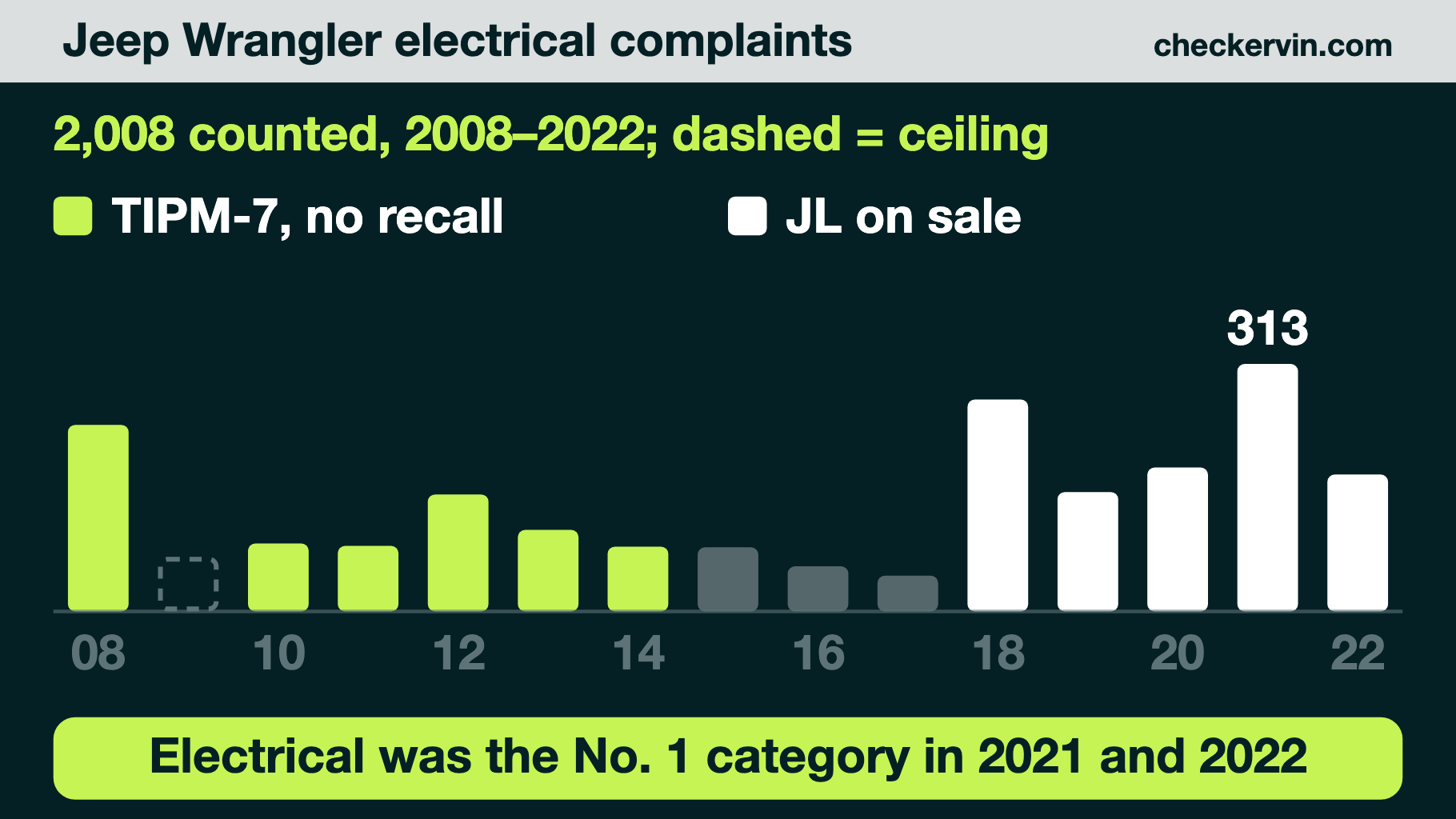
Our corpus of federal NHTSA complaints holds 11,029 reports against the 2008–2022Wrangler. NHTSA has no starter category. The nearest is ELECTRICAL SYSTEM, which covers the 12-volt batteries, wiring, lighting, fuse and body modules, and on the 4xe the high-voltage system too; the starter is a small slice. The category ranks among each year’s five most-reported components in 14 of 15 years. It is first in 2021 and 2022 and second in 2008, 2019 and 2020. The 14 ranked years add up to 2,008 counted reports, about 18% of everything filed. In 2009 it falls below fifth place, so all the data says is that it sat under that year's fifth-place count of 66. The chart draws that year as a dashed outline at that ceiling, not as a value.
The JK years from 2008 to 2014 account for 738 of the counted reports across 6 ranked years. The 2008 is the heaviest of them: electrical is 19% of its complaints, at 236. The later JK years are quieter, averaging 61 counted electrical reports. Then the JL arrives. From 2018 the rows average 217 a year, and the 2021 peaks at 313, which is 33% of that year’s complaints; the 2022 follows at 43%. In 2018, 2019 and 2020 steering complaints led the list and electrical sat behind them.
One pooling note. NHTSA files the outgoing JK and the new JL under one name for 2018, so the 2018 row, 268 electrical reports, mixes both Jeeps.
JK: the fuse box that was never recalled
The 2007–2014 JK Wrangler routes power through a Totally Integrated Power Module, the fuse and relay box under the hood that also switches the lights, wipers, horn and door locks. NHTSA’s 2015 review of these modules lists the 2007–2014 JK, about 962,000 Jeeps, among the vehicles built with the TIPM-7 version, and names what makes that version different: the fuel pump relay lives inside it. A relay that sticks open leaves the pump without power, and the engine cranks at full speed without catching.
Chrysler recalled that relay on the 2011–2013 Grand Cherokee and Durango, a story our Grand Cherokee starter post covers in full. The Wrangler was reviewed and left out. In the agency’s complaint table, confirmed relay failures on the JK were a handful against nearly a million Jeeps, well under one per 100,000, and in its separate look at 2011 models it found no TIPM-related stalls among the JKs at all. Chrysler’s testing showed relays in the lower-current platforms outlasting the Grand Cherokee’s. NHTSA denied the petition in July 2015.
The owner narratives for the early JK describe the module failing in a different, louder way than on the Grand Cherokee: the horn sounding, wipers and washers running on their own, lights flashing, and in some reports the fuel pump cutting out. A few describe a battery drained overnight. There is no free fix to ask for, so the practical point is diagnostic: a JK with those symptoms and a no-start has a fuse box problem until proven otherwise.
JK no-starts that are not the starter
Chrysler’s own bulletins for the late JK name three no-start causes that have nothing to do with the starter motor. Bulletin 08-067-13, from September 2013, replaces the TIPM on 2013 Wranglers built in a nine-day window, May 29 to June 6, 2013, for a no-start condition. It is a narrow build range, but a VIN check settles whether a 2013 falls in it.
Two more go after the key, not the starter. On 2013 JKs built before October 10, 2012, bulletin 08-060-12 explains that if voltage drops below 4.5 volts for more than a fifth of a second, the Wireless Control Module can forget that the key is programmed, and the Jeep will not crank. The fix is a module reflash. Bulletin 08-068-14 covers a similar no-crank on 2013–2014 JKs with invalid-key codes and allows 0.2 hours for the flash. Both are fast, cheap dealer jobs, and a weak battery that browns out during a crank is exactly how the first one gets triggered.
The click is the classic starter symptom, and FCA’s technician case S1121000006, revised in 2020, has a test for it that costs nothing. Its product list includes the 2007–2011 Wrangler. For a no-crank where the starter clicks and no codes are stored, the case tells technicians to run a jumper cable from the battery negative to the engine block and try again. If the engine now cranks, the fault is a ground: inspect the engine and PCM grounds, check the transmission range sensor connector for moisture and corrosion, and add a redundant heavy-gauge ground from the battery negative to the transmission bell housing. If it still will not crank on an automatic, the case points to a new transmission range sensor, the part that tells the Jeep it is in Park.
That matches what early JK owners describe in the complaint record: clicks, new batteries, new starters, and the same click a few weeks later. Ask the shop to do the jumper test before they order the part.
JL: two batteries, one relay
The JL that replaced the JK for 2018 brought Engine Stop-Start, and with it a second battery. FCA’s case S1908000166, for 2018–2020 Wranglers, describes the arrangement plainly. A Power Control Relay decides which battery does what. When the engine is cold, both batteries crank it. Once it is warm, only the large starting battery handles Stop-Start restarts, and the smaller auxiliary battery runs the rest of the Jeep. The repair in that case was no part at all: clean and tighten the main connections between the relay, the battery and the fuse array.
A later case, S2008000075, adds the failure owners notice. A Jeep with a weak, failed or disconnected auxiliary battery can show a Service Start/Stop message and, in the case’s words, a no start condition with a drained battery and the need to jump start. It names two fault codes, one for the auxiliary battery’s state of charge and one reading starter relay stuck, and tells technicians to disconnect the auxiliary battery’s ground before testing the main battery, or the test result is false. Stop-Start wants the main battery above about 65% charge.
That is why a JL that will not crank deserves a two-battery test, not a one-battery test and a starter. The auxiliary battery is small and tucked away, so it is easy to forget it is there at all. Our battery size by VIN page shows what the Jeep should carry.
What Stellantis tells dealers about a no-crank JL
The JL’s technician cases read like a list of connections to tighten. For a 2021 Wrangler that will not crank and stores no codes at all, case S2108000030 says to inspect the Power Control Relay’s main cables, wiggle them, tighten them or replace the relay. For no-starts with a battery or check-engine light and a group of codes including the stuck-starter-relay code, case S2008000103, revised as recently as April 2025 and listing 2018 through 2025 Wranglers, sends technicians to clean and secure every connection at the high-current fuse array and the relay. Case S2208000022 does the same for a no-crank with a battery light, telling technicians to loosen and retighten eight terminals on the fuse array.
Other cases point elsewhere but still not at the starter. A loose ground stud in the upper left front fender causes intermittent no-crank on 2019–2020 Jeeps. An unlatched crankshaft sensor connector on 2020 models gives a no-crank or long crank with a check-engine light. On the 2021 diesel, a transmission harness that can chafe against the particulate filter flange produces a crank-no-start with a Service Shifter message. And Stellantis’s battery sensor guidance, which lists every Wrangler from 2014 on, says a replacement sensor is not required on a vehicle without fault codes.
The 392 and its starter studs
One bulletin does involve the starter itself, and it is free on the Jeeps it covers. FCA bulletin 08-096-21, issued June 2021 as a rapid response transmittal, applies to 2021 Wranglers with the 6.4-liter V8, sales code ESG, built from June 9, 2020 to April 24, 2021. The symptom is a Jeep that intermittently fails to crank or start. The repair replaces the starter’s two mounting studs and tightens them to 67 N·m, with the Jeep raised and the battery disconnected, sensor first. FCA allowed 0.4 hours and paid for it under warranty.
The bulletin applies only to VINs on FCA’s list, and that list expired 18 months after issue, so most of these Jeeps have either had the fix or aged past the window. If you own or are looking at a 2021 392 with an intermittent no-crank, ask a dealer whether the VIN was on the list and whether the work was done. A starter that is loose on its mounts can look like a failed starter.
eTorque and the 4xe: motors that are not the starter
From the 2018 model year, the JL’s 2.0-liter turbo was offered with eTorque, a 48-volt mild hybrid whose belt-driven motor generator replaces the alternator and restarts the engine during Stop-Start. Press reports say it was later offered on the 3.6 as well. FCA bulletin 08-144-23 covers the 2018 2.0-liter eTorque Jeep and describes the failure that matters for a no-start diagnosis: loss of 12-volt charging, a battery light and a loud noise from the motor generator, fixed with a software update and, if needed, a new motor generator. A Jeep that dies because the battery was never charged will not crank, but the starter is not the cause. A Stellantis warranty bulletin also restricts orders of the 48-volt power pack for select 2018–2021 JLs; we read only its summary.
Does an eTorque Wrangler still have a regular starter? Jeep’s own eTorque description, as quoted by owners on a JL forum, says both eTorque engines keep a traditional 12-volt starter motor. We could not open the Jeep page itself, so treat that as reported, not confirmed.
The 2021-and-later 4xe plug-in hybrid is a different machine. FCA bulletin 08-071-21 says its high-voltage battery keeps the 12-volt battery charged like an alternator, and that the 4xe can and often does idle and drive without starting the gasoline engine at all. We did not find a Stellantis document that says which motor cranks the 4xe’s engine, so we do not guess. What the paperwork does show is that a 4xe no-start can come from the high-voltage side: case S2208000067 covers 2021–2022 4xe models that will not start, with a Service Hybrid Electric message, traced to a fuse set at the wrong gap inside the high-voltage system. That is dealer work behind a safety power-down, not a starter job.
Why 2021 and 2022 lead the electrical record
Reading the 2021 and 2022electrical complaints, the starter barely comes up. The bulk are about the 4xe: charging failures, loss of electric drive, warning messages, and owners worried about the high-voltage battery fire recalls. Recall 23V-787 told 2021–2023 4xe owners not to charge and to park outside until the battery software was updated, and 25V-741, filed in October 2025, extended the same warning to 2020–2025 Wrangler 4xe models, including Jeeps already fixed under the earlier campaigns. A 2026 recall, 26V-363, covers 2021–2025 Wranglers, gas and 4xe, whose electric power steering pump wiring may overheat, again with advice to park outside.
So the 2021 peak of 313 counted electrical complaints is a hybrid and wiring story more than a starting story. It still matters to a starter buyer for one reason: a no-start on a 2021 or later Wrangler is worth a recall lookup before anything is replaced. Our Jeep recalls by VIN page runs that check.
Which engine, and how big the job is
These Wranglers used a 3.8-liter V6 on the early JK, the 3.6-liter Pentastar V6 from 2012, and on the JL the 3.6, the 2.0-liter turbo with or without eTorque, a 3.0-liter diesel from 2020, the 6.4-liter V8 from 2021 and the 4xe. Each takes its own starter, so a quote without the engine is a guess. Our Jeep VIN decoder or the engine size by VIN lookup tells you which one you have before you order a part.
On size of job: the 392 bulletin is done from underneath with the Jeep on a lift, and replacing the two studs alone is a 0.4-hour allowance. We did not find a Stellantis document giving the full starter removal time or location for the 3.6 or the 2.0, and we do not guess at one. One older recall worth knowing about if you are near it: 18V-524, a small campaign that replaced the powertrain control module on certain 2017–2018 Wranglers because a voltage regulator chip could fail and cause a stall or a no-start. The bigger engine faults on these Jeeps are in our Wrangler engine replacement post.
Before you authorize the starter
- Run the VIN for open recalls, including 18V-524 on a 2017–2018 and the 4xe battery campaigns
- Note whether the engine cranks at normal speed; if it does, the starter works
- On a JL, test both batteries, with the auxiliary battery ground disconnected for the main test
- Ask whether the Power Control Relay and fuse array connections were cleaned and tightened
- On a JK that clicks, ask for the jumper-to-block ground test first
- On a JK with horn, wiper or light faults, ask whether the TIPM was checked
- Ask for stored codes and whether the quote is a new Mopar, remanufactured or aftermarket starter
Most of that list costs little or nothing. Write down the pattern before the shop sees the Jeep: cold or warm, after sitting or after a short drive, one click, rapid clicking or a full crank. A starter earns the bill when it fails a voltage-drop or current-draw test, clicks with charged batteries and good grounds, or grinds. The technician cases above are guidance for dealers, not free repairs; a recall is free and a bulletin usually is not, and our explainer on bulletins versus recalls covers who pays.
If you are buying the Wrangler, not repairing it
A receipt for a new starter on a JK is not proof the starting problem is gone. Ask whether the TIPM was replaced, start the Jeep cold more than once, and listen for the horn or wipers acting on their own. On a JL, ask when the auxiliary battery was last replaced and check that Stop-Start works, because a Service Start/Stop message is often the first sign of the two-battery fault described above. On a 4xe, check the recall status of the high-voltage battery before anything else, and see our guide to buying a car with an open recall if one is still open.
A free CheckerVIN report gives you the factory build, engine, specifications and open recalls. It does not include accident, title or odometer history, and it cannot tell you whether a fuse box or a battery relay is about to fail. Cold starts, the recall record and a shop’s tests do that.
Where this information comes from
- NHTSA — DP14-004 petition denial, TIPM failures (July 2015)Lists the 2007–2014 JK Wrangler as a TIPM-7 vehicle and explains why its fuel pump relay was not recalled.
- NHTSA copy — Chrysler bulletin 08-067-13, no start due to TIPMThe TIPM replacement for 2013 JKs built May 29 to June 6, 2013.
- NHTSA copy — FCA STAR case S1121000006, starter will not engageThe jumper-to-block test, grounds and transmission range sensor for a clicking no-crank.
- NHTSA copy — FCA STAR case S1908000166, JL auxiliary batteryHow the JL's two batteries and Power Control Relay share cranking duty.
- NHTSA copy — FCA STAR case S2008000075 Rev. A, no start with Stop-Start faultAuxiliary battery faults that drain the Jeep and need a jump start, and how to test correctly.
- NHTSA copy — FCA bulletin 08-096-21, 392 starter mounting studsThe 2021 6.4-liter intermittent no-crank fix and FCA's labor time.
- NHTSA copy — FCA bulletin 08-144-23, 2.0L eTorque motor generatorLoss of 12-volt charging on the 2018 eTorque Wrangler, a no-start cause that is not the starter.
- NHTSA — recalls by VINThe official lookup for 18V-524, the 4xe battery campaigns and every other Wrangler recall.
- YourMechanic — Jeep Wrangler starter replacement estimateThe $244 average and parts-labor split quoted above, retrieved November 2026.
- YourMechanic — Jeep Wrangler JK starter replacement estimateThe 2018 JK 3.6L estimate and shop/dealer range quoted above, retrieved November 2026.
Keep reading
Frequently asked questions
How much does it cost to replace a starter on a Jeep Wrangler?
YourMechanic lists an average of about $244 for a Jeep Wrangler starter replacement, roughly $104 in parts and $140 in labor, read in November 2026. Its estimate for a 2018 Wrangler JK with the 3.6-liter V6 is $755, with a shop or dealer range of $908.60 to $1,361.30. The engine, the model year and whether the part is new Mopar or remanufactured move the price more than anything else.
How do I know if my Jeep starter is bad?
A bad starter usually clicks once or does nothing while the dash lights stay bright, or it grinds. If the engine cranks at normal speed but never fires, the starter is doing its job. On a JL with Stop-Start, a weak auxiliary battery or a loose Power Control Relay cable can also stop the engine cranking, and Stellantis tells dealers to check those connections first.
How do I change the starter on a Jeep Wrangler?
Disconnect the battery first, unplugging the Intelligent Battery Sensor before the negative cable on Wranglers that have one, then raise and support the Jeep and work from underneath. FCA's 2021 bulletin for the 6.4-liter 392 follows that order and torques the starter studs to 67 N·m. We found no Stellantis document giving the full procedure for the 3.6 or 2.0, so follow the service manual for your engine.
Is replacing a starter on a Wrangler a big job?
Usually not. FCA allows 0.4 hours just to replace the two starter mounting studs on a 2021 Wrangler 392, which needs the Jeep raised, and YourMechanic's average labor charge is about $140. The bigger cost is a misdiagnosis: owners in the federal complaint record describe replacing starters and batteries before the real fault, a fuse box, a ground or a relay, was found.
What year Wrangler has the most electrical problems?
In our federal complaint data, the 2021 Wrangler has the most electrical complaints, and electrical is the top category in 2021 and 2022. Those years are driven mostly by the 4xe plug-in hybrid's high-voltage battery and charging faults, not starters. For no-starts specifically, the 2008 to 2014 JK's fuse box and the JL's dual-battery Stop-Start system are where the paperwork points.
Check the VIN before the starter
A free CheckerVIN report shows the factory build, engine and open recalls for any VIN, so you order the right starter and know whether a no-start recall is open.
Run a free VIN check