The short answer
- What does it cost?
- RepairPal lists $999–$1,086 on average for a Grand Cherokee alternator, before tax. Labor is the small part of it.
- Could it be free?
- On a 2012–2014 with the 3.6-liter V6, yes. Three recalls replaced alternators whose diodes fail from heat and power-steering load.
- Is it really the alternator?
- On 2018 and later, check first. Stellantis says low displayed voltage can be normal smart charging, and lists connections and grounds to test.
$999–$1,086
RepairPal Grand Cherokee alternator average
Retrieved Nov. 2026, before tax
0.5 hr
FCA's warranty time for the 3.6 alternator swap
From its own recall instructions
3
Alternator recalls on 2012–2014 3.6L models
14V-634, 17V-435, 17V-741
4,173
Electrical reports counted
2008–2022, federal record
The prices, and whose prices they are
CheckerVIN sells no repairs and sets no prices, so the dollar figures on this page are someone else’s, with the date we read them. RepairPal’s Grand Cherokee alternator estimator lists an average of $999 to $1,086 across model years. We read it in November 2026 through its search listing, because RepairPal refuses direct requests from our tools; three separate searches returned the same range. It excludes tax and does not adjust for your area.
The split runs the opposite way from a Grand Cherokee starter. RepairPal’s 2015 and 2021 year pages put labor at about $122 to $179, so even the high end of that labor is roughly 18% of the low end of the model-wide average. Chrysler agrees the job is short: its dealer instructions for all three alternator recalls pay 0.5 hour to replace the alternator on a 3.6-liter Grand Cherokee. A warranty time allowance is not the retail labor time a shop bills, but the direction is clear: what you are paying for is the alternator.
RepairPal lists the three-row Grand Cherokee L on its own page, at $1,122 to $1,259 with labor of about $293 to $430. We could not open YourMechanic’s or AutoNation’s estimate pages, so their numbers are not quoted here, and Kelley Blue Book surfaced no Grand Cherokee alternator estimate.
What 4,173 counted electrical complaints say
Our corpus of federal NHTSA complaints holds 11,924 reports against the 2008–2022 Grand Cherokee. NHTSA has no alternator category; the nearest is ELECTRICAL SYSTEM, which takes in the battery, wiring, lighting, the power and body modules and anything else an owner files as electrical. It ranks among the five most-reported components in every model year here, leads outright in 2008–2014, 2018 and 2020–2022, and adds up to 4,173 reports, about 35% of the total. Most of that is not the alternator.
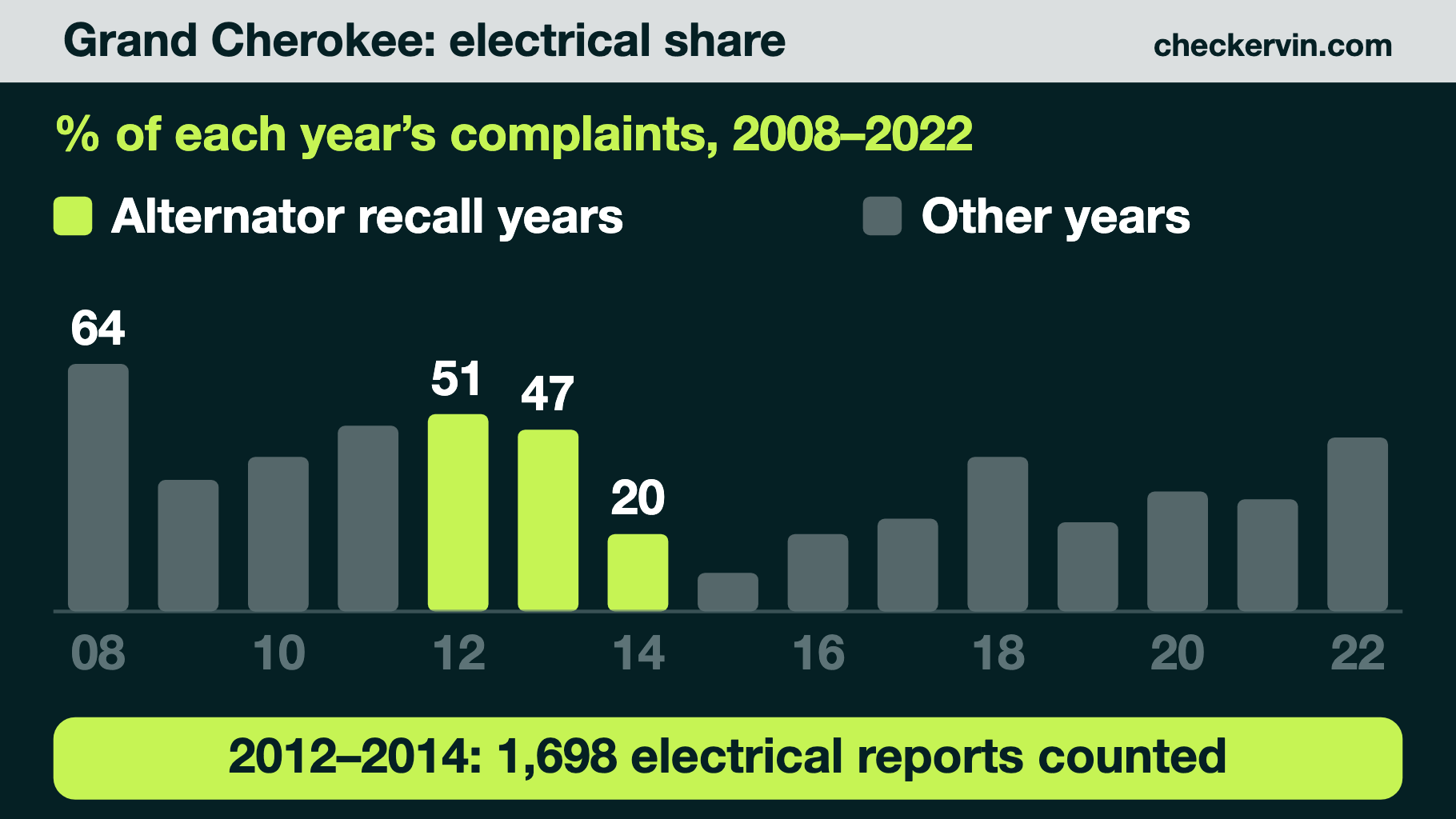
The 2011–2013 bulk belongs mainly to the fuel pump relay in the TIPM power module, which our Grand Cherokee starter post covers in full. The alternator story overlaps it by a year and runs one year longer. The three alternator-recall years, 2012 to 2014, hold 1,698 counted electrical reports, 41% of the 2008–2022count. Reading the narratives, the word “alternator” turns up far more often in 2012 than in any other year, followed by 2011, 2014 and 2013. The accounts repeat: a battery light, a whine, a burning smell, smoke at the front of the engine, then a stall or a dashboard full of warnings.
Electrical is 51% of everything filed against the 2012 and 47% for the 2013. The 2014 looks different on the chart because its record is crowded with powertrain, engine and seat complaints: electrical still ranks first at 485 reports but is only 20% of the year. By 2015 it falls to fifth place. Later years average 141 counted electrical reports, with a bump to 339 in 2018. Our record pools every name NHTSA files the Grand Cherokee under, so the 2021 and 2022 rows include the three-row L and, for 2022, the 4xe plug-in.
Three alternator recalls on the 3.6
All three campaigns cover the same Grand Cherokee generation, the WK body, and only with the 3.6-liter Pentastar V6. Each one replaces the alternator free on a covered VIN, and each carries the same warning in NHTSA’s record: the alternator may fail and stall the engine.
| Recall | Grand Cherokees covered |
|---|---|
| 14V-634 (2014), FCA P60 | 2012–2014, 3.6L, 160-amp, built through Dec. 23, 2013 |
| 17V-741 (2017), FCA T75 | 2014, 3.6L, 160-amp, built Jan. 2–Feb. 14, 2014 |
| 17V-435 (2017), FCA T36 | 2012–2014, 3.6L with EHPS, 180- or 220-amp |
The scale is large. Recall 14V-634 covered 434,600 vehicles across the Grand Cherokee, Durango, Charger, Challenger and 300; 17V-435 covered 442,214; 17V-741 about 17,000. Completion lagged. The last quarterly report Chrysler filed for 14V-634, for the end of 2015, counted 282,494 of the 434,600 remedied. For 17V-435 the report for the third quarter of 2018 counted 230,304 of 442,214. Those figures cover every model in each recall, not only the Jeep, and they are years old, but they are a reason to run the VIN on any 2012–2014 3.6 before paying for a part.
Why the diodes failed, in Chrysler’s words
An alternator turns alternating current into direct current through a bridge of diodes, the rectifier. Chrysler’s defect report for 14V-634 puts the root cause there: “thermal fatigue in the silicon diode within the alternator rectifier bridge, due to a combination of high operating temperatures and cyclical system load conditions, induced by the EHPS.” EHPS is electro-hydraulic power steering, an electric pump that loads the alternator every time the wheel turns. The supplier named in the reports is DENSO.
The way it fails is what made it a safety recall. A failed bridge can mean no output, reduced output or a short to ground. In some low battery conditions, the report says, the diodes can fail in rapid sequence and stall the engine without the advance warning of a lingering charging lamp. As voltage falls, the antilock brakes, stability control and engine controller can drop out; with a short, the whole electrical system can shut down. That matches the owner accounts: steering suddenly heavy, a warning-light display, then silence.
The fix was a better diode. Remedy alternators use “higher amp resin diodes, the same diodes used in the 180 amp alternator that does not exhibit the condition,” and production switched on January 3, 2014. Three years later Chrysler found that the change reached the assembly plant later than its first cutoff assumed, so 17V-741 picked up 3.6-liter vehicles built through February 14, 2014.
180 and 220 amp: the second round
The first recall’s remark that the 180-amp alternator “does not exhibit the condition” did not hold. Owners of 2012 Grand Cherokees in the federal record describe burned-out alternators and being told the 160-amp recall did not apply because their Jeep had a 180-amp unit. In June 2016, according to FCA’s chronology, NHTSA asked the company to look at 84 owner complaints about 180-amp alternators. FCA pulled failed parts from the field, found the same diode fatigue, added the 220-amp unit, and in July 2017 filed recall 17V-435. By then it counted 6,427 warranty claims and two accidents, with no injuries, across the five models.
This campaign is an inspection first. The dealer reads the part number on the alternator’s tag and replaces the alternator only if it is not one of the improved numbers, or if the tag is missing or unreadable, or if the unit is aftermarket or remanufactured. That last line matters for anyone who already paid for a rebuilt alternator: it does not take the VIN out of the recall.
One correction to how this recall is often described, including on our own starter page. NHTSA’s summary mentions the 5.7-liter V8, but FCA’s vehicle list puts the Grand Cherokee in 17V-435 with the 3.6 only, and the dealer parts list marks the Jeep alternators “3.6L only.” The 5.7 alternators in this recall belong to the Challenger, Charger and 300.
Years with no alternator recall
The 2011 Grand Cherokee is not in any of the three campaigns, though it shared the 3.6 and much of its electrical layout with the 2012. Some 2011 owners in the complaint file describe a dealer confirming exactly that after the alternator failed, and others ask why their Jeep was left out. The 2011 logs 780 counted electrical reports, more than any year but 2012, though the part 2011 owners name most often is the TIPM, not the alternator. A 2011 owner pays for an alternator.
The 2014 has one more charging-related recall worth knowing. Recall 13V-483 covered 2014 Grand Cherokees built January to August 2013 for warning lights, a dark cluster and loss of antilock brakes and stability control, caused by a communication fault “and loose alternator ground wires.” The remedy was software and a tightened ground. A loose ground can make a good alternator look bad.
For 2018, the recall to know is not an alternator recall at all. Recall 18V-524 replaced powertrain control modules whose voltage regulator chip could fail and cause a stall or no-start. Owners of 2018 Grand Cherokees in the record describe replacing the main battery, the auxiliary battery and the alternator and still being stranded. Check 18V-524 before buying charging parts for a 2018.
Low voltage that is not a fault
Newer Grand Cherokees charge differently, and Stellantis has filed several technician documents warning against replacing parts for it. A STAR case updated in August 2023, listing Grand Cherokees from 2018 on, says the smart charge strategy “can give a false perception that the charging system is not charging properly” and tells technicians not to replace the battery, the battery sensor or the alternator unless fault-code diagnosis leads there.
A June 2024 case, listing 2021 and later Grand Cherokees, explains why: the engine computer suspends charging at idle when the battery sensor reports little demand, so voltage at the alternator stud close to battery voltage is “not uncommon.” The alternator itself has no internal regulator; the engine computer runs it. The checks before removal are cheap: reseat the two-wire field and sense connector and look for bent pins, confirm the nut on the B+ cable is clamping, check the fuse between the alternator and the power distribution center, and test the grounds, including the alternator case, which grounds through its mounting bolts. A 2022 Stellantis parts-quality note for 2021–2022 Grand Cherokees and 2021–2023 Grand Cherokee L gives the same list.
For 2016–2019 models, a 2021 STAR case ties overcharging and undercharging codes, flickering lights, Stop-Start that will not work, and a crank-no-start to one loose ground nut, G918A, “in the battery compartment under the passenger seat.” That is where the battery sits on these models, and it is why Chrysler’s recall procedure starts by sliding the passenger seat forward.
Battery drains that get blamed on the alternator
A battery that is flat every morning is usually something drawing power with the key off, not an alternator that stopped charging. A 2023 STAR case for 2018 and later Grand Cherokees covers radios that stay on after shutdown: a device in the media hub, an active phone connection or a stuck switch can keep modules awake. It tells technicians to wait an hour for the modules to sleep before measuring draw, and not to replace the radio until the draw is proven to be the radio.
On the 2021 Grand Cherokee L, bulletin 08-021-22 replaces the power liftgate module on vehicles built from December 2020 to August 2021 for exactly this symptom: a dead battery and a Jeep that starts on a jump. Our battery size lookup by VIN shows which battery the Jeep should carry, which matters on Stop-Start models with an auxiliary battery as well as the main one.
Which engine, and why labor varies
The Grand Cherokee in these years came with the 3.6 Pentastar V6, the 5.7 Hemi V8, the 6.4 SRT V8 and, from the 2014 model year, the 3.0 EcoDiesel V6. The only Stellantis procedure we found is for the 3.6 WK, in the recall instructions: slide the passenger seat forward, disconnect the battery, unplug the field connector, remove the B+ cable and the drive belt, take off the ground strap and three fasteners, and lift the alternator out. That is why it pays 0.5 hour. The 3.6 was also offered with 160-, 180- and 220-amp alternators, which is part of why parts quotes differ.
We found no Stellantis procedure or labor time for the 5.7, 6.4 or diesel alternator and do not guess at one. The engine size by VIN lookup or the Jeep VIN decoderconfirms which engine you are pricing, and on a 2012–2014 the engine decides whether any alternator recall can apply.
Before you authorize the alternator
- Run the VIN for open recalls: 14V-634, 17V-741 and 17V-435 on 2012–2014 3.6L, 13V-483 on early 2014, 18V-524 on 2018
- Charge and load-test the battery, then measure charging voltage with the engine at more than idle
- On 2016 and later, ask whether the shop checked for fault codes before blaming low displayed voltage
- Have the B+ nut, field connector, fuse and grounds checked, including the ground under the passenger seat
- For a dead-every-morning battery, ask for a key-off draw test after the modules sleep
- Ask whether the quote is new Mopar, remanufactured or aftermarket, and the amperage it is rated for
The first two items cost little and settle many cases. If the VIN shows an open alternator recall, the replacement is free and the rest of the list is moot. The difference between a bulletin and a recall decides who pays: the three alternator campaigns are recalls, while the STAR cases above are guidance for technicians, not repairs FCA funds.
If you already paid, keep the receipt. The defect reports for 17V-435 and 17V-741 state FCA’s policy of reimbursing owners who paid for a repair that later became the subject of a recall, on proof of payment. We do not know how individual claims are decided.
If you are buying the Grand Cherokee, not repairing it
On a 2012–2014 3.6, ask for proof the alternator recalls were done, and check the VIN, because completion was far from total. A car with an open safety recall can still be bought; our guide to buying a car with an open recall explains how to handle it. The Jeep Grand Cherokee years-to-avoid breakdown scores every year’s full complaint record, beyond the electrical system.
CheckerVIN’s free report gives the factory build, engine, specifications and open recalls. It does not include accident, title or odometer history, and it cannot tell you how many miles are on an alternator. A voltmeter at the battery with the engine running, and the recall record, are what answer that.
Where this information comes from
- NHTSA — Chrysler Part 573 report, recall 14V-634 (160-amp alternator)Root cause, the no-warning stall mode, the resin-diode remedy and the January 2014 production change.
- NHTSA — FCA Part 573 report, recall 17V-435 (180- and 220-amp)Lists the Grand Cherokee with the 3.6 only, names the fire risk, and states the reimbursement policy.
- NHTSA copy — FCA dealer instructions, recall 17V-435The part-number inspection, the 3.6-only Jeep parts and the 0.5-hour labor allowance.
- NHTSA — FCA Part 573 report, recall 17V-741 (early-2014 builds)Extends the 160-amp recall to Grand Cherokees built January 2 to February 14, 2014.
- NHTSA copy — Stellantis STAR case S2408000066, charging concernsWhy idle voltage can look low on 2021 and later models, and the checks before replacing.
- NHTSA copy — FCA STAR case S1708000055, ground under the passenger seatCharging codes and no-starts on 2016–2019 models traced to a loose ground nut.
- NHTSA — recalls by VINThe official lookup for the three alternator recalls, 13V-483 and 18V-524.
- RepairPal — Jeep Grand Cherokee alternator replacement estimatorThe $999–$1,086 average quoted above, retrieved November 2026.
Keep reading
Frequently asked questions
How much does it cost to replace the alternator on a Jeep Grand Cherokee?
RepairPal's Grand Cherokee alternator estimator lists an average of $999 to $1,086 across model years, read in November 2026, before tax and without adjusting for your area. Its year pages vary widely, mostly because the part price varies. On a 2012 to 2014 Grand Cherokee with the 3.6-liter V6, check the VIN for open alternator recalls first: if one is open, the dealer replaces the alternator free.
How much is labor to replace an alternator on a Grand Cherokee?
Not much, by the standards of this job. RepairPal's 2015 and 2021 Grand Cherokee pages put labor at about $122 to $179, and Chrysler's own recall instructions pay dealers 0.5 hour to swap the alternator on a 3.6-liter Grand Cherokee. Most of the bill is the alternator itself. RepairPal lists the three-row Grand Cherokee L separately, with labor of about $293 to $430.
Is there a recall on the Jeep Grand Cherokee alternator?
Yes, three, all on 2012 to 2014 models with the 3.6-liter V6. Recall 14V-634 replaced 160-amp alternators built through 2013, 17V-741 added 2014 models built in early 2014, and 17V-435 covers 180- and 220-amp alternators on vehicles with electro-hydraulic power steering. Chrysler's documents describe diode failure that can stall the engine with little warning and, in 17V-435, a fire risk.
Will Jeep pay me back for an alternator I already replaced?
Possibly. The Part 573 reports for recalls 17V-435 and 17V-741 state FCA's policy of reimbursing owners who paid for a repair that later became the subject of a recall, on proof of payment. If you paid for an alternator on a VIN covered by one of those campaigns, send the receipt to FCA US. We cannot say how a given claim will be decided.
What are the worst years for the Jeep Grand Cherokee to avoid?
For electrical complaints, the 2012 and 2011 carry the most in the federal record, 837 and 780 counted reports, and the 2008 has the highest electrical share of its complaints, about 64%. The 2014 has the most complaints of any year overall, 2,383, with electrical ranked first. Our years-to-avoid page scores every year's full record, not only the electrical system.
Check the VIN before the alternator
A free CheckerVIN report shows the factory build, engine and open recalls for any VIN, so you know whether an alternator recall is still open before you pay for one.
Run a free VIN check