The short answer
- Is there a Jeep build sheet lookup by VIN?
- Not as a single free database. The original window sticker is retrievable from the manufacturer, a dealer can pull the order record, and the paper build sheet may still be inside the vehicle. A VIN decode establishes the car but returns no option codes.
- What are the codes on it?
- Mopar sales codes — the Chrysler-family equivalent of GM's RPO codes, using a different scheme. A GM code list will not read them.
- What does the door sticker settle?
- Not options. Federal law requires it to carry the manufacturer, build date, GVWR, axle ratings, a conformity statement, the VIN and the type class. Read it anyway — the VIN on it must match the windshield.
Sales codes
The Mopar scheme
not RPO — a GM list will not decode them
Inside the car
Where the paper sheet hides
carpet, seat, headliner, door panel
49 CFR 567
The rule behind the door label
seven required statements
3/32 inch
Minimum lettering height
in a contrasting color
Four documents, and only one the law requires
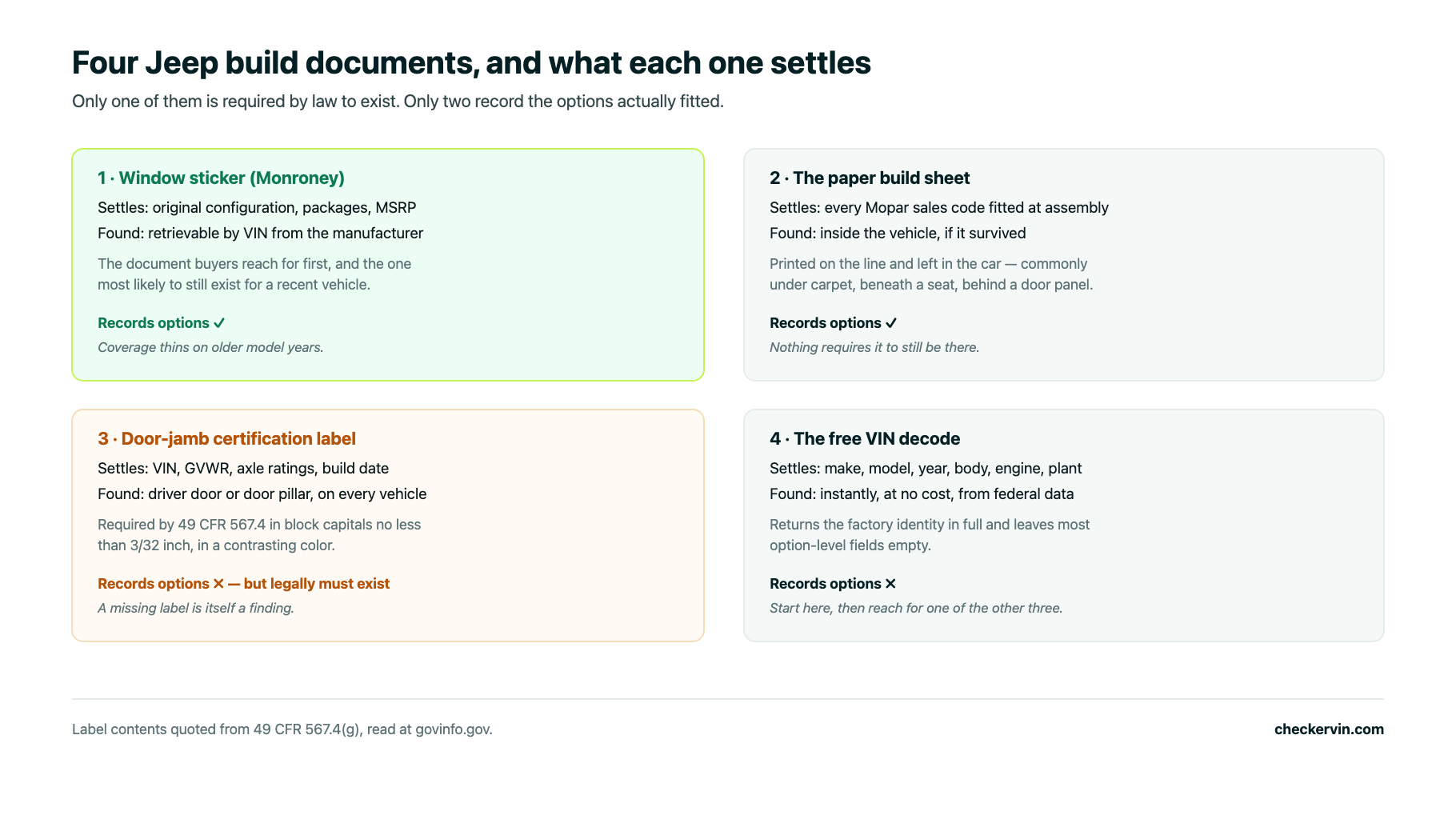
The confusion around Jeep build sheets comes from expecting a single artifact. GM owners look in the glovebox for an RPO sticker and usually find one. There is no direct Chrysler-family equivalent that reliably lives in a fixed place, so the record is spread across four documents with very different odds of still existing.
The window sticker records the configuration as ordered and can be retrieved from the manufacturer for reasonably recent vehicles. The paper build sheet was printed during assembly and left inside the car, where it either survived or did not. The door-jamb certification label is on every vehicle by law but carries no option information. And the free VIN decode establishes what the vehicle is without touching what was fitted to it.
Mopar sales codes, and why a GM list will not read them
Chrysler, Dodge, Jeep and Ram identify options with sales codes: short alphanumeric identifiers, one per option, package element or trim feature. They do the same job as GM’s RPO codes and they are not interchangeable with them. A code list for a Silverado will not decode a Wrangler, and a decoder that appears to read both is almost certainly matching on the model name rather than the code.
The practical consequence for a buyer is that a listing quoting codes is quoting from a document, and it is worth asking which one. Codes copied from the window sticker describe what was ordered. Codes read off a build sheet found in the car describe what the line actually fitted. Those are usually the same and occasionally are not, which is precisely the case worth catching.
The sheet built into the car
Chrysler-family vehicles have long left the assembly-line build sheet inside the vehicle rather than handing it to the buyer. When one turns up it is usually under carpet, beneath or inside a seat, above the headliner, or behind a door trim panel. Owners of older Jeeps trade locations for specific model years, and none of them is a rule.
Two cautions follow. Its absence is not evidence of anything — nothing required it to be placed in a particular spot, nothing required it to stay, and interior work over a decade or two removes them routinely. And finding one does not settle the vehicle’s current condition; it records what left the factory, which is a different claim from what is bolted to the car today.
- Under the carpet, most often on the passenger side
- Beneath a seat cushion or inside the seat frame
- Above the headliner, reachable at a trim edge
- Behind a door trim panel or kick panel
- Absent entirely — which tells you nothing at all
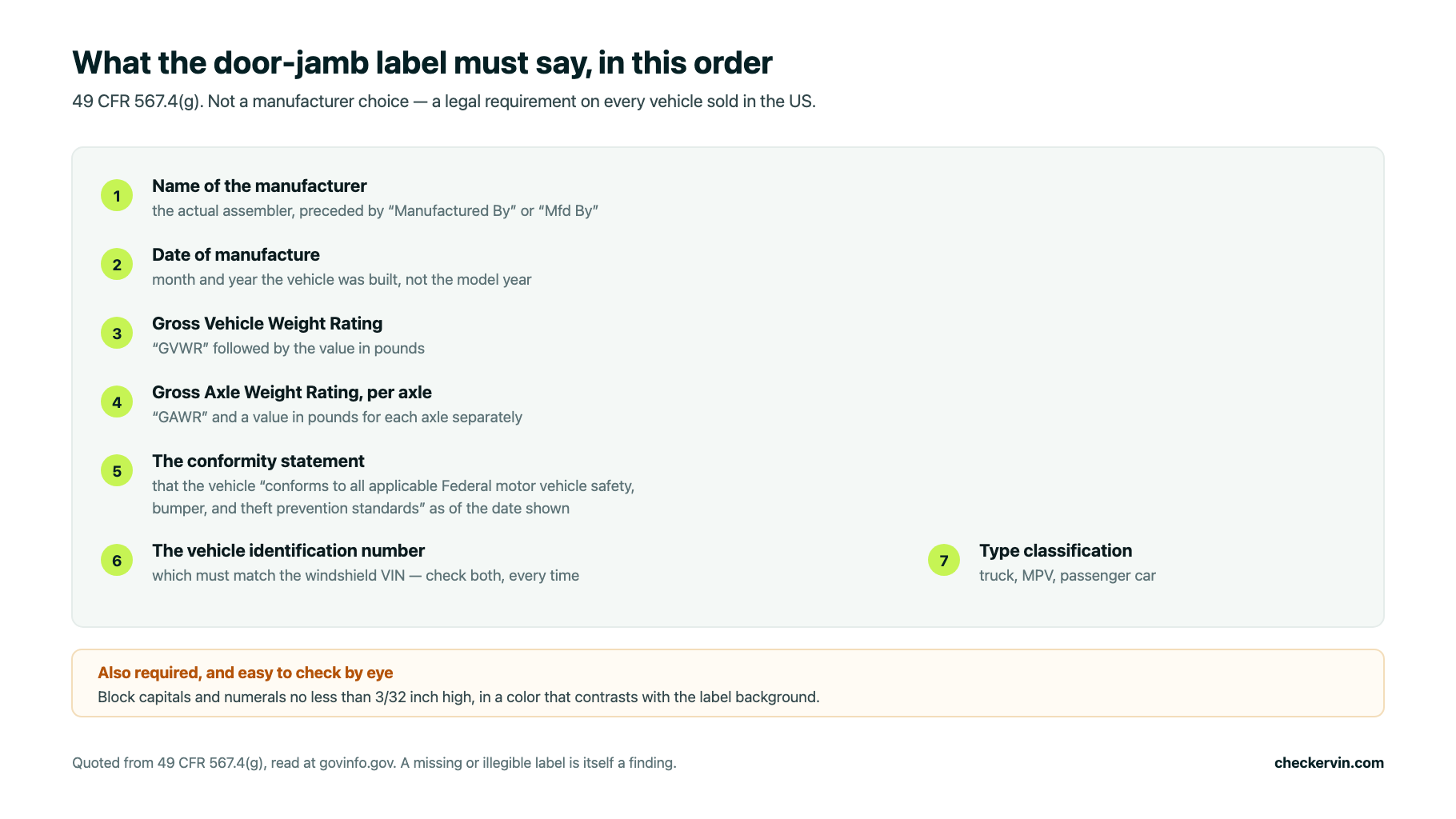
What the door label must legally say
The certification label on the driver’s door or door pillar is the only build document federal law requires. It is not an equipment list and it will not tell you which axle or which package the vehicle carries. What it must carry is fixed by regulation, in a specified order.
| Required by 49 CFR 567.4(g) | What it gives a buyer |
|---|---|
| Manufacturer, as “Manufactured By” or “Mfd By” | Who actually assembled it, which is not always the brand on the grille |
| Month and year of manufacture | The build date — distinct from the model year, and often a year apart |
| Gross Vehicle Weight Rating in pounds | The loaded ceiling, and the number that governs registration class |
| Gross Axle Weight Rating, each axle | Front and rear separately — a towing and payload input |
| The conformity statement | That it met all applicable federal standards as built |
| The vehicle identification number | Which must match the windshield VIN exactly |
| Type classification | Truck, MPV or passenger car — which affects which rules applied |
The rule also fixes the presentation: block capitals and numerals no less than three thirty-seconds of an inch high, in a color contrasting with the label background. That detail is worth knowing because it makes a substituted or reproduced label easier to spot than most people expect.
What the VIN settles before you look for anything
Run the decode first. It costs nothing, it returns instantly, and it establishes make, model, model year, body class, engine and assembly plant from the manufacturer’s own federal filing. That is enough to confirm a listing is describing the vehicle it claims to be, which is the check most worth doing before spending time on documents.
What it will not do is return options. Drive type and transmission are defined fields that manufacturers frequently leave blank, and axle ratio is not a field at all. The specs by VIN page sets out exactly which fields come back populated and which are routinely empty, using a real decode rather than a promise.
Why the codes matter more on a Jeep than on most vehicles
Configuration drives value here more than on an average sedan. Axle ratio, transfer case, locking differentials, tow packages and roof or door variations are the difference between two Wranglers that look identical in photographs and are not the same vehicle. Several of those are exactly the things a VIN decode leaves blank.
The same applies to aftermarket work. Jeeps are modified more than most vehicles, so establishing what the factory actually fitted is the baseline against which everything else is a change. A build document is what separates “came with it” from “someone added it,” and that distinction shows up in price, in insurance and in whether the drivetrain has been asked to do work it was not specified for.
Verifying a claimed configuration
- 1Decode the VIN and confirm the basicsMake, model, year, engine and plant. If any of these contradict the listing, nothing further matters until that is explained.
- 2Read the door-jamb label in personCheck the VIN against the windshield, and note the build date and weight ratings. This is the only document guaranteed to exist.
- 3Retrieve the window stickerFor a reasonably recent vehicle this is the fastest complete option list, and it names the packages by their marketing names as well as their codes.
- 4Ask what the seller is quoting fromCodes from a sticker, a found build sheet or a dealer printout carry different weight. A seller who cannot say where the codes came from is quoting a listing, not a document.
When there is no build sheet at all
For older Jeeps this is the normal case rather than the exception, and it is not a red flag on its own. The paper sheet was never guaranteed to be placed anywhere findable, window-sticker retrieval thins out on older model years, and dealer systems do not reach back indefinitely.
What to do instead is establish the configuration physically. The door placard gives weight ratings and original tire size. The axle tag or differential cover gives the ratio. Casting numbers on the engine and transmission identify what is actually fitted, which on a heavily modified vehicle is more useful than what was fitted originally. That is slower than a lookup and it describes the car in front of you rather than the one that left Toledo.
Where this information comes from
- 49 CFR 567.4 — Requirements for manufacturers of motor vehiclesThe rule fixing what the certification label must say, in order, and how it must be printed
- NHTSA vPIC — the VIN decoding APIThe free federal decode behind the first step, and the source of what it can and cannot return
- NHTSA recall lookupOpen safety recalls by VIN — worth running on any Jeep before purchase
Keep reading
Frequently asked questions
How do I get a Jeep build sheet by VIN?
There is no single federal database that returns one. Three routes work in practice: retrieve the original window sticker from the manufacturer, which records the configuration as ordered; search the vehicle itself for the paper build sheet left inside during assembly; or ask a Jeep dealer to pull the vehicle's order record from the internal system. A free VIN decode establishes the vehicle first but does not return option codes.
What are Mopar sales codes?
Short alphanumeric codes that identify each option, package and trim element fitted to a Chrysler, Dodge, Jeep or Ram vehicle. They serve the same purpose as GM's RPO codes but use a different scheme, so a GM code list will not decode a Jeep. Sales codes appear on the build sheet and, in most cases, on the original window sticker.
Where is the build sheet hidden in a Jeep?
When one survives, it is usually inside the vehicle rather than in the glovebox: under carpet, beneath or inside a seat, above the headliner, or behind a door trim panel. Nothing requires it to be there and nothing requires it to have stayed, so its absence tells you nothing about the vehicle.
Does the door-jamb sticker show the options?
No. The certification label on the driver's door or pillar is a safety-compliance document, not an equipment list. Federal law requires it to carry the manufacturer, build date, weight ratings, a conformity statement, the VIN and the type classification — and nothing about options. It is still worth reading, because the VIN on it must match the windshield.
Can a VIN decode tell me a Jeep's axle ratio or transmission?
Axle ratio, no — it is not a field in the federal database at all, and it lives in the sales-code list or build sheet. Transmission is a defined field but manufacturers frequently leave it blank, so the decode may be silent. Where it is, the build sheet or the door placard settles it.