The short answer
- What does it cost?
- Published Sonata averages run from $338 (YourMechanic) to $519 (AutoNation Mobile Service), parts and labor together.
- Is it really the starter?
- Check first. Hyundai bulletins blame cold no-crank on a frozen solenoid or a loose terminal nut, and other no-starts on switches, software or the engine.
- Anything covered?
- Possibly. The solenoid bulletin runs under normal warranty with goodwill review outside it, and the 2015–2019 fuel filter extension reaches 15 years or 150,000 miles.
$338–$519
Published Sonata starter averages
YourMechanic and AutoNation Mobile Service, Nov 2026
0.9–1.1 hr
Hyundai's frozen-solenoid repair
TSB 26-EE-003H, 2015–2019 and 2021–2023 Sonatas
14 of 15
Years electrical makes the top five
2008–2022 Sonata, NHTSA complaints
15 yr / 150k
Fuel filter coverage, 2015–2019
Crank-but-no-start, TSB 23-FL-004H
The published prices, and whose they are
Two mechanic services publish a Sonata-specific starter figure, and they disagree by about $180. In search results served on November 22, 2026, YourMechanic put the Hyundai Sonata starter replacement average at $338, about $198 for the part and $140 for labor. AutoNation Mobile Service put its average at $519. Both sell the job themselves, so these are their own rates, not a market survey. Neither site would load for us directly, and we label them as served in search.
AAA’s repair estimator prints a starter range of $350 to $1,100 including labor, but we saw it on a 2008 Sonata page with no ZIP code entered, and AAA’s own 2014 and 2016 Sonata starter pages returned no estimate at all. Treat that range as generic boilerplate, not a Sonata quote. RepairPal surfaced no Sonata starter page we could cite.
In YourMechanic’s split the part outweighs the labor, and that is the bigger lever. A remanufactured unit, a new aftermarket one and a new Hyundai starter differ more than the labor does. We sell VIN checks, not repairs, and publish no price of our own. What we add is which Sonatas Hyundai has written starting bulletins for, and what those bulletins say a no-crank usually is.
Which Sonata, and which starter
The 2008–2022 Sonata spans four generations, three gasoline engine families and two hybrid systems. The model year narrows the job; the VIN settles it.
| Sonata | Starting documents worth knowing |
|---|---|
| 2008–2010 (NF) | Stop lamp switch recall 13V-113; 2009 range switch bulletin |
| 2011–2014 (YF), 2.4L or 2.0T | Stop lamp recalls; range switch bulletin; Theta II engine seizure |
| 2015–2019 (LF), 1.6T, 2.0T, 2.4L | Frozen solenoid TSB; fuel filter extension; 2017 inhibitor campaign |
| 2018 (LF), 2.4L or 2.0T | Loose starter M-terminal nut, TSB 19-EE-007H |
| 2020–2022 (DN8), 2.5L or 1.6T | Frozen solenoid TSB (2021 on); stop-start restart update |
| Sonata Hybrid | Hybrid starter generator cranks the engine, not a conventional starter |
A Hyundai VIN decode confirms the generation and plant, and the engine lookup by VIN reads the displacement from the factory record. Several bulletins below are limited by engine and by build date, so that one lookup decides which of them a shop should check.
What 13,246 federal complaints can and cannot say
Our corpus holds 13,246 NHTSA owner complaints against the 2008–2022Sonata, hybrids included, with each model year’s five most-reported components. NHTSA has no starter category. The nearest is the electrical system, which also takes in the battery, fuses, wiring, lighting, switches and modules, so it is an outer limit on starter trouble and never a count of it.
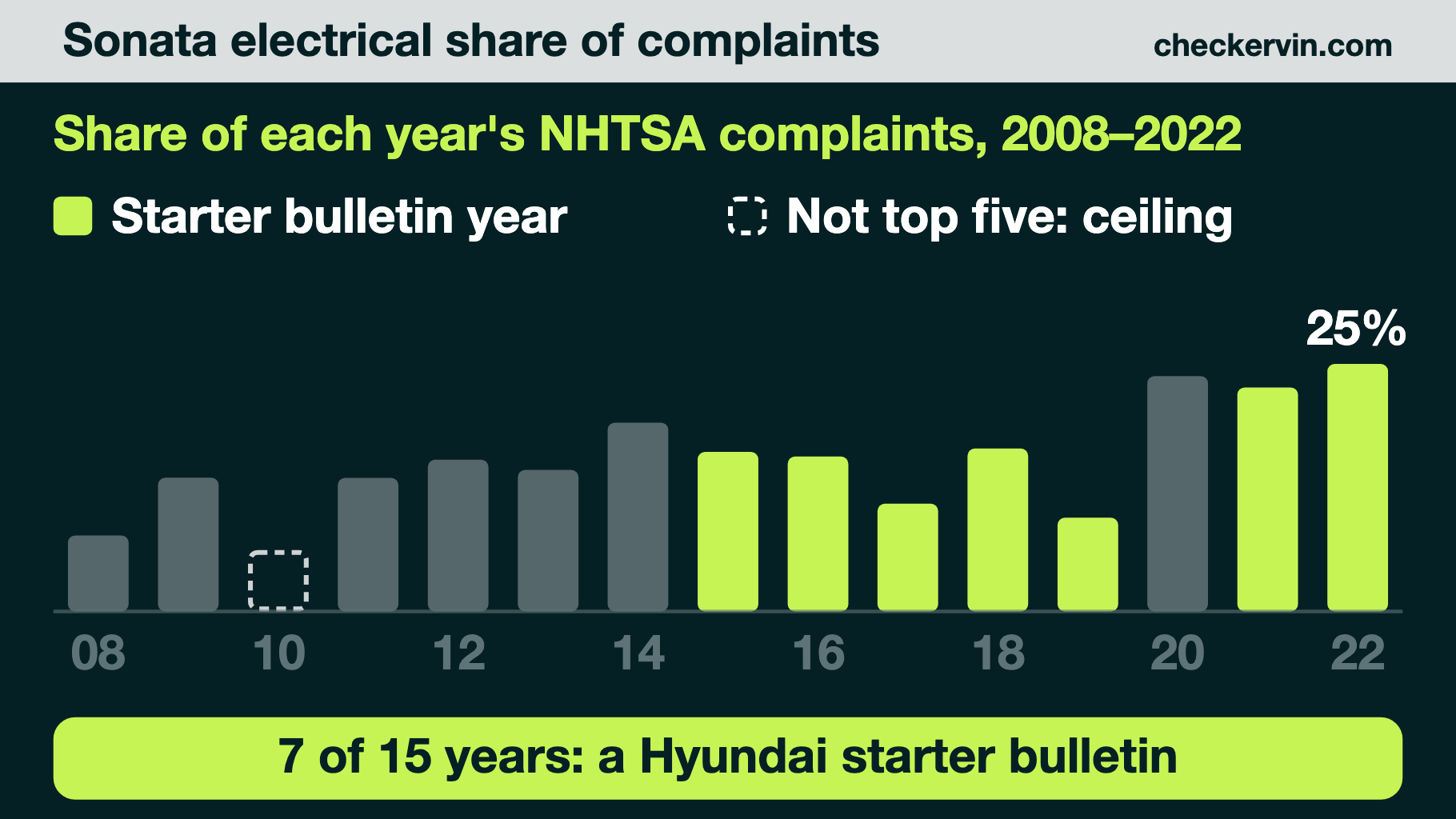
The electrical system makes the top five in 14 of 15 model years, missing 2010, where it sits below a fifth-place component worth about 6% of that year’s complaints (a ceiling, not zero), and it leads only 2022. At least 1,856 electrical reports are counted across those years. The charging side of that record, and the raw counts year by year, are in our Sonata alternator replacement post; here the more telling measure is share.
On 2011–2013 cars the electrical system is about 14% of complaints. On 2020–2022 cars it is about 23%, peaking at 25% on 2022, though on far smaller totals. Hyundai’s two starter-motor bulletins land on the later cars: every year from 2015 to 2019 and 2021 to 2022 in our file. Yet the three years from 2011 to 2013 carry 1,002 counted electrical reports, more than the 569 across all 7 bulletin years combined, and Hyundai wrote no starter-motor bulletin for them. The early-car no-starts sit elsewhere in the paper trail, which the next sections follow.
No crank or no start? The distinction that saves the bill
A starter can only fail one way that matters here: the engine does not turn over. Hyundai’s bulletins are careful about this, and a buyer should be too. A no-crank is silence or a click with the engine still. A crank, no start is the engine spinning normally and refusing to fire, which clears the starter immediately.
The Sonata has a documented example of each that is not the starter. Bulletin 23-FL-004H covers certain 2015–2019 Sonatas with VINs beginning 5NP, built between May 2014 and September 2019, that may show a “Crank/No Start” condition or reduced power from a leaking fuel pump filter housing, with code P1233. Hyundai extended coverage of that filter to 15 years or 150,000 miles for original and later owners. A starter replaced on that car buys nothing.
The no-crank example is worse. Hyundai’s connecting-rod bearing bulletins for the 2.0T and 2.4L engines, which NHTSA files against 2012–2019 Sonatas (its 2011 listing would not load for us), list abnormal noise and a “No Crank/No Start condition” among the signs, with engine replacement or a software update as the outcome. An engine that has seized will not turn for any starter. Recalls 15V-568 (2011–2012) and 17V-226 (2013–2014) cover the same bearing wear; our Sonata engine replacement post tells that story and the warranty extension behind it.
Hyundai's two bulletins aimed at the starter itself
19-EE-007H, certain 2018 Sonatas.On 2.4L and 2.0T cars built between April 12, 2017 and August 13, 2018, Hyundai says the nut on the starter’s M-terminal “may become relaxed and loosened,” producing a no-crank in cold weather while the starter works normally at room temperature. The fix is tightening that nut to a few pound-feet, booked at 0.6 labor hours. Hyundai warns that over-tightening can damage the solenoid, and that skipping the battery disconnect can blow the 180-amp battery fuse or the 30-amp starter fuse and kill starting and charging together. The electrical system ranks second among 2018 Sonata complaints in our file.
26-EE-003H, 2015–2019 and 2021–2023 Sonatas.Issued in April 2026 across eleven Hyundai lines, this bulletin addresses cars that are hard to start in cold weather because the starter’s magnetic switch, the solenoid, can freeze. The remedy is a new solenoid assembly rather than a whole starter: 0.9 hours on the 2015–2019 car and 1.1 hours on the 2021–2023 car, after a 0.3-hour inspection. “Normal warranty applies,” and for cars outside warranty the bulletin tells dealers to request goodwill approval before doing the work. It lists 2021–2023 for the current generation, not 2020.
The inspection doubles as a lesson in diagnosis. Hyundai wants it done in the cold, because the symptom can vanish as the car warms. If the dash lights blink or dim on a start attempt, the bulletin calls that a discharged battery, not a frozen starter. If the engine turns slowly or the starter buzzes, Hyundai says “this is not a freezing problem.” Only silence, no engine movement and no electrical flicker, followed by a failed jump-pack start, leads to the solenoid.
Brake and range switches: the interlocks in front of the starter
A Sonata will not crank unless the computer sees the car in Park or Neutral, and on push-button cars, the brake pedal pressed. Two switches report those facts, and both have Hyundai paperwork.
The stop lamp switch.Recall 13V-113, which NHTSA lists against the 2008–2011 Sonata, replaced the stop lamp switch. Its summary says a failing switch “may also result in intermittent operation of the push-button start feature” besides brake lights and the shift interlock. A separate recall, 15V-759, replaced a brake pedal stopper pad on 2011–2012 cars that could hold the brake light switch plunger out; NHTSA’s summary for that one names brake lights and the shifter, not starting.
The inhibitor, or range, switch.Hyundai’s diagnostic bulletin 19-AT-024H lists “intermittent no engine crank/no start in ‘P’ or ‘N’” among its symptoms and covers 2011–2014 Sonatas, 2015–2019 2.0T and 2.4L cars, 2020-and-later cars, and both hybrid generations through 2019. Its procedure checks transmission fuses and a ground before anything is replaced. An older bulletin, TSB-09-AT-013, describes a misadjusted range switch on 2008–2009 cars with an “impossible engine start in P or N.” On 2017 Sonatas, including the hybrid and plug-in, Hyundai also ran Service Campaign T2M to replace the inhibitor switch; its bulletin states the symptom only as code P0705 and books 0.4 hours.
The tell for a range switch is that the car starts in Neutral but not Park, or after the shifter is jiggled. A starter does not care where the shifter is. The Hyundai recall check shows whether 13V-113 or 15V-759 is still open on a specific car.
Sonata Hybrid: the starter generator does the cranking
Hyundai’s Sonata Hybrid emergency response guide describes a hybrid starter generator mounted at the front of the engine that “cranks the engine for starting” and charges the high-voltage battery. The guide’s component list names no separate starter motor. It prints no model years, so we scope it to the generation it describes and to Hyundai’s own bulletins: for 2017 hybrids, Campaign T2E replaced the generator where its pulley could work loose, with an engine no-start among the symptoms, and for 2016–2017 hybrids, Campaign T4M inspected a high-voltage power relay assembly whose loose connection “could cause a no start condition.”
A generic “starter replacement” price does not describe either repair. We could not confirm whether any Sonata Hybrid also carries a conventional 12-volt starter, or how the 2020-and-later hybrid cranks its engine, so we do not say either way. A shop quoting a starter for a Sonata Hybrid should show you the part number.
What Hyundai's labor times show about the job
Hyundai publishes no full starter replacement time in the bulletins we read, but the procedures reveal the access. On the 2018 2.4L and 2.0T, reaching the starter terminal means disconnecting the battery, raising the car, removing the engine under cover and unbolting an intake manifold stay bracket on the side of the engine, all for a 0.6-hour nut. Replacing the solenoid alone books 0.9 to 1.1 hours. A whole starter takes the same path plus the mounting bolts, so a labor line well under an hour should make you ask what is being skipped, and one of several hours deserves an explanation.
| Hyundai bulletin operation | Labor booked |
|---|---|
| Starter M-terminal nut re-tightening, 2018 2.4L/2.0T | 0.6 hr |
| Starter freezing inspection only | 0.3 hr |
| Inspection plus solenoid, 2015–2019 Sonata | 0.9 hr |
| Inspection plus solenoid, 2021–2023 Sonata | 1.1 hr |
| Inhibitor switch replacement, 2017 Sonata (T2M) | 0.4 hr |
| Fuel filter diagnosis and replacement, 2015–2019 | 0.8 hr |
| Stop-start software update, 2020–2022 | 0.6 hr |
Those are warranty times paid to dealers, not retail quotes, and independent shops use their own guides. They are still the best public evidence of how much work each possibility involves, and every one of them is shorter than a starter swap.
Before you authorize a Sonata starter
- Load-test the battery and clean the terminals; dimming dash lights point at the battery, by Hyundai's own test
- Note whether the engine cranks; a normal crank with no start clears the starter
- Try Neutral as well as Park, and on push-button cars confirm the brake lights work
- On a 2011–2019 2.0T or 2.4L that knocked first, have the crankshaft turned by hand
- On a 2015–2019 or 2021–2023 car with a cold-weather no-crank, ask about TSB 26-EE-003H
- On a 2018 2.4L or 2.0T built April 2017–August 2018, ask about TSB 19-EE-007H
- On a 2015–2019 car that cranks but will not fire, ask about the fuel filter extension
- On a 2020–2022 car that will not restart after stop-start, ask for the software update first
- Get the starter's test result in writing, and whether the quote is for a new or remanufactured unit
If a parts store tests the starter on the bench, it has to come out of the car first, so that test belongs at the end of the list, not the start. The battery size by VIN page reads the correct battery from the build, which matters on stop-start cars that are picky about battery type.
If you are buying the Sonata, not repairing it
A starter is a modest risk on a used Sonata; the things that impersonate one are the bigger ones. Ask for a cold start, listen for a slow or labored crank, and start it once from Neutral. On a 2011–2019 2.0T or 2.4L, ask for the engine paperwork, because a car that “needed a starter” and then a long block tells a different story. On a 2015–2019 car, the fuel filter extension travels with the vehicle to later owners. Our Hyundai engine warranty extension check explains how to confirm engine coverage by VIN, and the Hyundai Sonata years-to-avoid breakdown scores every model year on the full complaint record. If a recall turns up open, read buying a car with an open recall, and for how bulletins differ from recalls in who pays, see our guide to bulletins versus recalls.
Where this information comes from
- Hyundai TSB 26-EE-003H (NHTSA copy) — starter freezing and solenoid replacement2015–2019 and 2021–2023 Sonata: cold-weather no-crank, diagnostic steps, 0.9–1.1 hours, normal warranty.
- Hyundai TSB 19-EE-007H (NHTSA copy) — starter M-terminal nutCertain 2018 Sonata 2.4L and 2.0T: no-crank in the cold, 0.6 hours, and the access path to the starter.
- Hyundai TSB 19-AT-024H (NHTSA copy) — inhibitor/range switch diagnosisIntermittent no-crank in Park or Neutral; covers 2011-and-later Sonatas and the hybrids through 2019.
- Hyundai TSB 17-01-064, Campaign T2M (NHTSA copy) — inhibitor switch replacement2017 Sonata; symptom stated as P0705; 0.4 hours. Later extended to the 2017 hybrid and plug-in.
- Hyundai TSB 23-FL-004H (NHTSA copy) — fuel pump filter warranty extension2015–2019 Sonata crank/no-start and reduced power; 15 years or 150,000 miles.
- Hyundai TSB 24-FL-002H (NHTSA copy) — stop-start restart software2020–2023 Sonata 2.5L may not restart after Idle Stop and Go; software update under normal warranty.
- Hyundai TSB 23-AT-006H-1 (NHTSA copy) — push-button shifter diagnosis2020-and-later Sonata and Sonata Hybrid: shifter faults that can leave the car unable to start.
- Hyundai TSB 20-01-003H, Campaign T4M (NHTSA copy) — hybrid power relay assembly2016–2017 Sonata Hybrid: loose high-voltage connection that can cause a no-start.
- NHTSA recalls API — 2011 SonataReturns 13V-113 (stop lamp switch, push-button start), 15V-759 and the engine bearing recall; none names the starter.
- NHTSA — recalls by VINThe official lookup for open safety campaigns on a specific Sonata.
- Hyundai Sonata Hybrid Emergency Response Guide, ©2015 (third-party-hosted copy)Says the hybrid starter generator cranks the engine; names no separate starter motor.
- YourMechanic — Hyundai Sonata starter replacement estimateThe $338 average ($198 parts, $140 labor) as served in search results on November 22, 2026.
- AutoNation Mobile Service — Hyundai Sonata starter replacementThe $519 average as served in search results on November 22, 2026.
Keep reading
Frequently asked questions
How much does a starter for a Hyundai Sonata cost?
Published averages for the whole job, parts and labor, ran from $338 at YourMechanic (about $198 parts, $140 labor) to $519 at AutoNation Mobile Service in search results we read on November 22, 2026. AAA prints a generic starter range of $350 to $1,100 that is not specific to the Sonata. Before paying either, check whether Hyundai bulletin 26-EE-003H (frozen solenoid, 2015–2019 and 2021–2023 Sonatas) or 19-EE-007H (loose terminal nut, certain 2018 cars) fits the symptom.
How much does it cost to replace the starter on a 2011 Hyundai Sonata?
We found no 2011-specific price we could verify, so the general Sonata averages are the honest guide. On a 2011 the first checks are free or nearly so: recall 13V-113 replaced the stop lamp switch, which NHTSA says can cause intermittent push-button starting, and Hyundai's range switch bulletin lists intermittent no-crank in Park or Neutral for 2011–2014 cars. A 2011–2014 2.0T or 2.4L that will not turn over can also be a seized engine, which no starter fixes.
Is it worth it to replace a starter in a car?
Usually, when the starter is really the fault: it is a few-hundred-dollar repair on most Sonatas, small next to the car's value. The money is wasted when the starter was never the problem. Hyundai's own bulletins blame cold-weather no-crank on a frozen solenoid or a loose terminal nut, and other no-starts on switches, software, a fuel filter or the engine. Ask for the test that condemned the starter before approving one.
Will AutoZone replace a starter?
AutoZone sells starters, and its product pages say a starter can be tested there free of charge. We found no AutoZone statement that its stores install them, so plan on doing the job yourself or paying a shop. On a Sonata the bench test also only helps once the starter is out of the car; testing the battery and the starting circuit first is cheaper.
Does the Hyundai Sonata Hybrid have a starter?
Not in the usual sense, as far as Hyundai's documents show. Its emergency response guide says a hybrid starter generator (HSG) on the front of the engine cranks the engine for starting, and the guide names no separate starter motor. Hyundai's no-start campaigns for 2016–2017 hybrids cover a loose HSG pulley and a high-voltage power relay. We could not confirm the 2020-and-later hybrid's starting hardware, so ask a shop for the exact part number.
Check the VIN before you price the starter
A free CheckerVIN report shows the factory build, engine, specifications and open recalls for any VIN, enough to know which Hyundai starting bulletins to ask about before a starter is ordered.
Run a free VIN check