The short answer
- What does it cost?
- Published Sonata estimates run from YourMechanic's $358 average to a RepairPal range, cited by a parts seller, of $678–$1,012. Most of it is the part.
- Is it really the alternator?
- Often not. Electrical complaints peak on 2011–2013 cars, and owners there mostly describe switches, stalls, steering and lights, not charging.
- Anything free to check first?
- Yes. 2015–2017 1.6T and 2017 2.0T/2.4L Sonatas had Hyundai alternator campaigns, and the hybrid has no conventional alternator at all.
$358–$1,012
Published Sonata alternator estimates
YourMechanic to RepairPal (via Go-Parts), Nov 2026
14 of 15
Years electrical makes the top five
2008–2022 Sonata, federal complaints
54%
Of counted electrical reports
Fall on 2011–2013 model years
0.5 hr
Hyundai's 2017 regulator-screw fix
Service Campaign T1Y, 2.0T and 2.4L
The published prices, and whose they are
No one publishes a single price for this job, and the figures that exist disagree by a factor of almost three. Search results served on November 22, 2026 showed YourMechanic’s Hyundai Sonata alternator replacement average at $358, split into $218 of parts and $140 of labor, and AutoNation Mobile Service’s average at $663. Both are mobile-mechanic services quoting their own rates. Go-Parts, a parts retailer, cites RepairPal for a Sonata range of $678 to $1,012, with labor at $162 to $238 and parts at $516 to $774. RepairPal’s own pages refused our requests, so that range is secondhand and we label it that way.
The useful pattern is in the split rather than the totals. Every source that breaks the job down puts more money in the part than in the labor, which makes the choice of unit the biggest lever on the bill: a new Hyundai alternator, a new aftermarket one and a remanufactured one can differ by more than the whole labor charge. We sell VIN checks, not repairs, and publish no price of our own. What we can add is which Sonatas have a Hyundai campaign that may already cover the fault, which have no conventional alternator at all, and what the federal complaint record says Sonata electrical trouble usually turns out to be.
Which Sonata, and which alternator job
Between 2008 and 2022 the Sonata went through four generations and several engines. The model year narrows the job; the VIN settles it.
| Sonata and engine | What applies |
|---|---|
| 2011–2014 (YF), 2.4L or 2.0T gasoline | Belt-driven alternator; check the 2011–2012 stop-lamp recalls first |
| 2015–2017 (LF), 1.6L Turbo | Manual belt tensioner; Campaign TTT replaced the top mounting bolt |
| 2017 (LF), 2.0T or 2.4L | Campaign T1Y tightened a loose regulator screw on certain cars |
| 2020–2022 (DN8), 2.5L or 1.6T | Smart battery sensor and stop-start; check the blower-fuse bulletin |
| Sonata Hybrid and Plug-in Hybrid | Starter generator plus DC-DC converter, not an alternator |
A Hyundai VIN decode confirms the generation, trim and plant, and the engine lookup by VIN reads the displacement from the factory record. That one check tells you whether a campaign could apply, whether the car is a hybrid, and which labor time the shop should be quoting.
Sonata Hybrid: a starter generator, not an alternator
A Sonata Hybrid still has a gasoline engine and an ordinary 12-volt battery, so it is easy to assume an alternator keeps that battery charged. Hyundai’s emergency response guide for the 2016-and-later Sonata Hybrid describes something else. A hybrid starter generator, mounted at the front of the engine, “cranks the engine for starting and acts as a generator when the HV battery needs charging.” The 12-volt side is fed by a low-voltage DC-DC converter inside the hybrid power control unit; the guide’s jump-start steps say that once the car is in hybrid-ready mode “the LDC will recharge the 12V Auxiliary Battery.”
The starter generator has its own documented weak spot. Hyundai’s Service Campaign T2E covered certain 2017 Sonata Hybrid and Plug-in Hybrid cars where the pulley could work loose on the generator shaft, causing an abnormal noise, a hybrid or check-engine warning, or a car that would not start. The bulletin books 1.6 to 1.7 labor hours to replace the unit. We read the guide for the 2016-and-later car only; the 2011–2015 and 2020-and-newer hybrid guides were not reviewed, so treat their layout as unconfirmed here.
Two Hyundai alternator campaigns worth checking by VIN
Hyundai fixed two gasoline-Sonata charging faults through service campaigns, which a dealer performs free on affected cars. Neither is a safety recall, so neither appears in NHTSA’s recall search; both sit in the manufacturer bulletins NHTSA hosts.
Campaign TTT, 2015–2017 Sonata 1.6L Turbo.These cars use a manual alternator belt tensioner, and Hyundai’s bulletin 16-01-050 says the top alternator mounting bolt “may break over time if it is tightened over specification,” lighting the battery warning lamp and, in some cases, letting the engine overheat. The fix is a new bolt and 0.3 labor hours. One 2015 owner complaint describes the same picture from the driver’s seat: a broken tensioner bracket, a slack belt, then a gradual loss of electrical power.
Campaign T1Y, 2017 Sonata 2.0T and 2.4L.Bulletin 17-01-033-1 says a screw securing the alternator’s regulator may not have been properly torqued at the factory on certain cars, so “the interior and/or exterior lights may flicker” and the charging warning can come on. The repair is tightening that screw, booked at half an hour. The procedure also shows how this alternator is reached: the technician disconnects the battery, lifts the car and removes the engine under cover. Hyundai warns that skipping the battery disconnect can blow the “180A alternator fuse” and leave the charging system dead, which is a useful thing to know if a car comes back from an unrelated repair with no charge.
What 13,246 federal complaints say about the electrical system
Our corpus holds 13,246 NHTSA owner complaints against the 2008–2022 Sonata, hybrids included, and each model year keeps its five most-reported components. NHTSA has no alternator category. The closest is the electrical system, which also takes in the 12-volt battery, fuses, wiring, lighting, switches and electronic modules, so it is a ceiling on alternator trouble, not a measure of it.
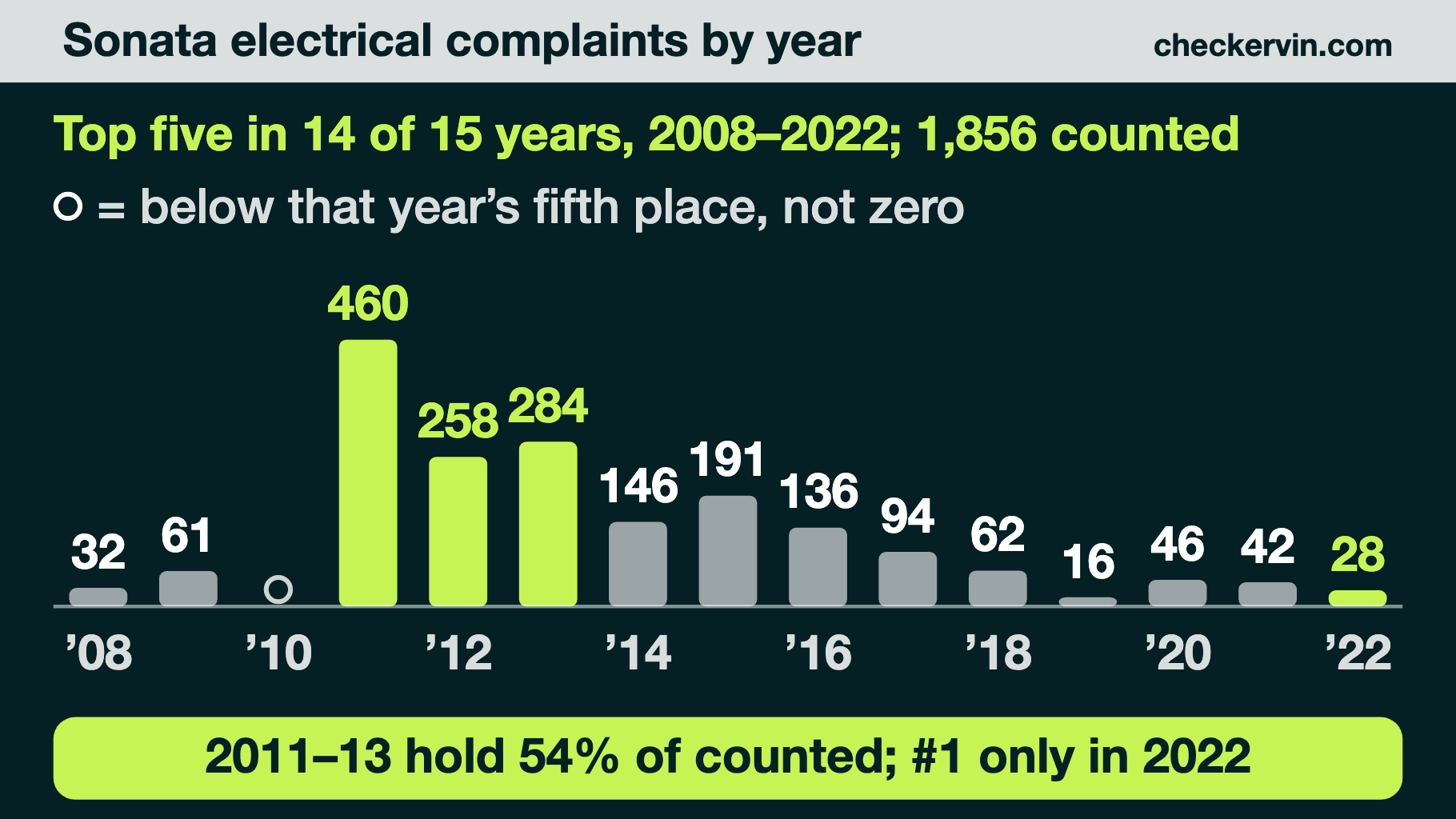
On the Sonata that ceiling is always in view. The electrical system makes the top five in 14 of 15 model years, missing only 2010, where it ranks below a fifth-place component carrying 21 reports (below that line, not zero). Added up, that is at least 1,856 counted reports, about 14% of the nameplate’s complaints. It leads a model year only in 2022.
The weight sits early. The three model years from 2011 to 2013 account for 1,002 counted electrical reports, 54% of the whole, with 2011 the single largest at 460. In those years the category ranks third, behind engine and steering complaints, and makes up about 14% of the complaints filed. On 2020–2022 cars the share climbs to about 23%, but of a far smaller pile: 500 complaints across those three years against 7,210for 2011–2013.
What the 2011–2013 peak is made of
The counts say the electrical system is a large part of the early-2010s Sonata’s record. The narratives say what it is made of, and the alternator is a small part of it. Reading the 2011–2013 electrical complaints, many are filed under the engine as well: stalls and power loss that belong to the Theta II engine story, which our Sonata engine replacement post covers in full. Others describe a brake light that stays on or will not light, push-button start that works only sometimes, sudden loss of steering assist, headlights going out, smart-key faults, and burning smells.
Several of those have a recall behind them. Campaign 13V-113 replaced the stop lamp switch on 2007–2011 Sonatas, and Hyundai’s recall notice lists intermittent push-button starting, a shifter that will not leave Park and an ESC warning light among the possible effects. Campaign 15V-759 replaced a deteriorating brake pedal stopper pad on 2011–2012 cars that could leave the brake light switch plunger extended. Campaign 16V-190 covered the electronic power steering circuit board on early 2011 cars. Any of those can look like an electrical gremlin on a quote.
Alternators are named rarely, and often in a list of parts an owner has already replaced without curing the problem: an alternator and battery swapped three times on a car that kept draining, or headlights still failing after a second alternator. Owners of the 2011–2015 Sonata Hybrid describe a different event, a “Hybrid System Warning” or “Check Charging System” message and a loss of power, which is a hybrid-system diagnosis, not a belt-driven part.
2020–2022: the blower fuse, not the alternator
The newest cars in our record have the smallest complaint totals and the highest electrical share, and the narratives point at one circuit. Owners of 2020–2022 Sonatas describe the heater and air-conditioning fan quitting, and a melted multi-fuse or burned terminal in the engine-room fuse box when someone looks. Hyundai has two bulletins on it. TSB 20-HA-003H covers early 2020 cars with an inoperative A/C traced to a junction-box terminal, at 0.8 labor hours. TSB 25-EE-002H, from April 2025, replaces the multi-fuse and reroutes the blower wiring with a kit on 2020–2022 and 2021–2023 Sonatas within stated build dates, at 0.7 hours. Both say normal warranty applies.
The other recurring theme is a 12-volt battery that goes flat while parked. These cars track the battery with a sensor, and Hyundai’s stop-start bulletin 20-FL-004H says the engine will not auto-stop below a 70% state of charge, that the sensor needs a four-hour rest to recalibrate after a battery cable is disconnected, and that the battery “may not get adequate charging when driving short distances and frequent stop & go situations.” Hyundai’s later battery-diagnosis bulletin, 23-EE-010H, has dealers read 30 days of that sensor history for 2021-and-newer Sonatas. Its “charging defect” result, R03, reads “Abnormal charging current detected, replace battery.” Even Hyundai’s own charging verdict ends at the battery.
What the recall record covers, and what it doesn't
We queried NHTSA’s recall database for every Sonata and Sonata Hybrid model year from 2008 through 2022 and filtered for electrical components, batteries and charging. The search clearly sees electrical campaigns: beyond the stop-lamp recalls above, it returns an ABS warning-light software fix for 2015–2016, a smart junction box turn-signal update for 2015–2017, an accessory-socket fire risk on the 2011–2012 Sonata Hybrid, and a 2020 parking-assist software recall.
None of them names the alternator or the charging system, so no recall pays for this part. The two alternator fixes Hyundai did make were service campaigns, which is why the distinction matters; our guide to bulletins versus recalls explains how each is paid for. The Hyundai recall check shows which safety campaigns are still open on a specific car, and if one turns up on a car you are buying, read buying a car with an open recall before you negotiate.
Test before you buy the part
Because the alternator is the expensive guess and the battery, the fuse box or a campaign is often the real answer, the order of checks matters. Each step below is cheap or free.
- Load-test the 12-volt battery after a full charge; a weak battery fails here and the alternator is off the hook
- Run a charging-system test with the engine on; parts stores and dealers do it in minutes
- Inspect the belt and tensioner; on a 2015–2017 1.6T, ask about Campaign TTT's mounting bolt
- On a 2017 2.0T or 2.4L with flickering lights, ask whether Campaign T1Y is done
- If the car dies only after sitting, test for a parasitic drain before touching the charging side
- On a 2020–2022 car with a dead blower, have the engine-room fuse box inspected before anything else
- After any battery work on a stop-start car, allow the battery sensor its four-hour recalibration
Battery fit matters too: the wrong group size or type can shorten its own life and trip the stop-start logic. Our battery size by VIN page reads the right one from the car’s build.
Reading a Sonata alternator quote
- The test result that justified the part: battery, charging output, or drain
- New Hyundai, new aftermarket or remanufactured unit, and the warranty on each
- Core charge, and whether it is refunded when the old unit is returned
- Whether the belt is being replaced and the tensioner checked while it is off
- That the battery was disconnected first, so the high-amp alternator fuse survives
- On a hybrid, the actual part number, since there is no conventional alternator
The first item is the one most often missing. A quote that cannot say which test the alternator failed is a quote for a guess, and on this car the federal record suggests the guess is usually somewhere else in the electrical system.
If you are buying the Sonata, not repairing it
A charging fault is one of the cheaper things to find on a used Sonata and one of the easier to test for on the lot. Ask for a cold start, watch for a battery or charging lamp once the engine is running, switch on the headlights and the blower and look for flicker, and on a 2020–2022 car run the fan on every speed. A seller who has replaced batteries more than once may have been fighting a drain or a fuse-box fault rather than bad batteries.
The electrical system stays in the top five on every 2015–2017 Sonata, the campaign years above, and ranks fourth on 2017. The Hyundai Sonata years-to-avoid breakdown scores each model year on the whole complaint record, where engine complaints dominate most years. A VIN warranty check settles whether any factory coverage is left on a newer car, which matters here because both blower-fuse bulletins and the battery-diagnosis procedure run under normal warranty.
Where this information comes from
- Hyundai TSB 17-01-033-1, Campaign T1Y (NHTSA copy) — loose alternator regulator screwCertain 2017 Sonata 2.0T and 2.4L: flickering lights, charging warning, 0.5 labor hours, 180A alternator fuse warning.
- Hyundai TSB 16-01-050, Campaign TTT (NHTSA copy) — top alternator mounting bolt2015–2017 Sonata 1.6L Turbo with a manual tensioner: bolt can break, battery light, possible overheating.
- Hyundai TSB 17-01-045-2, Campaign T2E (NHTSA copy) — hybrid starter generator2017 Sonata Hybrid and Plug-in Hybrid: loose generator pulley, noise or no-start, 1.6–1.7 hours to replace.
- Hyundai TSB 25-EE-002H (NHTSA copy) — multi-fuse and blower wiring repairThe 2020–2023 Sonata fuse-box fault behind many recent electrical complaints; normal warranty applies.
- Hyundai TSB 20-HA-003H (NHTSA copy) — engine-room junction box terminalEarly 2020 Sonata with inoperative A/C traced to a junction-box terminal, 0.8 labor hours.
- Hyundai TSB 20-FL-004H (NHTSA copy) — stop-start and battery sensor recalibrationThe 70% charge threshold, the four-hour sensor reset and the short-trip charging warning on the 2020 Sonata.
- Hyundai TSB 23-EE-010H (NHTSA copy) — GDS battery diagnosisHow dealers read 30 days of battery-sensor history on 2021-and-newer Sonatas, including the charging-defect result.
- NHTSA recalls API — 2011 SonataReturns the stop-lamp switch and brake-pedal stopper recalls; our 2008–2022 query found none for the alternator.
- NHTSA — recalls by VINThe official lookup for open safety campaigns on a specific Sonata.
- Hyundai Sonata Hybrid Emergency Response Guide, ©2015 (third-party-hosted copy)Describes the hybrid starter generator and the DC-DC converter that recharges the 12-volt battery.
- YourMechanic — Hyundai Sonata alternator replacement estimateThe $358 average ($218 parts, $140 labor) as served in search results on November 22, 2026.
- Go-Parts — Hyundai Sonata alternatorsA parts seller citing RepairPal at $678–$1,012; secondhand, not confirmed on RepairPal's own page.
Keep reading
Frequently asked questions
How much does it cost to replace a Hyundai Sonata alternator?
Published estimates are wide. Search results served in November 2026 showed YourMechanic's Sonata average at $358 ($218 parts, $140 labor) and AutoNation Mobile Service's at $663. A parts seller, Go-Parts, cites RepairPal at $678 to $1,012, with labor of $162 to $238 and parts of $516 to $774; we could not open RepairPal's own page to confirm it. The unit you choose (new Hyundai, new aftermarket or remanufactured) moves the bill more than labor does, because on most Sonatas the part is the larger share.
How much does it cost to replace a 2011 Hyundai Sonata alternator?
We found no published 2011-specific figure we could verify, so the general Sonata ranges above are the honest guide. Before paying for one on a 2011, check two free recalls: 13V-113 replaced the stop lamp switch, whose failure Hyundai says can cause intermittent push-button starting and an ESC warning light, and 15V-759 replaced the 2011-2012 brake pedal stopper pad behind a stuck brake light switch. Both produce electrical-looking symptoms that no alternator will cure.
Does the Hyundai Sonata Hybrid have an alternator?
Not a conventional one. Hyundai's emergency response guide for the 2016-and-later Sonata Hybrid describes a hybrid starter generator that cranks the engine and generates power for the high-voltage battery, and a low-voltage DC-DC converter that recharges the 12-volt battery. On the 2017 Sonata Hybrid and Plug-in Hybrid, Hyundai ran Service Campaign T2E for a loose pulley on that starter generator. A shop quoting an ordinary alternator for a Sonata Hybrid should show you the part number.
Can I drive a Sonata with a bad alternator?
Only as far as the battery lasts, and not safely. When the alternator stops charging, the car runs everything from the 12-volt battery until it is drained, then warning lights stack up, accessories quit and the engine can stall, which Sonata owners describe happening at highway speed. Hyundai's own campaign bulletins list flickering lights and the charging warning lamp as the early signs. If the battery light comes on while driving, head for a shop rather than home.
How long does a Hyundai Sonata alternator last?
Hyundai does not publish a replacement interval for it; the alternator is replaced when it fails a test. What shortens its working life on a Sonata is usually something around it: a weak battery that keeps it working hard, a slipping belt or failed tensioner, or, on specific cars, a defect Hyundai already campaigned, such as the 2015-2017 1.6-liter turbo's top mounting bolt or the 2017 2.0T and 2.4L loose regulator screw.
Know the engine before you price the alternator
A free CheckerVIN report shows the factory build, engine, specifications and open recalls for any VIN, so you know whether a campaign might apply, whether the car is a hybrid, and which job the quote should describe.
Run a free VIN check