The short answer
- What does it cost?
- One used-engine seller quotes $2,300-$5,000 installed with a used engine, $3,800-$6,500 remanufactured and $6,000-$9,000 new from a dealer. Its figures, not ours.
- Which years carry the engine record?
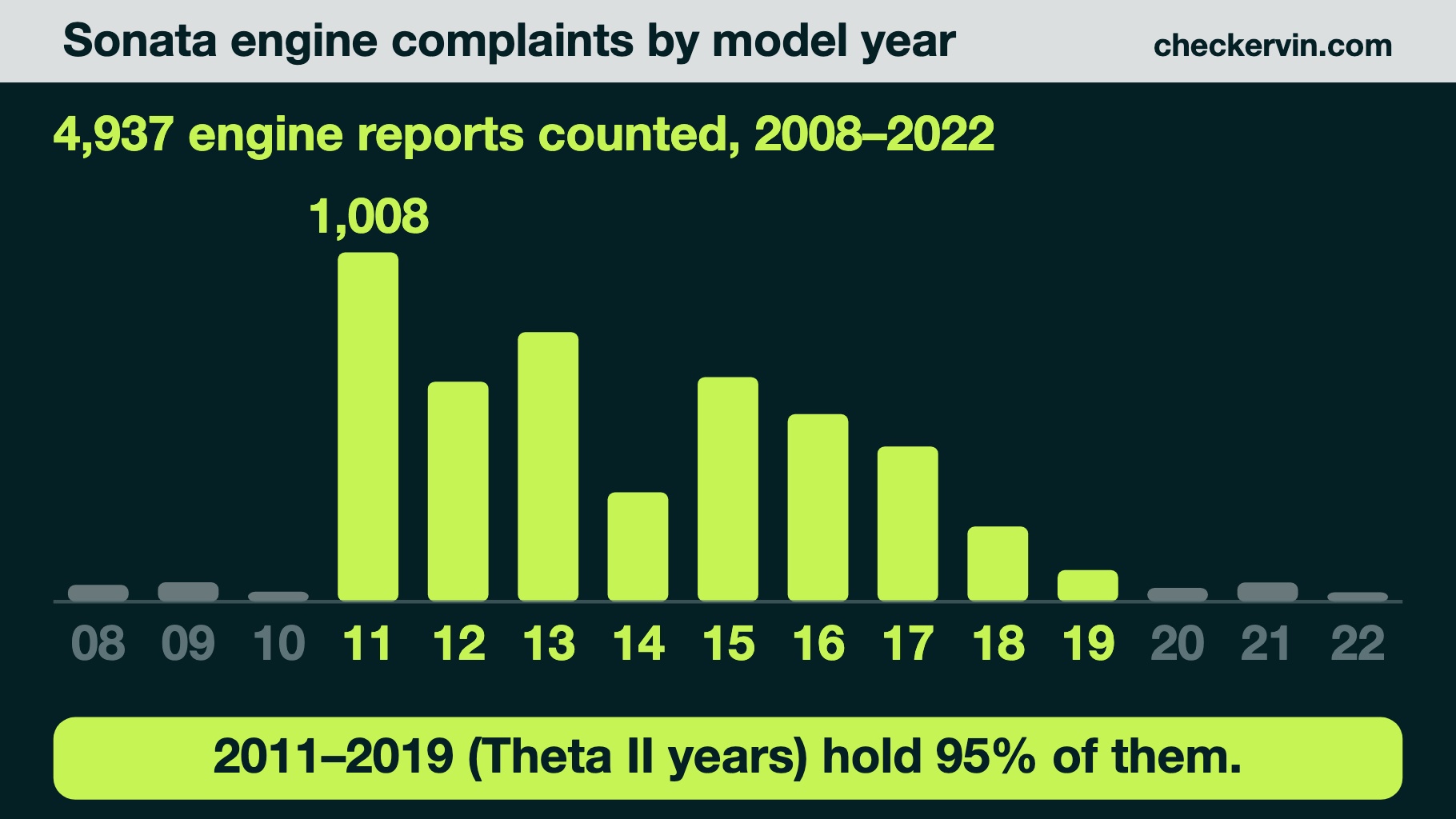
- 94.8% of the Sonata's counted engine complaints sit in 2011-2019, the years Hyundai's Theta II bearing extension names.
- Could Hyundai pay instead?
- On a 2011-2019 2.0T or 2.4 GDI car with rod-bearing failure, possibly, for life. It hinges on knock-sensor Campaign 953 being done and on the title and condition terms.
The prices on this search, and who set them
The page Google’s AI summary leans on for this query is a cost guide from Premium Used Auto Parts, a seller of used engines, dated October 15, 2026 and labeled as AI-assisted and editor-reviewed. Its installed totals are $2,300 to $5,000 with a used engine ($6,000 on 2020-and-newer cars), $3,800 to $6,500 with a remanufactured engine, and $6,000 to $9,000 for a new Hyundai engine installed by a dealer. It puts labor at $1,000 to $2,100, figured at $110 to $160 an hour, and says fluids, gaskets, mounts and a coolant flush usually add $300 to $600. We read those figures on November 22, 2026.
| Route, per Premium Used Auto Parts | Engine / installed total |
|---|---|
| Used engine | $900-$4,000 / $2,300-$5,000 |
| Remanufactured | $2,500-$4,200 / $3,800-$6,500 |
| New Hyundai engine, dealer | $4,500-$7,000 / $6,000-$9,000 |
Keep in mind who wrote that table: a business that sells the cheapest of the three routes. RepairPal and Kelley Blue Book, the usual neutral references, publish no Sonata engine-replacement estimate that we could find, and the higher “average” numbers circulating on aggregator sites come with no method we could check, so we leave them out. We sell VIN checks, not engines. What we can add is the part that decides whether any of these numbers lands on you.
What 13,246 federal complaints say about Sonata engines
Our corpus holds 13,246 NHTSA owner complaints against the 2008–2022 Sonata, hybrids and plug-ins included. ENGINE sits among the five most-reported categories in 15 of those 15 model years and is the single most-reported category in 9 of them. Across the span it accounts for 4,937 complaints, 37.3% of the record.
A caution before the sharper number. NHTSA files every engine complaint under ENGINE: knocking, stalling, oil burning, warning lights, leaks, fires that started under the hood. It is the ceiling on how many owners reported an engine problem, not a count of engines that had to be replaced.
With that said, the distribution is lopsided. The 2011–2019 model years hold 4,682 of the 4,937, or 94.8%. Split by generation, the 2011–2014 YF car carries 2,737and the 2015–2019 LF car 1,945. The three years before carry 133 between them and the three after carry 122. 2011 has the most engine reports of any year, at 1,008, yet even there ENGINE ranks second, behind steering, in a model year that drew 3,474 complaints of every kind.
The LF years tell it differently. Their totals are smaller, but in every one of them engine complaints are more than half of what owners reported against that model year, never lower than 51%. On a 2015–2019 Sonata, an owner complaint is more likely to be about the engine than about everything else combined.
Six Sonatas, six different answers on who pays
“Sonata” covers at least six engine situations between 2008 and 2022, and each one routes an engine failure to a different payer. This is the map we built from Hyundai’s bulletins and NHTSA’s recall file.
| Sonata | Where an engine failure goes first |
|---|---|
| 2008-2010 (NF generation) | No engine recall or extension in the federal file; usually your bill |
| 2011-2014 gas, 2.0T or 2.4 GDI (YF) | Recalls 15V-568 or 17V-226, then Hyundai's lifetime bearing extension |
| 2011-2015 Sonata Hybrid | Settlement extension (see below); 2011-2013 also in recall 20V-746 |
| 2015-2019 gas, 2.0T or 2.4 GDI (LF) | No NHTSA recall; Campaign 953 plus the lifetime bearing extension |
| 2016-2019 Hybrid and Plug-In | Settlement extension; 2016 in recall 20V-746, 2017 in 21V-727 |
| 2020-2022 (DN8 generation) | Hyundai's standard powertrain warranty, if any remains |
Two details in that table catch people. The 2015 Sonata Eco used a 1.6-liter turbo, and Hyundai’s lifetime bulletin lists only the 2.0-liter turbo and 2.4-liter engines, so an Eco is outside it. And the hybrids sit in a separate class-action settlement with its own terms. Our breakdown of Hyundai’s two engine warranty programs covers which engine lands in which program, so we will not repeat it here.
The engine recalls in NHTSA’s file, campaign by campaign
We queried NHTSA’s recall database for every Sonata and Sonata Hybrid model year in our span. These are the campaigns that touch the engine or the fuel system bolted to it.
| Campaign | Sonata years and what it does |
|---|---|
| 15V-568 (Hyundai 132) | 2011-2012 Alabama-built 2.0/2.4 GDI: crankshaft debris, rod bearing damage; inspect, replace engine |
| 17V-226 (Hyundai 162) | 2013-2014: machining errors, bearing wear; inspect, replace short block |
| 18V-934 (Hyundai 180) | 2011-2014 cars already repaired under 15V-568 or 17V-226: high-pressure fuel pipe may leak |
| 20V-121, then 22V-312 | 2013-2014: low-pressure fuel hose can crack from engine heat |
| 20V-746 (Hyundai 198) | 2011-2013 and 2016 Sonata Hybrid: rod bearings; inspect, replace engine, install KSDS |
| 21V-727 (Hyundai 209) | 2017 Sonata Hybrid: same bearing remedy and KSDS |
| 21V-524 | 2021-2022 2.5-liter turbo: fuel leak at the high-pressure pipe |
| 25V-796 | 2020-2022: fuel-tank check valve, tank inspection, engine software update |
The gap matters as much as the list. The gasoline 2015–2019 Sonata, the generation where engine complaints make up most of each year’s record, has no engine recall at all. We confirmed the query works by watching it return 15V-568 and 17V-226 for the earlier years, so the empty result is a real one. Hyundai handled the LF car through a software campaign and a warranty extension instead, which is why its coverage is easy to miss.
18V-934 has a cost lesson of its own. It exists because engines swapped under the first two recalls could leave the high-pressure fuel pipe damaged, misaligned or under-torqued. If a Sonata has already had a campaign engine, confirm 18V-934 is closed, and if you pay an independent shop for a swap, ask how it handles that pipe.
What the lifetime extension pays for, and what it leaves out
Hyundai’s January 2022 dealer guidance for warranty extension TXXI covers “engine long block repair or replacement” when the damage comes from connecting rod bearing wear, for life, for original and subsequent owners. Long block means the full engine assembly, not a part. A parallel extension, TXXC, sets 10 years or 120,000 miles on the same Sonata years. For an owner looking at a dead engine, the fine print shapes the cost more than the headline does.
- Only bearing wear qualifies. Hyundai's dealer guide says engine conditions unrelated to the campaign, giving oil consumption as its example, follow standard warranty rules
- Every claim needs Hyundai prior approval, with photos, video and bearing-clearance test results from the dealer
- The April 2022 bulletin lists settlement conditions on Campaign 953 completion, certain neglect, branded or salvage vehicles, and some commercial used-car owners
- Hyundai's talk track has dealers quote an hour of diagnosis, free if the repair turns out to be covered
- Dealers are told not to charge diagnosis on a car that already had Campaign 953 and returns with code P1326 or in Engine Protection Mode
- Rental or loaner costs for those cars are reimbursed to the dealer whether or not the engine claim is approved
That last pair is worth knowing before you walk in. A knock-sensor alert on a car with 953 done should not cost you a diagnostic fee, and asking for a loaner while Hyundai reviews the claim is a reasonable request under its own process.
The campaign a recall lookup will not show you
The knock sensor detection software that the lifetime extension depends on reached gasoline Sonatas as Hyundai Product Improvement Campaign 953, launched in late 2018. Hyundai filed its bulletins with NHTSA as manufacturer communications, and we found them in NHTSA’s communications listing for the 2013 and 2016 Sonata. They are not safety recalls, so they do not show up in a recall search by VIN.
The practical result: a gasoline 2011–2019 Sonata can come back clean on a recall check while 953 is still open, and Hyundai’s own guidance says an open 953 means the engine is not covered by the extension. Hyundai’s campaign lookup on its owner site, or any Hyundai service desk, can read 953 status off the VIN. Hybrids are the exception, because their knock-sensor software came through actual recalls (20V-746 and 21V-727), which a recall search does list.
A 2026 campaign that LF owners should not skip
A newer campaign sits on many of the same engines. In 2026 Hyundai began Service Campaign 9C2, an engine control software update for 2015–2019 Sonatas with the 2.4-liter GDI Theta II, after finding that some of these engines may emit pollutants above federal and California limits. The owner letter says the update takes under 30 minutes at no charge, and that California and the states that follow its rules may ask for proof of the fix at registration.
The letter also says skipping it “could also be considered a lack of proper maintenance.” The lifetime extension’s terms carve out certain neglect. We cannot tell you how Hyundai would weigh an open 9C2 against a bearing claim, and we have seen no document that links the two, but a free 30-minute update is a cheap way to keep the question from coming up.
When the bill is yours
Three groups end up paying out of pocket: the 2008–2010 Sonata, which no engine program names; the 2020–2022 car once its factory coverage is spent; and any 2011–2019 car whose failure is not bearing wear or whose claim fails the conditions. Hyundai’s warranty page lists 10-year/100,000-mile powertrain coverage for the original owner only. Several secondary sources, including AutoGuide and The Drive, say later owners get 5 years/60,000 miles instead, so on a 2022 Sonata bought used, the start date on that clock matters.
Out of pocket, the three routes in the price table carry different risks. A used engine is cheapest and comes with whatever mileage and history the donor car had. On a 2011–2019 car that includes the chance of a donor engine from the same bearing-prone family without the campaign work done. A remanufactured unit costs more and carries the rebuilder’s warranty, so read its terms: reman-engine.com, one seller on this search, advertises a “No-Fault Warranty” that includes parts and labor, and like most rebuilders it works on a core-return basis. A new Hyundai engine from a dealer is the top of the range.
For a car worth little more than the repair, compare the quote against the car’s running value first. Our post on what does and does not pay for a blown engine covers why gap insurance is not the backstop people hope it is.
Match the engine before you buy one
A “2.4 Sonata engine” is not one part. Reman-engine.com lists two different 2.4-liter Hyundai engines for the Sonata: the G4KE with multi-point injection and the G4KJ with direct injection. Add the 2.0-liter turbo, the 1.6-liter turbo, the hybrids, and the 2.5-liter engines in the 2020-and-newer car, and a listing that matches on model year alone can be the wrong engine.
The engine is coded in the VIN. A Hyundai VIN decode and an engine lookup by VINsettle which one the car left the factory with, and that same answer decides whether the car is inside Hyundai’s bulletins at all. Do it before you order a part or accept a quote.
The order to check things in, before you pay
- Decode the VIN: model year, generation and exact engine code
- Run a recall check for open safety recalls, including 15V-568, 17V-226, 18V-934, 20V-746 or 21V-727 where they apply
- Ask a Hyundai dealer, by VIN, for Campaign 953 and 9C2 status, any prior campaign engine, and the extension position
- Check the title for a salvage or other brand, since the lifetime terms carve out branded and salvage vehicles
- Get the diagnosis in writing: bearing wear, or something else
- Only then compare used, remanufactured and new quotes on the same scope, fluids, mounts and fuel-pipe work included
The recall step is free through our Hyundai recall check, and our guide to bulletins versus recalls explains why a campaign like 953 sits outside that lookup. For the title step, an NMVTIS report from an approved provider shows reported brands.
If you are shopping for a Sonata, not repairing one
The 2011–2019 years carry most of the engine record, and they are also the years with the strongest manufacturer backstop. A car from that span with the 2.0-liter turbo or 2.4-liter GDI, Campaign 953 done, no title brand, and service records is a different purchase from the same car with 953 open and a salvage brand. The seller’s paperwork is worth more than the model year here.
For the whole-car picture, not only the engine, see which Sonata model years draw the most complaints overall, including the 2011’s steering record. Our Sonata transmission post shows how quiet the gearbox is next to all this, so a Sonata’s drivetrain budget mostly belongs to the engine.
Where this information comes from
- NHTSA recalls API — Sonata by model yearQueried for every Sonata 2008-2022 and Sonata Hybrid 2011-2019; source of every campaign number and remedy on this page.
- NHTSA-hosted Hyundai TXXI dealer best practice (January 19, 2022)Read in full: lifetime long-block term, Campaign 953 qualification, Sonata YF and LF years, diagnosis talk track.
- NHTSA-hosted Hyundai TSB 22-EM-001H-1 (TXXI)The settlement conditions on neglect, branded or salvage vehicles and commercial owners.
- NHTSA-hosted Hyundai T3G / TXXC / TXXI dealer best practice (rev. April 15, 2022)Prior approval, the oil-consumption exclusion example, no-charge diagnosis and rental reimbursement rules.
- NHTSA-hosted Hyundai TSB 22-EM-002H-1 (TXXC)The parallel 10-year/120,000-mile long-block extension on the same Sonata years.
- NHTSA-hosted Hyundai Campaign 9C2 owner letter (2026)The 2015-2019 Sonata 2.4 GDI emissions software update and its maintenance warning.
- Premium Used Auto Parts — Hyundai Sonata engine replacement costThe used, remanufactured and new price ranges quoted above, dated October 15, 2026, read November 22, 2026.
- Reman-engine.com — 2.4-liter Hyundai/Kia enginesThe G4KE and G4KJ Sonata engine codes and the warranty wording, opened November 22, 2026.
Keep reading
Frequently asked questions
How much does it cost to replace a Hyundai Sonata engine?
Premium Used Auto Parts, a used-engine seller, puts the installed total at $2,300 to $5,000 with a used engine, $3,800 to $6,500 with a remanufactured one, and $6,000 to $9,000 for a new Hyundai engine installed by a dealer, with labor at $1,000 to $2,100. Those are its figures from an October 15, 2026 post, read on November 22, 2026; we sell VIN checks, not engines, and publish no price of our own. On a 2011-2019 Sonata with the 2.0-liter turbo or 2.4-liter GDI engine, check Hyundai's coverage before comparing any of them.
Will Hyundai replace my Sonata engine for free?
Possibly, if it is a 2011-2014 or 2015-2019 Sonata with the 2.0-liter turbo or 2.4-liter GDI engine and the failure is connecting rod bearing wear. Hyundai's bulletins extend long-block coverage for that failure to a Limited Lifetime Warranty for original and subsequent owners, on conditions: the Knock Sensor Detection System update (Campaign 953) must be done, and the settlement terms carve out certain neglect, branded or salvage vehicles, and some commercial owners. Every claim goes through Hyundai prior approval. Other engine failures, such as oil consumption, fall under standard warranty rules.
What year to stay away from Hyundai Sonata?
For engine risk, the federal record points at 2011-2019. Computed from our NHTSA corpus, those nine model years hold 4,682 of the 4,937 engine complaints counted across 2008-2022 (94.8%), and in every 2015-2019 model year engine complaints are more than half of everything owners reported. Those are also the years Hyundai's lifetime bearing extension names, so a well-documented car with the knock-sensor update done can be a safer buy than its year suggests. Complaints are unverified owner reports, not failure rates.
Will a free recall check show whether my Sonata's engine is covered?
Not fully. A recall lookup lists safety recalls such as 15V-568 (2011-2012) and 17V-226 (2013-2014), but the Knock Sensor Detection System update on gasoline Sonatas is Hyundai Product Improvement Campaign 953, filed with NHTSA as a manufacturer communication rather than a recall, and the lifetime extension is a warranty term, not a recall. A Hyundai dealer or Hyundai's own campaign lookup can show 953's status on the VIN. The Sonata Hybrid is different: its knock-sensor updates came through recalls 20V-746 and 21V-727.
Can a Hyundai Sonata last 300,000 miles?
Our data cannot answer that. NHTSA complaints record what owners reported and at what model year, not how far engines run, so we have no mileage-survival figure for the Sonata and will not invent one. What the record does show is where engine complaints cluster: 2011-2019. On those cars the more useful question is whether the knock-sensor update was installed and whether the engine has already been replaced under a campaign, because both affect what a high-mileage failure would cost you.
Know the engine before anyone quotes one
A free CheckerVIN report shows the factory build, engine, specifications and open recalls for any VIN, so you know which Sonata you are pricing and which bulletins could apply.
Run a free VIN check