The short answer
- What does it cost?
- RepairPal lists $623–$775. KBB serves $806–$898 for a 2016 Fusion near Columbus, Ohio, and $869–$969 for a 2020 near Snohomish, Washington.
- What is the catch?
- Ford documents coolant entering the cylinders on 2014–2019 1.5L and 2015–2019 2.0L EcoBoosts. That fix is an engine, not a pump.
- Is anything free?
- No recall names the pump. Ford's 1.5L programs 19B37 and 21N12 cover only 2017–2019 Fusions; a dealer checks the VIN.
3,279
Fusion ENGINE complaints counted
2008–2020, top-five data
2015–2019
Years ENGINE ranks No. 1
Of all NHTSA categories
19.2 hrs
Ford labor, 1.5L short block
Fusion, TSB 19-2375 / 21N12
$623–$775
RepairPal, Fusion pump
Parts and labor, no year given
The prices, and whose they are
We sell no repairs and publish no price of our own, so every dollar figure here belongs to the site that published it, retrieved on November 22, 2026. RepairPal’s Fusion estimator lists $623 to $775 for a water pump replacement, made up of $314 to $461 in labor and $308 to $313 in parts. It does not name a model year or an engine. YourMechanic’s Fusion page shows an average of $324, $128 for parts and $196 for labor, which is a mobile-mechanic price rather than a shop price.
Kelley Blue Book prices by year and ZIP code. As served for specific ZIP codes, its 2010 Fusion page shows $659 to $800 near Stow, Ohio; its 2016 page $806 to $898 near Columbus; and its 2020 page $869 to $969 near Snohomish, Washington. Opened without a ZIP, the same KBB pages show only a generic $375 to $787 line that appears across Ford models, and we do not treat that as a Fusion estimate. RepairPal and YourMechanic refused our tools, so their figures are as their pages appear in search results.
Every one of those numbers prices the common case: a belt-driven pump bolted to the outside of a four-cylinder. None of them asks which of the Fusion’s eight gasoline engines you have, and several of them break the assumption in opposite directions.
Which engine you have, by model year
The federal fuel economy records at fueleconomy.gov list every engine Ford certified for the Fusion. That list decides which pump, which bulletins and which recalls apply:
| Model years | Engines EPA lists for the Fusion |
|---|---|
| 2008–2009 | 2.3L four; 3.0L V6 |
| 2010–2012 | 2.5L four; 3.0L V6 (flex fuel); 3.5L V6; 2.5L hybrid |
| 2013 | 1.6L turbo four; 2.0L turbo four; 2.5L four; 2.0L hybrid and Energi plug-in |
| 2014–2016 | 1.5L turbo four; 2.0L turbo four; 2.5L four; hybrid; Energi (1.6L manual in 2014 only) |
| 2017–2019 | 1.5L turbo four; 2.0L turbo four; 2.7L turbo V6 (AWD); 2.5L four; hybrid; Energi |
| 2020 | 1.5L turbo four; 2.0L turbo four; 2.5L four; hybrid; Energi |
The 2014–2019 rows matter most for a coolant complaint, because two of the engines sold in those years have Ford bulletins for coolant in the cylinders. An engine lookup by VINsettles which one a particular Fusion carries, and the 1.5L and 2.0L look alike enough under a plastic cover that it is worth doing before a shop writes “water pump” on the work order.
What turns the pump, engine by engine
A water pump that carries its own pulley is spun by a belt outside the engine, which is the cheap case. We opened Ford’s own parts pages on ford.com and read each one’s fitment list on November 22, 2026. Pulley HJ5Z-8509-A lists the 2010–2020 Fusion with the 2.0L and 2.5L. Pulley AE8Z-8509-A lists the 2013–2015 Fusion 1.6L. Pulley DS7Z-8509-A, titled for the 1.5L Escape and Fusion, lists the 2014–2020 Fusion. Pulley FT4Z-8509-B lists the 2017–2019 Fusion with the 2.7L V6. So every four-cylinder gas Fusion from 2010 on, and the 2.7L Sport, has a pump a mechanic reaches from the front of the engine.
The 2010–2012 3.5L V6 is the exception. A federal court opinion in Roe v. Ford Motor Co., summarizing the owners’ complaint, says Ford’s “Cyclone” V6 powered the Fusion among other models and placed the water pump inside the engine, driven by the timing chain. Those are allegations the court was describing, not findings, but they match why the Explorer’s 3.5L pump job costs so much more. No estimator above prices that version.
Two engines we could not settle from Ford’s catalog. Ford sells a Motorcraft pump titled for the 3.0L Escape and Fusion, and aftermarket listings sell the 2010–2012 3.0L pump with a pulley, but we did not open a Ford page showing one. For the hybrids, Ford lists an “Engine Auxiliary Water Pump” (PW589) for the 2013–2020 Fusion 2.0L and the 2019–2020 plug-in hybrid police model, and a 2013–2014 Ford engineering notice describes inspecting Fusion Hybrid “water pump connectors”, so at least one pump on those cars is wired. We could not confirm what drives the hybrid’s main pump. Our Fusion hybrid battery post covers the rest of that car’s cooling hardware.
What 22,447 complaints say about the Fusion’s engines
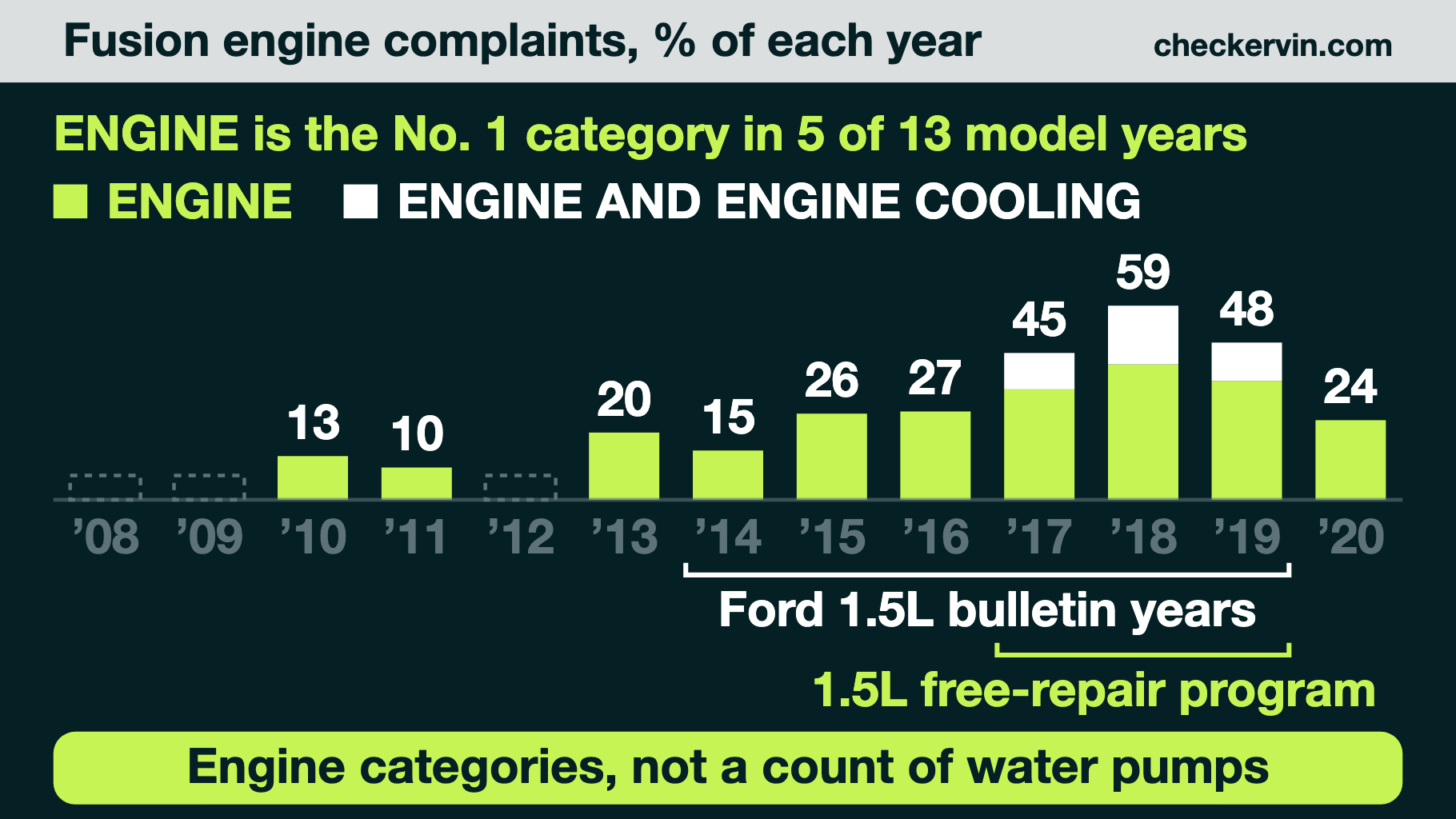
Our corpus of federal NHTSA complaints holds 22,447 reports against the 2008–2020Fusion. NHTSA files nothing under “water pump”; the closest categories are ENGINE and ENGINE AND ENGINE COOLING. ENGINE reaches a year’s top five in 10 of 13 model years, for 3,279 reports counted, and it is the single largest category of all for 2015–2019. ENGINE AND ENGINE COOLING reaches the top five only in 2017, 2018, 2019, with 279 more.
Share shows the shift more clearly than raw counts, because the late model years drew far fewer complaints of any kind. The two engine categories hold about 9% of all complaints for the 2010–2012 cars, 23% for 2014–2016 and 49% for 2017–2019, where they account for 1,065 reports. The peak is 2018, at 59% of that year’s complaints. The 2020 car, the last model year, drops back to 24%.
What the chart cannot tell you
Both categories are wide. ENGINE takes in oil leaks, misfires, stalling and failed engines of every kind, and ENGINE AND ENGINE COOLING mixes pumps with radiators, hoses, thermostats and fans. Complaints are unverified owner reports, not a measured failure rate. Our data keeps only each year’s five largest categories, so every total is a minimum: in 2008, 2009, 2012 ENGINE sat below fifth, which is not the same as zero.
The complaint records also do not say which engine a car had. Every year from 2014 to 2019 sold the 1.5L alongside the 2.0L EcoBoost, the 2.5L and the hybrid, so the chart cannot tell you how many of these reports were coolant intrusion, and certainly not how many were pumps. What it shows is that the Fusion’s engine record concentrates in the same years Ford wrote its coolant bulletins for.
The 1.5L EcoBoost: coolant in the cylinders, not at the pump
Ford’s technical service bulletin 19-2375, dated December 10, 2019, covers 2014–2019 Fusions with the 1.5L EcoBoost built on or before June 10, 2019. The symptoms it lists are low coolant, white exhaust smoke and a rough-running engine, with codes P0300 through P0304, P0316, P0217, P1285 or P1299. Ford’s stated cause is coolant intrusion into a cylinder, and the repair is a new short block and head gasket, with a labor allowance of 19.2 hours on the Fusion. The bulletin’s own parts list includes a new coolant pump gasket and bolts, because the old pump moves over to the new block.
The test it prescribes separates this from a pump failure. A technician pressurizes the warm cooling system to 20 psi for five hours; if it loses more than 4 psi, the spark plugs come out and a borescope looks for coolant in the bores. A pump that weeps from its seal leaves a wet trail on the outside of the engine. This failure leaves none.
Ford then built two customer satisfaction programs around it, both read in full from the copies filed with NHTSA. Program 19B37 reprogrammed the engine computer to run what Ford calls the “external coolant pump” after shutdown. Program 21N12, dated June 9, 2022, provides “a no-cost, one-time repair (if needed) to the 1.5L short block” for 7 years or 84,000 miles from the warranty start date, transferable to later owners, once 19B37 is done. Its Fusion coverage is 2017–2019 cars built at Hermosillo, Mexico from October 6, 2015 through June 10, 2019, plus a two-week batch of 2017s from Flat Rock, Michigan.
If your 1.5L Fusion is a 2014, 2015 or 2016
This is where the Fusion differs from its sibling. The Escape water pump post could treat the bulletin years and the program years as the same span, because the Escape only got the 1.5L in 2017. The Fusion got it for 2014. Ford’s bulletin covers those three earlier model years; its programs do not. A 2014–2016 Fusion 1.5L with coolant in the cylinders gets the same 19.2-hour repair, but only under whatever warranty still applies, which on a car that old means none.
The earlier cars also have a second, cheaper cause on file. Ford bulletin 17-0028 describes 2014–2017 Fusions with the 1.5L showing the same low coolant and white smoke because an intake manifold bolt backs out and damages the charge air cooler, a fault Ford ties to the same coolant loss. Ford’s later engineering notices on the 1.5L, such as SSM 47625, say to pressure test and then inspect the block surface between the cylinders for erosion before deciding. On a 2014–2016, ask the shop which of those it found, and get the pressure-test result in writing.
The 2.0L EcoBoost: the same symptom, a bigger engine, no program
The 2.0L EcoBoost has its own paper trail. Ford’s SSM 47204 from 2018 described 2015–2018 Fusions with the 2.0L running rough from coolant intrusion “due to corrosion on the engine block”. TSB 19-2346, dated December 19, 2019, covers 2017–2019 Fusions with the 2.0L built on or before April 8, 2019, and its remedy is a complete long block: 12.9 hours of labor on a front-drive Fusion and 14.9 on all-wheel drive. We found no customer satisfaction program for the 2.0L in the Fusion’s filed communications, so it follows the normal 5-year or 60,000-mile powertrain warranty, long expired on these cars.
A 2.0L Fusion losing coolant with no puddle and white smoke on startup should get the same pressure test as the 1.5L before anyone prices a pump. If the pump turns out to be fine, the number on the estimate stops being hundreds of dollars.
The 1.6L EcoBoost: two recalls about coolant
The 2013 Fusion’s 1.6L had its cooling problems handled as safety recalls, which cost the owner nothing whatever the car’s age. Recall 12V551 covers 2013 Fusions with the 1.6L built from February 3 through November 29, 2012: coolant leaks could overheat the engine and leak flammable fluids onto the exhaust. Dealers inspected for leaks and installed new overheat software.
Recall 17V209 covers 2013–2014 Fusions with the 1.6L. Driving with too little coolant could overheat the cylinder head until it cracked and leaked oil, with a fire risk, so dealers added a coolant level sensor. Two other 1.6L coolant campaigns often quoted online, 12V431 and 13V583, list only the Escape when queried by campaign number. Check the Ford recalls on that VINbefore paying for any coolant work on a 2013–2014.
Other ways a Fusion loses coolant or runs hot
Several Ford documents describe coolant or overheating problems a new pump will not touch:
- Recall 25V685: block heaters on 2019–2020 Fusions (among other Fords) may crack, leak coolant and short-circuit when plugged in. Ford says not to plug in until remedied; the final remedy is expected in December 2026.
- SSM 48659: some 2019–2020 non-hybrid Fusions overheat because one or more of the three cooling fan fuses (F59, F60, F63) has blown, sometimes after driving through water or snow.
- SSMs 46906, 47791 and 48991: 2017–2019 Fusions with the 2.7L can set overheat codes from a loose or damaged coolant temperature sensor connector, not a real overheat.
- TSB 17-0028: 2014–2017 1.5L intake manifold bolt damaging the coolant-carrying charge air cooler.
Our TSB versus recall page explains the difference that matters for the bill: a recall is free regardless of age or mileage, while a bulletin like 19-2375 is only free while a warranty or program covers the car.
Is it worth fixing, and can you keep driving it?
If the pump is genuinely leaking from its weep hole or its bearing is growling, on a belt-driven Fusion engine the repair is priced in the hundreds, and it is almost always worth doing. Ask for the belt, thermostat and coolant as separate lines, and refill with the coolant the engine was built for; the coolant type lookup by VIN shows the factory specification.
Driving on a failing pump is the expensive choice. Ford’s own wording in recall 17V209, written for the 1.6L but true of any engine run low, is that running with too little coolant can crack the head and leak oil onto hot parts. If the gauge climbs or a coolant warning lights, stop, switch off and let the engine cool. A tow costs less than a head.
Before you authorize the repair
- Confirm the engine by VIN: 1.5L, 1.6L, 2.0L, 2.5L, 2.7L, 3.0L, 3.5L or hybrid each lead somewhere different
- Ask where the leak was seen — at the pump, or only as a falling reservoir
- On a 2014–2019 1.5L or 2015–2019 2.0L with no outside leak, ask for the pressure test and a cylinder check first
- On a 2017–2019 1.5L, have a Ford dealer check the VIN for 19B37 and 21N12
- On a 2013–2014 1.6L, check recalls 12V551 and 17V209; on a 2019–2020, check 25V685
- On a 2010–2012 V6, ask whether it is the 3.0L or the 3.5L before comparing quotes
Shopping for one rather than fixing one? A Ford VIN decode confirms the engine and model year, and the full year-by-year record is on our Ford Fusion problems page. The transmission side, where Ford also extended coverage on some later cars, is in our Fusion transmission cost post.
Where this information comes from
- Ford Customer Satisfaction Program 21N12 (NHTSA-hosted)The 7-year or 84,000-mile no-cost 1.5L short block repair, its 2017–2019 Fusion build windows and the 19.2-hour Fusion labor allowance.
- Ford Customer Satisfaction Program 19B37, Supplement #4 (NHTSA-hosted)The engine computer update that runs the external coolant pump after shutdown, required before 21N12.
- Ford TSB 19-2375, 1.5L EcoBoost low coolant and white smoke (NHTSA-hosted)Extends the 1.5L repair to 2014–2019 Fusions built on or before June 10, 2019; the pressure test and parts list quoted above.
- Ford TSB 19-2346, 2.0L EcoBoost coolant in cylinders (NHTSA-hosted)The long block remedy and the 12.9- and 14.9-hour Fusion labor times.
- NHTSA — Fusion complaints, recalls and manufacturer communicationsThe federal complaint record behind every figure here, recalls 12V551, 17V209 and 25V685, and the Ford service messages cited.
- EPA and DOE — fueleconomy.gov vehicle recordsThe per-year Fusion engine listings behind the engine table.
- Roe v. Ford Motor Co., No. 2:18-cv-12528 (E.D. Mich.) — opinions on govinfo.govThe court's summary of the internal, chain-driven pump on Ford's Cyclone V6, which it says powered the Fusion.
- Ford Parts — Water Pump Pulley 1.5L Escape/Fusion, DS7Z8509AOne of four ford.com pulley pages whose fitment lists show which Fusion engines have a belt-driven pump.
- RepairPal — Ford Fusion water pump replacement costThe $623–$775 estimate quoted above, as shown in search results November 2026.
Keep reading
Frequently asked questions
How much does it cost to replace the water pump on a Ford Fusion?
Published estimates for a straightforward pump job mostly fall between about $620 and $970. RepairPal lists $623 to $775 for the Fusion, with $314 to $461 of that in labor. Kelley Blue Book, as served for specific ZIP codes, shows $659 to $800 for a 2010 Fusion near Stow, Ohio, $806 to $898 for a 2016 near Columbus and $869 to $969 for a 2020 near Snohomish, Washington. Those are their figures, retrieved November 2026. None of them prices the 3.5-liter V6, whose pump sits inside the engine, or a 1.5L EcoBoost whose coolant is getting into the cylinders.
Is it worth fixing a water pump on a Fusion?
Usually, if the pump really is the problem. On the four-cylinder engines Ford's parts catalog shows a pulley-driven pump, so the job is priced in the hundreds, not thousands. The decision changes when the coolant is going somewhere else. On a 2014–2019 1.5L EcoBoost or a 2015–2019 2.0L EcoBoost, Ford's own bulletins describe coolant getting into the cylinders, and the fix is a short block (19.2 hours of labor on a Fusion 1.5L) or a long block (12.9 hours front-drive on the 2.0L). Confirm where the coolant is going before you pay for a pump.
Can I still drive a Fusion with a bad water pump?
Not far. Ford's recall 17V209 on the 2013–2014 Fusion 1.6L says that driving with too little coolant can overheat the cylinder head until it cracks and leaks oil, which can reach hot parts and start a fire. That logic applies to any engine running low. If the temperature gauge climbs or a coolant warning appears, pull over, shut the engine off and let it cool before adding coolant or arranging a tow.
How long should it take a mechanic to change a Fusion water pump?
We could not open a published labor-time guide for the pump itself, so we will not quote hours we have not read. What we can quote is Ford's own labor allowance for the jobs a misdiagnosed pump hides: 19.2 hours to replace a 1.5L Fusion short block for coolant intrusion, and 12.9 hours (front-drive) or 14.9 hours (all-wheel drive) for a 2.0L EcoBoost long block. RepairPal's labor estimate for the pump job is $314 to $461.
Is there a recall on the Ford Fusion water pump?
No. We queried NHTSA's recall database for every Fusion model year from 2008 through 2020, including the Hybrid and Energi names, and no campaign names the water pump. Coolant-related recalls do exist: 12V551 and 17V209 on the 2013–2014 Fusion 1.6L, and 25V685 for cracked block heaters on 2019–2020 Fusions among other Fords. The 1.5L coolant intrusion repair ran as Ford customer satisfaction programs 19B37 and 21N12, not as a safety recall.
Confirm the engine before you price the pump
A free CheckerVIN report shows the factory build, engine, specifications and open recalls for any VIN, so you know whether a coolant problem points to a pump, a recall or a Ford program.
Run a free VIN check