The short answer
- What does it cost?
- KBB’s ZIP-specific ranges run $290-$448 depending on year and location; YourMechanic’s mobile estimate averages around $180.
- What fluid does it take?
- Motorcraft FNR5 for the 2008-2009 five-speed, Motorcraft MERCON LV for every 2010-2020 car with the 6F35 six-speed. The two are not interchangeable.
- Which years carry the most risk?
- 2010 alone holds 31.6% of every Fusion power-train complaint on record; the 2010-2012 six-speed years run at 12.5% against 2% for the five-speed years just before them.
The price, and whose price it is
Kelley Blue Book publishes a transmission-fluid-change page per Fusion model year, and like its repair-cost pages, the range it shows depends on the ZIP code behind it. As served in search this session, its 2013 page showed $338 to $402 for a shop near Hickory, North Carolina; its 2016 page showed $290 to $384 near Chicago; and its 2018 page showed $367 to $448 in Pennsylvania. YourMechanic, a mobile-mechanic marketplace, prices the same job lower on average: about $180 total, split $85 for fluid and a filter and $95 for labor.
One dealer source we found in search notes that a straight drain-and-fill change typically runs about half the price of a full transmission flush, because it moves less fluid and takes less time — worth asking about explicitly, since some shops quote a flush by default. We sell VIN checks, not repairs, so none of these figures are ours.
Which fluid your Fusion actually takes
The Fusion’s automatic-transmission lineup split once, in 2010, and the fluid split with it. The 2008-2009 Fusion’s five-speed automatic, built on a Mazda-derived design, takes Motorcraft FNR5 fluid (part XT-9-QMM5, the same fluid sold under the Mazda M5 number), with a roughly 7.0-quart capacity. Starting with the 2010 model year, when Ford put the new 6F35 six-speed automatic behind every Fusion engine, the fluid changed too: Motorcraft MERCON LV (part XT-10-QLVC, Ford specification WSS-M2C938-A).
| Years and transmission | Fluid to use |
|---|---|
| 2008-2009, five-speed automatic | Motorcraft FNR5, part XT-9-QMM5 (Mazda M5) |
| 2010-2020, 6F35 six-speed automatic | Motorcraft MERCON LV, part XT-10-QLVC (WSS-M2C938-A) |
| 2013-2020 Hybrid/Energi, HF35 eCVT | No official Ford spec confirmed this session — see below |
What the complaint record says about each one
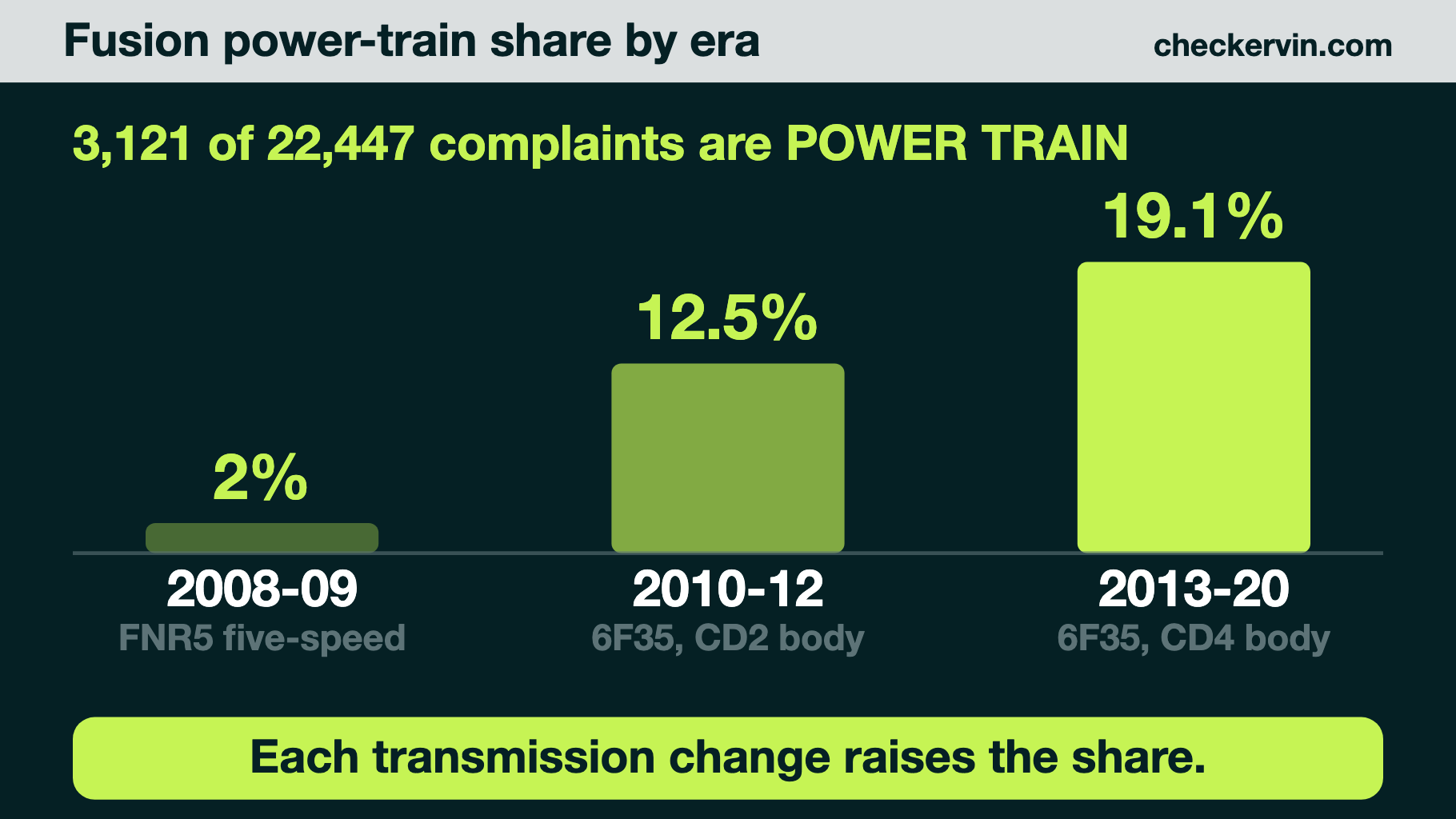
Our corpus holds 22,447 federal complaints against the 2008–2020 Fusion. POWER TRAIN, the category covering the transmission and its linkage, accounts for 3,121 of them (13.9%), and places in the model year’s own top five complaint types in 12of the nameplate’s 13 years. Grouped by which transmission and fluid a model year actually carried, rather than by body platform, the record climbs in two separate steps.
The 2008–2009 five-speed cars hold 47 power-train complaints out of 2,376, 2%. The 2010–2012 cars, the first three years of the 6F35 six-speed and still the same CD2 body as the five-speed years before them, hold 1,429 of 11,469, 12.5% — roughly 6.3 times the five-speed years’ share, on an otherwise unchanged body. The 2013–2020cars, the 6F35’s run in the all-new second-generation body, hold 1,645 of 8,602, 19.1%.
The single busiest Fusion model year by total complaints is 2010 (5,926), which is also the single peak power-train year: 987 complaints, 31.6% of the nameplate’s entire power-train record and 16.7% of that year’s own total. The year with the highest power-train SHARE of its own complaints is 2020, at 28.5%, on a much smaller complaint count (235) — a recent, small sample swings harder than a large, settled one, so treat that one figure with more caution than the rest.
Complaints are unverified owner reports, not a measured failure rate, and this is not proof that the fluid itself caused the jump at either line. It is still the clearest record-based reason to know which transmission, and which fluid, a given Fusion actually has before paying for its service.
What Ford’s own manual says about when
Two independently retrieved copies of the North American Fusion owner’s manual (2014 model year, printings v.1 and v.2) agree on the same line, worded almost identically: under the manual’s special- or severe-operating-conditions table, “change automatic transmission fluid” every 30,000 miles (48,000 km). That table applies to extensive idling, towing, mostly low-speed or stop-and-go driving, and similar heavy use — not every driver qualifies.
Under the manual’s NORMAL schedule, we found no fixed-mileage transmission-fluid change at all. Instead it calls for inspecting the fluid level at every oil change, and the oil-change interval itself is set by the car’s Intelligent Oil-Life Monitor: roughly 7,500 to 10,000 miles under normal use, 5,000 to 7,499 under severe use, and 3,000 to 4,999 under extreme use. In plain terms: on the normal schedule, Ford’s own manual treats the fluid as something to check, not something with a standing change date, unless your driving qualifies as severe.
The Hybrid and Energi are a different transmission
Everything above describes the gas Fusion’s 6F35 or five-speed automatic. The 2013-2020 Fusion Hybrid and Fusion Energi use a completely different unit, the HF35 hybrid eCVT transaxle, and this session could not find a directly sourced, official Ford fluid specification or change interval for it. Secondary parts listings sell ENEOS ECO ATF and Liqui Moly Top Tec ATF 1800 as HF35-compatible fluids, and one independent source describes the unit as filled for life. None of that is a Ford document, so treat it as a starting point for a question to your dealer, not a confirmed spec.
What we can confirm: Ford technical service bulletin 19-2391, dated January 9, 2020, covers an HF35 noise — thumping, rubbing or grinding while moving — on some 2013-2016 Fusion, MKZ and C-MAX hybrids built on or before August 15, 2015, traced to the differential side bearings or transfer shaft. That bulletin’s own fix is a transfer-shaft kit or a full remanufactured transmission assembly, which is a repair, not a fluid-change interval. Our sibling post on Fusion transmission replacement cost covers that bulletin and the gas car’s recalls in more depth.
When "needs fluid" is really a recall
Several NHTSA campaigns on the 6F35-equipped Fusion involve the shifter linkage rather than the fluid or the gearbox itself. Campaigns 18V-471, 19V-362 and 22V-413 cover a shift-cable bushing on 2013-2016 Fusions that can detach, letting the lever say Park while the transmission is not. A shop or an owner who does not know about that bushing can easily read the symptom as a fluid or transmission problem. Separately, Ford’s Customer Satisfaction Program 22N12 covers a cracked flexplate on some 2019-2020 2.0-liter EcoBoost cars, which can also look like a transmission fault from the driver’s seat.
- Lever says Park, car still in gear: check the shift-cable bushing recall first, not the fluid
- Rattle near the bellhousing or a no-start: check 22N12 flexplate coverage before a fluid change
- Harsh or delayed shifts with no linkage fault: a fluid check and change is the reasonable next step
- Any of the above on a Hybrid or Energi: confirm it is the HF35, not the 6F35, before you diagnose
None of these recalls is a reason to skip a fluid service the record above supports. They are a reason to rule out the free fix first, since a fluid change will not repair a detached bushing or a cracked flexplate.
Checking it yourself: there is no dipstick
Like most modern Ford automatics, the 6F35 has no dipstick. Level is set and checked through a plug, with the fluid warm and the car level, and the correct fill is to the bottom edge of that plug’s hole, not a mark on a stick. Owner reports we found describe the check plug on the 6F35 family as located low on the transmission case near the CV axle, with a separate fill point higher up — but more than one owner in the same discussion thread asked whether they had the right plug, which is the honest state of this information outside an official Ford diagram. If you are not confident which hole is which, that uncertainty alone is a reason to have a shop do the first one.
Getting the level wrong in either direction causes real symptoms: overfilled, a 6F35 can foam and shift poorly; underfilled, it can overheat and wear faster. A shop quote for the job should include confirming the level the correct way, not just topping off from the fill port and calling it done.
Does a fluid change help, or hurt
On a Fusion with a known service history and no symptoms, a fluid change at the manual’s own interval is maintenance, not a gamble. The harder question is the high-mileage car with unknown history and already-degraded fluid. Mechanics disagree, publicly and often, about whether a full flush on a transmission that has gone a very long time without service can dislodge wear debris and cause new slipping that a simple drain-and-fill would not have caused. We did not find a Ford document settling that question for the 6F35 specifically, so it is stated here as a genuine, unresolved question, not a rule.
What the record above does support: a 2010-2012 Fusion carries a meaningfully heavier power-train history than the 2008-2009 cars immediately before it, on the same body. If you are deciding whether to pay for a fluid change on a 2010-2012 car versus skipping it, that is the direction the record leans, not the reverse.
Before you pay for the service
- Confirm the exact transmission by VIN or the door-jamb label: five-speed, 6F35, or HF35 eCVT
- Ask whether the quote is a drain-and-fill or a full flush, and which one your car’s interval calls for
- Ask which fluid the shop is using by name and part number, not just “ATF”
- On a 2013-2016 Fusion with a shift or Park-lever complaint, ask about the shift-cable bushing recall first
- Get the level check method in writing: warm, level, plug-to-plug — not a dipstick reading
If you are buying a Fusion, not maintaining one
The same three-way split works as a shopping check. A 2010-2012 Fusion carries a heavier power-train record than the 2008-2009 cars that share its body, so a clean fluid-change history matters more on one of those than on an otherwise-similar five-speed car. A Ford VIN decode confirms the exact model year; it does not always identify which automatic is behind the engine, so check the build sheet or ask the seller directly, the same caution our page on finding the transmission by VIN gives for every nameplate.
Before you buy, run the Ford recall lookup for the shift-cable bushing and flexplate campaigns above, and look at which Fusion model years draw the most complaints overall, not just power train. Then ask for the fluid-service history by name: “Mercon LV” or “FNR5” on a receipt tells you more than “transmission serviced” ever will.
Where this information comes from
- NHTSA — Ford Fusion complaints and recallsThe federal complaint and recall record this page’s figures come from, browsable by model year.
- Motorcraft — MERCON LV automatic transmission fluidFord’s own parts brand listing XT-10-QLVC under the MERCON LV specification used by every 2010-2020 Fusion’s 6F35.
- Ford FCSD — automatic transmission fluid quick referenceFord’s own chart distinguishing MERCON SP, MERCON LV, Motorcraft Premium ATF and FNR5 as non-interchangeable fluids.
- Kelley Blue Book — Fusion transmission fluid changeZIP- and year-specific price ranges quoted above, as served in search this session.
- YourMechanic — Fusion transmission fluid service estimateThe mobile-mechanic average price quoted above, with its own parts/labor split.
- NHTSA — recalls by VINThe official lookup that shows whether a specific Fusion’s shift-cable bushing or flexplate campaign was completed.
Keep reading
Frequently asked questions
How much does a Ford Fusion transmission fluid change cost?
Kelley Blue Book’s year- and ZIP-specific “transmission fluid change” pages, as served in search this session, show $338 to $402 for a 2013 Fusion near Hickory, North Carolina; $290 to $384 for a 2016 near Chicago; and $367 to $448 for a 2018 in Pennsylvania. YourMechanic’s mobile-mechanic estimate page puts the average lower, around $180 total ($85 in parts, $95 in labor). Treat all of these as local or channel-specific snapshots, not a national price.
What transmission fluid does a Ford Fusion take?
It depends on which transmission is behind the engine. The 2008-2009 five-speed automatic takes Motorcraft FNR5 fluid (part XT-9-QMM5, also sold as Mazda M5). Every 2010-2020 Fusion with the 6F35 six-speed automatic takes Motorcraft MERCON LV (part XT-10-QLVC, Ford spec WSS-M2C938-A) instead. The two are not interchangeable with each other or with MERCON V or MERCON SP, so confirm the transmission before buying fluid.
How often should you change the transmission fluid in a Ford Fusion?
Ford’s own North American Fusion owner’s manual, as reproduced in two independently sourced manual-mirror copies, lists no fixed-mileage change under its normal schedule — only an inspection of the fluid level at each oil change set by the Intelligent Oil-Life Monitor. Under the manual’s separate special- or severe-operating-conditions table, both copies list the same line: change the automatic transmission fluid every 30,000 miles. Confirm against your own printed manual or a Ford dealer before paying for a change your schedule may not call for yet.
Does the Ford Fusion Hybrid or Energi need a transmission fluid change?
It has a different transmission entirely — the HF35 hybrid eCVT transaxle, not the 6F35 automatic in gas Fusions — and this session could not find a directly sourced, official Ford fluid spec or change interval for it. Secondary parts listings name themselves as HF35-compatible and one source describes the unit as filled for life. A separate Ford bulletin, 19-2391, covers an HF35 noise from the differential bearings or transfer shaft on some 2013-2016 cars; that is a repair procedure, not a routine fluid service, and our sibling post on Fusion transmission replacement cost covers it.
Which Ford Fusion years have the most transmission complaints?
Computed from src/data/models/ford-fusion.json: POWER TRAIN makes up 3,121 of the Fusion’s 22,447 federal complaints (13.9%). Split by which transmission and fluid a model year actually has, the 2008-2009 five-speed years hold the lightest record at 2%; the 2010-2012 cars, the first three years of the 6F35 six-speed, jump to 12.5%; and the 2013-2020 cars hold 19.1%. The single peak year is 2010, with 987 power-train complaints, 31.6% of the nameplate’s entire power-train record.
Confirm the transmission before you buy the fluid
A free CheckerVIN report shows the factory build, specifications and open recalls for any VIN. On a Fusion, that can be the difference between the right fluid and the wrong one.
Run a free VIN check