The short answer
- What does it cost?
- RepairPal lists $365–$443 for an F-150 starter. A genuine Ford starter for 2018–2020 EcoBoost and 3.3L trucks lists at $217.49 from one Ford parts retailer.
- Is it the starter?
- Often not. Ford's service messages trace F-150 no-crank conditions to a transmission harness, a body module and cold-weather fuel issues before the starter.
- Which years show electrical trouble?
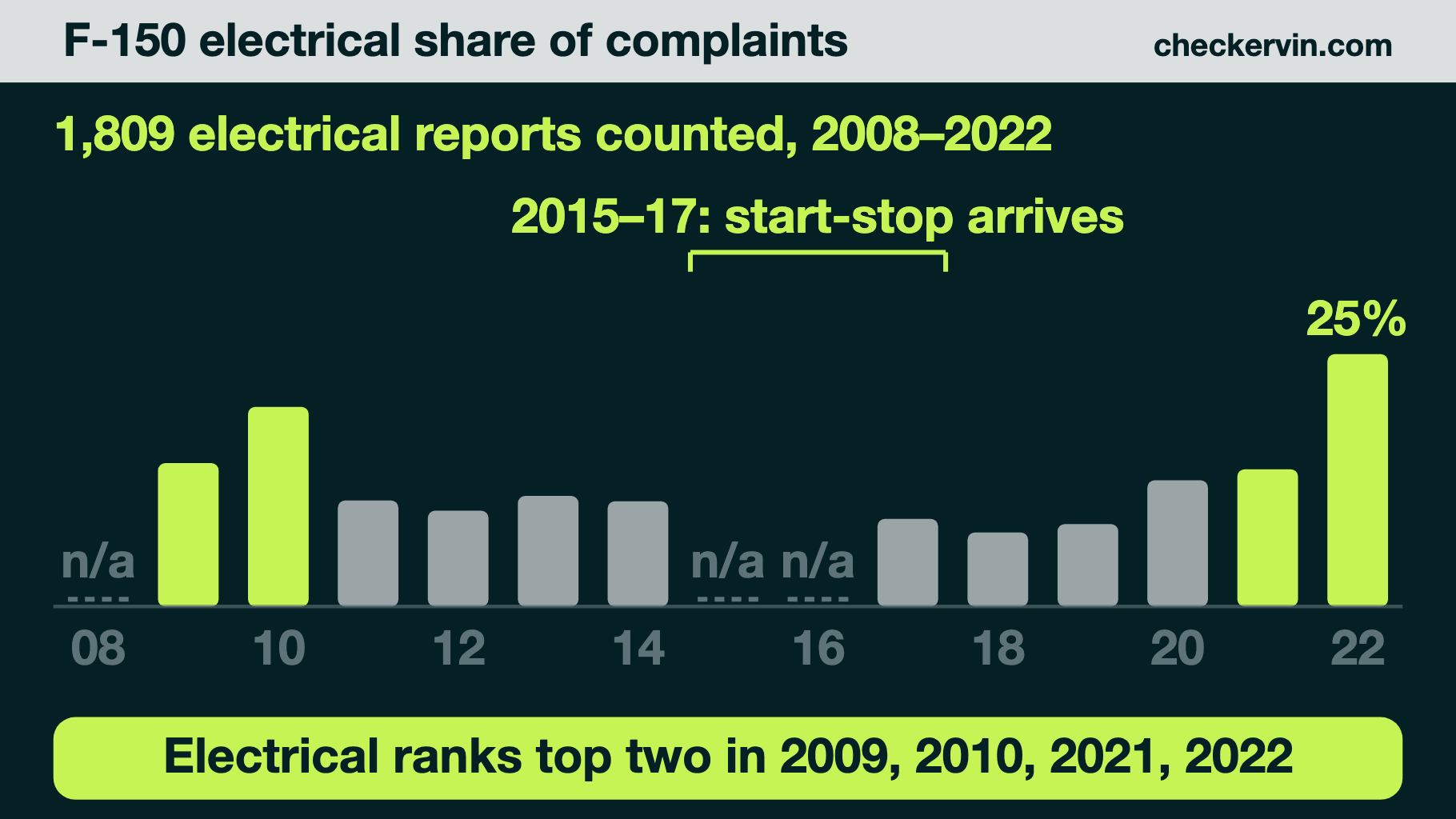
- Electrical complaints peak as a share in 2022 (25%) and 2010 (20%); the start-stop rollout years do not stand out.
$365–$443
RepairPal F-150 starter range
Retrieved Oct. 2026, before tax
$217.49
Ford starter JL3Z-11002-E
FordPartsGiant listing, 2018–2020
1,809
Electrical reports counted
2008–2022, a minimum
25%
Electrical share, 2022
Highest of any model year
The numbers, and whose numbers they are
RepairPal, the estimator most shops and owners quote, lists a Ford F-150 starter replacement at $365 to $443. That figure appears on its F-150 overview pages as retrieved in October 2026. The listing does not split labor from parts, and like every RepairPal range it excludes taxes and fees and is not adjusted for where you live. We did not find a Kelley Blue Book F-150 starter figure we could read on the page, so we quote none.
The part price is easier to pin down for one generation. Ford’s own service message for a cold-weather no-crank on 2017–2018 EcoBoost and 3.3L trucks names the replacement starter as JL3Z-11002-E, and FordPartsGiant, a retailer of genuine Ford parts, lists that number at $217.49 against a $354.55 MSRP for 2018–2020 F-150s with the 3.5L EcoBoost or the 3.3L V6. RepairPal does not say which part its range assumes, so the two figures cannot simply be subtracted, but together they show the shape of the bill: a part in the low hundreds and a modest amount of labor, not the multi-day teardown of an engine-internal job.
Ford’s service message does not print a labor time; it points dealers to the labor manual instead. We could not find a Ford document giving starter hours for each F-150 engine, so we do not invent one. Ask your shop which labor guide it is quoting and how many hours, then check that the number has not quietly grown to include a battery, cables and a diagnosis fee you did not ask for. We sell VIN checks, not repairs, and publish no price of our own.
What 19,248 complaints say about the electrical side
Our corpus of federal NHTSA complaints holds 19,248 reports against the 2008–2022 F-150. The ELECTRICAL SYSTEM category appears in the top five components for 12 of those 15 model years, and those years add up to 1,809 counted electrical reports. That category is far wider than a starter: it covers the 12-volt battery and its cables, fuses and relays, wiring, lighting, audio and the body modules. The starter is a slice of it, and some owners file a no-start under ENGINE instead.
Raw counts mostly track how many trucks were sold and how loud a given year was about everything. A sharper question is what share of each year’s complaints are electrical. Asked that way, the F-150 record has two high points at opposite ends. The 2010 truck is the only year where ELECTRICAL ranks first, at 20% of complaints. The 2022 truck is the peak, at 25%, roughly one complaint in four. In between, the share mostly sits near a tenth, and its low point is the 2018 truck at 7%. Power train complaints outnumber electrical ones in 13 of the fifteen years, which is why the sibling posts on this truck lead with the transmission and the engine.
For 2008, 2015, 2016, ELECTRICAL is not among the five most-reported components, so the chart marks those years n/a instead of drawing a zero. What we can say is that its share in those years was no higher than the fifth-place component’s, a ceiling, not a count.
Did auto start-stop wear F-150 starters out?
It is the first theory many owners reach for. A truck that shuts its engine off at every light restarts many times a day, and the starter takes the load. Ford made Auto Start-Stop standard on the 2.7L EcoBoost when that engine arrived for 2015, then extended it to every 3.5L EcoBoost, Raptor included, for 2017. Trade coverage of Ford’s 2016 announcement reported Ford saying those trucks carry a heavy-duty starter and battery to cope. We could not read Ford’s original release, so that claim stays attributed to the coverage. The system stays off when towing or in four-wheel drive.
The complaint record does not show the rollout as an electrical event. ELECTRICAL drops out of the top five entirely for the 2015 and 2016 trucks, which caps its share at about 10% and 11% respectively. On the 2017 truck it is 9%, and across 2017–2019 it never exceeds 9%. The 2011–2014 trucks, built before start-stop, ran 9–11%. That does not prove start-stop starters never fail. It says that if they fail more often, owners are not reporting it to NHTSA in numbers that move the electrical line.
A start-stop system that stops working is also not a starter symptom on its own. Ford’s TSB 21-2065 covers 2018 F-150s built on or before February 25, 2018 whose start-stop went dead after a powertrain module update, and the fix is reprogramming the module. The system also suspends itself when the battery’s charge is low, which on a short-trip truck is a battery question.
2017–2018: the one Ford message that blames the starter
Of the Ford communications we found indexed against the 2009–2020 F-150, the clearest starter-specific one is Special Service Message 47503, dated August 31, 2018. It covers some 2017–2018 vehicles with a 3.3L engine or a 3.5L EcoBoost that will not crank, but only in freezing temperatures. Ford’s diagnosis is a frozen starter, and the instruction is to replace it with part JL3Z-11002-E. The message is short and does not print a labor time or a build-date window.
The pattern is the useful part. A truck that cranks normally all summer and goes silent on the first hard frost, then recovers as the day warms, fits this message. A truck that will not crank at any temperature fits something else. A special service message is guidance, not coverage, so outside the new-vehicle warranty this is the owner’s bill, at the part price quoted above plus labor.
No crank, but not the starter: what Ford checks first
A starter that clicks or stays silent is the obvious suspect, and on an F-150 it is frequently the wrong one. Ford has published several service messages in which the truck will not crank and the starter is fine:
| Ford document | No-crank cause it names |
|---|---|
| SSM 48563 (2017–2020 F-150) | Transmission harness 15525 not secured; also start-stop dead, warning lights, network codes |
| SSM 47097 (2017–2018, built by Sept. 29, 2017) | Same harness condition, earlier build window |
| SSM 47824 / 48108 (2015–2019) | Body control module key-table error; module replaced |
| TSB 14-0010 / 14-0067 / 14-0077 (2011–2014) | No start or hard start below 0°F, EcoBoost and block heater use |
| TSB 17-0008 (2015–2016, 5.0L) | Hard start or crank, no start with block heater below 0°F |
The first two deserve attention because their symptoms overlap with a dead starter. SSM 48563 describes a 2017–2020 truck that will not crank, with auto start-stop inoperative, warning lamps lit, shifting complaints, and codes such as P061A, U0140 and U0401 stored across several modules. Ford’s instruction is to inspect the transmission harness at the rear of the engine for damage and routing before anything else. A scan that shows a burst of U-codes across modules points at wiring, not a starter.
The body-module messages are the other trap. On some 2015–2019 trucks, a key-table error inside the body control module stops the truck from cranking, and the scan tool reports an error when keys are programmed. The fix there is a module, at a price that has nothing to do with a starter quote.
2011–2014: cranks fine, will not start, melted fuse
The 2011–2014 trucks hold 835 counted electrical reports out of 8,012 complaints across those four years. Reading the owner narratives behind the 2013 count, the starter is a small minority. A recurring story is a truck that cranks normally but will not fire, or stalls while driving, traced to a melted fuse and burned terminals at the fuel pump relay, usually identified as fuse 27 in the under-hood box.
Several owners cite a Ford bulletin numbered 15-0137 and a fuse relocation kit for it. We could not find that bulletin in NHTSA’s index of Ford communications for these years, though the index does return other 2011–2014 F-150 bulletins, so we report it as what owners wrote rather than as a verified Ford document. The practical point holds either way: on these trucks, a crank-no-start is a fuel delivery question, and a starter cannot fix a truck that is already cranking.
The same years carry Ford’s cold-start bulletins. TSBs 14-0010, 14-0067 and 14-0077 cover 2011–2014 F-150s that will not start, or start hard, below 0°F, including EcoBoost trucks after block heater use. A northern-state truck that fails only on the coldest mornings has more than one explanation besides the starter.
Two recalls at the battery end of the starter circuit
We queried NHTSA’s recall database for every F-150 model year from 2008 through 2022, and the campaign counts matched our corpus year for year. No campaign replaces the starter motor. Two sit on the cable that feeds it:
| Campaign | What it covers |
|---|---|
| 20V467 (Ford 20S40), 2020 F-150 | Wrong nut on the battery cable at the starter; arcing and fire risk; nut replaced free |
| 19V805 (Ford 19S40), 2019–2020 F-150 | Positive battery terminal fastener may loosen; displays, assist and engine can drop out |
Neither pays for a starter, but both matter before you buy one. A loose or wrongly fastened supply cable produces the same weak crank, click and intermittent no-start a tired starter does, and both remedies are free at a dealer. The Ford recall lookup by VIN shows whether either campaign is still open on a particular truck. The 2020 truck, the year of the starter-cable recall, has electrical complaints at 12% of its total, ranked third among its components.
PowerBoost: a hybrid with two ways to crank
A hybrid is the obvious place to assume there is no starter to replace. On the F-150 that assumption is wrong. According to Ward’s reporting in 2024, the PowerBoost hybrid that arrived for 2021 carried a belt-driven starter-generator on the front of the engine as well as a conventional starter. For 2024, Ford used software changes to remove the belt unit and let the 35-kW hybrid motor between the engine and transmission handle low-speed restarts. Ward’s reports that the conventional starter still cranks the engine at higher speeds.
For the 2021–2022 PowerBoost trucks in our data, that means a no-crank can involve either unit, and the belt starter-generator is a different, hybrid-system repair from a flywheel starter. Ask a shop which of the two it diagnosed before comparing its quote with any starter range on this page.
2021–2022: a high electrical share, but not starters
The newest trucks are where the electrical share climbs: 14% on the 2021 and 25% on the 2022, with electrical ranked second and second among components. It is tempting to read that as a starter story. The owner narratives say otherwise. Reading the 2022electrical reports available through NHTSA’s live complaint search, the recurring themes are speakers that blast static or pop at startup, instrument and center displays going blank, and door lock actuators. We found none that names the starter.
The recall record for these years points the same way: campaigns on the integrated trailer brake module, reverse lights disabled by an over-the-air update, and a parking-brake harness. A 2022 F-150 with a high electrical share is a truck with a lot of software and modules, which is useful to know when buying one, and says little about the odds of needing a starter.
Before you authorize the starter
- Load-test the battery and check both cable ends; a bad connection mimics a bad starter
- Scan every module, not just the engine; a burst of U-codes points at wiring
- On a 2017–2020 truck, ask the shop to inspect harness 15525 per SSM 48563
- On a 2019–2020 truck, run the VIN for recalls 19V805 and 20V467 first
- If it fails only below freezing on a 2017–2018 3.3L or EcoBoost, mention SSM 47503
- On a PowerBoost, ask whether the diagnosis is the flywheel starter or the belt starter-generator
The first two items cost little and rule out most of the expensive mistakes. A starter that tests good on the bench and goes back into a truck with a corroded cable fails the same way the next cold morning. If the shop has confirmed voltage at the starter’s trigger wire while turning the key, and the starter still does nothing, then it is the starter and RepairPal’s range is a fair yardstick.
If you are buying the truck, not repairing it
A starter is not a reason to walk away from an F-150; at RepairPal’s range it is a negotiating line, not a deal-breaker. The more useful checks are the ones that separate a cheap fix from a wiring chase. Start the truck yourself, more than once, and watch the cluster for a string of warnings. An F-150 VIN decodeconfirms the engine, which decides which starter it takes and whether the 2017–2018 frozen-starter message could apply, and the battery size lookup by VIN tells you which battery group the truck should carry, worth knowing on a start-stop truck where an undersized battery shuts the feature off.
The F-150 years-to-avoid breakdown covers the rest of the complaint record by year. The bigger repair bills on these trucks sit elsewhere: the F-150 timing chain cost post charts the EcoBoost years Ford’s bulletins flag, and the engine replacement cost post prices the worst case.
Where this information comes from
- Ford SSM 47503 (NHTSA copy) — frozen starter, no crank in freezing temperatures2017–2018 3.3L and 3.5L EcoBoost; replace the starter with JL3Z-11002-E.
- Ford SSM 48563 (NHTSA copy) — 2017–2020 F-150 no crank, no startTransmission harness 15525 not secured; start-stop inoperative and network codes across modules.
- NHTSA — Ford communications indexed to the F-150Where the key-table, cold-start, start-stop and harness messages above were found and summarized.
- NHTSA recalls — 2020 Ford F-150Includes 20V467, the starter battery-cable nut, and 19V805, the battery terminal fastener.
- NHTSA — recalls by VINThe official lookup; no F-150 campaign from 2008 to 2022 replaces the starter motor itself.
- Ward's — F-150 PowerBoost propulsion system (Sept. 30, 2024)Ford removed the belt starter-generator for 2024; the conventional starter still cranks at speed.
- RepairPal — Ford F-150 repair costsThe $365–$443 starter replacement range quoted above, retrieved October 2026.
Keep reading
Frequently asked questions
How much does it cost to replace a starter on a Ford F-150?
RepairPal's Ford F-150 listings put starter replacement at $365 to $443, its figure as retrieved in October 2026, before taxes and fees and not adjusted for your area. For the part alone, one Ford parts retailer, FordPartsGiant, lists the genuine Ford starter JL3Z-11002-E for 2018-2020 F-150s with the 3.5L EcoBoost or 3.3L V6 at $217.49 against a $354.55 MSRP. A dealer installing a Ford part will usually land above RepairPal's range; an independent shop with a remanufactured unit can land inside it.
Does the F-150 auto start-stop wear out the starter faster?
Ford anticipated the question: trade coverage of its 2016 announcement reported Ford saying start-stop trucks carry a heavy-duty starter and battery. The federal complaint record does not show the rollout years standing out either. Electrical complaints are not among the top five components for the 2015 or 2016 F-150 at all, and on the 2017 truck they are 9% of complaints, below the 9-11% range of the 2011-2014 trucks that had no start-stop.
Why won't my F-150 crank when the battery is good?
Ford's own service messages list several causes that are not the starter. On 2017-2020 trucks, SSM 48563 points to a transmission wire harness that was not properly secured, with no crank, inoperative start-stop and a string of network codes. On some 2015-2019 trucks, a body control module key-table fault prevents cranking and the module is replaced. On 2017-2018 3.3L and 3.5L EcoBoost trucks, SSM 47503 does blame the starter, but only for a no-crank that happens in freezing weather. Scan for codes before buying a starter.
Does the F-150 PowerBoost hybrid have a starter?
Yes. According to Ward's, the 2021-2023 PowerBoost carried a belt-driven starter-generator on the front of the engine in addition to a conventional starter, and Ford removed only the belt unit for 2024. Even on later trucks, Ward's reports, the hybrid motor handles low-speed restarts while the conventional starter cranks the engine at higher speeds, so a PowerBoost can still need a starter.
Is there a recall for the F-150 starter?
Not for the starter motor itself. Recall 20V467 (Ford 20S40) covers certain 2020 F-150s where the wrong nut may have been used to fasten the battery cable to the starter, which can cause arcing and a fire risk; dealers replace the nut free. Recall 19V805 (Ford 19S40) covers 2019-2020 trucks whose positive battery terminal fastener may loosen. Run the VIN to see whether either is open on a specific truck.
Confirm the engine and open recalls before you buy a starter
A free CheckerVIN report shows the factory build, engine, specifications and open recalls for any VIN, so you know which starter fits and whether a free recall repair comes first.
Run a free VIN check