The short answer
- What does it cost?
- RepairPal lists $1,655–$2,242 for an Explorer timing chain tensioner job, mostly labor. Ford books 21.6–23.4 hours for the 2020–2023 3.0L cam timing job.
- Which years are worst?
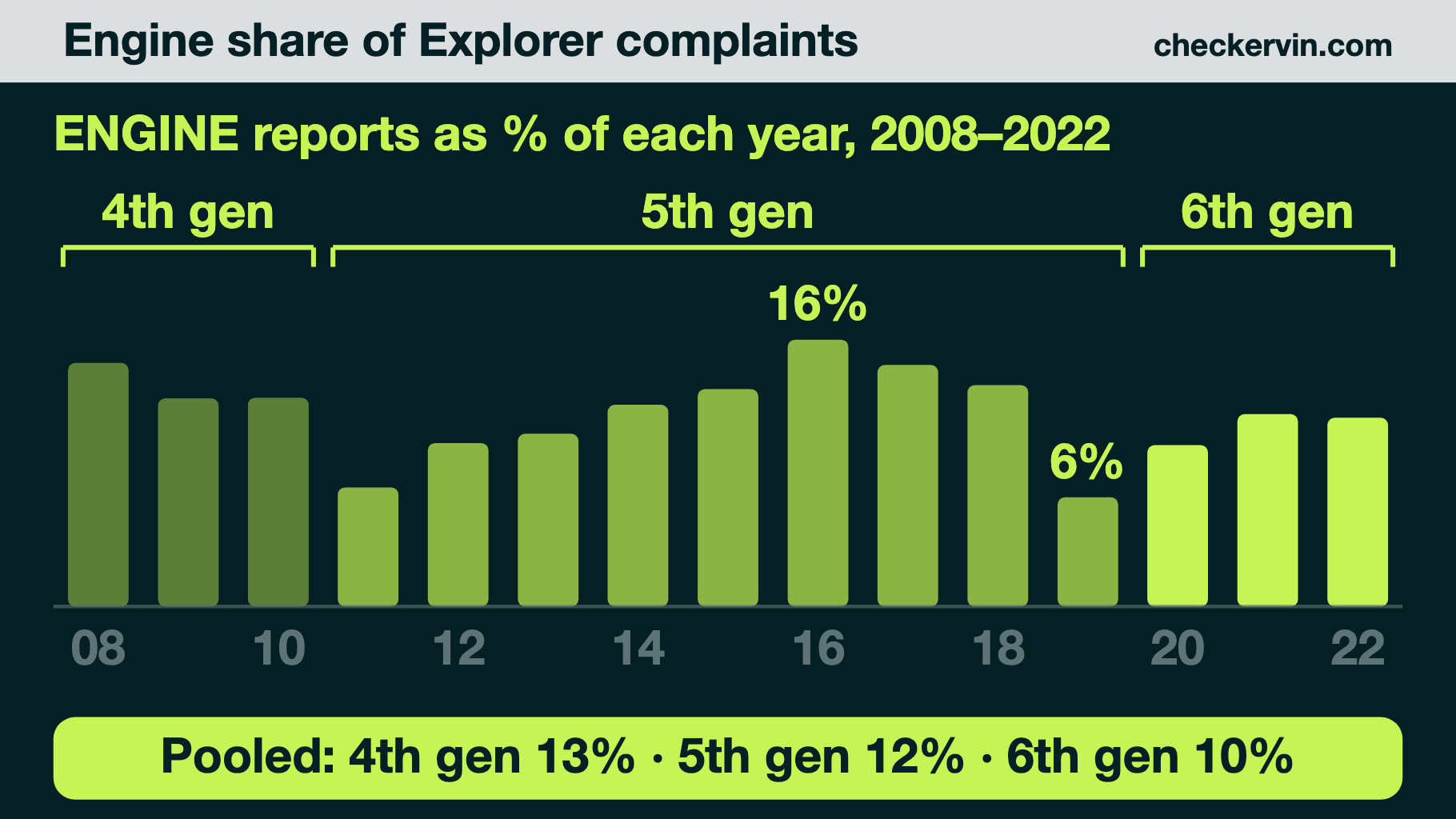
- None stands out. Engine complaints stay 6–16% of every model year's reports, 2008–2022.
- Is anything covered?
- No extended program. Ford's 3.0L bulletin pays only under the normal warranty, and no recall names an Explorer timing part.
23.4 hrs
Ford labor, 4WD 3.0L Explorer
TSB 23-2058, all four cam units
6–16%
Engine share of each year's complaints
2008–2022
#3–#5
Where ENGINE ranks each year
Top five in 15 of 15 years
0
Recalls naming a timing part
All years 2008–2022
The numbers, and whose numbers they are
We sell VIN checks, not repairs, so every dollar figure on this page is someone else’s. The most specific one comes from RepairPal, and it is narrower than the search suggests. RepairPal does not publish an Explorer timing chain replacement figure at all. Its closest estimate is a timing chain tensioner replacement: $1,655 to $2,242 across all Explorer model years, of which $1,256 to $1,843 is labor and about $399 is parts. Its 2012 Explorer page lists $1,720 to $2,301. Both were read in November 2026 through RepairPal’s own search listings.
RepairPal’s 2008 Explorer page is the odd one out at $455 to $535, with labor of only $171 to $251, while its all-years table lists the same year at $487 to $566. The estimator disagrees with itself on that year, and a labor figure that low does not describe opening the front and back of a 4.0L V6, so treat it as a tensioner-only access price rather than a chain job.
Labor is roughly three-quarters or more of RepairPal’s all-years estimate at either end of its range, and that is the pattern to carry into any quote. The parts in a timing set are a few hundred dollars. The bill is set by how much of the SUV has to come apart, and on the Explorer that changed sharply between generations.
Ford's own labor clock: 21.6 to 23.4 hours
A Ford technical service bulletin lists the hours Ford pays a dealer to do a repair under warranty. Independent shops price from labor guides built on the same teardown, so a bulletin’s hours are the most objective floor available. For the Explorer, the bulletin that matters is TSB 23-2058, issued March 21, 2024, which superseded TSB 22-2377 from October 2022. It covers 2020–2023 Explorers with the 3.0L EcoBoost and tells technicians to replace all four variable cam timing (VCT) units, the phasers that sit on the camshaft ends and are driven by the timing chains.
| TSB 23-2058 labor operation | Ford warranty time |
|---|---|
| 2020–2023 Explorer RWD 3.0L EcoBoost, replace all 4 VCT units | 21.6 hours |
| 2020–2023 Explorer 4WD 3.0L EcoBoost, replace all 4 VCT units | 23.4 hours |
| Check and correct caster, camber and toe afterward | 1.1 hours (1.3 with lane departure) |
Those hours are more than double what Ford books for the comparable cam phaser job on the 3.5L EcoBoost F-150, which our F-150 timing chain cost post puts at 9.5 to 10 hours. The bulletin’s parts list explains the gap without saying so directly. Alongside the four VCT units and three engine front cover gaskets, it calls for new rear and front subframe bolts, transmission bolts, torque converter nuts, engine mount bolts and a front main seal, and it adds a wheel alignment check. That is the parts list of a job where the powertrain comes out of the chassis, not one done through the hood.
Three generations, three different timing jobs
EPA’s fuel economy records list the engines Ford sold in each Explorer model year, and they fall cleanly into the three redesign generations our data spans. Every one of these engines drives its camshafts with chains. What changes is the layout around the chain, and with it the labor.
| Generation and engines (EPA) | What a timing job involves |
|---|---|
| 2008–2010: 4.0L SOHC V6, 4.6L V8 | 4.0L uses three chains and a jackshaft, one chain at the back of the engine |
| 2011–2019: 3.5L V6, 3.5L EcoBoost, 2.0L and 2.3L EcoBoost | Front-cover job on a transverse engine; the 3.5L V6 pump is chain-driven |
| 2020–2022: 2.3L, 3.0L EcoBoost, 3.3L incl. hybrid | Rear-drive layout; Ford books 21.6–23.4 hours for 3.0L cam units |
The middle row carries the complication most owners already know about. On the 2011–2019 3.5-liter V6 the timing chain also turns the water pump, which sits inside the engine, so a chain job and a pump job share most of their labor. We covered that in detail in the Explorer water pump cost post and will not repeat it here, beyond the practical point: on that engine, price the chain and the pump together. To confirm which of these engines a specific SUV has, the engine lookup by VIN reads it from the factory build.
What 15,262 complaints say about timing-chain years
Our corpus of federal NHTSA complaints holds 15,262 reports against the 2008–2022 Explorer, and 1,793 of them are counted in the ENGINE category. ENGINE is among the five most-reported components in 15 of 15 model years, ranking between #3 and #5. It is never first. Steering, structure and power train problems, or the catch-all “unknown or other,” lead in different years.
The useful view for a timing-chain question is ENGINE as a share of each year’s complaints, because that strips out the years that simply drew more reports overall. It is strikingly flat. The highest year is 2016 at 16% and the lowest is 2019 at 6%. Pooled by generation, engine reports are 13% of 2008–2010 complaints, 12% of 2011–2019 and 10% of 2020–2022. There is no hump of the kind the F-150 shows around its bulletin years.
Two limits keep that reading honest. NHTSA has no timing-chain category, so ENGINE covers every engine fault on every engine sold that year; it is a ceiling on timing complaints, never a count of them. And complaints are unverified owner reports, not a measured failure rate. What the flat line does support is the post’s main point: on the Explorer, the cost of a timing repair depends far more on which engine and which layout you have than on which model year you bought.
2008–2010: the 4.0L SOHC and its three chains
The 4.0-liter single-overhead-cam V6 in the last body-on-frame Explorers has the most awkward timing layout Ford put in this nameplate. Trade and enthusiast references describe three chains: a short one from the crankshaft to a jackshaft, a second at the front driving the left cylinder head’s camshaft, and a third at the back of the engine driving the right head. The guides and tensioners in those chain cassettes are the reputed weak point, and the rear one cannot be reached with the transmission in place. Owner guides disagree on whether that means pulling the engine or only the transmission, but neither is a small job.
Sources also disagree on whether a failure bends valves. Brake & Front End magazine’s 4.0L service article says the engine is not an interference design; several owner forums say it is. We found no Ford document settling it, so we report the disagreement rather than pick a side. The 4.6-liter three-valve V8 sold in the same years has its own cam-follower service message from Ford, SSM 47331, but that concerns roller followers, not the chain.
NHTSA also holds a one-line summary of Ford TSB 10-18-11, dated September 14, 2010, covering 2010 Explorers, Explorer Sport Tracs and Mustangs with symptoms that include an engine rattle, a check engine light, lack of power, no start and rough running. NHTSA has no copy of the bulletin and the summary does not name the engine, so we cannot say what it fixed. Its 2008–2010 model years carry 39 engine complaints in our data, the smallest group in the series because these SUVs drew few reports overall.
2011–2019: quiet on chains, noisy on solenoids
We pulled every manufacturer communication NHTSA lists for each Explorer model year and searched them for timing chains, tensioners, phasers, cam timing codes and rattles. The same search found the 3.0L bulletin above, so it does find timing documents when they exist. For the fifth-generation 3.5L V6, 3.5L EcoBoost, 2.0L and 2.3L engines, it found no Explorer bulletin for a stretched chain or a failed tensioner. Ford’s well-known 3.5L EcoBoost chain bulletin, TSB 17-0026, is written for the F-150 and does not appear among the Explorer’s NHTSA communications.
What it did find is a run of Ford special service messages that can save an owner real money. SSMs 48423, 49821, 50067 and 54366 cover a range of Ford and Lincoln models, including 2015–2020 Explorers, that set cam timing codes P0011 through P0025. Ford says the codes “may be due to small debris causing the VCT solenoid to stick,” and tells technicians to cycle the solenoid ten times with a scan-tool test before diagnosing or replacing anything.
2020–2022: the 3.0L EcoBoost and its cam timing units
The 2020 redesign moved the Explorer onto a rear-drive layout, and Ford’s labor table reflects it: separate operations for RWD and 4WD SUVs, both above 21 hours. The problem TSB 23-2058 fixes is specific. A 3.0L EcoBoost may tick, tap or rattle from the top front cover area for two to five seconds on start-up after sitting six hours or more, and Ford attributes it to a worn VCT unit. The bulletin’s service procedure is equally specific: replace the four VCT units and do not replace any other timing component not on its parts list.
Ford then narrowed the diagnosis. Special service messages 54262 and 54275, issued in October 2025 for 2020 and for 2021–2023 3.0L Explorers, say the Workshop Manual’s pinpoint test now includes extra steps and a video to identify the affected VCT unit that needs replacing. For an owner, that is the question to put to the shop: is the quote for all four units, or for the one the updated test identifies? The labor of reaching the front of the engine is the same either way, but the parts and the argument for doing all four are not.
These model years are also where the Explorer’s recall count climbs: 86 campaigns across 2020–2022 in our data, against 85 across the nine fifth-generation years. None of them is a timing recall, which the next section covers.
What the recall record covers, and what it doesn't
We queried NHTSA’s recall database for every Explorer model year from 2008 through 2022. No campaign names a timing chain, tensioner, phaser or VCT unit. Three engine recalls sit close enough to cause confusion. Campaign 24V635 covers 2021–2022 Explorers with the 3.0L EcoBoost (and 2.7L engines in other Ford models) whose intake valves may break, causing engine failure; a valve problem, not a chain problem. Campaign 24V598 covers 2020–2022 Police Interceptor Utility vehicles and the fire risk after an engine failure. Campaign 20V788 covers motor mount fasteners on 2020–2021 Explorers.
| Ford document type | What it pays for |
|---|---|
| Recall | Safety defect, free at any dealer; none covers Explorer timing parts |
| Technical service bulletin | Repair steps and labor time; pays only under existing warranty |
| Special service message | Diagnostic guidance for dealers; pays nothing by itself |
| Extended coverage program | None found for Explorer timing components |
The difference between those rows is explained on our TSB versus recall page. The practical step is to run the specific SUV through the Ford recall lookup by VIN, because a 2021 or 2022 3.0L Explorer with an open 24V635 campaign has a free engine repair waiting that has nothing to do with the chain.
What failure sounds like before it costs anything
- 2020–2022 3.0L EcoBoost: tick, tap or rattle from the top front cover for 2–5 seconds after sitting six hours or more (Ford TSB 23-2058)
- 2015–2020, any engine: check engine light with cam timing codes P0011–P0025, which Ford says may be a stuck VCT solenoid
- 2008–2010 4.0L V6: rattle from the front or rear of the engine, worst at start-up, as owner references describe guide wear
- Any year: rough running or a no-start after a rattle has gone on for months, a sign the timing has moved
The first two items come from Ford documents; the third is secondary, and labeled that way. All of them are cheaper caught early. A cam unit that rattles for a few seconds is a scheduled repair. A chain that has jumped a tooth is the same repair with a tow, and on an engine whose valves can meet the pistons it can be an engine.
Is a timing chain replacement worth it?
It usually is when the engine is otherwise sound, because a timing job costs less than a replacement engine. Three situations change the math. On a 2020–2022 3.0L Explorer out of warranty, the bulletin labor alone is a large bill, so get a written quote that states the hours and compare it with what the SUV is worth. On a 2011–2019 3.5L V6, a chain job without the pump wastes most of the labor. And on any engine where the chain has already let go, ask for a compression or leak-down test before paying for timing parts that will sit on a damaged engine.
A related question shows up in the same searches: what is the most common problem on a 2015 Explorer? In the federal record it is not the engine. For 2015, the most-reported component is structure, and ENGINE ranks #4 with 230 reports. The Ford Explorer years-to-avoid page lays out every year that way.
Before you authorize the repair, or buy the SUV
- Confirm the engine by VIN; the job, the hours and the parts differ by engine
- On a 3.0L, ask whether the quote is all four VCT units or the one Ford's updated test identifies
- On a 3.5L V6, ask for chain-and-pump and chain-only quotes side by side
- With a cam timing code, ask whether the VCT solenoid test was run first
- Compare quoted labor with Ford's 21.6 or 23.4 hours on a 2020–2023 3.0L
- Check for open recalls, especially 24V635 on 2021–2022 EcoBoost Explorers
If you are buying rather than repairing, start a 2020–2022 3.0L Explorer cold, after it has sat overnight, and listen to the first five seconds. Ask the seller not to warm it up first. A warranty check by VINshows whether factory powertrain coverage remains, which is the only coverage Ford’s bulletin offers.
Where this information comes from
- Ford TSB 23-2058 (NHTSA copy) — 3.0L EcoBoost cold-start rattle2020–2023 Explorer: replace all four VCT units, 21.6 hours RWD and 23.4 hours 4WD, normal warranty only.
- Ford TSB 22-2377 (NHTSA copy) — the original 3.0L bulletinThe October 2022 version for 2020–2022 Explorers that 23-2058 superseded.
- Ford SSM 54275 (NHTSA copy) — updated VCT diagnosisOctober 2025: a revised pinpoint test to identify the affected VCT unit on 2021–2023 3.0L Explorers.
- NHTSA — recalls and manufacturer communicationsOur year-by-year query found no Explorer recall naming a timing chain, tensioner or VCT unit.
- EPA fueleconomy.gov — Explorer engines by model yearThe source for which engines Ford sold in each 2008–2022 Explorer year.
- RepairPal — Explorer timing chain tensioner estimateThe $1,655–$2,242 all-years figure quoted above, read November 2026.
Keep reading
Frequently asked questions
How much does it cost to replace the timing chain on a Ford Explorer?
RepairPal does not publish a full timing chain figure for the Explorer. Its closest estimate, timing chain tensioner replacement, lists $1,655 to $2,242 across all model years, with $1,256 to $1,843 of that in labor, and $1,720 to $2,301 for a 2012 Explorer — its figures, read in November 2026. On a 2020–2023 Explorer with the 3.0L EcoBoost, Ford's own bulletin for replacing the four cam timing units books 21.6 hours on a rear-drive SUV and 23.4 hours on a 4WD one, so multiply your shop's hourly rate by those hours before parts.
Is a timing chain replacement worth it on an Explorer?
Usually, if the rest of the engine is healthy. A timing job is cheaper than a used engine. The case gets weaker on a high-mileage 3.0L EcoBoost where the bulletin labor alone runs past 21 hours, or on any engine where the chain has already jumped and damaged valves. Get a compression or leak-down test before committing, and compare the quote with the vehicle's market value.
Is the 2020–2023 Explorer 3.0L EcoBoost cold-start rattle covered by Ford?
Only under the normal warranty. Ford's TSB 23-2058, which superseded TSB 22-2377, describes a tick or rattle from the top front cover for two to five seconds after the SUV sits six hours or more, caused by a worn variable cam timing unit. Its warranty status is the New Vehicle Limited Warranty, emissions warranty or an extended service plan. We found no customer satisfaction program extending coverage, unlike the F-150 cam phaser program. A 2025 Ford service message added a test to find the single faulty unit.
Which Ford Explorer years should you avoid for timing chain problems?
The federal record does not single out a timing-chain year. Engine complaints, which cover every engine fault, stay between 6% and 16% of each model year's reports from 2008 to 2022. The one Ford bulletin that names an Explorer timing component covers the 2020–2023 3.0L EcoBoost, so on those SUVs a cold-start listen and a service history matter most. For 2008–2010 Explorers with the 4.0L V6, the engine's three-chain layout makes any timing repair labor-heavy.
Does the Ford Explorer have a timing belt or a timing chain?
A chain, on every engine EPA lists for the 2008–2022 Explorer: the 4.0L V6 and 4.6L V8, the 3.5L V6 and 3.5L EcoBoost, the 2.0L and 2.3L EcoBoost fours, the 3.0L EcoBoost and the 3.3L V6 including the hybrid. Kelley Blue Book publishes Explorer pages titled timing belt replacement anyway, so read any belt quote as a chain job and confirm the engine by VIN before pricing it.
Confirm the engine before you price the repair
A free CheckerVIN report shows the factory build, engine, specifications and open recalls for any VIN, so you know which timing job and which Ford bulletin apply.
Run a free VIN check