The short answer
- What does it cost?
- Kelley Blue Book's ZIP-dependent Fair Repair Range runs roughly $293-$420 for a fluid change across the 2019-2021 Explorers checked here, and $4,910-$6,419 for a full transmission replacement.
- Is it the same Explorer every year?
- No. The body-on-frame Explorer (through 2010), the unibody front-wheel-drive-based Explorer (2011-2019) and the unibody rear-wheel-drive Explorer (2020 on) are three different platforms with three different complaint patterns.
- Which years carry the risk?
- 2020-2021-2022 — the one generation where POWER TRAIN ranks #1 in every model year of our top-five data, peaking at 40.5% of 2020's complaints, and the same three years covered by two driveline recalls and a third, newer one on the transmission's own park system.
The numbers, and whose numbers they are
We sell VIN checks, not repairs, so every dollar figure here belongs to someone else. Kelley Blue Book’s Fair Repair Range, which varies by ZIP code, lists $293–$367 for a 2019 Explorer (Columbus, OH), $341–$420 for a 2020 (Durham, NC) and $299–$408 for a 2021 (Las Cruces, NM) — all fluid changes, not rebuilds. A full transmission repair or replacement is a different order of job: $5,967–$6,419 for a 2021 (Columbus, OH) and $4,910–$5,719 for a 2022 (Santa Cruz, CA) in the same source.
None of those six figures explain why a 2020 Explorer’s service would be priced any differently from a 2013’s. What they can’t show on their own is what our own federal complaint record says changed under the hood between those two cars — which is most of the rest of this page.
Three platforms, one job title
“Explorer transmission fluid change” describes at least three different vehicles, not one. The Explorer sold through the 2010 model year was body-on-frame, a truck platform shared underpinnings with. From 2011 Ford moved it to a unibody, front-wheel-drive-based platform shared with the Ford Flex and Lincoln MKT — the first Explorer built that way. Then, for the 2020 model year, Ford moved it again, this time to the rear-wheel-drive CD6 platform it shares with the Lincoln Aviator, the first rear-wheel-drive Explorer since the body-on-frame era ended.
A search estimator that quotes one flat number for “Explorer transmission fluid change” regardless of model year is quoting across all three without saying so.
What 15,262 complaints say about three platforms
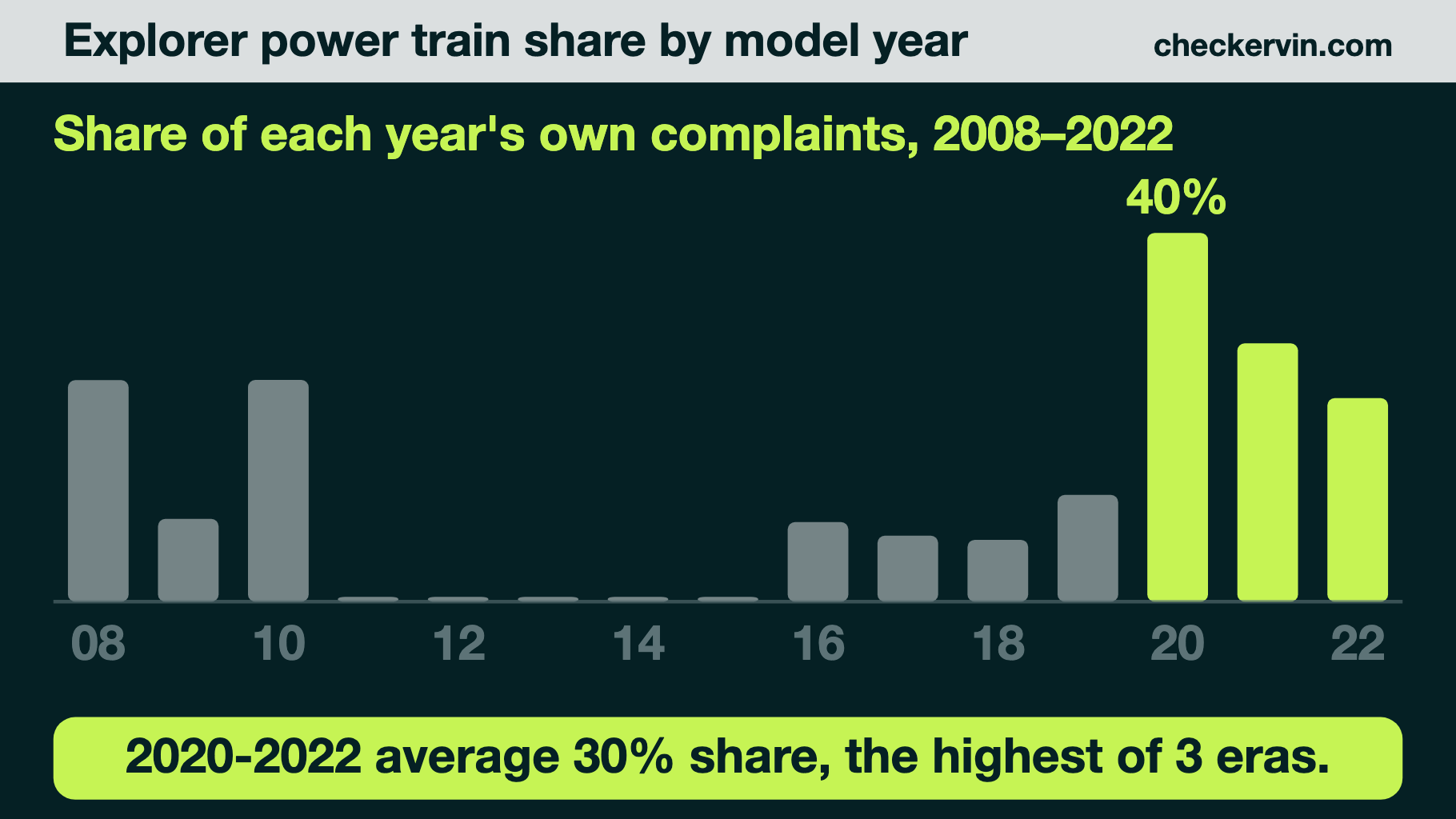
Our corpus of federal NHTSA complaints holds 15,262 reports against the 2008–2022 Explorer, and 1,187of them fall in the POWER TRAIN category. Laid out by the three platform eras above, the share of each era’s own complaints that POWER TRAIN accounts for runs 22.6% in 2008–2010, drops to 3.3% in 2011–2019, then jumps to 35.2% in 2020–2022— higher than either of the other two platforms ever reached.
Raw counts make the newest platform’s concentration even clearer. The three 2020-2021-2022 model years hold 694 of the nameplate’s all-time 1,187POWER TRAIN complaints — 58.5% of every POWER TRAIN report this Explorer has ever drawn — despite being only 3 of the corpus’s 15 model years and only 12.9% of its total complaint volume. Complaints are unverified owner reports, not a measured failure rate, but a share that lopsided is not noise.
2008-2010: the body-on-frame years
The last body-on-frame Explorer carries a real but limited POWER TRAIN concentration: 24.3% of 2008’s complaints, ranking 2ndin that year’s own top five, and 24.3% of 2010’s, ranking #1. 2010 is the only year of the three where it leads outright. 2009 is the exception, a smaller sales year with far fewer complaints overall (33), where POWER TRAIN still ranks 4th but at a lower 9.1% share. This era ended with the platform change, so it is not evidence about anything sold after 2010.
2011-2019: the quiet unibody years
The front-wheel-drive-based unibody Explorer is the quietest of the three platforms on this measure. POWER TRAIN does not crack the model year’s own top five at all in 5 of these nine years (2011, 2012, 2013, 2014, 2015), and in the 4 years it does appear — 2016, 2017, 2018, 2019— it never ranks higher than 3rd and never exceeds 11.7% of that year’s total. This is the generation most “Explorer transmission fluid change” estimators are implicitly pricing when they quote one number across every model year, because it is the longest-running of the three and the one with the least to distinguish by year.
2020-2022: three recalls, one generation
The rear-wheel-drive Explorer flips the pattern immediately. POWER TRAIN ranks #1 in our top-five data in all three model years on record for this platform, peaking at 40.5% of 2020’s complaints — the highest single-year share this nameplate has ever recorded, more than three times the 2011–2019 ceiling. Our own recall counts move the same way: 2020, 2021, 2022 average 28.7 recorded recalls a year, against 9.4 a year for 2011–2019 — roughly 3.1x the rate, in a newer, smaller generation.
Three named NHTSA campaigns sit inside that window, and they are not the same defect repeated. NHTSA 22V255 (Ford’s own 22S27, opened April 2022) covers a rear axle horizontal mounting bolt that can fracture and let the driveshaft disconnect, on Explorers built at Chicago Assembly between October 2018 and April 2022 — 224,413 vehicles by one secondary account of NHTSA’s own recall-supplement figure, though CarComplaints separately reports “more than 252,000,” a discrepancy this page could not resolve and states rather than hides. The interim remedy, per multiple reports, was a software change that applies the parking brake automatically — not a parts replacement.
| Campaign | What it actually covers |
|---|---|
| 22V255 (2022) | Rear axle bolt fracture / driveshaft disconnect — software interim remedy |
| 23V675 (2023) | Same defect family, expanded — hardware fix, 238,364 vehicles |
| 26V402 (2026) | Transmission park pawl engaging while moving — the one actually on the gearbox |
NHTSA 23V675, opened in October 2023, is that same defect family’s second chapter: after an investigation opened into complaints that the 2022 software fix was not stopping failures, Ford expanded the recall to 238,364 MY2020-2022 Explorers with an actual hardware remedy, replacing the subframe bushing and the bolt itself. A third campaign, NHTSA 26V402 (Ford’s own 26S48), is newer still — acknowledged by NHTSA on June 29, 2026, after its Office of Defects Investigation opened a review in April 2026 following 11 owner complaints, 9 of them on 2020 Explorer and Aviator models. This is the one campaign of the three actually on the transmission itself: the park pawl can engage while the vehicle is moving, damaging the park system and raising a rollaway risk once parked. It covers 2020-2021 Explorer among 741,195 vehicles total across several Ford and Lincoln nameplates; sources disagree on the Explorer-specific count, so none is stated as settled here. Ford’s remedy is now out: owner letters were mailed November 20, 2026, and dealers update the powertrain control module software and inspect and replace any damaged transmission parts free of charge, per the NHTSA recall record.
What "power train" actually covers
NHTSA’s POWER TRAIN complaint category is broader than the transmission or its fluid. It covers the driveline, the axles and related hardware generally — which is exactly why two of the three campaigns above, a rear axle bolt and a disconnecting driveshaft, land in the same complaint category this page’s chart is built from, even though neither one is a fluid or gearbox failure. Only the third campaign, the 2026 park-pawl recall, is actually on the transmission itself.
Which 10-speed, and which fluid
The 2020-2022 Explorer does not use one single transmission code. Per parts-industry references and NHTSA-listed technical service bulletins (cited here via secondary aggregation, not fetched as primary PDFs), non-hybrid Explorers use the 10-speed 10R60 or 10R80 depending on engine, and hybrid models use the 10R80 MHT variant. Those sources describe ordering the wrong one, by guessing from the model year alone rather than the VIN or build sheet, as a commonly made and costly mistake.
How often it's actually due
A third-party summary of this generation’s Scheduled Maintenance table lists the automatic transmission fluid change at 150,000 miles under normal driving conditions. Independent shops cited in the same research commonly recommend a shorter interval for vehicles used for towing or heavy stop-and-go driving. Neither figure here was read directly from Ford’s own manual for a specific VIN, which is the source that should settle it for any one car.
Before you authorize the service
- Confirm the exact model year and platform by VIN — the complaint pattern and the recall exposure both depend on it
- Pull the VIN's open recalls before paying for anything a campaign might already cover for free
- On a 2020-2021 Explorer, ask specifically whether 26V402 (the park-pawl campaign, remedy available since November 2026) has been done on that VIN
- Confirm which 10-speed code the shop is pricing — 10R60, 10R80 or 10R80 MHT — rather than assuming by model year alone
- Get the quote itemized — fluid brand, quantity and labor — not a single flat "transmission service" line
If you are buying the Explorer, not maintaining it
The same record reads as a shopping map. A 2020–2022Explorer carries the heaviest power-train complaint share of any generation in the corpus and sits inside three separate recall windows — running its VIN before negotiating matters more here than on an older car, not less. A Ford VIN decode confirms the exact model year, platform and build before you price a service, and checking what factory coverage remains by VIN settles whether anything here is still someone else’s responsibility to fix.
On any candidate car, run the Ford recall checkfirst — three named campaigns sit inside this generation alone, and the newest only got its remedy in November 2026 — and check which Explorer model years show the most complaints overall rather than judging the nameplate by the power-train figure alone. A 2011-2019 Explorer carries a materially lighter power-train record than either the generation before it or the one after.
Where this information comes from
- NHTSA — Explorer complaint databaseThe federal complaint record this page's figures are computed from, browsable by model year.
- NHTSA — recalls by VINThe official lookup that settles which campaigns, including 22V255, 23V675 and 26V402, are still open on a specific VIN.
- Kelley Blue Book — Explorer Fair Repair Range (transmission fluid change)Source for the ZIP-dependent price ranges quoted above.
- Kelley Blue Book — Explorer transmission repair and replacementThe full-replacement price range quoted above, distinct from a routine fluid change.
Keep reading
Frequently asked questions
How much does it cost to change the transmission fluid in a Ford Explorer?
Kelley Blue Book's ZIP-dependent Fair Repair Range runs roughly $293-$420 across the model years checked for this page: $293-$367 for a 2019 Explorer, $341-$420 for a 2020, and $299-$408 for a 2021. A full transmission repair or replacement is a much larger job, priced by KBB at $5,967-$6,419 for a 2021 and $4,910-$5,719 for a 2022 in the ZIP codes checked. None of these are our figures — we sell VIN checks, not repairs.
Which Ford Explorer model years have the most power-train complaints?
2020, 2021, 2022 — computed from src/data/models/ford-explorer.json, POWER TRAIN ranks as the single most-reported category in our top-five data in every one of those three years, peaking at 40.5% of 2020's own complaints, the nameplate's highest single-year share on record. The prior generation, 2011-2019, never exceeds 11.7% and is below the top five entirely in five of those nine years.
Are the 2020-2022 Ford Explorer recalls about the transmission?
Mostly not, which matters if you're pricing a fluid change rather than a recall repair. NHTSA campaigns 22V255 (2022) and 23V675 (2023) both cover a rear axle mounting bolt that can fracture and disconnect the driveshaft — a driveline and axle defect, not the gearbox or its fluid, even though NHTSA's own complaint coding groups it under the same POWER TRAIN category this page's chart uses. A third campaign, 26V402, opened in mid-2026, is the one actually on the transmission itself: the park pawl can engage while the vehicle is moving, which is a park-system defect, not a fluid-degradation one. A recall repair and a scheduled fluid service are two different things, and a free VIN check settles which campaigns, if any, are still open on a specific vehicle.
What transmission does the Ford Explorer have, and what fluid does it use?
A 2020-2022 Explorer uses one of Ford's 10-speed automatics — the 10R60 or 10R80 depending on engine, or the 10R80 MHT in hybrid models — per parts-industry references and NHTSA-listed service bulletins; it is not one single transmission code across every version of this generation. Getting the exact unit from the VIN or build sheet before ordering parts or fluid is described in those sources as the most commonly made, and costliest, mistake on this transmission family.
How often should a Ford Explorer's transmission fluid actually be changed?
A third-party summary of the Scheduled Maintenance table lists 150,000 miles under normal driving conditions for the automatic transmission fluid on this generation. Independent shops cited in the same research commonly recommend a shorter interval, well under that figure, for vehicles used for towing or heavy stop-and-go driving. Neither number here is read directly from Ford's own manual for a specific VIN, which is the source that should settle it for any one car.
Confirm the generation before you price the service
A free CheckerVIN report shows the factory build, specifications and open recalls for any VIN — confirm what you're actually pricing.
Run a free VIN check