The short answer
- What does it cost?
- RepairPal's Escape estimator averages $795 to $1,050, before tax and fees; its 2013 Escape page lists $863 to $1,194.
- Is it really the alternator?
- Check first. Ford recalled 2008–2011 Escapes for a steering sensor and 2013–2014 cars for stall-causing sensor splices, symptoms owners often blame on charging.
- How common are electrical complaints?
- Electrical makes the Escape's top five in 11 of 15 model years but never ranks higher than No. 3, and no Escape recall names the alternator.
$795–$1,050
RepairPal Escape estimate
Average, before tax; read Nov. 22, 2026
No. 3
Best rank for electrical complaints
On the 2013 Escape; never No. 1, 2008–2022
740,878
Escapes and Mariners in the steering recall
14V-284 (Ford 14S05), 2008–2011
0
Escape recalls naming the alternator
Every model year, 2008–2022
The estimate, and whose it is
CheckerVIN decodes VINs and lists open recalls; we do not repair cars, so every price here belongs to someone else and carries the date we read it. RepairPal’s Ford Escape alternator estimator gives an average between $795 and $1,050. Its page for the 2013 Escape lists a higher band, $863 to $1,194. RepairPal refuses direct requests from our research tools, so both figures come from the page text that two separate searches served on November 22, 2026, with identical wording. Neither includes tax, fees or a battery.
Two mobile-repair services publish much lower Escape averages in search snippets, but we could not open either page to check the figure or what it covers, so we leave them out. What the spread does tell you is that the quote varies more with the part than with the shop. A new Motorcraft unit, a remanufactured one and an aftermarket alternator sit in different price bands, and none of them fixes a fault that was never in the charging system. On the Escape, the federal record has several of those.
How big the Escape's electrical record really is
Our corpus holds 23,216 NHTSA owner complaints against the 2008–2022 Escape, pooling the gasoline, hybrid and plug-in versions NHTSA files under separate names. NHTSA has no alternator category. The nearest one, ELECTRICAL SYSTEM, also takes in the 12-volt battery, wiring, lights, switches and control modules, so it is a ceiling on charging trouble, never a count of failed alternators.
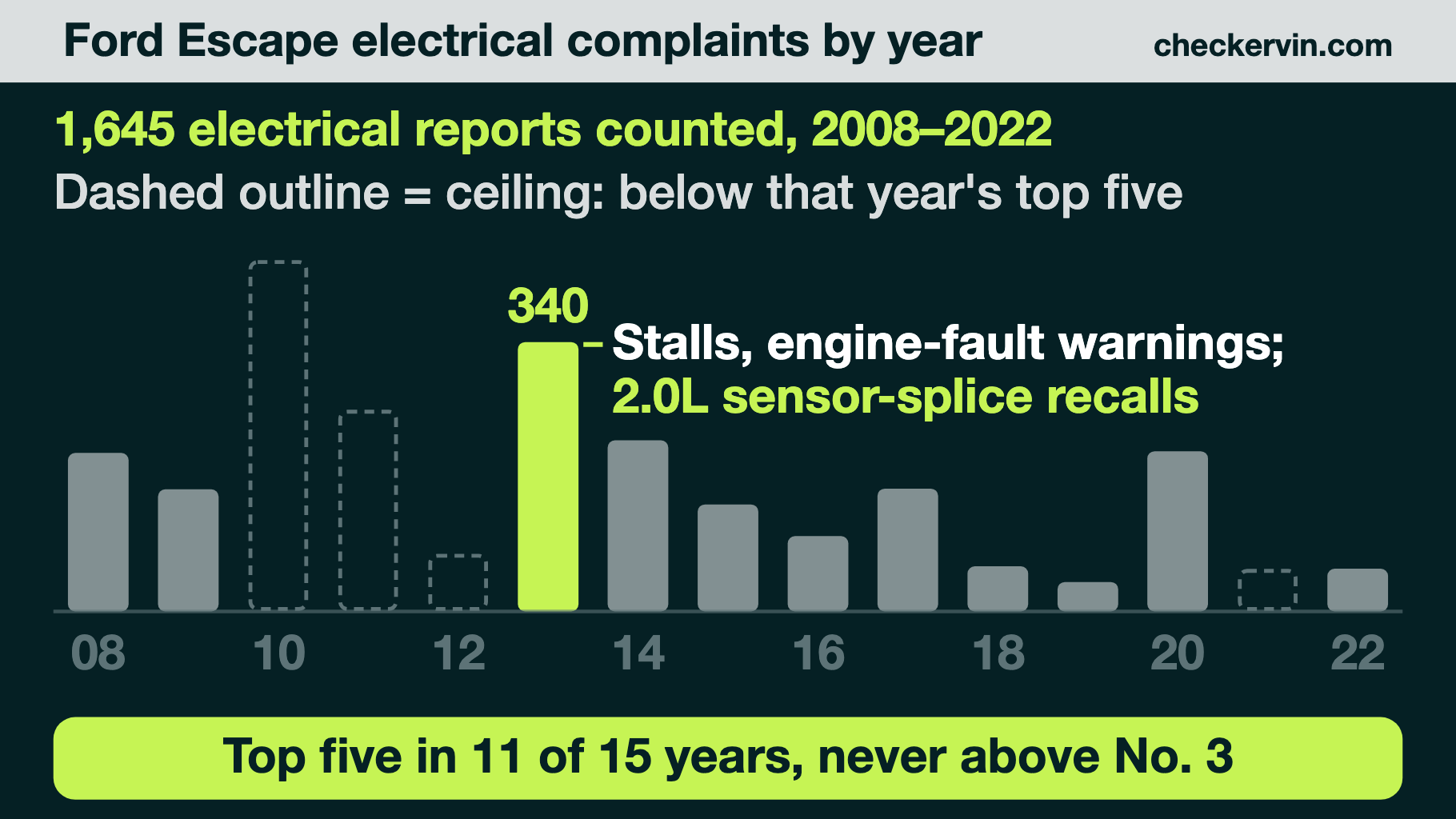
We keep each model year’s five most-reported categories. Electrical makes that list in 11 of 15 years, which sounds like a lot until you see where it ranks: never first, and no higher than No. 3, reached on the 2013 Escape with 340 complaints. Across the years where it appears, electrical never exceeds 14% of a year’s complaints. On the 2010, 2011, 2012 and 2021 cars it falls below fifth place, which means uncounted, not zero.
The counted total is 1,645 electrical complaints, and the 2013 model alone holds 21% of it. In most Escape years some other category, usually engine, transmission or steering, outnumbers electrical by a wide margin: on the 2008 car, steering complaints outnumber electrical more than 6 to one. A battery light on an Escape is worth checking, but the record does not describe a model that eats alternators.
2008–2011: the steering fault that gets blamed on the alternator
The first Escape years in our record show a pattern worth knowing before you buy a part. Electrical complaints against the 2008 and 2009 cars are frequently filed together with steering complaints, and the stories overlap: power steering that cuts out mid-turn, a heavy wheel at parking speed, sometimes a battery light at the same moment. In several of the narratives that mention the alternator, a shop replaced it, often along with the battery, to cure the steering, and the steering fault came back.
Ford identified a different cause. Its Part 573 report for recall 14V-284, Ford number 14S05, dated May 27, 2014, covers 2008–2011 Escape and Mercury Mariner models built at Kansas City from August 18, 2006 to September 11, 2010, about 740,878 vehicles. It says a poor signal-to-noise ratio in the electric power steering torque sensor can leave the steering module unable to read driver input, at which point it removes assist and defaults to manual steering. The remedy was new software for the steering module and the instrument cluster, with parts replaced on cars showing a history of the fault. The report says nothing about voltage, the battery or the alternator.
The 2010 car shows how the top-five list can mislead in the other direction. Electrical drops below fifth there, but the fifth category that year was large, so the dashed outline on the chart is the tallest mark on it. That outline is only the most electrical could have been. It is not a spike.
2013: the peak is stalls and sensor wiring
The 2013 Escape, the first year of the redesign, carries the largest electrical bar we counted, 340 complaints and No. 3in its year. Read the narratives and very few are about charging. The common story is an engine that stalls in traffic or drops into limp mode with an “Engine Fault – Service Now” warning, plus overheating and smoke complaints from cars with the 1.6-liter engine. When owners mention the alternator in these reports, it is usually to say it tested fine.
Ford recalled the wiring behind a share of those stalls. Recall 14V-495, Ford number 14S17, covers 2013–2014 Escapes with the 2.0-liter engine built from October 5, 2011 to April 1, 2013: insufficient compression in the engine harness splices to the manifold absolute pressure sensor can send bad signals to the engine computer, which NHTSA’s summary says could cause the vehicle to hesitate or the engine to stall. Recall 15V-813 extended the same fix to more 2013 Escapes built from January 11, 2012. Dealers replace the crimped splices. The 1.6-liter overheating and fire recalls from the same year are covered in our Escape water pump post.
A stall with the battery light on can look like charging failure, because a dying engine stops turning the alternator. The order of checks matters: stored engine codes and the recall status first, then the charging test.
Dead after sitting: drains Ford has documented
From the 2014 model on, a second story appears alongside the stalls: a battery found flat after the car sat, a new battery that dies again, and an alternator that tests good. That is a parasitic drain, something drawing current with the key off, and no alternator can cause or cure it. Ford has published several for the Escape:
| Ford document | What it describes |
|---|---|
| SSM 46411, February 2017 | 2017 Escape with Sony audio built on or before Dec. 23, 2016: discharged battery and a cycling noise like a CD ejecting; reprogram the audio module |
| SSM 49574, February 2021 | 2020 Escape 2.5L hybrid and plug-in built June 9 to Nov. 16, 2020: key-off drain, no crank, parking-brake warnings; the ABS module keeps the cluster lit; reprogram ABS |
| SSM 49990, July 2021 | The same drain and fix for 2020 Escapes built in the same window |
| TSB 22-2169 | 2020–2022 Escape plug-in hybrid: 12-volt battery discharged while plugged in to charge |
The 2020 Escape, a new generation, brings electrical back to No. 4in its year. Its narratives are mostly about door check-arm welds, all-wheel-drive module faults and rear camera glitches rather than charging. Owners of 2017 cars also describe auto start/stop messages telling them to shift to Park and restart. Ford has bulletins on start/stop faults for these years, TSB 18-2193 for 2017 cars built on or before May 18, 2016 with stored engine codes, fixed by reprogramming the engine computer, and SSM 48046 for 2018–2019 2.0-liter cars that will not restart after an auto stop, fixed with a revised crankshaft position sensor. Neither involves the alternator.
Hybrids: ask about the DC/DC converter
The 2020–2022 Escape Hybrid and Plug-In Hybrid add a wrinkle. Ford’s Special Service Message 52201, from January 2024, covers 2020–2023 Escapes with the 2.5-liter hybrid or plug-in powertrain that show a low or discharged 12-volt battery with trouble code U3003:62 stored in the direct current/direct current (DC/DC) converter control module. Ford’s suggested cause is an open 300-amp high-current fuse in the battery junction box; the fix is to confirm and replace the fuse, then recharge and test the battery.
The bulletin never mentions an alternator. One 2020 hybrid owner told NHTSA that the dealer first replaced the 12-volt battery, the car died again within a mile, and the dealer then blamed the “battery converter.” We found no Ford document that states outright whether a given Escape Hybrid has a belt-driven alternator, so we will not claim either way. If a shop quotes an alternator on a hybrid Escape, ask it to show you where the part is and whether it has read the DC/DC converter module’s codes.
What a failing alternator does look like
None of this means Escape alternators never fail. Among the owners who did describe a genuine charging fault, the sequence is consistent: a battery warning light while driving, headlights and dash lights that dim or flicker, accessories shutting off, then a stall, often with the power steering going heavy first because the Escape’s steering is electric. One 2014 owner describes the steering locking up mid-turn just after leaving a highway, the car’s electrical system then shutting features down to save battery power, and a Ford dealer finding the alternator weak.
The pattern to separate from that is a car that drives normally and is dead in the morning. A failing alternator shows itself while the engine runs; a drain shows itself while the car sits. A shop can tell them apart with a charging-voltage reading at idle and under load, plus a key-off current draw test, before anyone orders a part.
Which engine, which part
The alternator, its mounting and the labor to reach it change with the engine, and the Escape has had many. EPA’s fuel economy listings give this lineup:
| Model years | Engines listed by EPA |
|---|---|
| 2008 | 2.3-liter four, 3.0-liter V6; hybrid with a 2.3 |
| 2009–2012 | 2.5-liter four, 3.0-liter V6; hybrid with a 2.5 |
| 2013–2016 | 1.6 turbo four, 2.0 turbo four, 2.5 four (front-drive only) |
| 2017–2019 | 1.5 turbo four, 2.0 turbo four, 2.5 four (front-drive only) |
| 2020–2022 | 1.5 turbo three, 2.0 turbo four, 2.5 hybrid and plug-in hybrid |
We could not obtain Ford’s labor times for alternator replacement on any of these engines, so we will not rank which one is the hard job. Ask the shop how many hours it is quoting and from which labor guide. A Ford VIN decode confirms the engine, and the engine size lookup does the same for any make, so the parts counter gets the right unit the first time.
Before you authorize an alternator
- On a 2008–2011 Escape that loses power steering, check recall 14V-284 before anything else
- On a 2013–2014 Escape that stalls, ask for stored engine codes and check recalls 14V-495 and 15V-813
- Ask for the charging voltage with the engine running, at idle and under load, in writing
- If the battery only dies after sitting, ask for a key-off current draw test
- On a 2020 or newer hybrid, ask whether the DC/DC converter module codes were read
- Get a quote that names the part as new, remanufactured or aftermarket and states the core charge
The first two checks are free if a recall applies. A Ford recall lookup by VIN shows whether a campaign is still open on your car, and our guide to bulletins versus recalls explains why a recall repair costs nothing while a special service message like 46411 is only guidance to dealers. If the battery itself is the casualty, the battery size lookup by VIN gives the right group size.
If you are buying the Escape, not repairing it
On a test drive, turn the wheel lock to lock at parking speed and watch for a steering warning, and let the car idle with the headlights, blower and rear defroster on to see whether the lights dim. Ask whether the battery or alternator has been replaced, and why. The Ford Escape years-to-avoid page ranks every model year on its full complaint record, which on most years is dominated by engine and transmission trouble rather than electrical.
A free CheckerVIN report returns the factory build, engine, specifications and open safety recalls for any VIN. It does not include accident, title, odometer or repair history, so it cannot tell you whether an alternator was ever replaced, but it will show whether the steering or splice recall is still open on the car in front of you.
Where this information comes from
- Ford Part 573 report, recall 14V-284 / 14S05 (NHTSA copy), May 20142008–2011 Escape and Mariner; EPS torque sensor can drop steering assist; about 740,878 vehicles; software remedy.
- NHTSA: recalls by VIN (14V-495 and 15V-813 summaries)2013–2014 Escape MAP sensor harness splices that could cause hesitation or stalling; our year-by-year query found no alternator recall.
- Ford SSM 52201 (NHTSA copy): hybrid 12V battery low, DTC U3003:62 in the DC/DC converter2020–2023 Escape 2.5L hybrid and plug-in; open 300-amp fuse F4 in the battery junction box.
- Ford SSM 49574 (NHTSA copy): 2020 Escape hybrid no crank, discharged batteryKey-off drain from the ABS module keeping the cluster lit; reprogram the ABS module.
- Ford SSM 46411 (NHTSA copy): 2017 Escape Sony audio, discharged batteryCars built on or before Dec. 23, 2016; reprogram the audio control module.
- Ford TSB 18-2193 (NHTSA copy): 2017 Escape auto start/stop codesCars built on or before May 18, 2016; reprogram the engine computer, 0.3 hours.
- NHTSA: vehicle complaintsThe federal complaint database our electrical counts are computed from.
- EPA and DOE: fueleconomy.gov vehicle listingsEngine lineup for each Escape model year in the table above.
- RepairPal: Ford Escape alternator replacement cost estimateAverage $795–$1,050 as served in search results, November 22, 2026; direct requests refused.
- RepairPal: 2013 Ford Escape repair and maintenance costsAlternator replacement listed at $863–$1,194, as served in search results on the same date.
Keep reading
Frequently asked questions
How much does it cost to replace an alternator on a Ford Escape?
RepairPal's Escape estimator gives an average between $795 and $1,050, and its 2013 Escape page lists $863 to $1,194, as served in search results on November 22, 2026. Those figures exclude tax and fees. The engine, the shop's labor rate and whether the unit is new or remanufactured move the price, so ask for a written quote that separates part and labor.
What year to stay away from Ford Escape?
That depends on what you are worried about. For electrical trouble specifically, the 2013 Escape carries the most electrical complaints in our NHTSA corpus, mostly stalls and engine-fault warnings tied to recalled sensor wiring on the 2.0-liter. The 2008–2011 cars have a power-steering recall that owners often confuse with charging trouble. Our Ford Escape years-to-avoid page ranks every year on its full complaint record.
What are the first signs of a bad alternator?
Escape owners who reported charging trouble to NHTSA describe a battery warning light while driving, headlights and dash lights that dim or flicker, and a car that dies or will not restart after a short trip. A battery that goes flat only after the car sits overnight points more often to a drain than to the alternator. A charging-voltage test with the engine running tells the two apart.
Can I drive 20 miles with a bad alternator?
Nobody can promise a distance. Once the alternator stops charging, the car runs on what is left in the battery, and the Escape's electric power steering, lights and engine computer all draw from it. Escape owners describe a battery light followed within minutes by lost power steering or a stall. Treat a charging warning as a reason to get off the road and to a shop, not as a range estimate.
Is there a recall on the Ford Escape alternator?
No. We queried NHTSA's recall database for every Escape model year from 2008 through 2022, including the hybrid and plug-in names, and no campaign names the alternator. The recalls owners most often confuse with charging trouble are 14V-284, a 2008–2011 power-steering torque sensor fix, and 14V-495 and 15V-813, which replaced stall-causing sensor splices on 2013–2014 Escapes.
Check the VIN before you price the alternator
A free CheckerVIN report shows the factory build, engine, specifications and open recalls for any VIN, so you order the right part and catch a recall that covers the real fault.
Run a free VIN check