The short answer
- What does it cost?
- RepairPal lists $1,959–$2,627 for a 2013 Edge and $585–$731 for a 2019. The difference is almost all labor.
- Why so much on 2007–2018?
- Those Edges all offered the 3.5L V6, whose pump sits inside the engine, turned by the timing chain.
- What is the 2.0L trap?
- On 2015–2018 2.0L EcoBoost Edges, coolant loss can be coolant entering the cylinders. Ford's fix for that is a new long block, not a pump.
81%
Of counted Edge engine complaints
2015–2018 model years
2,108
Engine complaints counted
2008–2022, top-five years only
0
NHTSA recalls naming the pump
All years 2007–2022
6×
RepairPal labor, 2013 vs 2019
$1,391+ against $220+
The numbers, and whose numbers they are
We do not sell repairs and publish no price of our own, so every dollar figure here belongs to the site that published it, retrieved in November 2026. RepairPal has year pages for the Edge, and three of them tell the story. Its 2009 Edge page lists $1,785 to $2,435, with $1,391 to $2,041 of labor and parts around $394. Its 2013 page lists $1,959 to $2,627, with the same $1,391 to $2,041 of labor and $568 to $587 of parts. Its 2019 page lists $585 to $731, with $220 to $322 of labor and $365 to $409 of parts, a figure its listing says is localized to Columbus, Ohio.
The parts barely move across those years. The labor drops by roughly a factor of six between 2013 and 2019. That is not inflation running backward; it is a different pump in a different place, which the next section traces to the engine list. Other estimators blur the split. YourMechanic’s all-years Edge average is $324, with $128 for parts and $196 for labor, and Kelley Blue Book’s 2013, 2018 and 2020 Edge pages showed no fair repair range for this job at all when we checked, only a generic $375 to $787 in their FAQ. A single number for “the Edge” averages an hour-long belt job with a weekend of engine teardown.
Which Edge, which pump
The federal fuel economy records at fueleconomy.gov list every engine Ford certified for each Edge model year. Read year by year, they split the Edge into four engine eras:
| Model years | Engines EPA lists for the Edge |
|---|---|
| 2007–2010 | 3.5L V6 only |
| 2011–2014 | 3.5L V6, 3.7L V6 (Sport); 2.0L EcoBoost four from 2012 |
| 2015–2018 | 3.5L V6, 2.0L EcoBoost four, 2.7L EcoBoost V6 |
| 2019–2022 | 2.0L EcoBoost four, 2.7L EcoBoost V6 — no 3.5L |
The 3.5-liter V6 is listed in every Edge model year from 2007 through 2018and in none after. That is the line RepairPal’s prices fall across. For the 2.7L EcoBoost, Ford’s own parts site sells a Motorcraft water pump labeled for the 2.7L F-150 and Edge with a pulley flange, plus a separate 2.7L water pump pulley. A pump with a pulley is turned by the accessory belt from outside the engine, which is the cheap kind of job. Dealer parts catalogs list a pump pulley for the 2.0L Edge as well, though we could only read that listing through search results.
So a 2015–2018 Edge could be either job, depending on which of three engines it left the plant with. The first step in pricing this repair is confirming the engine, and an engine lookup by VIN settles it in a minute.
The 3.5L and 3.7L pump, and why the Edge is in the court record
The Edge is not a bystander in the internal-pump story. When Judge Laurie Michelson summarized the plaintiffs’ complaint in Roe v. Ford Motor Co., in an August 6, 2019 opinion from the Eastern District of Michigan, the first vehicle she listed as powered by Ford’s “Cyclone” V6 since 2007 was the Edge. The opinion describes the pump placed inside the engine block, where the timing chain spins it. It also notes that the 2011 Edge was the vehicle owned by three of the twelve plaintiffs, and uses that Edge as its running example.
We covered how that design fails, and the plaintiffs’ account of coolant mixing into the oil, in our Explorer water pump post, so here is only what is different for the Edge. The court did not name the 3.7-liter V6 sold in the 2011–2014 Edge Sport. Motor1, reporting on a May 2025 teardown of a 3.7L, described its pump as “nestled in the V, driven by the timing chain,” the same layout. Treat a 3.7L Edge as the expensive job until a shop tells you otherwise in writing.
The Edge is also the shortest internal-pump run among the big Ford crossovers: it got the 3.5L in its first model year, 2007, and lost it after 2018. Every first-generation Edge has the internal pump; in the second generation it depends on the engine.
What 13,042 complaints say, year by year
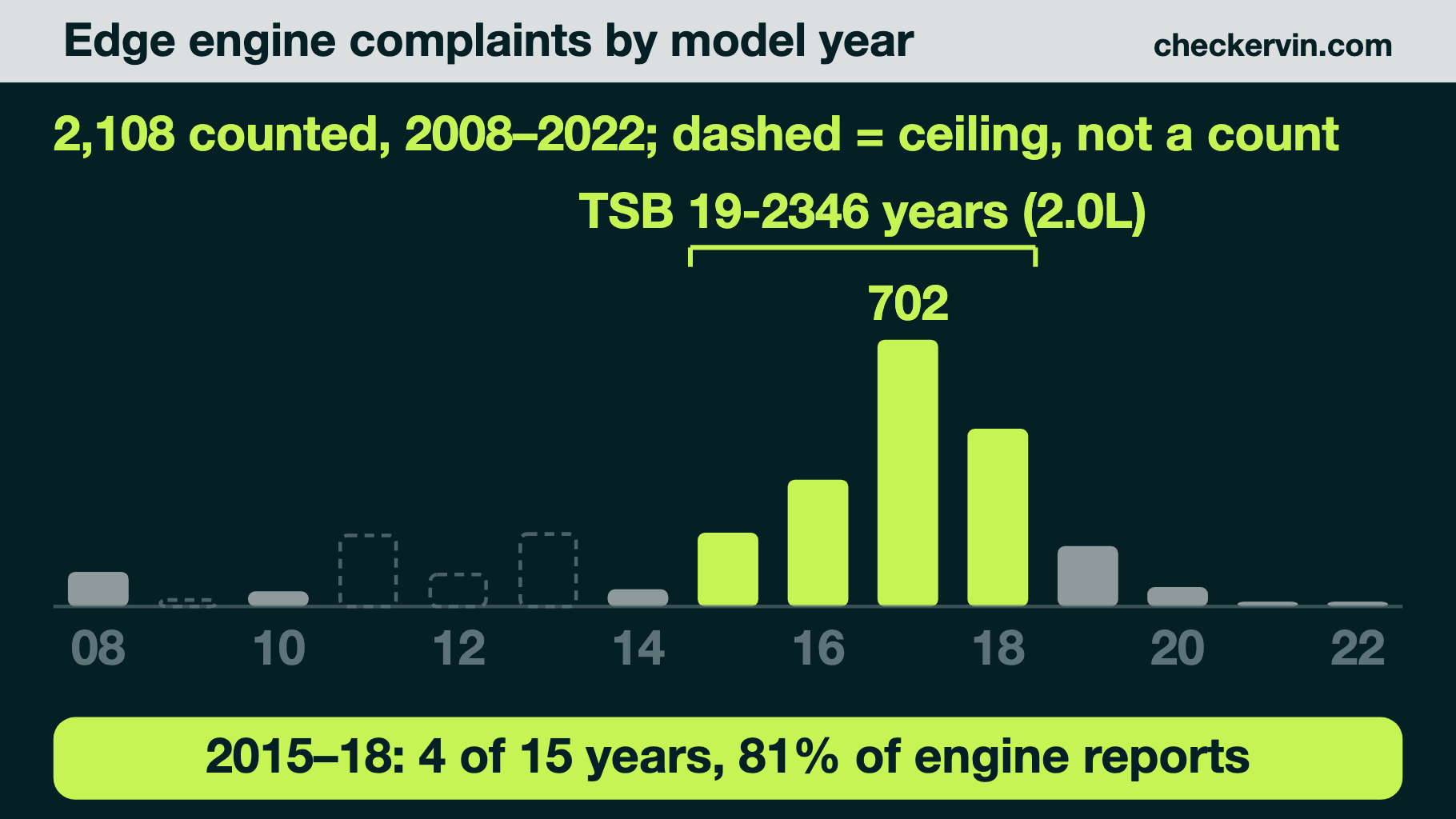
Our corpus of federal NHTSA complaints holds 13,042 reports against the 2008–2022Edge. ENGINE is in a year’s five most-reported components in 11 of those 15 years, and those years add up to 2,108 counted engine reports, a minimum, since a year where ENGINE fell below fifth contributes nothing to the sum. The 2015–2018 model years hold 1,698 of them, or 81%, and ENGINE is the number one component in 2015–2018. The worst single year is 2017, at 702 engine reports.
What the record does not show is a spike in the early internal-pump years. ENGINE is missing from the top five in 2009, 2011, 2012, 2013. In 2011, the model year the Roe plaintiffs drove, ENGINE ranked below a fifth-place count of 187, and in 2013, the Edge’s biggest complaint year at 2,446 reports, it ranked below 191. Those years were dominated by electrical, brake and body complaints instead. The Roe plaintiffs reported pump failures between 54,000 and 117,000 miles, and the complaint record captures what owners chose to file, not every pump that failed later and was fixed quietly at an independent shop.
A second category moves with the first. ENGINE AND ENGINE COOLING reaches the top five in 2016–2019, adding 568 counted reports. Then the 2019 model year breaks the pattern: engine reports fall from 468 to 159, a 66% drop, the same year the 3.5L and the 2.0L engine-swap bulletin both leave the Edge’s story. The Ford Edge years-to-avoid page breaks the rest of the record down by year.
What the record does not prove
ENGINE is not a water pump category. NHTSA has no water pump category; ENGINE holds every engine complaint from every engine sold that year. For 2015–2018that means three engines in one bar, the 3.5L with its internal pump, the 2.7L and the 2.0L, so the chart cannot say which engine or which part drove the peak. The reports are unverified owner filings, not a measured failure rate, and our counts are as of our October 2026 pull; NHTSA’s live totals have crept slightly higher since.
The 2015–2018 years also carry 30% of all Edge complaints, so part of the peak is simply volume. Not all of it, though: engine reports run about 44% of those years’ complaints, against about 4% for every other year combined, a floor for those years, since the ones where ENGINE fell below fifth add nothing to it. That gap is real, and it lines up with the model years in which Ford published a bulletin telling dealers to replace 2.0L engines for coolant in the cylinders. It does not prove the bulletin explains the peak, and we do not claim it does.
The 2.0L trap: coolant loss that is not the pump
On a 2015–2018 Edge with the 2.0L EcoBoost, the symptoms that send owners shopping for a water pump overlap with a known engine fault. Ford’s technical service bulletin 19-2346, dated December 19, 2019, covers 2015–2018 Edges with that engine showing a low coolant level, white exhaust smoke or a rough run, with or without a check engine light, and says the cause may be coolant intrusion into the cylinder. The repair it prescribes is a replacement long block. It books 15.0 hours for an all-wheel-drive Edge and 13.3 hours for front-wheel drive, before parts. Ford reissued the bulletin in 2022 as 22-2133 and then 22-2229.
A pump will not fix that. One owner’s July 2026 filing with NHTSA describes exactly the sequence to avoid: a 2017 Edge with the 2.0L losing coolant, a shop replacing the water pump, the problem continuing, the pump replaced again under the shop’s warranty, and a Ford dealer finally pointing to the engine, with an estimate the owner put at $8,000 to $10,000. A 2016 owner’s filing tells a similar story about a pump, thermostat and sensors replaced before coolant in the cylinders was traced to the engine. Those are owner accounts, not findings, but they match the bulletin’s symptom list closely.
We found no Ford program that extends coverage for this on the Edge. The Escape’s smaller 1.5L engine got customer programs for coolant intrusion; the Edge’s 2.0L, as far as the bulletins NHTSA hosts show, got the bulletin and nothing more. The bulletin itself says coverage comes only from whatever warranty or service plan still applies to the car; it pays nothing on its own.
2.7L and 2019-on Edges: three other coolant leads
The newer engines have the cheaper pump, but Ford’s bulletins list several other causes for the same warnings, and each is worth ruling out before paying for a pump.
| Ford bulletin | What it says can cause the symptom |
|---|---|
| SSM 48991 (2020) | 2015–2020 Edge 2.7L: over-temperature warning from the coolant temperature sensor or knock sensor harness |
| SSM 48345 (2019) | 2019–2020 Edge 2.0L: low coolant and white smoke from an EGR cooler leaking coolant |
| SSM 51385 (2023) | 2019–2023 Edge 2.0L: repeat block heater failures caused by air in the cooling system |
A sensor or harness that reports overheating when the engine is fine is a short repair. An EGR cooler leak loses coolant the same way an internal leak does, with no puddle. None of those three is a water pump, and none of the complaint narratives NHTSA holds for 2019–2022 Edges that we searched mentions the water pump at all. When the engine needs coolant, use the type it was built for; a coolant type lookup by VIN confirms it.
Recalls, Ford programs and the lawsuits
There is no water pump recall. We queried NHTSA’s recall database for every Edge model year from 2007 through 2022, and no campaign names the pump. To make sure the search could find one, we ran the same query on a vehicle with a known pump recall, a 2012 BMW 328i, and it returned hits. The only Edge recall filed under engine cooling, 24V635 for 2021–2022 models, concerns intake valves on the 2.7L, not coolant. We also reviewed every Ford program number in the Edge’s manufacturer communications and found none covering a water pump, coolant intrusion or an engine. The Ford recall check by VIN shows whether a specific Edge has anything open.
The U.S. lawsuit is over. The Roe court dismissed most claims in 2019, finding among other things that the plaintiffs had sought repairs after the powertrain warranty ran out, and the docket shows the case terminated in January 2024. The Canadian case is alive. According to a notice issued October 8, 2026 by class counsel Koskie Minsky LLP, the Ontario Superior Court of Justice certified a class on June 8, 2021 that lists the 2007–2018 Ford Edge and 2007–2018 Lincoln MKX, covering owners whose water pump failed on or before September 8, 2026. Newly added members who want out must opt out by January 6, 2027. The notice names no engine and mentions no settlement.
A recall, a bulletin, a program and a class action pay for very different things, and only the first is free regardless of age. Our TSB versus recall page explains the difference.
The signs, and whether to keep driving
- Coolant reservoir dropping repeatedly with no leak under the vehicle
- Temperature gauge climbing, or an engine coolant over-temperature message
- Oil on the dipstick or under the cap that looks tan or milky
- White exhaust smoke or a misfire with coolant loss (2.0L: think bulletin 19-2346)
- On belt-driven pumps: coolant drips or crust at the pump, or a wobbling pulley
On a 3.5L or 3.7L Edge, any of the first three is a reason to stop and tow. A missing puddle is the symptom on that engine, not reassurance. One 2010 Edge owner’s NHTSA filing describes an overheating warning at 30 mph and a mechanic’s diagnosis of an internal pump that had put coolant into the oil, at 117,000 miles. A tow costs far less than turning a pump job into an engine job.
Is it worth fixing?
On the 3.5L, the deciding question is whether the oil is still clean. Caught early, the job is the pump, which on RepairPal’s 2013 numbers lands around $2,000 to $2,600. Once coolant reaches the bearings, the Roe plaintiffs alleged bills of up to $9,000 with engine damage, against $1,500 for a pump alone. Those are allegations, not our figures. Because the timing chain drives the pump, ask for a second quote that adds the chain set; the labor overlaps almost entirely. Our F-150 timing chain post shows how Ford books front-of-engine labor on a sibling engine.
On a 2.7L or 2019-and-later 2.0L Edge, a confirmed pump failure is a routine repair at a few hundred dollars by RepairPal’s 2019 figure, and almost always worth doing. On a 2015–2018 2.0L, the worth-it question is really about the engine: if the pressure test points to coolant in the cylinders, the pump price is irrelevant and you are comparing a long block, at 13 to 15 book hours plus the engine, against the value of the car.
Before you pay for the repair, or buy the Edge
- Confirm the engine by VIN — 3.5L, 3.7L, 2.0L and 2.7L are four different conversations
- On a 2015–2018 2.0L, ask for a cooling-system pressure test and cylinder check before a pump
- On a 3.5L or 3.7L, get two quotes: pump only, and pump plus timing chain set
- Ask for the oil to be checked for coolant before work starts
- Keep the invoice — a documented pump job adds value at resale
For a shopper looking at a 2007–2018 Edge, the most useful document is a receipt for a water pump at some point past 80,000 miles on a 3.5L. Without one, leave room in the price. A Ford VIN decode confirms the engine and build year before you go any further.
Where this information comes from
- Roe v. Ford Motor Co., No. 2:18-cv-12528 (E.D. Mich.) — opinions on govinfo.govThe August 6, 2019 opinion naming the Edge as a Cyclone-engine vehicle, describing the chain-driven internal pump, and using three plaintiffs' 2011 Edge as its example.
- CourtListener — Roe v. Ford docketShows the U.S. case terminated January 16, 2024.
- Ford TSB 19-2346 — 2.0L EcoBoost coolant in cylinders (NHTSA-hosted)2015–2018 Edge 2.0L: replace the long block; 15.0 labor hours AWD, 13.3 FWD.
- NHTSA — recalls and manufacturer communications by vehicleOur 2007–2022 query found no campaign or Ford program naming the Edge water pump; source of SSMs 48991, 48345 and 51385.
- EPA and DOE — fueleconomy.gov vehicle recordsPer-year Edge engine listings behind the engine-era table and the 2018 cutoff for the 3.5L.
- Koskie Minsky LLP — Canadian Ford water pump class action noticeOctober 8, 2026: 2007–2018 Edge and MKX in the class, the September 8, 2026 cutoff and the January 6, 2027 opt-out date.
- RepairPal — 2013 Ford Edge water pump estimateThe 2013 range quoted above; its 2009 and 2019 Edge pages give the other two, retrieved November 2026.
- Motor1 — 3.7-liter V6 teardownMay 2025 report describing the 3.7L's pump as inside the V and driven by the timing chain.
Keep reading
Frequently asked questions
How much does it cost to replace a water pump on a Ford Edge?
It depends on the engine. RepairPal's estimator lists $1,959 to $2,627 for a 2013 Edge, with $1,391 to $2,041 of that in labor, and $585 to $731 for a 2019 Edge, with $220 to $322 in labor (its figures, retrieved November 2026). The 2007–2018 Edges with the 3.5-liter V6 cost the most because the pump sits inside the engine and is driven by the timing chain. The 3.5L is not listed for the Edge from 2019 on.
How much is a water pump for a 2007 Ford Edge?
Every 2007 Edge has the 3.5-liter V6, so it is the internal-pump job. We found no RepairPal page for 2007, but its 2009 Edge page, the same engine, lists $1,785 to $2,435, of which $1,391 to $2,041 is labor and about $394 is parts. The part is not the expensive piece; the hours to open the front of the engine are. Get the quote in writing as pump only or pump plus timing chain set.
Can you drive a Ford Edge with a faulty water pump?
Not for long, and on a 3.5-liter Edge not at all once the signs show up. According to the plaintiffs in a federal case against Ford, a failing internal pump can leak coolant into the oil, and owners filing complaints with NHTSA describe engines that overheated or shut down. A climbing temperature gauge, a coolant level that keeps dropping with no puddle, or milky oil means stop and tow.
What are the first signs of a bad water pump on an Edge?
On older external-pump engines, coolant drips or crust at the front of the engine. On the 3.5-liter V6, the pump leaks inside, so the early sign is usually a coolant level that keeps dropping with nothing on the ground, then overheating or tan, milky oil. On a 2015–2018 Edge with the 2.0L EcoBoost, the same coolant loss plus white exhaust smoke or a misfire points first to Ford's coolant-intrusion bulletin, not the pump.
Is there a recall on the Ford Edge water pump?
No. We queried NHTSA's recall database for every Edge model year from 2007 through 2022 and no campaign names the water pump, and we found no Ford extended-coverage program for it. In Canada, a certified class action lists 2007–2018 Edge owners whose pumps failed and damaged the vehicle; it is a lawsuit, not a recall, and its notice mentions no settlement.
Confirm the engine before you price the pump
A free CheckerVIN report shows the factory build, engine, specifications and open recalls for any VIN, so you know which Edge water pump job you are paying for.
Run a free VIN check